Written by Auto Electrical & Airbags Editorial Team
Updated September 1, 2026
Car electrical problems can be some of the most frustrating vehicle issues to diagnose.
A battery may keep dying even after it has been replaced. Several warning lights can suddenly appear at the same time. A power window may work normally one day and stop the next. Your car may have full dashboard power but refuse to start. An electrical problem may even appear only after rain, cold weather, or the vehicle sits overnight.
The reason is simple: modern vehicles depend on hundreds of electrical circuits, sensors, switches, wires, grounds and electronic control modules working together.
The part that stops working is not always the part that failed.
A dead power window does not automatically mean the window motor is bad. A blown fuse does not mean the fuse itself was the original problem. A module trouble code does not necessarily mean the vehicle computer needs replacement.
Proper diagnosis asks a different question:
Where does the electrical system stop operating correctly, and why?
This guide explains how electrical problems in cars are diagnosed, the symptoms different faults can create, what components may need testing, and when a problem points toward wiring, battery power, grounds, modules or a specific electrical system.
If you are still trying to determine whether the symptoms you are experiencing are electrical, start with our guide to the 15 signs of electrical problems in a car.
Quick Answer: How Do You Diagnose an Electrical Problem in a Car?
Automotive electrical diagnosis generally follows a logical process:
- Identify exactly what is not working.
- Determine whether one feature or multiple systems are affected.
- Check battery condition and basic system voltage.
- Inspect the appropriate fuses and relays.
- Verify power and ground at the affected circuit.
- Inspect wiring and electrical connectors.
- Test switches, motors, sensors or actuators.
- Scan the appropriate vehicle modules for trouble codes.
- Review live data and module communication when necessary.
- Trace the circuit until the actual failure is isolated.
A diagnostic scan can provide important clues, but reading a trouble code and diagnosing the cause of that code are not the same thing.
Our complete guide to what a car diagnostic test checks explains the difference in greater detail.
Car Electrical Problem Quick Finder
Not sure where to start? Match the symptom to the area most likely to require investigation.
| What Your Car Is Doing | Systems That May Need Testing |
|---|---|
| Battery dies overnight | Battery, charging system, parasitic draw, wiring, relay, module |
| Car will not start | Battery, grounds, starter circuit, fuse, relay, security system, ECU/ECM |
| Multiple dashboard lights appear | System voltage, grounds, sensors, communication network, modules |
| Same fuse keeps blowing | Short circuit, damaged wiring, overloaded component, moisture |
| Problem appears after rain | Wiring, connectors, grounds, sensors, modules, fuse boxes |
| One window stops working | Motor, regulator, switch, wiring, connector, door circuit |
| All windows or locks fail | Master switch, shared power, wiring, BCM, module communication |
| Power seat is stuck | Motor, switch, fuse, wiring, connector, seat electronics |
| Headlights flicker | Power supply, ground, wiring, switch, lighting circuit |
| AC controls or blower fail | Fuses, relays, wiring, blower circuit, sensors, controls |
| Airbag/SRS light stays on | SRS sensors, wiring, connectors, seat components, module |
| Blind spot unavailable appears | Radar sensor, wiring, connector, module, communication |
| Power steering warning appears | EPS system, voltage, sensors, wiring, module communication |
Think of this chart as a starting point rather than a diagnosis.
The same symptom can have several causes.
Start With the Exact Electrical Symptom
The better the symptom is described, the easier it becomes to narrow down the electrical system involved.
Compare:
“My window doesn’t work.”
with:
“The driver’s window goes down normally but will not go back up, and every other window still works.”
The second description provides far more diagnostic information.
Before testing begins, pay attention to questions such as:
- What exactly stopped working?
- Is it completely dead or partially working?
- Does the problem happen every time?
- Does only one component fail?
- Are several systems affected together?
- Does the problem happen when the vehicle is cold?
- Does it appear after the engine warms up?
- Does it happen after rain?
- Does moving a door, seat or steering wheel change it?
- Did it start after another repair?
- Was the battery recently replaced or jump-started?
- Has another shop already replaced parts?
- What warning messages appear?
Electrical problems often leave patterns.
Those patterns can be extremely valuable.
Understand How a Basic Car Electrical Circuit Works
Most electrical circuits can be simplified into something like:
Power → Fuse/Protection → Control → Wiring → Component → Ground
Consider a power window.
A simplified circuit might include:
Battery → Fuse → Switch or Door Module → Wiring → Window Motor → Ground
If the window stops moving, several possibilities exist.
The problem could involve:
- Battery power
- Fuse
- Relay
- Switch
- Wiring
- Connector
- Motor
- Regulator
- Ground
- Door module
- Body Control Module
- Electronic communication
This is why replacing the motor simply because the window does not move can be a mistake.
The motor cannot operate if the electricity or command required to operate it never reaches the motor.
Battery, Charging & Starting Problems
Check the Battery and Main Electrical Supply First
Many diagnostic situations should begin with the vehicle’s basic electrical supply.
Low or unstable voltage can produce symptoms that look like several unrelated problems.
Possible symptoms include:
- Slow cranking
- Clicking when trying to start
- Dim lights
- Electrical systems resetting
- Multiple warning lights
- Accessories behaving unpredictably
- Module communication faults
- Intermittent no-start conditions
A battery does not have to be completely dead to create problems.
Connections matter too.
A battery terminal can be loose. A cable can develop excessive resistance. A ground connection can become corroded.
And simply installing a new battery does not solve an electrical problem that is causing the battery to repeatedly discharge.
Why Does My Car Battery Keep Dying Overnight?
If the battery is fine after driving but dead again the next morning, there may be a parasitic electrical draw.
Possible causes include:
- Interior or trunk light staying on
- Relay remaining energized
- Aftermarket electrical accessory
- Door or latch switch problem
- Wiring fault
- Security-system issue
- Module that does not enter sleep mode
- Body Control Module problem
- Charging-system issue
Modern vehicles continue consuming electricity for some time after the ignition is switched off.
Various modules eventually enter lower-power sleep states.
If something prevents that process from occurring correctly, the vehicle may continue consuming excessive electricity while parked.
If this matches your situation, read our detailed guide: Car Battery Keeps Dying Overnight? Common Electrical Causes Explained.
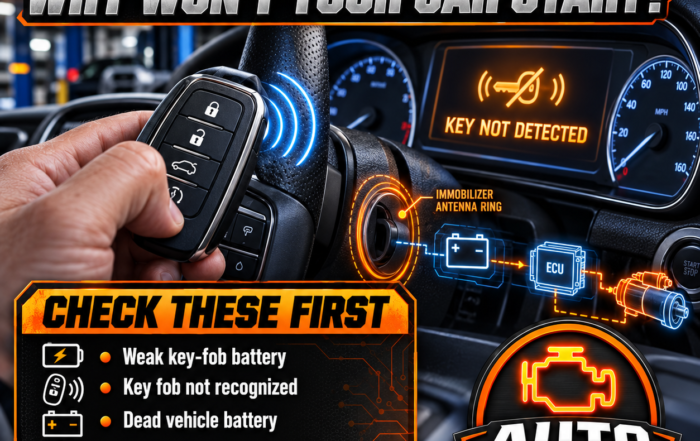
Car Won’t Start: Is It Electrical?
“Car won’t start” can mean very different things.
The Engine Does Not Crank
You turn the key or press the start button and the engine does not turn over.
Electrical areas that may need investigation include:
- Battery
- Battery connections
- Ground cables
- Starter circuit
- Starter relay
- Fuse
- Ignition/start circuit
- Brake or clutch switch
- Security system
- Wiring
- Electronic control modules
The Engine Cranks but Does Not Start
If the engine turns normally but never begins running, the investigation changes.
Possible systems may include:
- Engine-management sensors
- ECU or ECM controls
- Ignition system
- Fuel-system electronics
- Security authorization
- Wiring
- Module communication
The Car Starts Sometimes but Not Others
Intermittent starting problems may involve:
- Loose electrical connections
- Grounds
- Relays
- Wiring
- Temperature-sensitive components
- Security systems
- Electronic modules
- Moisture-related problems
Read Car Won’t Start? Electrical Problems That Could Be the Cause for the broader electrical causes.
If your dashboard and headlights still work but the engine will not start, see Car Won’t Start but the Lights Work: What Could Be Wrong?.
Fuses, Wiring, Grounds & Circuit Problems
A Blown Fuse Is a Clue — Not Always the Cause
Automotive fuses protect electrical circuits from excessive current.
If too much current passes through the circuit, the fuse opens before the wiring becomes dangerously hot.
That means a blown fuse may explain why the component stopped working, but it may not explain why excessive current occurred.
A repeatedly blown fuse can point toward:
- Shorted wiring
- Damaged wire insulation
- Failing electrical motor
- Water inside a connector
- Shorted component
- Incorrect aftermarket wiring
- Electrical overload
- Circuit fault
The timing can also provide clues.
A fuse that blows immediately when the ignition is switched on presents a different problem from a fuse that blows only when the power window reaches the top of its travel.
If you keep replacing the same fuse, read Car Fuse Keeps Blowing? What It Means and How the Fault Is Found.
Never substitute a higher-amperage fuse simply because the correct fuse keeps failing.
Wiring Problems Can Hide in Plain Sight
Vehicles contain wiring throughout:
- Engine compartment
- Dashboard
- Doors
- Seats
- Steering column
- Roof
- Trunk
- Bumpers
- Lighting systems
- Safety systems
Those wires are constantly exposed to heat, cold, vibration, moisture and movement.
Wiring can be damaged by:
- Corrosion
- Previous repairs
- Collision damage
- Rodents
- Water intrusion
- Heat
- Vibration
- Door movement
- Seat movement
- Poor aftermarket installations
One of the difficult things about wiring problems is that the wire may not look obviously broken.
A conductor may be damaged internally while the insulation still appears intact.
A connector may also appear properly connected while one terminal inside has poor contact.
Movement Can Reveal a Wiring Problem
Pay attention if the electrical failure changes when something moves.
Examples include:
- Window works only when the door is partly open
- Door lock fails when the door moves
- Power seat stops in a certain position
- Warning appears when the steering wheel turns
- Component starts working after hitting a bump
- Electrical issue changes when a wiring harness is moved
Those patterns can help identify a wiring, connector or harness problem.
Why Grounds Matter So Much
Electrical current needs a complete path.
A poor ground connection can affect one component or several systems simultaneously.
Possible symptoms include:
- Flickering lights
- Slow electrical motors
- Intermittent accessories
- No-start problems
- Multiple warning lights
- Electronic modules resetting
- Communication problems
- Strange electrical behavior
This is why proper diagnosis should ask both:
Is the component receiving power?
and:
Does the component have a reliable ground path?
What Is Voltage-Drop Testing?
A wire does not need to be completely broken to create an electrical problem.
Corrosion, loose terminals and damaged wiring can create excessive electrical resistance.
Voltage-drop testing looks for voltage being lost across an operating circuit.
It can help identify resistance in:
- Battery cables
- Ground cables
- Connectors
- Terminals
- Wiring
- Switch contacts
High resistance can sometimes create weak operation instead of total failure.
For example:
- Window moves slowly
- Starter cranks slowly
- Headlights are dim
- Blower motor runs weakly
- Electrical motor works intermittently
Short Circuit vs. Open Circuit vs. High Resistance
These terms describe different types of electrical faults.
Short Circuit
Electrical current travels through an unintended path.
Possible clues:
- Fuse repeatedly blows
- Wire becomes hot
- Circuit draws excessive current
- Component fails when activated
Open Circuit
The intended electrical path is interrupted.
Possible causes include:
- Broken wire
- Disconnected connector
- Failed switch
- Open fuse
- Damaged terminal
High Resistance
The circuit remains connected, but corrosion or damage restricts electrical current.
Possible clues include:
- Slow operation
- Dim lighting
- Intermittent operation
- Voltage changing under load
Understanding which type of failure exists helps determine which test should come next.
Multiple Warning Lights & Shared Electrical Problems
Why Did Several Dashboard Warning Lights Come On at Once?
Seeing the ABS, traction control, power steering, check engine and other lights appear at the same time can make it seem like several systems failed simultaneously.
Sometimes there are multiple problems.
But modern vehicle systems also share:
- Power supplies
- Grounds
- Sensors
- Wiring
- Communication networks
One fault in a shared part of the system can create warnings in several modules.
Possible shared causes include:
- Weak battery
- Low voltage
- Charging-system issue
- Bad ground
- Wiring problem
- Communication-network fault
- Shared sensor problem
- Moisture
- Module power failure
That means it can be a mistake to immediately replace one component for each warning light.
Our guide to why multiple dashboard warning lights come on at the same time explains this relationship in detail.
For individual dashboard symbols, see What Do the Different Lights on My Car Dashboard Mean?.
One Failed Feature vs. Several Failed Features
This distinction is one of the most useful clues in automotive electrical diagnosis.
Example: One Window Stops Working
Diagnosis may stay relatively local to that door:
- Window switch
- Motor
- Regulator
- Door wiring
- Connector
- Ground
- Door module
Example: Windows, Locks and Interior Lights All Start Acting Strange
Now shared systems become more important:
- Shared power
- Ground
- Fuse
- Wiring
- Communication network
- Body Control Module
When several unrelated-looking symptoms appear at the same time, ask:
What electrical resource do these systems share?
That question can dramatically narrow the diagnostic path.
Power Windows & Door Lock Electrical Problems
Why Did My Power Window Stop Working?
A power window that will not move does not automatically need a motor.
Possible causes include:
- Window motor
- Window regulator
- Window switch
- Master window switch
- Fuse
- Wiring
- Connector
- Ground
- Door module
- BCM
The exact symptom matters.
One Window Stopped Working
The problem may be isolated to that specific door.
All Windows Stopped Working
Shared power, fuse, master switch or body-control functions become more important.
Window Goes Down but Will Not Come Back Up
The switch circuit, motor circuit, wiring or mechanical regulator may require testing.
Motor Makes Noise but the Glass Does Not Move
The problem may involve the regulator or another mechanical movement component.
Our complete guide to power windows and door locks not working explains the common causes.
Milwaukee drivers who need testing can also visit our Power Window & Door Lock Electrical Repair in Milwaukee page.
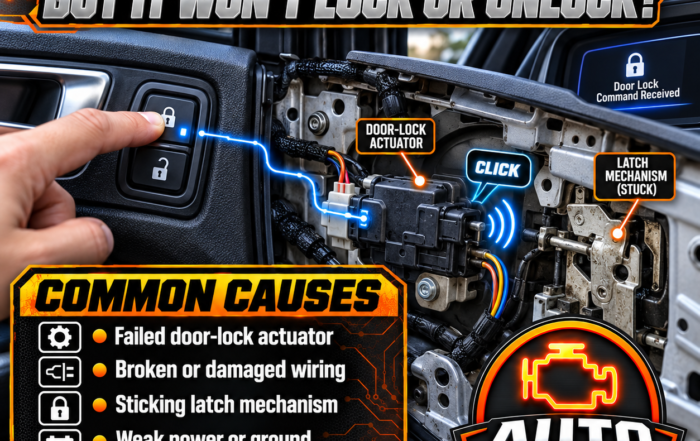
Why Does One Power Door Lock Stop Working?
If one door will not electronically lock or unlock while the others work normally, possible causes include:
- Door lock actuator
- Wiring
- Connector
- Switch
- Local door controls
If all door locks suddenly stop responding or several other body electrical features fail at the same time, the investigation may move toward shared circuits or the vehicle’s body-control system.
Power Seat Electrical Problems
Why Is My Power Seat Stuck?
Power seats combine electrical and mechanical components.
Possible causes include:
- Fuse
- Seat switch
- Seat motor
- Wiring
- Connector
- Power supply
- Ground
- Position sensor
- Memory-seat system
- Electronic seat controls
- Mechanical movement problem
The symptom again helps narrow the issue.
Power Seat Moves in Only One Direction
A specific switch circuit, motor direction, wiring problem or movement component may be involved.
Power Seat Is Completely Dead
Fuse, shared power, switch, wiring and grounding become more important.
Memory Seat Does Not Work
Position sensors, switches, wiring and electronic controls may require diagnosis.
For Milwaukee service, visit our Power Seat Electrical Repair in Milwaukee page.
Vehicle Lighting Electrical Problems
Why Do Headlights Flicker or Stop Working?
A vehicle lighting problem is not always just a bad bulb.
Modern lighting systems may involve:
- Fuses
- Relays
- Switches
- Wiring
- Connectors
- Grounds
- Lighting modules
- Body Control Module
Electrical lighting symptoms can include:
- Headlight flickering
- Dim headlights
- One light repeatedly failing
- Brake lights not working
- Turn signal malfunction
- Interior lights remaining on
- Lights working intermittently
- Lighting warning messages
If lighting problems occur alongside other electrical issues, shared power, grounds or electronic control systems may need investigation.
Learn more about Vehicle Lighting Electrical Repair in Milwaukee.
AC & Climate-Control Electrical Problems
A Car AC Problem Is Not Always a Refrigerant Problem
Modern climate-control systems depend heavily on electronics.
An AC problem may involve:
- Blower motor
- Fuse
- Relay
- Wiring
- Ground
- Climate-control panel
- Pressure sensor
- Temperature sensor
- Compressor electrical command
- Electronic control module
For example, a mechanically functional component may still not operate if the electrical command required to activate it is missing.
If the blower, AC controls or compressor command is not functioning correctly, see our Car AC Electrical Diagnostics & Repair in Milwaukee page.
Airbag & SRS Electrical Problems
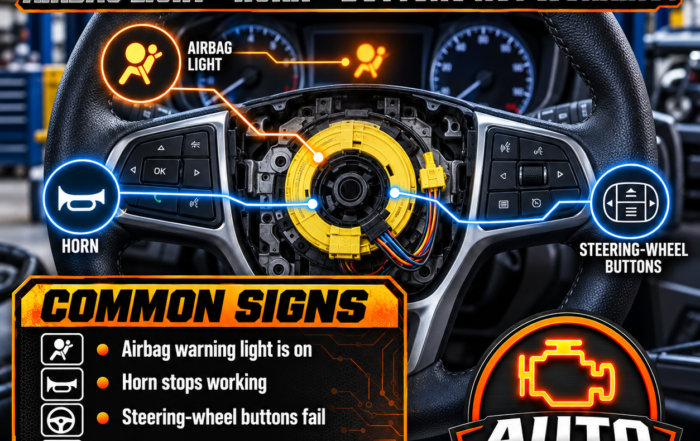
What Does an Airbag or SRS Light Mean?
The Supplemental Restraint System includes several electronic components.
Depending on the vehicle, these may include:
- SRS control module
- Impact sensors
- Airbag components
- Seat belt pretensioners
- Occupancy sensors
- Clock spring
- Wiring
- Connectors
- Power and ground circuits
An SRS warning should receive more caution than an ordinary accessory circuit because it involves a vehicle safety system.
Do not randomly probe or alter airbag wiring.
If you are researching the warning itself, read SRS Light On? What Milwaukee Drivers Should Know or Why Is My Airbag Light On?.
For professional system testing, visit SRS Repair & Airbag Light Diagnostics in Milwaukee.
Blind Spot Monitoring & Driver-Assistance Problems
Why Does My Car Say Blind Spot Monitoring Unavailable?
Blind spot monitoring systems can involve:
- Radar sensors
- Electronic modules
- Wiring
- Connectors
- Power
- Grounds
- Communication networks
Problems may also begin after:
- Collision repair
- Bumper work
- Water intrusion
- Connector damage
- Wiring damage
- Low system voltage
An unavailable message does not automatically mean the radar sensor itself has failed.
Read Blind Spot Monitoring Unavailable? Common Causes Explained for more information.
Milwaukee drivers can also visit our Blind Spot Monitoring Repair & Sensor Diagnostics page.
Electronic Power Steering Problems
Can a Power Steering Warning Be Electrical?
Yes.
Many newer vehicles use electric power steering or electronically controlled steering assistance.
Electrical problems may involve:
- System voltage
- Steering sensors
- Wiring
- Connectors
- Grounds
- EPS electronics
- Module communication
If the steering warning appears alongside several other warning lights, a shared electrical problem may also need to be considered.
Read Power Steering Warning Light On? Common Causes Explained for the informational guide.
For service information, visit Power Steering Module Repair & EPS Diagnostics in Milwaukee.
ABS & Brake Warning Electrical Problems
Modern braking systems also contain important electronics.
ABS-related warnings can involve:
- Wheel-speed sensors
- Sensor wiring
- Connectors
- ABS electronics
- Power and grounds
- Communication faults
Because traction-control and stability-control systems may use ABS information, one ABS-related problem can sometimes produce several dashboard warnings.
For Milwaukee testing and brake-related service information, visit our Brake Services & ABS Diagnostics page.
ECU, ECM, BCM & Vehicle Computer Problems
What Are ECU, ECM and BCM Modules?
Modern vehicles contain numerous computers responsible for different systems.
Three terms you will commonly encounter are:
ECU
ECU generally means Electronic Control Unit and may be used as a broad term for an electronic vehicle controller.
ECM
The Engine Control Module manages many engine-related electronic functions.
BCM
The Body Control Module is commonly associated with body electrical functions such as:
- Power locks
- Windows
- Interior lighting
- Exterior lighting
- Security functions
- Wipers
- Other body electronics
For a detailed comparison, read our guide: ECU vs. ECM vs. BCM: What’s the Difference?.
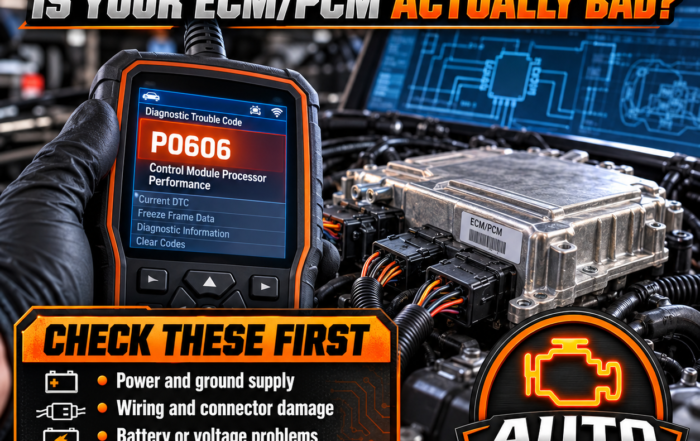
Does a Module Trouble Code Mean the Computer Is Bad?
Not automatically.
Before an expensive vehicle computer is condemned, diagnosis may need to verify:
Power → Ground → Wiring → Connectors → Communication → Inputs → Outputs → Module
Imagine a scan tool reports that another module cannot communicate with the BCM.
The BCM could be faulty.
But it could also:
- Have no power
- Have a poor ground
- Have damaged communication wiring
- Have connector corrosion
- Be affected by low system voltage
- Be affected by another network problem
The same principle applies to many vehicle computers.
If diagnosis points toward a particular module, our Milwaukee shop has dedicated pages for:
- ECU Repair & Car Computer Diagnostics
- ECM Repair & Engine Computer Diagnostics
- BCM Repair & Body Control Module Diagnostics
How Diagnostic Trouble Codes Should Be Used
A Trouble Code Is a Clue, Not an Automatic Parts List
Modern vehicles monitor hundreds of electrical conditions.
When something operates outside its expected range, the vehicle may store a Diagnostic Trouble Code.
A code may indicate:
- Signal too high
- Signal too low
- Open circuit
- Short circuit
- Communication failure
- Voltage problem
- Implausible sensor value
- System performance fault
That information is valuable.
But it may not identify the failed part.
For example, a sensor-related code may ultimately come from:
- Sensor itself
- Broken wiring
- Bad connector
- Missing reference voltage
- Poor ground
- Another electronic fault
That is why scanning should guide testing rather than replace testing.
Why a Free Code Scan May Not Solve the Problem
A basic scan can answer:
What codes are stored?
It may not answer:
- Why did the code appear?
- Is the sensor actually bad?
- Is the wiring intact?
- Is voltage correct?
- Is the ground reliable?
- Is the module receiving power?
- Is another system creating the code?
- Are several codes related?
This distinction is especially important when someone has already replaced the component named in a code and the exact same problem returns.
What Is Live Data?
Professional diagnostic equipment may allow technicians to view information being reported by vehicle modules and sensors while the system is operating.
This is commonly called live data.
It can help answer questions such as:
- Does the module recognize that the switch was pressed?
- Does the sensor report a realistic value?
- Does the vehicle recognize the brake pedal?
- Is battery voltage stable?
- Does the controller send the requested command?
- Does another module receive the command?
This is increasingly important because many modern controls are not simple direct electrical switches.
A modern system might operate like this:
Switch → Control Module → Vehicle Network → Another Module → Component
That is very different from a simple switch directly supplying electricity to a motor.
Intermittent Electrical Problems
Why Does My Car’s Electrical Problem Come and Go?
Intermittent problems are among the most difficult electrical faults to diagnose.
The vehicle may operate perfectly while being inspected.
Then the problem returns later.
Intermittent electrical failures can be affected by:
- Temperature
- Moisture
- Vibration
- Vehicle movement
- Electrical load
- Connector position
- Door movement
- Seat movement
- Time since shutdown
That is why documenting the conditions surrounding the problem can be extremely useful.
When the Problem Happens, Make Note of:
- Outside temperature
- Whether it recently rained
- Whether the vehicle was recently washed
- How long the vehicle had been sitting
- Whether the engine was hot or cold
- Which warning message appeared
- Whether hitting bumps changes anything
- Whether opening or closing a door changes anything
- Whether the vehicle recently needed a jump
A photo or video of an intermittent dashboard warning can also provide valuable information.
Why Do Electrical Problems Appear After Rain?
Water and electricity are a bad combination, but rain-related problems are not always as obvious as a completely soaked component.
Moisture can affect:
- Connectors
- Wiring
- Grounds
- Sensors
- Fuse boxes
- Modules
- Door electronics
- Lighting circuits
Symptoms can include:
- Blown fuses
- Warning lights
- Battery drain
- No-start conditions
- Windows not working
- Door locks malfunctioning
- Sensor warnings
- Module communication faults
If your vehicle behaves differently after rain or a car wash, read Car Electrical Problems After Rain? Common Causes Explained.
Symptom-to-System Electrical Diagnosis Chart
Here is another way to look at common symptoms.
| Symptom | Possible Areas to Investigate |
|---|---|
| Clicking but no start | Battery, connections, starter circuit, ground |
| Dashboard power but no crank | Starter circuit, relay, security system, wiring, module |
| Battery repeatedly dies | Parasitic draw, charging system, relay, module, wiring |
| Several warning lights | Voltage, ground, sensor, network, module |
| Flickering headlights | Charging system, ground, wiring, connector, lighting circuit |
| Fuse keeps blowing | Short circuit, damaged wire, failing component |
| One window fails | Switch, motor, regulator, door wiring |
| All windows fail | Shared fuse, master switch, power, BCM |
| One door lock fails | Actuator, wiring, switch, connector |
| Power seat moves one direction | Switch circuit, motor circuit, wiring, movement system |
| AC blower does not work | Fuse, relay, blower motor, resistor/control, wiring |
| Airbag light stays on | Sensor, pretensioner, wiring, connector, SRS module |
| Blind spot unavailable | Radar, wiring, connector, power, module |
| Steering warning | Voltage, EPS electronics, sensors, wiring |
| Problem appears after rain | Moisture, corrosion, connector, wiring, module |
One symptom can have multiple causes.
Testing is what separates the possibilities.
Why Replacing Random Parts Gets Expensive
Electrical problems encourage parts swapping because the visible symptom often makes one component seem obvious.
Imagine a power window does not move.
Someone replaces the motor.
Nothing changes.
Then they replace the switch.
Still nothing.
Then the regulator.
Still nothing.
Eventually, testing finds a broken wire inside the door harness.
Several good parts were replaced without ever addressing the actual failure.
The same thing happens with:
- Batteries
- Starters
- Alternators
- Sensors
- Relays
- Switches
- Motors
- Modules
A good diagnostic process changes the question from:
“Which part should we try?”
to:
“At what point does this circuit stop working correctly?”
That is a much more useful question.
What Professional Auto Electrical Diagnostics Can Include
Depending on the vehicle and symptoms, electrical diagnosis may involve:
- Battery testing
- Charging-system testing
- Complete module scan
- Diagnostic trouble-code review
- Live-data analysis
- Power testing
- Ground testing
- Voltage-drop testing
- Fuse testing
- Relay testing
- Wiring inspection
- Connector inspection
- Wiring-diagram analysis
- Sensor testing
- Switch testing
- Motor testing
- Actuator testing
- Module communication testing
- Parasitic-draw testing
- Attempts to reproduce intermittent faults
Not every electrical problem requires every test.
The testing should follow the symptoms.
A stuck power window should not automatically receive the same diagnostic process as an overnight battery drain.
When Should You Avoid DIY Electrical Testing?
Some basic observations can be useful.
You can note symptoms, inspect accessible battery connections, check the owner’s-manual fuse information and document dashboard warnings.
But some systems deserve additional caution.
Airbag and SRS Systems
The Supplemental Restraint System contains important safety components.
Do not randomly probe SRS wiring or connectors.
Hybrid and Electric Vehicles
Hybrid and EV vehicles can contain high-voltage systems that are fundamentally different from ordinary 12-volt automotive circuits.
High-voltage systems require appropriate procedures, equipment and training.
Smoke, Heat or a Burning Electrical Smell
If you notice:
- Smoke
- Hot wiring
- Melting insulation
- Strong burning smell
stop treating the issue as routine troubleshooting.
Electrical overheating can create a serious safety hazard.
Critical Electrical Systems Fail While Driving
Seek prompt assistance if you experience:
- Headlight failure at night
- Loss of electrical power
- Serious steering warning
- Serious braking warning
- Smoke or overheating wiring
When Should You Schedule Professional Electrical Diagnostics?
Consider professional diagnosis when:
- The battery keeps dying after replacement
- Your car intermittently will not start
- Several systems fail together
- The same fuse repeatedly blows
- Warning lights keep returning
- The problem happens only occasionally
- The problem appears after rain
- Wiring is visibly damaged
- Another shop already replaced parts without solving the issue
- ECU, ECM or BCM problems are suspected
- Airbag or SRS systems are involved
- You cannot determine where the circuit is failing
The more complicated the pattern becomes, the more valuable systematic testing becomes.
Auto Electrical Diagnostics in Milwaukee, WI
If you are in Milwaukee or the surrounding area and need help finding the source of an automotive electrical problem, Auto Electrical & Airbags provides Auto Electrical Diagnostics & Repair in Milwaukee.
Electrical problems we diagnose can involve:
- Wiring faults
- Battery drains
- No-start problems
- Power and ground circuits
- Blown fuses
- Relays
- Warning lights
- Sensors
- Vehicle lighting
- Power windows
- Door locks
- Power seats
- AC electrical systems
- SRS and airbag systems
- ECU, ECM and BCM modules
- Blind spot systems
- Electronic power steering
- Module communication
Electrical diagnostics start at $135.
Auto Electrical & Airbags
2636 S 32nd St
Milwaukee, WI 53215
Call: (414) 345-7568
The goal is not to replace the first part that seems suspicious.
The goal is to find the actual source of the electrical problem before recommending the repair.
Frequently Asked Questions About Car Electrical Problems
What is the first thing to check when a car has an electrical problem?
Start with the exact symptom and the vehicle’s basic electrical supply. Depending on what is failing, battery condition, connections, fuses, power, grounds and the affected circuit may need to be checked.
What are the most common signs of electrical problems in a car?
Common signs include batteries that repeatedly die, no-start conditions, flickering lights, blown fuses, multiple dashboard warnings, power accessories that stop working and electrical problems that occur intermittently. See our complete guide to 15 signs of electrical problems in a car for more examples.
How do mechanics find electrical problems in cars?
The diagnostic process may include scanning control modules, checking voltage, testing power and grounds, reviewing wiring diagrams, inspecting wiring and connectors, testing components and tracing the affected electrical circuit.
Can a bad ground cause several electrical problems?
Yes. Several vehicle systems may share ground connections. A poor or high-resistance ground can therefore cause problems that appear unrelated.
How can you tell if your car has damaged wiring?
Possible clues include intermittent failures, blown fuses, visible harness damage, problems that change when a door or seat moves, corrosion or circuits that unexpectedly lose power or ground.
Why does my car electrical problem come and go?
Intermittent electrical problems may involve loose connections, damaged wiring, corrosion, moisture, worn switches, relays, motors, sensors or electronic communication faults.
Can a weak battery cause warning lights?
Yes. Modern vehicle computers depend on stable system voltage. Low or unstable voltage can sometimes contribute to warning lights, electronic resets and module communication problems.
Why does a new battery keep going dead?
If a replacement battery repeatedly loses its charge, the vehicle may have a charging problem, parasitic electrical draw, wiring fault, relay staying energized, electrical accessory remaining active or module that is not shutting down normally.
Does a diagnostic trouble code tell you which part needs replacement?
Not necessarily. A trouble code identifies a condition detected by the vehicle. Additional testing may be needed to determine whether the actual cause is the component, wiring, power supply, ground, connector or another electronic system.
Can water cause electrical problems in a car?
Yes. Moisture can contribute to corrosion, poor connections and unintended electrical paths inside wiring, connectors, sensors, modules and fuse boxes.
Can one electrical problem make several things stop working?
Yes. Different vehicle systems may share power, grounds, wiring, sensors or electronic communication networks. One shared fault can therefore create several symptoms.
Why does my car have power but still not start?
Dashboard lights and accessories require far less current than the starter, so having electrical power inside the vehicle does not prove that the starting system is functioning correctly. Read Car Won’t Start but the Lights Work for a detailed explanation.
Should I replace the part named in a trouble code?
Not automatically. The circuit supplying that part should be evaluated first. Wiring, voltage, connectors and grounds can all create codes that appear to point toward a component that is actually working correctly.
The Most Important Rule of Car Electrical Diagnosis
Automotive electrical problems become easier to understand when you stop thinking of them as mysterious “electrical gremlins” and start thinking of them as circuits.
Most electrical components need:
- Power
- Ground
- A complete circuit
- A working component
Modern electronic systems may additionally require:
- Accurate sensor information
- A control-module command
- Reliable network communication
That leads to several important rules:
A dead battery does not automatically mean the battery is bad.
A blown fuse does not automatically mean the fuse was the original problem.
A power window that will not move does not automatically need a motor.
An ECU, ECM or BCM trouble code does not automatically mean the computer needs replacement.
Several warning lights do not automatically mean several separate systems failed.
The best diagnostic question is:
Where does the system stop working correctly?
Find that point, determine why it failed, and then decide what actually needs repair.
That is the difference between diagnosing an automotive electrical problem and simply guessing which part to replace.