Written by: Auto Electrical & Airbag Specialist Editorial Team
Reviewed by: Auto Electrical & Airbag Specialist Technical Team
Updated: October 21, 2026
Reading time: 12 minutes
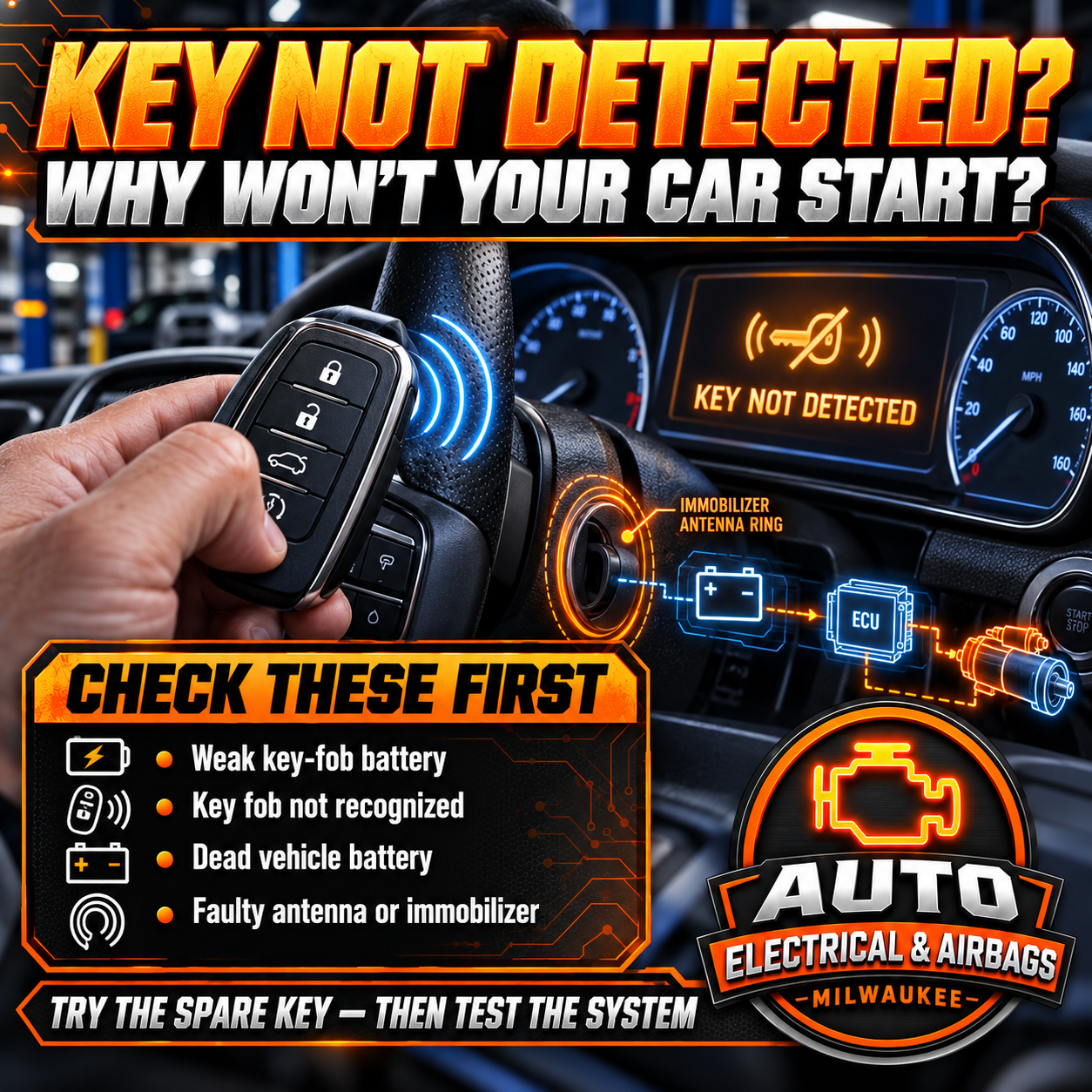
Quick answer: A Key Not Detected, Key Not Recognized, or security-system warning does not automatically mean the key fob is bad. The problem may involve the key battery, immobilizer transponder, keyless-entry antenna, ignition antenna ring, BCM, ECU, wiring, programming, low vehicle voltage, or communication between modules.
Key Takeaways
- A key fob can unlock the doors but still fail to authorize engine starting.
- A weak key-fob battery can cause intermittent recognition problems, but it is not the only possible cause.
- Modern vehicles may require the key, BCM, immobilizer system, and ECU/ECM to communicate before the engine is allowed to start.
- A flashing security light can indicate a key-recognition or immobilizer problem.
- Replacing the key does not fix damaged wiring, a failed antenna, lost programming, or module communication faults.
- A BCM or ECU code does not automatically mean the module itself needs replacement.
- The best diagnosis starts by determining where the security authorization process is failing.
What Does “Key Not Detected” Mean?
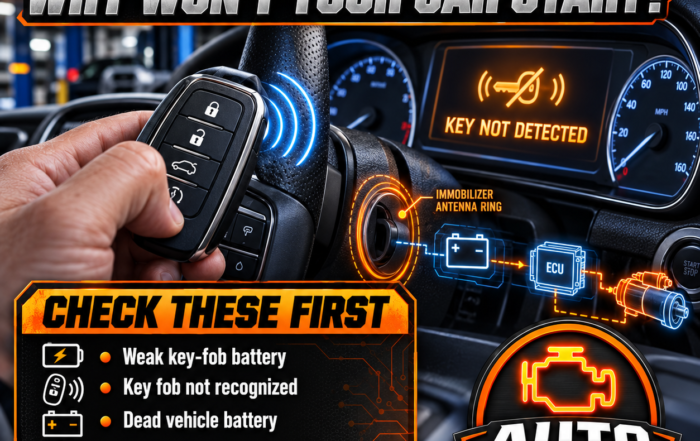
A Key Not Detected message generally means the vehicle cannot verify the presence or identity of the key it expects.
Depending on the vehicle, you may see messages such as:
- Key Not Detected
- Key Not Recognized
- No Key Detected
- Keyless Remote Not Detected
- Incorrect Key
- Immobilizer Active
- Theft Deterrent System
- Security System Fault
- Key Not Found
The wording varies by manufacturer.
The important point is that modern vehicles often require electronic authentication before starting.
Turning a mechanical key or pressing the START button is only one part of the process.
How Does a Modern Car Recognize the Key?
Modern keys may contain several different technologies.
A typical system can include:
- Remote-lock transmitter
- Transponder chip
- Keyless-entry electronics
- Immobilizer identification
- Passive keyless antenna communication
The vehicle may use components such as:
- Key fob
- Antenna
- Ignition antenna ring
- Receiver module
- Body Control Module
- Immobilizer module
- Engine Control Module
These components work together to determine whether the correct key is present.
What Is an Immobilizer?
An immobilizer is an electronic anti-theft system designed to prevent the engine from starting unless an authorized key is recognized.
Depending on the vehicle, the immobilizer may communicate with:
- Key transponder
- BCM
- ECU or ECM
- Instrument cluster
- Security module
- Gateway module
The exact architecture varies considerably.
The principle is simple:
Authorized key → security authorization → engine start permitted
If authorization fails, the vehicle may:
- Not crank
- Crank but not start
- Start and immediately shut off
- Display a security warning
- Disable fuel or ignition
- Ignore the START button
Can the Key Fob Unlock the Doors but Still Not Start the Car?
Yes.
This is one of the most confusing situations for drivers.
The remote-lock function and engine immobilizer authorization are not always identical systems.
The fob may still:
- Lock doors
- Unlock doors
- Open trunk
- Activate panic alarm
while the vehicle still fails to recognize the key for starting.
That means:
“The remote buttons work” does not prove the immobilizer portion of the key is working correctly.
Can a Dead Key Fob Battery Cause “Key Not Detected”?
Yes.
A weak or dead key-fob battery can interfere with passive key detection on many vehicles.
Possible symptoms include:
- Key Not Detected
- Need to hold key closer to START button
- Push-button start works intermittently
- Door unlocking works only at very close range
- Vehicle sometimes starts after several attempts
Replacing the key-fob battery is a reasonable simple first step when appropriate.
However, if a new battery does not solve the problem, continuing to replace batteries will not fix a deeper electrical or programming issue.
Why Does the Car Start When I Hold the Key Near the Start Button?
Many push-button-start vehicles include a backup method for reading the key when the key-fob battery is weak.
Depending on the vehicle, this may involve placing or holding the key:
- Against the START button
- Near the steering column
- In a designated console pocket
- In a specific cupholder location
The exact backup procedure is vehicle-specific.
If the car consistently starts using the emergency key-reading position but not through normal passive detection, that can provide an important diagnostic clue.
The passive antenna or key-fob battery may deserve additional attention.
Can a Bad Key Cause a No-Start?
Yes.
Possible key-related failures include:
- Damaged transponder
- Internal electronics failure
- Water damage
- Physical damage
- Lost programming
- Incorrect replacement key
But a key-related warning does not automatically prove the key itself is defective.
The vehicle’s receiver may be the actual problem.
How Can You Tell if the Key or the Vehicle Is the Problem?
One useful test is trying a known-good spare key.
If:
Key A fails + Key B works normally
the original key becomes more suspicious.
If:
Key A fails + Key B also fails
the problem becomes more likely to involve the vehicle.
Possible vehicle-side causes include:
- Antenna
- Immobilizer receiver
- BCM
- Wiring
- Module communication
- Power supply
This is not a complete diagnosis, but it is useful evidence.
Can the Ignition Antenna Ring Cause Key Recognition Problems?
Yes.
Vehicles using a transponder-style key may use an antenna around or near the ignition cylinder.
This antenna reads information from the key’s transponder.
If the antenna or its wiring fails, the vehicle may not recognize an otherwise good key.
Possible symptoms include:
- Security light flashes
- Key warning appears
- Vehicle cranks but does not start
- Vehicle starts intermittently
- Spare key also fails
Replacing the key would not solve a failed antenna circuit.
What Is a Keyless Entry Antenna?
Push-button-start vehicles may use several antennas throughout the vehicle.
Their purpose can include determining whether the key is:
- Outside the car
- Inside the passenger compartment
- Near the trunk
- Near a specific door
If an antenna fails, the vehicle may incorrectly report that the key is missing even when it is inside the vehicle.
Depending on the design, one failed antenna may affect only certain functions.
Why Does My Car Say “No Key” Even Though the Key Is Inside?
Possible causes include:
- Weak key-fob battery
- Damaged key
- Failed keyless antenna
- Radio-frequency interference
- Wiring problem
- BCM problem
- Receiver-module issue
- Low vehicle battery voltage
The location of the key can also matter.
Some systems may have difficulty detecting a key placed near electronic equipment or certain objects.
Can a Weak Car Battery Cause “Key Not Detected”?
Yes.
The vehicle’s own battery—not just the key-fob battery—can affect security and keyless systems.
Low system voltage may cause:
- Modules to reset
- Antennas to stop operating correctly
- Communication errors
- Security-system faults
- No-crank conditions
- Multiple warning lights
This becomes especially important when the vehicle also has:
- Slow cranking
- Flickering dashboard
- Clicking
- Recently dead battery
- Recent jump start
A key-recognition message can sometimes be a symptom of a broader voltage problem.
Why Is the Security Light Flashing?
A flashing security or anti-theft indicator can mean different things depending on the vehicle.
Some vehicles normally flash the security light when parked.
But if the light flashes abnormally while trying to start the engine, it may indicate that the system has not authorized the key.
Possible causes include:
- Unrecognized key
- Immobilizer fault
- Lost programming
- Antenna problem
- Module communication fault
Always distinguish between the vehicle’s normal anti-theft indicator behavior and an actual starting fault.
Can an Immobilizer Cause the Engine to Crank but Not Start?
Yes.
On some vehicles, the starter may crank normally while the immobilizer prevents the engine from running.
The system may disable:
- Fuel injection
- Ignition
- Other engine-control functions
Possible symptoms include:
- Engine cranks normally
- Engine never starts
- Security light flashes
- Key warning appears
However, a crank-no-start condition has many other potential causes.
These include:
- Fuel delivery
- Crankshaft sensor
- Ignition
- ECU power
- Wiring
The security-system evidence matters.
Can the Immobilizer Cause a No-Crank Condition?
Yes.
Some vehicles prevent starter operation when security authorization is missing.
You may press the START button or turn the key and get:
- Nothing
- Warning message
- Security light
- Start button response without starter operation
But no-crank conditions can also involve:
- Battery
- Starter
- Relay
- Brake switch
- Neutral-safety circuit
- Wiring
A proper diagnosis determines whether the security system is actually blocking the start request.
Why Does the Car Start and Then Immediately Shut Off?
Security authorization problems can sometimes cause an engine to start and then quickly stall.
That can happen if the vehicle allows initial starting but then determines that authorization is invalid.
Other causes are also possible, so the security indicator and stored codes are important.
Can the BCM Cause a Key Not Recognized Problem?
Yes, depending on the vehicle.
The Body Control Module may participate in:
- Key recognition
- Immobilizer authorization
- Door locks
- Security system
- Keyless entry
- Push-button start
This is one reason a BCM fault can sometimes cause symptoms that seem unrelated.
You might notice:
- Key not recognized
- Door locks acting strangely
- Interior lights malfunctioning
- Security light
- No-start
- Keyless entry problem
Your existing guide to BCM failure symptoms explains why BCM-related symptoms can overlap with wiring, power, and communication problems.
Does a Key Error Mean the BCM Is Bad?
No.
A BCM-related code or key-recognition issue can also be caused by:
- Weak battery
- Poor BCM power
- Bad ground
- Damaged wiring
- Failed antenna
- Connector issue
- Communication failure
Replacing the BCM before verifying these systems can lead to an expensive repair that does not solve the problem.
Can the ECU Cause the Key Not to Be Recognized?
The ECU or ECM can participate in immobilizer authorization on many vehicles.
The security system may require the BCM or immobilizer module to communicate with the engine computer.
If the expected authorization is missing, the ECU may prevent engine operation.
However, that does not automatically mean the ECU itself has failed.
The problem may involve communication between modules.
Can a CAN Bus Problem Cause an Immobilizer No-Start?
Yes.
Modern security systems often depend on electronic communication between modules.
For example:
Key recognized → BCM approves → security authorization sent → ECU allows engine start
If one part of that communication path fails, starting may be prevented.
Possible causes include:
- Damaged CAN wiring
- Module offline
- Missing power
- Poor ground
- Connector fault
Our guide to CAN bus communication faults explains how one communication problem can affect several vehicle systems.
Can Aftermarket Remote Start Cause Key Recognition Problems?
Yes.
Aftermarket security and remote-start systems often interface directly with:
- Ignition circuits
- BCM
- Immobilizer system
- Door locks
- CAN communication
Poor installation or a failing bypass module may contribute to:
- No-start
- Security warning
- Intermittent key recognition
- Battery drain
If the vehicle has an aftermarket remote starter or alarm, that information should be included in the diagnostic history.
Our guide to aftermarket electronics causing electrical problems explains why added electronics can create difficult-to-trace vehicle faults.
Can a Remote Starter Work but the Physical Key Not Work?
Potentially.
An aftermarket or factory remote-start system may use a different authorization process from a normal key-start attempt.
That means different symptoms can occur depending on which system is failing.
The exact vehicle configuration needs to be evaluated.
Can Water Damage Cause Immobilizer Problems?
Yes.
Moisture can damage:
- BCM
- Connectors
- Keyless receiver
- Antenna wiring
- Communication circuits
Possible sources include:
- Windshield leak
- Sunroof drain leak
- Flooding
- Water intrusion after collision repair
Water damage can cause intermittent problems that become worse over time as corrosion develops.
Can Collision Repair Cause Key Recognition Problems?
Potentially.
Collision repair may disturb:
- Wiring
- Ground points
- BCM connectors
- Antennas
- Harnesses
If the problem started immediately after body repair, that timing should be included during diagnosis.
Can a New Key Need Programming?
Yes.
Many modern replacement keys must be programmed or registered to the vehicle.
Simply cutting the physical key blade may not authorize engine starting.
Depending on the vehicle, programming may involve:
- Scan tool
- Security access
- Immobilizer registration
- PIN or security data
- Module synchronization
Vehicle-specific requirements vary significantly.
Can a Used Key Fob Be Programmed?
Sometimes, but not always.
Some used keys can be reprogrammed.
Others may remain electronically locked to their previous vehicle.
Compatibility can depend on:
- Part number
- Frequency
- Immobilizer generation
- Manufacturer programming rules
Buying an inexpensive used key does not guarantee that it can be successfully added to the vehicle.
Can Changing the Car Battery Make the Key Stop Working?
Normally, replacing a vehicle battery should not permanently erase programmed keys.
However, low-voltage events or battery disconnection can expose existing faults or cause certain modules to require initialization on some vehicles.
If key recognition fails immediately after battery service, technicians may check:
- Battery connections
- System voltage
- Module communication
- Stored faults
Can Disconnecting the Battery Reset the Immobilizer?
Not reliably.
Disconnecting the battery is not a universal immobilizer reset.
Modern security systems commonly store key authorization information in nonvolatile memory.
Repeatedly disconnecting the battery may also erase useful information from other systems without correcting the security fault.
Can You Fix “Key Not Detected” by Clearing Codes?
No.
Clearing a security or communication code does not repair:
- Broken wire
- Failed antenna
- Dead key
- Lost programming
- Module problem
If the underlying condition remains, the warning will return.
What Codes Can Appear With Key Recognition Problems?
The exact codes vary widely by manufacturer.
They may involve:
- Immobilizer
- Key identification
- Antenna
- Security authorization
- BCM
- ECU communication
- Lost communication
This is why a basic generic engine-code reader may not be enough.
Security-related codes can be stored in modules that a simple OBD scanner cannot access.
Why a Full Vehicle Scan Matters
A modern no-start diagnosis should not always stop with the engine computer.
A capable scan may need to communicate with:
- BCM
- ECU/ECM
- Immobilizer module
- Instrument cluster
- Gateway
- Keyless-entry module
The scan can answer important questions such as:
- Is the key being detected?
- Does the BCM recognize the start request?
- Is security authorization being granted?
- Can the ECU communicate?
- Are modules offline?
This is far more informative than simply replacing the key.
How Is a Key Not Recognized Problem Diagnosed?
A logical diagnostic process begins by identifying where the authorization process fails.
Try the Spare Key
If available, compare both keys.
One key failing while another works is strong information.
Check Key-Fob Battery
A weak battery can affect passive keyless detection.
Check Vehicle Battery Voltage
Low vehicle voltage can disrupt security modules.
Scan Security and Body Modules
Stored codes may identify:
- Key recognition
- Immobilizer
- BCM
- Communication
- Antenna
Evaluate Live Data
Depending on the vehicle, a technician may be able to see whether:
- Key is present
- Key is valid
- Start request is received
- Security authorization is approved
Inspect Antennas and Wiring
If the key itself appears valid, the receiving system may need testing.
Verify Module Communication
The BCM and ECU may need to exchange security authorization before the vehicle starts.
Check Programming
If keys or modules were recently replaced, programming or synchronization requirements should be verified.
Bad Key vs. Vehicle-Side Fault
| Symptom | Bad Key Possible? | Vehicle Fault Possible? |
|---|---|---|
| One key fails, spare key works | Strong clue | Less likely |
| Both keys fail | Possible | Strong clue |
| Works only when key is held near START button | Strong clue/key battery possible | Antenna also possible |
| Security light flashes | Yes | Yes |
| Door locks and other body electronics malfunction | Less likely | Stronger clue |
| No communication with BCM | No | Strong clue |
| Problem started after water intrusion | Possible | Strong clue |
No single symptom proves the answer, but the pattern helps determine where testing should begin.
Key Problem vs. Immobilizer Problem
A bad key affects the information being sent to the vehicle.
An immobilizer-system problem affects how that information is:
- Received
- Processed
- Approved
- Communicated
That distinction matters.
Replacing the key fixes only the first category.
Why Replacing the Key First Can Waste Money
Consider this sequence:
- Vehicle says Key Not Detected.
- New key is purchased.
- Key is programmed.
- Vehicle still will not start.
- A failed keyless antenna is finally found.
The original key was never the problem.
A better diagnostic sequence is:
Key comparison → battery voltage → scan data → antenna/wiring → module communication → programming
That approach reduces unnecessary parts replacement.
When Should a Key Recognition Problem Be Professionally Diagnosed?
Consider professional electrical diagnosis when:
- Both keys fail
- Security warning remains on
- Car will not crank
- Engine cranks but will not start
- Engine starts and immediately stalls
- Key works intermittently
- Problem changes with temperature or moisture
- Door locks and other body electronics also malfunction
- BCM or ECU codes are stored
- New key did not solve the problem
- Remote-start system is installed
- Vehicle recently had electrical or collision work
These symptoms often require more than replacing a battery in the key fob.
Key Recognition and Immobilizer Diagnostics in Milwaukee
At Auto Electrical & Airbag Specialist, we diagnose electrical no-start and key-recognition problems involving the BCM, ECU, immobilizer system, wiring, module communication, power, grounds, and related circuits.
Our BCM Repair & Body Control Module Diagnostics in Milwaukee service is especially relevant when key-recognition problems occur with door locks, lighting, security-system, or other body-electrical symptoms. Your current site identifies security and key-recognition functions as systems that can overlap with BCM operation.
For no-start concerns where the failed system has not yet been identified, our Auto Electrical Diagnostics & Repair in Milwaukee service covers no-start conditions, wiring faults, module communication, sensors, switches, and related electrical failures.
If testing points toward engine-computer communication or immobilizer authorization involving the ECU, our ECU Repair & Car Computer Diagnostics service addresses ECU communication, immobilizer data, module faults, and programming-related concerns.
Auto Electrical & Airbag Specialist
2636 S 32nd St, Milwaukee, WI 53215
(414) 345-7568
Frequently Asked Questions About Key Not Detected Warnings
Why does my car say Key Not Detected when the key is inside?
Possible causes include a weak key-fob battery, damaged key, failed antenna, receiver problem, wiring issue, BCM fault, low vehicle voltage, or module communication problem.
Can the key fob unlock the doors but still fail to start the engine?
Yes. Remote locking and immobilizer authorization may use different functions of the key system.
Can a dead key-fob battery stop push-button start?
It can interfere with passive detection. Many vehicles also provide an emergency method for reading the key when its battery is weak.
Why is my security light flashing and my car won’t start?
The vehicle may not be successfully authorizing the key. The key, immobilizer, antenna, BCM, ECU, wiring, or communication system may be involved.
Can a bad BCM make the car say Key Not Recognized?
Yes, on vehicles where the BCM participates in security and key authorization. But wiring, power, ground, antennas, and communication should also be checked.
Can a bad ECU cause an immobilizer no-start?
Potentially. The ECU may need to receive security authorization before enabling engine operation, but the fault may also be elsewhere in the communication path.
Why does the car start with the spare key but not my regular key?
That strongly suggests a problem with the original key or its programming.
Why do both keys suddenly stop working?
If both previously working keys fail at the same time, the vehicle-side receiver, antenna, wiring, voltage, BCM, or immobilizer system becomes more suspicious.
Can aftermarket remote start cause immobilizer problems?
Yes. Remote-start systems may interface with the security and immobilizer circuits and can create faults if a component or connection fails.
Does a replacement key need programming?
Many modern keys require electronic programming or registration before the immobilizer will authorize engine starting.
Can disconnecting the battery reset the immobilizer?
Not universally. Battery disconnection is not a reliable repair for modern immobilizer faults.
Should I replace the BCM because of a Key Not Recognized code?
Not without testing. Low voltage, wiring, antenna faults, connectors, and communication problems can produce similar symptoms.
The Bottom Line
A Key Not Detected message does not necessarily mean:
“Buy a new key.”
Modern vehicle starting can require a chain of electronic authorization:
Key → antenna/receiver → security system or BCM → ECU/ECM → engine start authorization
If one part of that chain fails, the vehicle may refuse to start.
The real diagnostic question is:
“At what point is the vehicle losing key recognition or security authorization?”
Answering that question can separate a simple key-fob problem from an immobilizer, BCM, ECU, wiring, voltage, antenna, or communication fault—and prevent unnecessary key or module replacement.