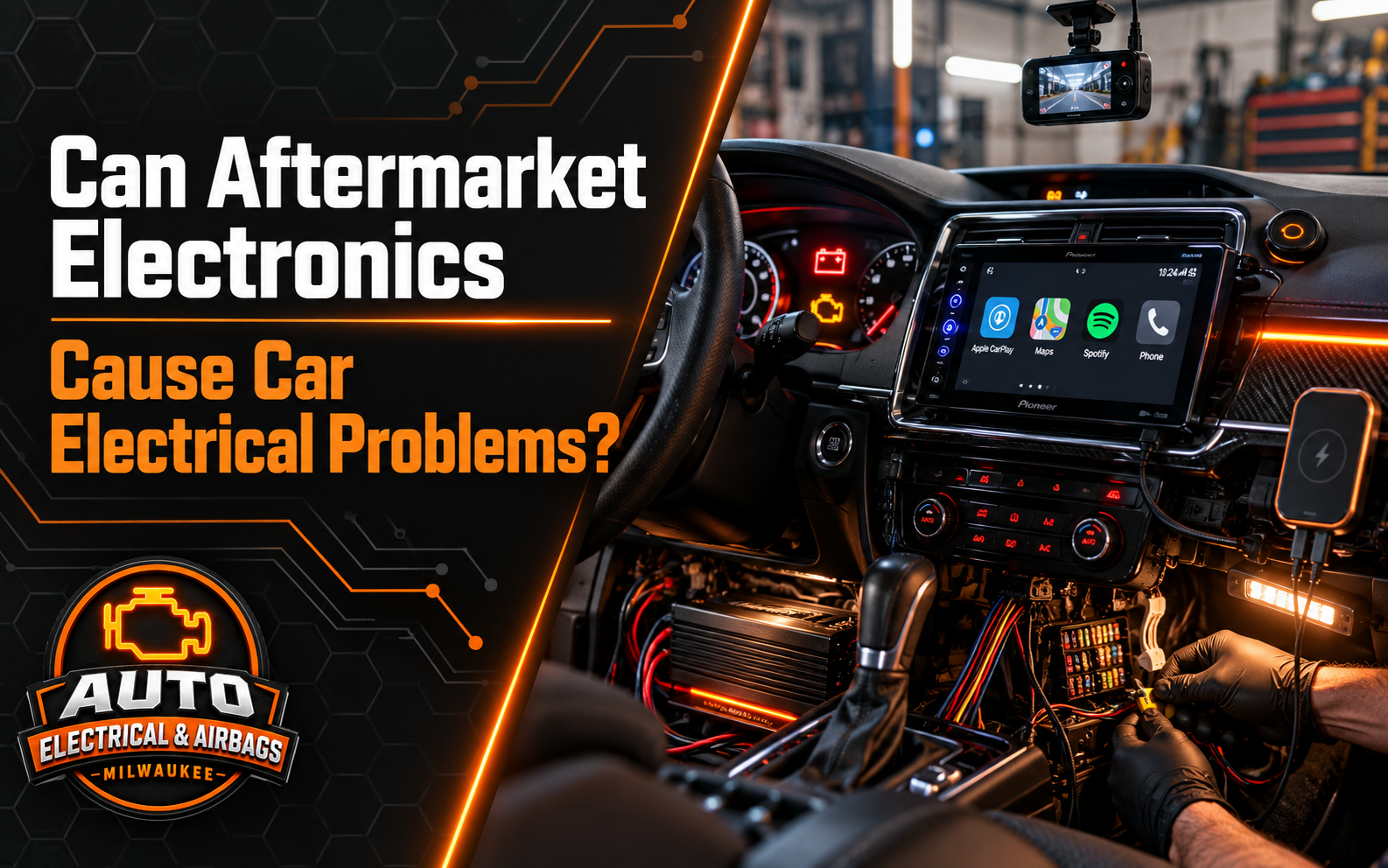
Your vehicle worked normally until an aftermarket accessory was installed.
Then the battery began dying overnight.
The remote start works sometimes but not others. The radio stays powered after the vehicle is shut off. Warning lights appear unexpectedly. The security system acts strangely. A fuse repeatedly blows. Or the car occasionally refuses to start even though the battery seems fine.
When electrical problems begin after installing an aftermarket device, the accessory itself may not necessarily be defective.
The problem can be how that device was connected to the factory electrical system.
Modern vehicles rely on electronic modules, communication networks, security systems and carefully controlled power circuits. Adding a remote starter, alarm, stereo, amplifier, dash camera, GPS tracker or other accessory means connecting new electronics to that existing system.
When the installation is correct, these devices can work without causing problems.
When wiring is incorrect, damaged, poorly grounded or connected to the wrong circuit, however, the result can be battery drain, intermittent faults, communication problems, warning lights or no-start conditions.
This guide explains which aftermarket electronics can cause vehicle electrical problems, what symptoms to watch for, why installation quality matters and how technicians determine whether an aftermarket device is actually responsible.
Quick Answer: Can Aftermarket Electronics Cause Electrical Problems?
Yes, aftermarket electronics can cause electrical problems when they are installed incorrectly, fail internally or interfere with factory vehicle circuits.
Potential problems include:
- Battery drain
- Blown fuses
- No-start conditions
- Intermittent starting
- Security-system problems
- Radio or amplifier staying powered
- Warning lights
- CAN bus communication faults
- Poor grounds
- Damaged factory wiring
- Modules remaining awake
- Electrical accessories behaving unpredictably
However, the presence of aftermarket equipment does not automatically mean it is causing the problem.
The electrical system should be tested to determine whether the accessory is actually involved.
What Counts as Aftermarket Electronics?
Aftermarket electronics are electrical or electronic devices added after the vehicle left the manufacturer.
Common examples include:
- Remote starters
- Alarm systems
- Aftermarket radios
- Amplifiers
- Subwoofers
- Dash cameras
- GPS trackers
- Fleet-tracking equipment
- Backup cameras
- LED lighting
- Light bars
- Phone charger hardwire kits
- Radar detectors
- Trailer wiring
- Aftermarket gauges
- Immobilizers
- Kill switches
- Accessory switches
- USB power systems
Some installations are simple.
Others require integration with factory ignition, security, lighting or vehicle communication circuits.
The more closely an accessory interacts with factory electronics, the more important correct wiring becomes.
Why Modern Vehicles Are More Sensitive to Added Electronics
Older vehicles generally used simpler electrical systems.
A switch supplied power to a component, and that component operated.
Modern vehicles may control the same function through:
- Electronic modules
- Relays
- Computer-controlled outputs
- CAN bus communication
- LIN communication
- Gateway modules
- Security authorization
- Intelligent battery-management systems
A wire that appears to be a simple 12-volt circuit may actually be monitored or controlled by a module.
That means adding electrical equipment without understanding the circuit can create unintended problems.
For example, connecting an accessory to the wrong factory wire could potentially:
- Keep a module awake
- Backfeed voltage
- Overload a circuit
- Create communication problems
- Cause repeated fuse failures
- Interfere with security functions
This is why modern accessory installation should be based on the specific vehicle’s electrical architecture rather than wire color alone.
Can an Aftermarket Remote Start Cause Electrical Problems?
It can if there is a fault in the system or installation.
Remote-start systems may interact with circuits involving:
- Ignition
- Starter
- Brake switch
- Hood switch
- Door locks
- Security system
- Immobilizer
- Keyless entry
- Vehicle communication network
Modern remote-start systems may also use data interfaces that communicate with factory modules.
Possible symptoms of remote-start wiring problems include:
- Vehicle will not crank
- Vehicle starts and immediately shuts off
- Remote start works intermittently
- Security light flashes
- Key is not recognized correctly
- Battery drains while parked
- Door locks behave strangely
- Warning lights appear
- Factory keyless entry stops working properly
If the vehicle developed a no-start condition shortly after remote-start work, the starting and security circuits should be evaluated before expensive factory modules are replaced.
Can an Aftermarket Alarm Prevent a Car From Starting?
Yes, depending on how the alarm system is designed and installed.
Some aftermarket alarm systems include starter-interrupt functions.
These systems intentionally interrupt part of the starting circuit when the alarm is armed.
If the alarm module, relay or wiring develops a fault, the vehicle may fail to start even though the factory starting system itself is functional.
Possible signs include:
- Dashboard lights work but engine does not crank
- Alarm behaves unpredictably
- Security-related problems occur
- Vehicle starts after the alarm system is bypassed or repaired
- Problem began after alarm installation
- Starter circuit shows an interruption
This is one example of why a no-start condition should be diagnosed before a starter, battery or control module is replaced.
For other electrical causes of no-start problems, see our guide to car electrical no-start problems.
Can an Aftermarket Stereo Drain the Battery?
Yes, but a properly installed stereo should not normally kill a healthy battery simply because it is aftermarket.
Battery drain can occur when:
- Accessory power is connected incorrectly
- Constant and switched power circuits are confused
- An amplifier stays powered
- A relay remains energized
- The radio does not enter sleep mode
- Wiring keeps another factory module awake
- The stereo itself develops an internal fault
Many aftermarket radios require both:
- Constant battery power for memory
- Switched or accessory power to tell the radio when the vehicle is on
If these circuits are wired incorrectly, the radio or amplifier may remain active after the vehicle is shut down.
AAA notes that improperly installed aftermarket stereos can continue drawing power when the vehicle is not in use, which can contribute to battery discharge.
Why Can an Amplifier Keep Draining the Battery?
An aftermarket amplifier normally uses a remote turn-on signal to tell it when to switch on and off.
If the amplifier remains on after the vehicle is shut down, possible causes include:
- Remote turn-on wire connected to constant power
- Radio output staying active
- Faulty relay
- Wiring error
- Internal amplifier problem
A simple clue may be an amplifier that remains warm long after the car has been turned off.
However, the actual current draw should be measured before assuming the amplifier is responsible.
Can a Dash Cam Drain a Car Battery?
It can.
Some dash cameras are intentionally designed to operate while the vehicle is parked.
That feature can be useful for parking surveillance, but it also means the camera may continue consuming power after the engine is off.
Battery drain becomes more likely when:
- Camera stays powered continuously
- Hardwire kit is connected incorrectly
- Low-voltage cutoff is missing or malfunctioning
- Camera uses more current than expected
- Vehicle sits for extended periods
- Battery is already weak
If a battery problem began after a dash camera was hardwired, the camera circuit should be considered during parasitic-draw testing.
Can GPS Trackers or Fleet Devices Cause Battery Drain?
Yes.
GPS trackers and telematics devices often require constant electrical power so they can continue reporting vehicle location or status.
Normally, their standby power consumption should be low enough for the intended installation.
Problems can occur when:
- Device fails internally
- Device never enters low-power mode
- Wiring is incorrect
- Vehicle sits for extended periods
- Several added devices remain powered
For fleet vehicles, multiple electronic add-ons can make battery-drain diagnosis more complicated because more than one aftermarket circuit may be present.
How Can Incorrect Wiring Cause Problems?
Several installation mistakes can create electrical faults.
Connecting to the Wrong Power Circuit
Not every wire that has voltage is an appropriate accessory source.
Some circuits are:
- Constant power
- Ignition switched
- Accessory switched
- Module controlled
- Timed
- Data circuits
Connecting an accessory to the wrong circuit may keep it powered longer than intended or interfere with factory operation.
Poor Splices
A poor wiring splice can cause:
- Intermittent connection
- Voltage drop
- Corrosion
- Heat
- Open circuit
- Short circuit
Quick taps and poorly crimped connections can become especially problematic as vehicles age or experience vibration.
Exposed Wiring
Bare conductors can contact metal parts or nearby circuits.
This may result in:
- Blown fuse
- Short circuit
- Heat
- Electrical smell
- Intermittent fault
Any added wiring should be appropriately insulated, protected and routed.
Wiring Pinched Behind Interior Panels
Aftermarket wiring frequently runs behind:
- Dash panels
- Kick panels
- Center consoles
- Headliners
- Trunk trim
If panels are reinstalled over wiring, a harness can become pinched.
A partially damaged wire may work initially and fail later.
Incorrect Fuse Protection
Added equipment should be protected by appropriate circuit protection.
Improperly fused accessory wiring can increase the risk of:
- Wiring damage
- Excessive heat
- Repeated electrical failure
Why Is Grounding Important for Aftermarket Electronics?
Every electrical device needs a reliable return path.
A poor accessory ground can cause symptoms including:
- Device resets
- Noise in audio systems
- Intermittent operation
- Low voltage
- Excessive heat at connections
- Unstable behavior
Grounding an accessory to painted, corroded or unsuitable metal can create excessive resistance.
This does not necessarily affect only the aftermarket device.
If factory wiring or grounds are altered during installation, other vehicle systems may also be affected.
For a deeper explanation of this issue, see our guide to bad ground wire symptoms in a car.
What Is Electrical Backfeeding?
Backfeeding occurs when voltage travels into a circuit from a direction or source that was not intended.
This can happen when aftermarket circuits are interconnected incorrectly.
Possible results include:
- Lights staying on
- Modules remaining awake
- Electrical functions activating unexpectedly
- Warning lights
- Battery drain
Modern electronically controlled circuits can be particularly sensitive because a small amount of unintended voltage may affect module inputs.
Diagnosing backfeeding requires understanding both the aftermarket wiring and the factory circuit.
Can Aftermarket Wiring Affect the CAN Bus?
Potentially.
Not every aftermarket installation connects directly to the CAN network.
However, many modern remote-start, alarm, infotainment and accessory systems use vehicle-data interfaces to communicate with factory electronics.
A problem involving:
- Data wiring
- Interface module
- Power supply
- Ground
- Connector
- Installation
could contribute to communication faults.
Symptoms might include:
- Lost communication codes
- Several warning lights
- Module offline
- Accessory systems behaving strangely
For more information about vehicle networks, see our guide to CAN bus communication faults.
Can an Aftermarket Device Keep Vehicle Modules Awake?
Yes.
Modern vehicles contain modules that remain active for a period after the ignition is turned off.
Eventually, the vehicle should enter a lower-power sleep state.
If an added device repeatedly communicates with the vehicle or supplies power to a circuit that should shut down, some modules may remain awake.
That can increase parked-current draw.
Possible symptoms include:
- Battery dies after one or two nights
- Vehicle starts normally when driven every day
- Battery tests good
- Charging system tests good
- Problem began after accessory installation
This type of battery drain can be difficult to diagnose because current draw may change over time as different modules wake and sleep.
Why Can the Problem Start Months After Installation?
An accessory can work normally for months or even years before creating an electrical fault.
Possible reasons include:
- Connection loosens
- Corrosion develops
- Wire rubs through insulation
- Device develops internal failure
- Ground connection deteriorates
- Vehicle repair disturbs accessory wiring
- Battery condition changes
- Connector becomes contaminated
This is why older aftermarket installations should not automatically be ignored just because the device worked correctly when first installed.
Signs an Aftermarket Device May Be Involved
The timing of the problem can provide useful clues.
Pay particular attention if:
- Electrical problem began immediately after installation
- Battery started dying after a new stereo or amplifier
- No-start began after alarm or remote-start installation
- Warning lights appeared after dash work
- Problem changes when aftermarket device is disconnected
- Fuse began blowing after accessory was added
- Wiring behind dash has been spliced
- Device behaves unpredictably
- Electrical issue began after accessory was repaired or replaced
These clues increase suspicion, but they are not proof.
Testing still matters.
Should You Remove the Aftermarket Device?
Not automatically.
Removing an aftermarket system without understanding how it was installed can create additional problems.
For example, an alarm or remote-start installation may have altered factory starter or ignition wiring.
Simply cutting the aftermarket wires out could leave the original circuit incomplete.
The correct approach depends on whether the system should be:
- Repaired
- Rewired
- Properly bypassed
- Removed and factory circuits restored
If removal is necessary, the factory wiring should be restored correctly.
How Are Aftermarket Electrical Problems Diagnosed?
A systematic approach helps determine whether the accessory actually caused the problem.
Review the Installation History
Technicians should know:
- What accessory was installed?
- When was it installed?
- Did symptoms begin immediately?
- Has the device worked normally before?
- Was the vehicle repaired afterward?
- Has other electrical work been done?
The history may point toward the most relevant circuits.
Perform a Complete Vehicle Scan
When warning lights or module problems are involved, technicians may scan multiple vehicle systems.
This can reveal:
- Communication codes
- Low-voltage codes
- Security faults
- Module errors
- Other electrical problems
The pattern matters more than one individual code.
Inspect the Added Wiring
Aftermarket wiring may be inspected for:
- Improper splices
- Loose connectors
- Exposed conductors
- Incorrect fuse taps
- Damaged insulation
- Poor grounds
- Pinched wires
Check Power Sources
Technicians may determine whether the device is connected to:
- Constant power
- Ignition power
- Accessory power
- Factory module-controlled circuits
This helps determine whether the device is receiving power when it should not.
Check Parasitic Current Draw
When the complaint is a dead battery, current draw can be measured after the vehicle has had time to enter its normal sleep state.
The technician can then determine whether disconnecting or isolating the aftermarket circuit changes the draw.
For more information, see our guide to a car battery that keeps dying overnight.
Verify Factory Wiring
If an aftermarket system has altered factory circuits, the original wiring diagram may be needed to determine:
- What the factory circuit should look like
- Where the wiring was modified
- Whether the original circuit can be restored
This is especially important with:
- Starter circuits
- Ignition wiring
- Security systems
- Door locks
- Module wiring
Aftermarket Electrical Fault vs. Factory Electrical Fault
| Symptom | Aftermarket System Could Cause It? | Factory Problem Also Possible? |
|---|---|---|
| Battery dies overnight | Yes | Yes |
| No-start condition | Yes | Yes |
| Radio remains powered | Yes | Yes |
| Warning lights appear | Possible | Yes |
| Security system acts strangely | Yes | Yes |
| Fuse repeatedly blows | Yes | Yes |
| Module communication codes | Possible | Yes |
| Problem began after accessory installation | Strong clue | Still possible |
| Device wiring is visibly damaged | Strong clue | Factory issue may also exist |
Timing and testing are what separate coincidence from causation.
Can You Blame the Aftermarket Installation Just Because the Problem Started Later?
No.
Two events occurring close together do not prove one caused the other.
For example, a battery may fail shortly after a stereo installation simply because the battery was already near the end of its service life.
Likewise, a no-start condition after remote-start installation could still be caused by:
- Weak battery
- Starter problem
- Factory security fault
- Wiring failure unrelated to the accessory
The accessory should be investigated because of the timing.
It should not automatically be blamed without evidence.
When Should You Have the Vehicle Professionally Diagnosed?
Consider professional electrical testing when:
- Battery repeatedly dies after accessory installation
- Vehicle intermittently will not start
- Alarm or remote start behaves unpredictably
- Several warning lights appeared after installation
- Factory electrical features stopped working
- Fuse repeatedly blows
- Added wiring becomes hot
- Electrical smell develops
- Module communication problems appear
- Disconnecting the accessory appears to change the symptom
- Another shop has already replaced parts without solving the problem
Complex electrical problems are usually easier to solve when the technician can identify exactly where factory wiring was modified.
Aftermarket Wiring and Electrical Diagnostics in Milwaukee
At Auto Electrical & Airbag Specialist in Milwaukee, we diagnose difficult vehicle electrical problems involving factory wiring, added accessories, control modules, power circuits, grounds and communication networks.
If electrical problems began after a remote starter, alarm, stereo, amplifier, dash camera or other accessory was installed, the aftermarket wiring can be evaluated as part of the complete electrical diagnosis.
Our auto electrical diagnostics in Milwaukee focuses on determining the source of the fault before recommending parts.
When the problem involves damaged, modified or improperly repaired wiring, see our automotive wiring repair services.
Auto Electrical & Airbag Specialist
2636 S 32nd St
Milwaukee, WI 53215
(414) 345-7568
Frequently Asked Questions About Aftermarket Electronics
Can an aftermarket remote start drain the battery?
It can if the system, interface or wiring continues drawing excessive current while the vehicle is parked. Proper current testing can determine whether the remote-start circuit is actually responsible.
Can an aftermarket alarm cause a no-start?
Yes. Some alarms use starter-interrupt circuits. A problem with the alarm module, relay or wiring can potentially interrupt the factory starting circuit.
Can an aftermarket radio kill the battery overnight?
It can if the radio or amplifier remains powered because of incorrect wiring or a fault. However, battery condition and other parasitic draws should also be tested.
Can a dash cam drain the battery?
Yes, especially if it operates in parking mode or is wired to constant power without appropriate voltage protection.
Can an amplifier stay on when the car is off?
Yes. Incorrect remote-turn-on wiring, a faulty relay or an internal problem can keep the amplifier energized.
Can aftermarket electronics cause CAN bus problems?
Potentially. Some modern accessories communicate with factory vehicle networks through interface modules. Faults involving the interface, wiring, power or ground can contribute to communication problems.
Can a remote starter interfere with the security system?
It can if there is a problem involving the immobilizer interface, wiring or system integration.
Can poor installation cause warning lights?
Yes. Altered power, ground, sensor or communication circuits can potentially trigger warning lights depending on the vehicle and installation.
Should I disconnect aftermarket equipment if I suspect a problem?
Not blindly. Some systems modify factory wiring, and improper removal can create additional faults. The installation should first be understood.
Can aftermarket wiring problems appear years later?
Yes. Corrosion, vibration, damaged insulation, loose connections and component failure can cause an older installation to develop problems over time.
Does an aftermarket device automatically void factory electrical systems?
No. The relevant question during diagnosis is whether the added equipment actually caused or contributed to the fault.
How do technicians determine whether an aftermarket device is causing battery drain?
They can measure parasitic current after the vehicle enters sleep mode and determine whether isolating the accessory circuit changes the excessive draw.
The Bottom Line
Aftermarket electronics are not automatically harmful to a vehicle.
A properly installed remote start, alarm, stereo, dash camera or other accessory can operate without causing factory electrical problems.
Problems usually begin when there is an issue involving:
- Wiring
- Power supply
- Ground
- Installation
- Circuit protection
- Network integration
- The aftermarket device itself
The biggest clue is often timing.
If an electrical problem began shortly after an accessory was installed—or if an older installation has damaged or modified wiring—it deserves attention during diagnosis.
But the goal should not be to automatically blame the aftermarket device.
The better question is:
“Did this accessory change the factory electrical system in a way that explains the symptoms?”
Testing that question can help identify the real fault without unnecessarily replacing batteries, starters, modules or other factory components.