Your headlights flicker when the blower motor turns on.
The engine cranks slowly even though the battery tests good.
Several dashboard warning lights appear at the same time. A power window moves slowly. The radio resets. A control module occasionally stops communicating.
These problems can look completely unrelated.
Sometimes they are connected by one thing:
a poor electrical ground.
Ground connections are essential to nearly every electrical system in a vehicle. A component can have the correct power supply and still fail to operate properly if electricity cannot return through a reliable ground path.
That is why a loose, corroded or high-resistance ground can imitate problems involving the battery, alternator, starter, sensors, wiring or even expensive electronic control modules.
This guide explains what automotive grounds do, common bad ground symptoms, why ground problems can affect several systems at once, and how technicians test a ground connection instead of relying only on visual inspection.
Quick Answer: What Are the Symptoms of a Bad Ground in a Car?
Possible symptoms of a poor vehicle ground include:
- Slow or intermittent starting
- No-crank condition
- Flickering headlights
- Dim interior or exterior lights
- Multiple dashboard warning lights
- Electrical accessories operating slowly
- Radio or infotainment system resetting
- Sensors storing unusual fault codes
- Control modules losing communication
- Intermittent electrical problems
- Battery or charging problems
- Electrical issues that change when accessories are turned on
- Hot ground cables or terminals
- Problems that become worse after rain or corrosion develops
A ground connection can look completely normal while still creating excessive resistance.
Proper testing is often necessary to determine whether the ground can carry electrical current correctly under load.
What Is a Ground Connection in a Car?
A vehicle electrical circuit needs a complete path for current to flow.
In simplified form:
Battery positive → electrical component → ground → battery negative
The positive side supplies electrical power.
The ground side provides the return path.
Many vehicle electrical systems use the metal body, chassis or engine as part of that return path rather than running an individual negative wire directly back to the battery for every component.
That is why vehicles have numerous grounding locations.
Depending on the vehicle, you may find grounds connecting:
- Battery to body
- Battery to engine
- Engine to chassis
- Transmission to chassis
- Electronic modules to body
- Lighting circuits to body
- Sensors to engine or module grounds
- Interior electronics to body grounds
One grounding point can sometimes serve several electrical components.
When that connection develops excessive resistance, several systems may begin behaving strangely.
Why Does a Bad Ground Cause So Many Different Symptoms?
Electricity needs both a power supply and a return path.
Imagine a headlight receives proper voltage on its positive circuit but its ground connection is corroded.
The light may still operate, but current cannot flow through the circuit normally.
The result might be:
- Dim light output
- Flickering
- Heat
- Unstable voltage
- Intermittent operation
Now imagine that the same ground point is shared by several components.
Suddenly the vehicle may have several symptoms at once.
That is one reason a single poor ground can sometimes look like multiple component failures.
1. The Car Cranks Slowly Even With a Good Battery
Slow cranking commonly makes drivers suspect the battery.
Sometimes that is correct.
But the starter also needs a strong ground path.
The starting circuit carries high electrical current. Even relatively small resistance in a battery cable, terminal, engine ground or connection can interfere with starter performance.
Possible symptoms include:
- Starter turns slowly
- Starter occasionally clicks
- Vehicle starts after several attempts
- Lights dim heavily during cranking
- Battery tests acceptable but cranking remains weak
Possible areas to investigate include:
- Battery terminals
- Negative battery cable
- Engine ground
- Chassis ground
- Cable connections
- Starter electrical circuit
If your vehicle has power but still refuses to start, our guide to why a car won’t start even when the lights work explains why having dashboard power does not necessarily mean the starting circuit is healthy.
2. The Vehicle Starts Sometimes but Not Others
Intermittent starting problems are particularly frustrating because the vehicle may behave normally when it reaches the shop.
A poor ground connection can change with:
- Temperature
- Vibration
- Engine movement
- Moisture
- Corrosion
- Cable position
One day the connection may carry enough current.
The next day it may not.
This can produce a vehicle that starts perfectly ten times and then unexpectedly refuses to crank.
When starting problems are inconsistent, the pattern can provide useful diagnostic clues.
3. Headlights or Interior Lights Flicker
Flickering lights are a classic electrical symptom, but they do not automatically mean the alternator is failing.
Possible causes include:
- Loose electrical connections
- Ground problems
- Battery connection issues
- Charging-system problems
- Wiring faults
- Connector damage
Pay attention to when the lights flicker.
Does it happen when:
- The blower motor turns on?
- You operate a power window?
- The engine is idling?
- You turn the steering wheel?
- You hit a bump?
- The vehicle gets wet?
Electrical problems that change when another electrical load is added can provide important clues.
4. Lights Become Dim When Another Accessory Turns On
Turning on one accessory should not normally cause another unrelated system to behave dramatically differently.
For example:
- Headlights dim when the blower starts
- Dashboard lights change when the rear defroster is activated
- Interior lights flicker when a window moves
- Radio resets when headlights turn on
Some voltage change under heavy electrical load can be normal.
But dramatic or inconsistent changes may point toward a charging, connection or ground problem.
A high-resistance ground can become more noticeable as electrical load increases.
5. Multiple Dashboard Warning Lights Appear
Modern vehicles contain numerous electronic control modules that depend on stable voltage and reliable electrical connections.
A poor ground can disrupt that stability.
Possible results include warnings involving:
- ABS
- Traction control
- Electronic stability control
- Power steering
- Airbag or SRS
- Check engine system
- Transmission
- Battery or charging system
Several warning lights do not necessarily mean several components failed simultaneously.
They may share a voltage, ground or communication problem.
Our guide to multiple dashboard warning lights explains why one electrical fault can sometimes trigger warnings across several systems.
6. Electronic Modules Reset or Stop Communicating
Modern vehicles rely on computers throughout the vehicle.
Examples include:
- ECU
- ECM
- BCM
- ABS module
- SRS module
- Electronic power steering module
- Instrument cluster
- Door modules
- Gateway modules
Electronic modules require reliable power and ground.
If a ground connection becomes unstable, a module may:
- Restart
- Temporarily shut down
- Store low-voltage codes
- Lose communication
- Become unavailable to a scan tool
- Generate several communication-related faults
This can make an electrical ground problem look like an expensive module failure.
Before replacing a module because it will not communicate, technicians may need to verify its power and ground circuits.
If communication codes are present, our guide to CAN bus communication faults explains why an offline module is not automatically a failed module.
7. Power Windows, Seats or Other Motors Operate Slowly
Electrical motors depend on adequate current.
A poor connection can create resistance that reduces the effective voltage available while the component is operating.
You may notice:
- Window moves unusually slowly
- Power seat struggles
- Blower motor changes speed
- Wiper motor works inconsistently
- Door locks sound weak
The motor itself may be worn.
But wiring, connectors, power supplies and grounds should also be considered.
A motor receiving inadequate voltage because of circuit resistance can behave like a failing motor.
8. Sensors Show Strange or Inconsistent Readings
Sensors also depend on proper electrical reference circuits.
Depending on the system, a sensor may use:
- Power supply
- Reference voltage
- Signal circuit
- Ground
If the ground is unstable, the sensor signal can become inaccurate.
The control module may then store a fault code because the reading is outside the expected range.
This does not automatically mean the sensor itself has failed.
That is why replacing a sensor solely because its name appears in a diagnostic code can sometimes fail to solve the problem.
9. Electrical Problems Appear Only When the Vehicle Is Wet
Moisture and corrosion can worsen weak electrical connections.
A ground connection may develop corrosion where a terminal contacts the body or engine.
Symptoms may appear primarily:
- After rain
- After a car wash
- During high humidity
- After snow or road salt exposure
As corrosion progresses, the problem may eventually become permanent.
If your electrical problems occur primarily around moisture, see our guide to car electrical problems after rain.
10. The Battery Keeps Dying or Appears Weak
A ground problem can sometimes contribute to battery or charging symptoms.
For example, a poor connection between the battery, engine and charging system can interfere with normal current flow.
However, repeated battery failure has many possible causes, including:
- Weak battery
- Charging-system problem
- Parasitic electrical draw
- Poor battery connections
- Wiring problem
- Module staying awake
- Accessory remaining powered
A ground should therefore be tested as part of the larger electrical system rather than automatically blamed.
Our article about a car battery that keeps dying overnight explains how parasitic drain differs from charging and connection problems.
11. Ground Cables or Connections Become Hot
Electrical resistance creates heat.
A damaged or corroded cable can become unusually warm while carrying significant current.
This can occur during:
- Starting
- Charging
- High electrical load
Heat at a terminal or cable connection can be an important warning sign.
Do not ignore electrical connections that become excessively hot, smell burned or show visible melting.
What Causes a Bad Ground Connection?
Ground failures develop for several different reasons.
Corrosion
Metal exposed to moisture and road contaminants can corrode.
Corrosion between a ground terminal and the vehicle body may increase electrical resistance even when the bolt still appears tight.
Loose Fasteners
Vehicle vibration can contribute to loose connections.
Previous repairs can also leave a ground fastener insufficiently tightened.
Damaged Ground Cable
Battery and engine ground cables can become:
- Frayed
- Corroded internally
- Heat damaged
- Stretched
- Broken
A cable can look acceptable externally while corrosion develops underneath the insulation.
Collision Damage
Vehicle impacts can:
- Stretch cables
- Damage body grounds
- Break wiring
- Move grounding locations
- Damage connectors
Ground problems can therefore appear after body or collision repairs.
Our guide to electrical problems after collision repair explains other hidden electrical problems that may remain after the visible damage is repaired.
Previous Electrical Repairs
A ground connection may be affected when:
- Engine components are removed
- Body panels are replaced
- Batteries are serviced
- Wiring repairs are performed
- Electronic accessories are installed
The ground may be left loose, moved or attached to a poor surface.
Paint or Coatings Under the Ground Terminal
Ground connections rely on good electrical contact.
If a terminal is attached over:
- Paint
- Heavy corrosion
- Sealant
- Thick coating
the electrical connection may be poor.
This can sometimes happen after body repairs or refinishing.
Water Intrusion
Water reaching grounding locations can promote corrosion.
Leaks may affect grounds located in areas such as:
- Trunk
- Passenger compartment
- Engine bay
- Kick panels
- Under seats
Water-related corrosion can initially create intermittent symptoms.
Why a Ground Can Look Good and Still Be Bad
This is one of the most important concepts in automotive electrical diagnosis.
A ground can:
- Be bolted tightly
- Look clean
- Show continuity on a simple meter test
and still fail under electrical load.
Why?
Because the connection may have enough continuity for a meter’s tiny test current but too much resistance when an actual component draws significant current.
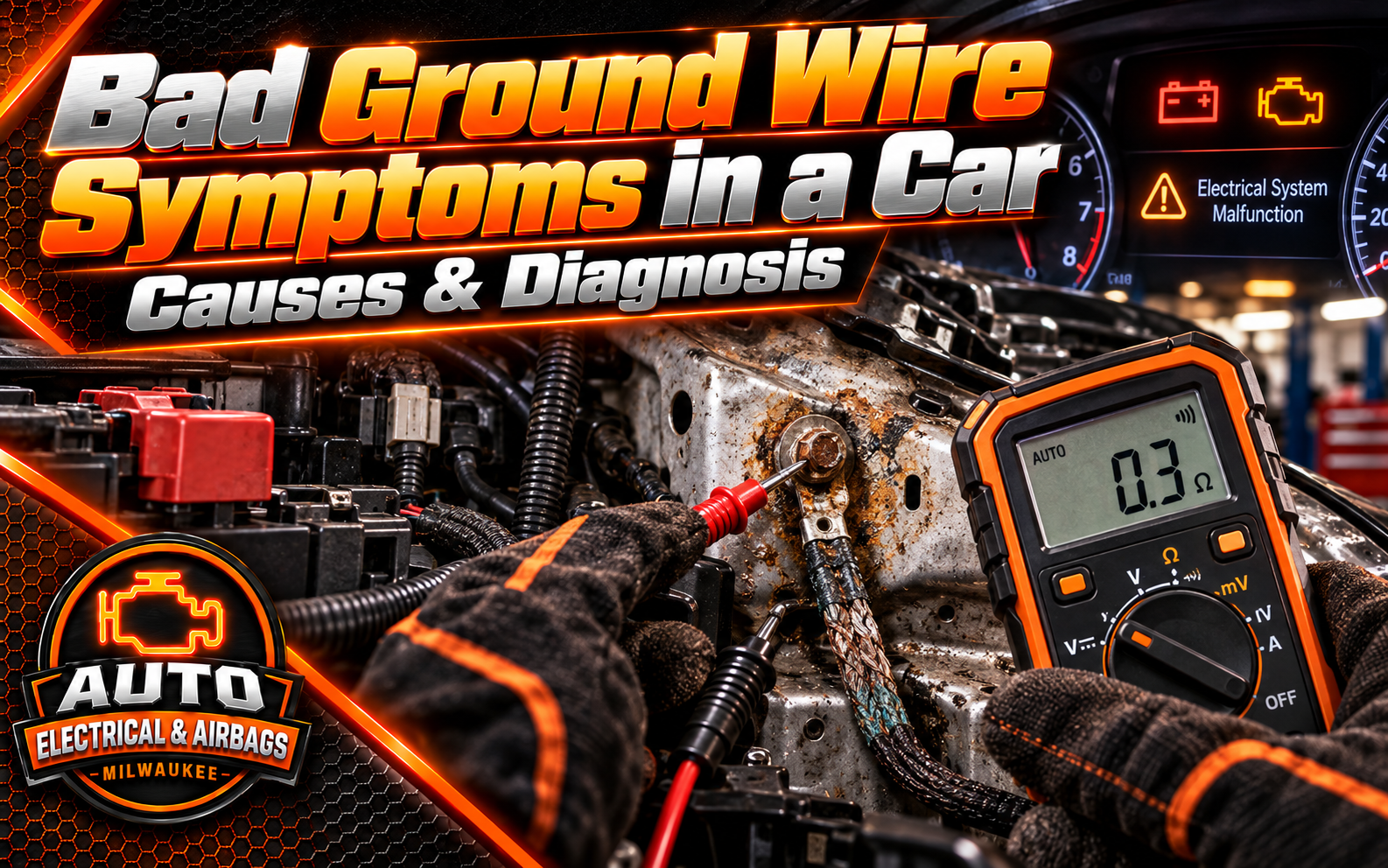
That is why technicians may use voltage-drop testing.
What Is Voltage-Drop Testing?
Voltage-drop testing measures how much electrical voltage is lost across part of a circuit while current is flowing.
Ideally, a cable or connection should offer very little resistance.
When corrosion, damaged wiring or a weak connection creates excessive resistance, measurable voltage is lost across that point.
A technician can use voltage-drop testing on areas such as:
- Battery cables
- Ground straps
- Terminals
- Connectors
- Engine grounds
- Chassis grounds
This can reveal problems that are not visible externally.
Continuity Testing vs. Voltage-Drop Testing
These tests answer different questions.
Continuity Test
A continuity test asks:
Is there an electrical path between these two points?
That can help locate a completely broken circuit.
But it does not always show whether the path can handle its normal electrical load.
Voltage-Drop Test
A voltage-drop test asks:
How well does this connection carry current while the circuit is working?
That can be more useful for finding:
- Corroded connections
- High resistance
- Weak cables
- Poor terminals
- Bad grounds under load
A circuit can therefore pass a simple continuity check but still fail a voltage-drop test.
Bad Ground vs. Bad Battery
Some symptoms overlap.
| Symptom | Bad Ground Possible? | Bad Battery Possible? |
|---|---|---|
| Slow cranking | Yes | Yes |
| No-start | Yes | Yes |
| Flickering lights | Yes | Possible |
| Several warning lights | Yes | Possible during low voltage |
| Battery tests weak | Not necessarily | Yes |
| Problems change when cable moves | Strong clue | Less typical |
| Hot ground connection | Strong clue | Less typical |
| Electrical accessories work inconsistently | Yes | Possible |
| Module communication faults | Yes | Possible during low voltage |
Testing is required to distinguish them.
Bad Ground vs. Bad Alternator
Charging problems can also produce similar symptoms.
A weak alternator may cause:
- Battery warning light
- Low system voltage
- Dimming lights
- Battery discharge
- Electronic warnings
A poor ground connection can interfere with the charging circuit and create similar behavior.
That means alternator output should not be evaluated in isolation.
Battery connections, cables, grounds and related wiring matter too.
If your battery light comes on while driving, the charging system should be tested instead of assuming the battery itself needs replacement.
Bad Ground vs. Bad Control Module
This distinction can save significant money.
A control module that:
- Resets
- Stops communicating
- Stores voltage faults
- Behaves unpredictably
may appear defective.
But if its ground supply is unstable, the module may simply be reacting to the electrical problem.
Before a BCM, ECU, ECM, ABS module or other electronic computer is condemned, technicians commonly need to determine whether the module has the correct:
- Power supply
- Ground
- Communication circuits
This same principle applies to the body control module symptoms discussed in our BCM guide.
A BCM-related code does not automatically prove the BCM itself is faulty.
Can One Bad Ground Cause Multiple Electrical Problems?
Yes.
One ground location may serve several circuits or electronic components.
If that ground develops excessive resistance, all of the connected systems can be affected.
That can make the vehicle appear to have several unrelated failures.
For example, you might experience:
- Flickering dashboard
- Radio resetting
- Warning lights
- Slow accessory motors
- Communication codes
The pattern of affected systems can help technicians determine whether they share a common electrical connection.
Can a Bad Ground Cause the Check Engine Light?
It can.
Engine-management sensors and control modules depend on proper electrical connections.
A ground problem may create:
- Abnormal sensor signals
- Voltage-related codes
- Module communication faults
- Control-circuit problems
However, the check engine light has many possible causes.
The trouble codes and affected circuits still need to be diagnosed.
Can a Bad Ground Cause an Airbag Light?
Potentially.
SRS electronic systems depend on stable voltage, wiring and module communication.
A poor electrical connection can contribute to faults in electronic systems, although an airbag warning may also result from:
- Impact sensor
- Pretensioner
- Seat wiring
- Occupancy sensor
- Clockspring
- Airbag module
- Other SRS circuit problems
Because airbags are part of a safety system, an SRS warning should be properly diagnosed.
Can a Bad Ground Cause ABS and Traction-Control Lights?
It can contribute to electronic faults affecting these systems.
ABS and traction-control systems depend on:
- Wheel-speed sensors
- Electronic modules
- Stable system voltage
- Communication networks
A voltage or ground problem may affect module operation or sensor circuits.
But a poor ground should not be assumed without testing.
Can a Bad Ground Cause a CAN Bus Communication Fault?
Yes, indirectly.
An electronic module must be powered and grounded correctly to communicate.
If a module loses its ground, it may:
- Shut down
- Restart repeatedly
- Stop communicating
- Appear offline to other modules
Other modules may then store lost-communication codes.
This can look like a CAN bus wiring problem even when the network wiring itself is intact.
Can a Bad Ground Drain the Battery?
A poor ground and a parasitic battery drain are different electrical problems.
A parasitic drain means excessive current continues flowing while the vehicle is supposed to be shut down.
A poor ground creates excessive resistance in a return path.
However, a ground fault can contribute to charging or operating problems that leave the battery undercharged.
If the battery repeatedly dies while parked, parasitic draw testing may still be necessary.
How Are Bad Grounds Diagnosed?
The exact testing depends on the affected circuit.
A systematic diagnosis may include the following.
Confirm the Symptoms
Technicians first determine exactly what is happening.
Useful questions include:
- Does the vehicle fail only when cold?
- Does it happen after rain?
- Does the problem change when headlights are turned on?
- Does moving a cable affect the symptom?
- Did the problem start after a repair?
- Does it happen only during starting?
- Are several systems affected?
The pattern can help identify which circuits should be tested.
Check Battery Condition and Connections
Electrical diagnosis should begin with a stable electrical supply.
Battery terminals and cable connections may need inspection and testing.
Review Fault Codes
A full diagnostic scan can reveal:
- Voltage-related codes
- Communication codes
- Sensor faults
- Modules that are offline
The code pattern may point toward a shared electrical problem.
Inspect Major Ground Connections
Depending on the symptom, technicians may examine:
- Battery negative cable
- Engine ground
- Chassis ground
- Body grounds
- Module-specific grounds
Visible corrosion or looseness can provide a clue.
Perform Voltage-Drop Testing
Testing the ground under electrical load helps determine whether excessive resistance exists.
This is particularly useful when the connection looks normal.
Trace Shared Grounds
When several systems fail together, wiring diagrams can help identify whether those systems share:
- Ground point
- Power supply
- Connector
- Harness
- Module
That can turn several symptoms into one logical diagnostic path.
When Should a Ground Problem Be Professionally Diagnosed?
Consider professional electrical testing when:
- The battery tests good but starting is inconsistent
- Multiple warning lights appear
- Headlights flicker with electrical load
- Electronics randomly reset
- Several accessories fail together
- A module intermittently stops communicating
- A new battery or alternator did not solve the problem
- Electrical symptoms change when cables or wiring move
- Problems started after collision repair
- Problems worsen after rain
- Ground cables or terminals become hot
- Electrical problems continue despite replacing parts
Ground problems are often inexpensive compared with electronic modules.
But finding the actual bad connection can require circuit testing rather than guessing.
Automotive Ground and Electrical Diagnostics in Milwaukee
At Auto Electrical & Airbag Specialist in Milwaukee, we diagnose difficult electrical problems involving power, ground, wiring, connectors, sensors and vehicle control modules.
A poor ground can imitate many other electrical failures.
That is why our auto electrical diagnostics and repair in Milwaukee focuses on testing the affected circuit before recommending parts.
When testing points toward damaged wiring, terminals or connectors, our car wiring repair service addresses electrical circuit and harness problems.
Auto Electrical & Airbag Specialist
2636 S 32nd St
Milwaukee, WI 53215
(414) 345-7568
Frequently Asked Questions About Bad Car Grounds
What is the most common symptom of a bad ground in a car?
There is no single symptom that proves a ground is bad. Common clues include slow starting, flickering lights, intermittent accessories, multiple warning lights and electrical problems that change when another electrical load is switched on.
How do you know whether a ground wire is bad?
The circuit can be inspected for corrosion, looseness and damage, but electrical testing is often necessary. Voltage-drop testing under load can help identify excessive resistance that may not be visible.
Can a bad ground make a good battery seem bad?
Yes. A battery may be healthy while poor cable or ground connections prevent the electrical system from using its available power correctly.
Can a bad ground cause a car not to start?
Yes. A poor battery, engine or chassis ground can interfere with the high current required by the starter or with electronic systems involved in starting.
Can a bad ground cause lights to flicker?
Yes. Excessive resistance in a ground or another electrical connection can contribute to unstable voltage and flickering lights.
Can a bad engine ground cause sensor codes?
It can. Sensors and control modules depend on reliable electrical references. Ground problems can affect signals and contribute to diagnostic trouble codes.
Can a bad ground make a control module appear faulty?
Yes. A module without a reliable ground may reset, stop communicating or behave unpredictably even though the module itself is functional.
Can a ground connection look good but still be bad?
Yes. Corrosion or resistance can exist between surfaces or inside a cable. The connection may appear secure but fail when current flows through it.
Can one bad ground affect several systems?
Yes. Multiple circuits may share a grounding point. A poor connection at that point can therefore create several symptoms simultaneously.
Is a bad ground the same as a short to ground?
No. A poor ground usually means the intended return path has excessive resistance. A short to ground means electrical current is taking an unintended path to ground.
Does replacing the battery fix a bad ground?
No. A new battery does not repair damaged cables, corrosion, loose terminals or poor grounding connections.
Can ground problems be intermittent?
Yes. Vibration, temperature, moisture and movement can change the electrical resistance of a marginal connection, causing symptoms to come and go.
The Bottom Line
A poor ground can create some of the strangest electrical problems in a vehicle.
The engine may crank slowly. Lights may flicker. Warning lights may appear. Sensors may store codes. Control modules may stop communicating. Several unrelated accessories may behave unpredictably.
Those symptoms can make an expensive component look faulty when the actual problem is simply the electrical path supporting it.
The important diagnostic question is not only:
“Is this component receiving power?”
It is also:
“Does this component have a reliable ground path while it is operating?”
Testing both sides of the circuit is what helps separate a real component failure from a wiring, connection or ground problem.