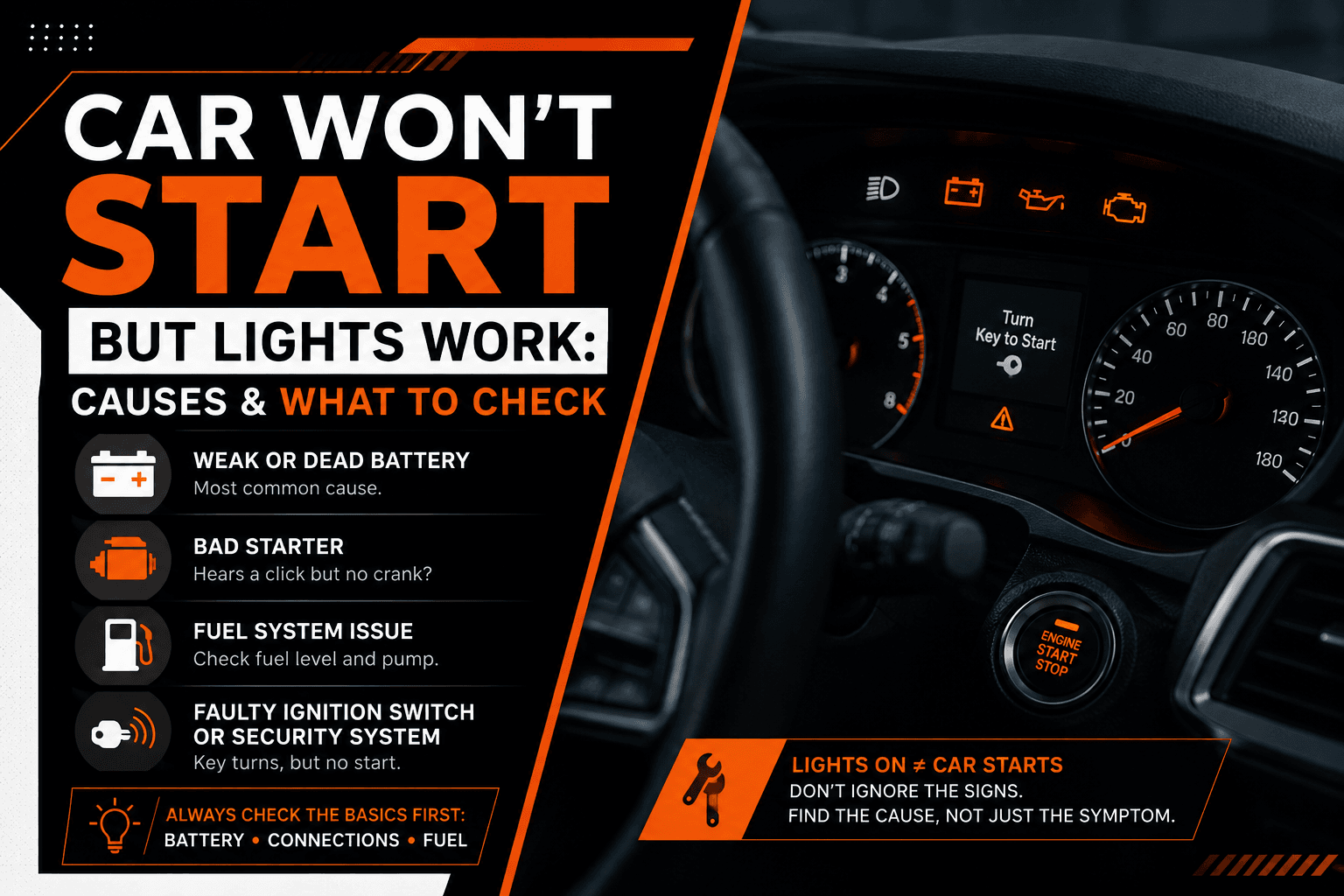
Why Won’t My Car Start if the Lights Still Work?
If your headlights, interior lights, radio, or dashboard turn on but the engine will not start, it can be confusing. The vehicle clearly has some electrical power, so why will the engine not turn over?
The answer is that starting a vehicle requires much more electrical power—and several more components—than turning on dashboard lights or accessories.
A car that will not start even though the lights work may have a problem involving the:
- Battery
- Battery terminals or cables
- Starter circuit
- Starter relay
- Ignition switch
- Fuses
- Grounds
- Wiring
- Sensors
- Security or immobilizer system
- ECU or other electronic control modules
The first clue is usually what happens when you turn the key or press the start button.
Does the engine crank? Does it click? Is there complete silence? Does the engine turn normally but never actually start?
Those symptoms point in different diagnostic directions.
Car Won’t Start vs. Car Won’t Crank: What’s the Difference?
These phrases are often used interchangeably, but they describe two different situations.
No-Crank Condition
A no-crank condition means the engine does not turn when you try to start the vehicle.
You may hear:
- One click
- Rapid clicking
- No sound at all
Or the dashboard may simply stay illuminated while nothing happens.
Potential causes can involve the battery, starter circuit, ignition switch, relays, wiring, grounds, security system, or electronic controls.
Cranks but Won’t Start
If the engine turns over normally but never begins running, that is a different type of problem.
Possible causes may involve:
- Fuel delivery
- Ignition
- Sensors
- Engine timing
- Electrical circuits
- Engine-control systems
- Security or immobilizer systems
Knowing whether the engine is cranking or not cranking is one of the most useful pieces of information you can provide when scheduling diagnostics.
Can the Battery Be Bad if the Lights Still Work?
Yes.
This is one of the most common misunderstandings about no-start problems.
Dashboard lights and interior electronics require much less electrical current than the starter motor.
A battery can sometimes have enough power to operate:
- Dashboard lights
- Radio
- Interior lights
- Power locks
- Headlights
while still being unable to deliver enough current to crank the engine.
The lights turning on therefore do not automatically prove the battery is good.
Battery voltage and performance may need to be tested under load rather than judged by whether the interior lights work.
Why Does My Car Click but Not Start?
The type of clicking can provide useful clues.
Rapid Clicking
Rapid clicking while trying to start often happens when there is not enough electrical power available to operate the starter properly.
Possible causes can include:
- Weak battery
- Poor battery terminal connection
- Corroded cable connection
- Bad ground
- Voltage drop in the starting circuit
The electrical system repeatedly tries to activate the starter circuit but cannot maintain enough voltage.
One Click
A single click can point in a different direction.
Possible causes may include:
- Starter or starter-solenoid problem
- Starter relay
- Wiring fault
- Poor electrical connection
- Voltage problem
The click alone does not prove which component is bad, so circuit testing may still be necessary.
Why Is There No Clicking at All When I Try to Start the Car?
If you turn the key or press the start button and hear absolutely nothing, the problem may be somewhere earlier in the starting circuit.
Possible causes can include:
- Ignition-switch problem
- Starter relay
- Blown fuse
- Wiring fault
- Brake-pedal or clutch-position switch
- Park/neutral safety circuit
- Security or immobilizer problem
- Control-module fault
- Loss of power or ground to part of the circuit
The dashboard can still illuminate because those systems may receive power through different circuits.
This is where electrical troubleshooting becomes especially useful.
Why Does My Car Have Power but Won’t Crank?
A vehicle having electrical power does not mean that power is successfully reaching the starter.
The starting circuit may involve several stages between pressing the start button and the starter motor actually turning the engine.
Depending on the vehicle, the request may pass through:
- Ignition switch or start button
- Brake or clutch switch
- Security or immobilizer system
- Vehicle control module
- Starter relay
- Starter circuit wiring
- Starter solenoid
- Starter motor
- Battery and ground circuits
A fault anywhere in that chain can result in lights and accessories working while the engine does nothing.
Can Loose Battery Terminals Cause the Lights to Work but the Car Not Start?
Yes.
A loose or corroded battery terminal can sometimes allow enough current for lights and accessories but fail when the starter demands significantly more power.
Possible signs include:
- Clicking while starting
- Lights dim dramatically when you try to start
- Vehicle starts sometimes but not others
- Electrical power cuts in and out
- Battery seems charged but vehicle will not crank
- Problems began after battery replacement
Battery terminals should be secure and free of excessive corrosion.
However, do not disconnect or work around the battery if you are unfamiliar with proper vehicle electrical safety.
Why Do My Dashboard Lights Go Dim When I Try to Start?
Dashboard or interior lights becoming noticeably dim when you attempt to start can indicate a significant voltage drop.
Possible reasons include:
- Weak battery
- Poor battery connection
- Battery cable problem
- Ground problem
- Excessive current draw in the starting circuit
A slight change in brightness can be normal on some vehicles. A dramatic loss of electrical power is more significant.
Testing voltage while the vehicle is attempting to crank can provide more useful information than checking the battery with no load.
What if the Lights Stay Bright but the Car Does Nothing?
If the lights stay bright and there is no crank or noticeable power drop, the starter may not be receiving the command or electrical path needed to operate.
Possible areas to investigate include:
- Starter relay
- Ignition switch
- Start-button circuit
- Brake or clutch switch
- Neutral-safety circuit
- Security system
- Wiring
- Fuses
- Module communication
This is a different pattern from a vehicle where everything becomes dim and the starter struggles to turn.
Can a Blown Fuse Stop a Car From Starting?
Yes.
Modern starting and engine-management systems rely on multiple protected electrical circuits.
A blown fuse affecting the starting, ignition, engine-control, fuel, or module circuit may prevent the vehicle from starting.
But if a replacement fuse immediately blows again, repeatedly installing new fuses is not the solution.
A fuse that keeps failing can indicate:
- Short circuit
- Damaged wiring
- Faulty electrical component
- Moisture
- Connector problem
- Circuit overload
The cause of the blown fuse should be identified before repeatedly replacing it.
Can a Bad Relay Cause a No-Start Problem?
Yes.
Relays allow lower-current control circuits to operate higher-current electrical components.
A starter relay or another engine-related relay can prevent the vehicle from starting if it fails or does not receive the correct control signal.
However, replacing a relay based only on the symptom can still be guesswork.
The circuit may instead have:
- Missing power
- Missing ground
- Wiring damage
- Faulty control signal
- Connector problem
- Module-related issue
Electrical testing can determine whether the relay is actually responsible.
Can a Bad Ground Cause a Car Not to Start?
Absolutely.
Ground connections are essential to vehicle electrical systems.
A poor ground can create:
- No-crank conditions
- Slow cranking
- Intermittent starting
- Flickering lights
- Multiple warning lights
- Communication faults
- Strange electrical behavior
Corrosion, loose fasteners, damaged cables, or previous repairs can create excessive resistance in a ground circuit.
A ground may appear visually connected while still failing electrically under load. If testing points to damaged wiring, poor grounds, loose connectors, or an electrical short, our car wiring repair in Milwaukee service focuses on tracing and repairing the affected circuit.
Can an Ignition Switch Cause the Car Not to Start?
Yes.
Depending on the vehicle, the ignition switch or start-button system helps initiate the starting process.
Possible symptoms of an ignition-related electrical problem can include:
- Nothing happens when the key is turned
- Vehicle starts only occasionally
- Accessories work but engine will not crank
- Vehicle cuts power unexpectedly
- Starting changes when the key position changes
Newer push-button vehicles may use different electronic controls than traditional ignition switches, so the exact diagnostic process varies by vehicle.
Can the Brake Pedal Switch Prevent a Push-Button Car From Starting?
Yes, on many push-button vehicles.
The vehicle may require confirmation that the brake pedal is pressed before allowing the engine to start.
If the brake-pedal switch or related circuit fails, the vehicle may not recognize that you are attempting the correct start procedure.
Similar problems can occur with clutch switches in manual-transmission vehicles.
This is one reason a modern no-start condition may involve sensors and switches rather than only the battery and starter.
Can the Park or Neutral Safety System Stop My Car From Starting?
Yes.
Automatic-transmission vehicles normally require the transmission to be recognized as being in Park or Neutral before starting is allowed.
If the related switch, sensor, wiring, or electronic communication has a problem, the vehicle may refuse to crank.
If a vehicle will not start in Park but starts in Neutral, that information can be useful during diagnosis.
Do not repeatedly move or operate a vehicle in an unsafe manner simply to test this yourself.
Can the Anti-Theft System Make the Car Not Start?
Yes.
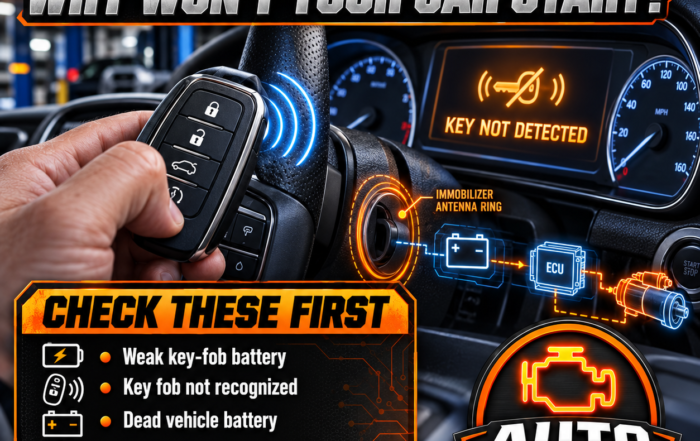
Modern vehicles often use immobilizer or anti-theft systems that communicate with the key, ignition system, body control module, and engine computer.
If the vehicle does not recognize the key or detects a security-system fault, it may prevent the engine from cranking or starting.
Possible signs include:
- Security light flashing
- Key warning message
- “Key Not Detected” message
- Vehicle cranks but immediately shuts off
- No-crank condition
- Problem begins after battery replacement or electrical work
Security problems can involve the key itself, but they can also involve wiring, voltage, control modules, or communication between systems.
Can a BCM Cause a Car Not to Start?
On some vehicles, the Body Control Module interacts with the ignition, security, key-recognition, and other body-electrical systems.
A BCM-related problem could potentially contribute to starting problems depending on the vehicle’s design.
However, a BCM-related trouble code does not automatically mean the module needs replacement.
The problem could involve:
- Power supply
- Grounds
- Wiring
- Connectors
- Communication network
- Another module
If diagnostic testing points toward the body computer, our BCM repair and diagnostics service can help determine whether the problem involves the module or the circuits connected to it.
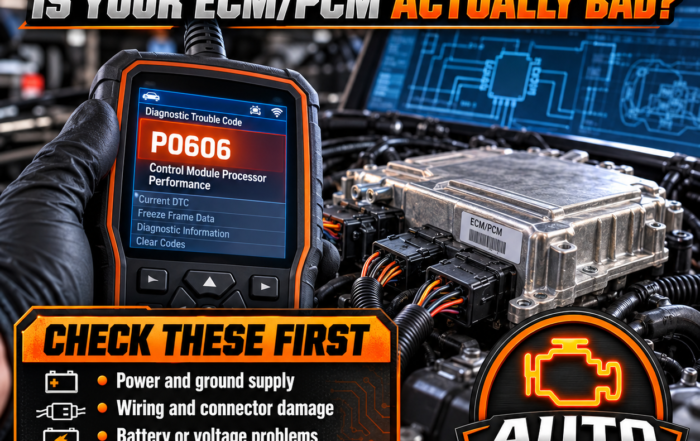
Can the ECU Cause a No-Start Condition?
Yes, although actual ECU failure is only one possibility.
The ECU depends on power, grounds, sensor inputs, wiring, and communication with other vehicle computers.
A no-start problem involving the engine-control system may actually be caused by:
- ECU power-supply fault
- Poor ECU ground
- Damaged wiring
- Connector problem
- Missing sensor signal
- Communication fault
- Security-system issue
- ECU itself
When testing points toward the engine-control system, further ECU diagnostics and repair can help identify whether the computer itself is responsible.
Why Won’t My Car Start After Replacing the Battery?
If the battery was just replaced and the vehicle still will not start, do not immediately assume the new battery is defective.
Possible causes include:
- Loose battery terminal
- Poor cable connection
- Ground problem
- Starter-circuit fault
- Blown fuse
- Security-system issue
- Starting problem unrelated to the original battery
- Electrical fault that caused the old battery to die
This last possibility is particularly important.
If the original battery repeatedly lost charge because of a parasitic drain or charging problem, replacing the battery may temporarily mask the symptom without fixing the cause.
Why Does My New Battery Keep Dying?
A new battery that repeatedly goes dead is a strong reason to investigate the rest of the electrical system.
Possible causes include:
- Parasitic electrical draw
- Charging-system fault
- Accessory staying powered
- Module failing to enter sleep mode
- Interior or exterior light staying on
- Wiring fault
- Poor electrical connection
A battery is an energy-storage device. If something continues draining that energy while the vehicle is parked, replacing the battery will not correct the drain.
What Is a Parasitic Battery Drain?
Vehicles normally continue using a small amount of electricity after they are turned off.
Modules may remain active for a short time before entering sleep mode, and systems such as alarms or memory functions may use a small amount of power.
A parasitic drain becomes a problem when an electrical circuit consumes more power than it should while the vehicle is parked.
Possible sources include:
- Electronic modules
- Relays
- Lighting
- Accessories
- Aftermarket equipment
- Wiring faults
- Switches
- Control circuits
A parasitic drain can create a frustrating pattern where the vehicle starts normally after driving but will not start after sitting overnight or for several days.
Why Does My Car Start Sometimes but Not Others?
Intermittent starting problems are often among the most frustrating electrical faults.
The vehicle may start perfectly ten times and then suddenly do nothing.
Possible causes include:
- Loose connection
- Failing relay
- Wiring problem
- Ground fault
- Starter-circuit issue
- Ignition switch
- Security-system problem
- Sensor or switch
- Module communication fault
The conditions surrounding the failure are extremely useful.
Take note of whether the problem happens:
- When the engine is hot
- When the vehicle is cold
- After rain
- After sitting overnight
- After driving for a long time
- Only in Park
- After using certain accessories
Intermittent faults often require more troubleshooting because the problem may not be present when the vehicle reaches the shop.
Why Won’t My Car Start After It Rains?
Moisture can sometimes expose existing electrical weaknesses.
Water intrusion may affect:
- Damaged wiring insulation
- Corroded connectors
- Electrical terminals
- Fuse or relay areas
- Sensors
- Modules
- Grounds
If starting problems consistently appear after rain, a car wash, or high humidity, tell the technician.
That pattern can help narrow the diagnostic search.
Why Won’t My Car Start After a Jump?
A successful jump start usually means additional electrical power helped the vehicle start, but it does not tell you why the vehicle lost power in the first place.
If the vehicle will not start again shortly afterward, possibilities include:
- Weak battery
- Charging problem
- Poor electrical connection
- Parasitic drain
- Battery cable fault
- Ground problem
Repeated jump starts should not become the long-term solution.
The underlying cause should be identified.
Why Does the Car Crank but Never Start?
If the engine turns over at a normal speed but never begins running, the battery and starter have at least done enough to crank the engine.
The diagnostic direction then changes.
Possible causes can involve:
- Fuel delivery
- Ignition
- Engine sensors
- Engine-control circuits
- Security system
- Wiring
- Mechanical problems
A cranks-but-won’t-start condition is different from a no-crank problem and may require different testing.
Can a Check Engine Light Help Diagnose a No-Start Problem?
Sometimes.
If the vehicle computer stored diagnostic trouble codes before or during the no-start condition, those codes can provide clues.
However, the absence of a check engine light does not mean the problem is not electrical.
Likewise, a stored code should not automatically determine which part gets replaced.
For a broader explanation of what dashboard warnings mean, see our guide to common dashboard warning lights.
What Should I Check First if My Car Won’t Start but the Lights Work?
Before assuming an expensive component has failed, pay attention to the symptoms.
Useful observations include:
- Do the headlights and dashboard lights come on?
- Do the lights become much dimmer when you try to start?
- Do you hear rapid clicking?
- Do you hear one click?
- Is there complete silence?
- Does the engine crank normally but fail to start?
- Is a security warning displayed?
- Does the vehicle start in Neutral but not Park?
- Did the problem begin after battery replacement?
- Has the battery recently needed a jump?
- Does the problem happen only sometimes?
These details can dramatically narrow down what needs to be tested.
What Happens During No-Start Electrical Diagnostics?
Testing depends on the symptoms, but a no-start electrical diagnosis may involve:
- Battery voltage and condition
- Battery terminal connections
- Voltage-drop testing
- Ground circuits
- Starter circuit
- Fuses and relays
- Ignition or start-request circuits
- Brake, clutch, or neutral-safety inputs
- Security-system information
- Wiring and connectors
- Stored diagnostic trouble codes
- Module communication
The goal is to determine where the starting process is being interrupted.
At our Milwaukee facility, auto electrical diagnostics start at $135. Our guide to auto electrical diagnostic costs in Milwaukee explains why testing time varies between straightforward and intermittent electrical faults.
When Should I Get a No-Start Problem Diagnosed?
Consider professional diagnostics when:
- Battery has already been replaced but the vehicle still will not start
- Vehicle repeatedly needs jump starts
- Car starts only sometimes
- Lights work but the starter does nothing
- Fuses repeatedly blow
- Security or key warnings appear
- Several dashboard warnings appear together
- Vehicle has unexplained battery drain
- Previous repairs did not fix the starting problem
The fact that your lights work is useful information—but it does not rule out an electrical problem.
Starting a modern vehicle requires the battery, wiring, grounds, switches, relays, sensors, security system, and electronic modules to work together. Finding where that process stops is much more reliable than guessing which part needs to be replaced.