What Does It Mean When the Battery Light Comes On While Driving?
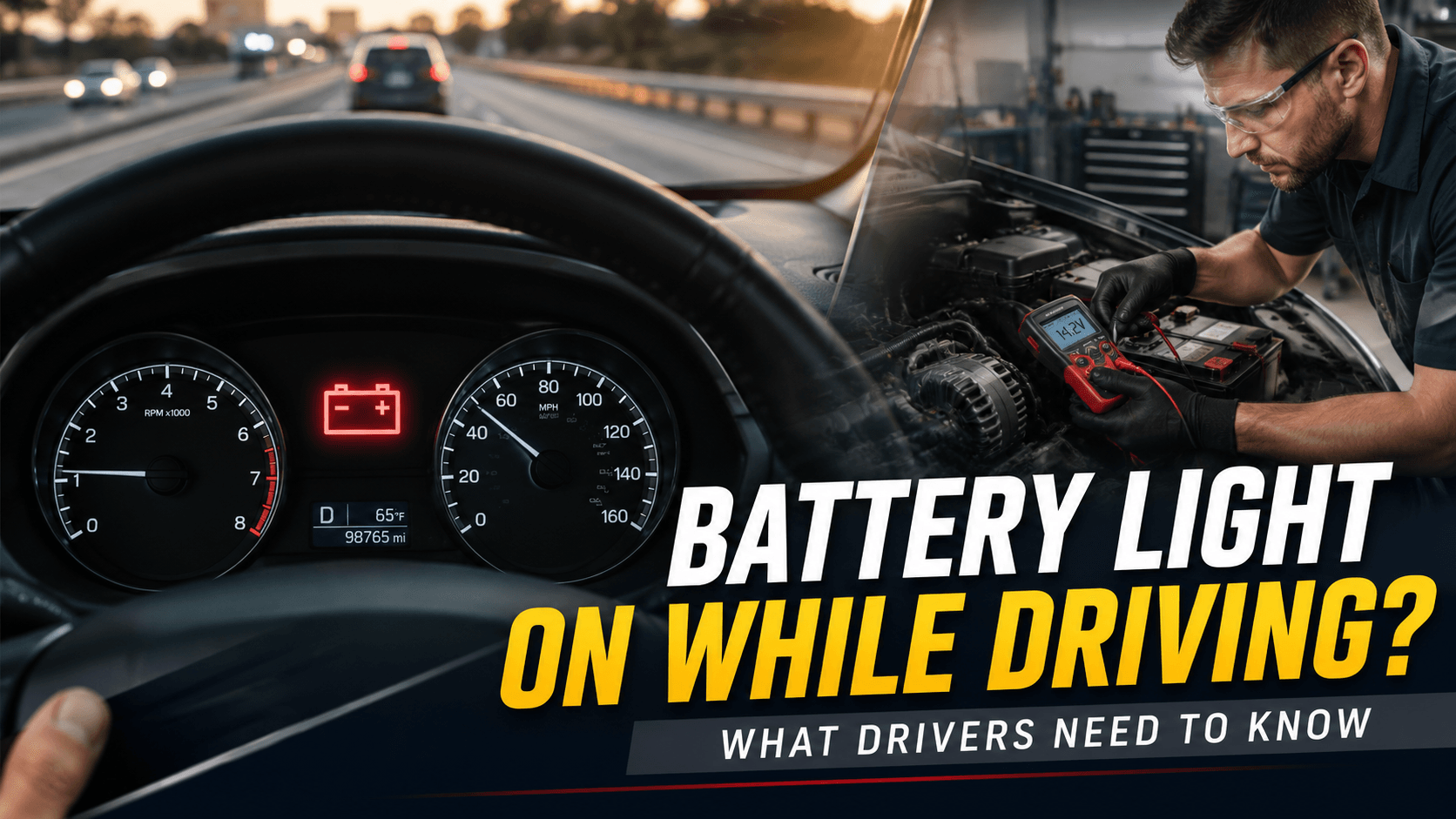
Seeing the red battery symbol appear while you are driving can be confusing. Your car may still be running normally, the headlights may still work, and you may have had no trouble starting the engine.
That does not mean the warning can be ignored.
A battery light that stays on while the engine is running usually means the vehicle has detected a problem with its charging or electrical system. The battery itself may be involved, but the warning can also appear because of an alternator problem, damaged wiring, a loose electrical connection, a belt problem, a poor ground, or another charging-system fault.
If the charging system stops supplying enough electrical power, the vehicle may begin relying on the electricity already stored in the battery. Once that stored power becomes too low, electrical systems can begin shutting down and the vehicle may eventually stall.
If your battery light is currently on, the safest approach is to find a safe place to stop and have the charging system inspected rather than assuming that replacing the battery will solve the problem.
For difficult charging and voltage problems, our auto electrical diagnostics in Milwaukee can help determine where the electrical system is actually failing.
Quick Answer: What Does the Battery Light Mean?
The battery-shaped dashboard warning does not automatically mean you need a new battery.
When the light stays on while the engine is running, the vehicle may not be producing, controlling, or delivering electrical power correctly.
Possible causes include:
- Alternator or charging-system problem
- Weak or damaged battery
- Loose or corroded battery connection
- Poor electrical ground
- Damaged charging-system wiring
- Belt or tensioner problem
- Voltage-regulation fault
- Fuse or fusible-link problem
- Intermittent electrical connection
- Vehicle computer or charging-control issue
The warning light tells you that the system needs attention. It does not identify which component should automatically be replaced.
What Should You Do If the Battery Light Comes On While Driving?
First, pay attention to what the rest of the vehicle is doing.
A battery light by itself is concerning. A battery light accompanied by dim headlights, heavy steering, rising engine temperature, multiple warning lights, electrical systems shutting down, or a burning smell can indicate a more urgent problem.
If the vehicle is still operating normally, avoid unnecessary electrical loads while moving toward a safe location. That may mean switching off nonessential accessories such as heated seats, phone chargers, or the radio.
Do not turn off headlights when they are needed for visibility and safety.
You should find a safe place to stop immediately if you notice significant changes in steering, braking, engine temperature, visibility, or vehicle control.
The important point is not to keep driving simply because the engine has not shut off yet. A charging problem can become progressively worse as available battery power falls.
7 Common Reasons the Battery Light Comes On
There is no single component responsible for every battery warning light. Modern charging systems involve multiple electrical and mechanical parts.
1. The Alternator Is Not Charging Correctly
The alternator supplies electrical power while the engine is running and helps replenish energy stored in the battery.
If alternator output becomes too low or unstable, the vehicle may detect that charging voltage is outside the expected range.
You might also notice:
- Headlights becoming dim
- Lights changing brightness
- Electronics restarting
- Multiple dashboard warnings
- A vehicle that eventually stalls
- Difficulty restarting after the engine is shut off
An alternator should be tested before replacement because a wiring, connection, belt, or control problem can create similar symptoms.
2. A Battery Connection Is Loose or Corroded
Even a good battery cannot function correctly if electricity cannot move reliably through its connections.
A loose terminal, corrosion, damaged cable, or high-resistance connection may interfere with the charging circuit.
The problem can sometimes be intermittent.
For example, the warning may appear:
- When driving over bumps
- During acceleration
- After hitting a pothole
- During cold weather
- After rain
- Only occasionally
That pattern can be especially important during diagnosis.
3. The Drive Belt Is Slipping, Loose, or Damaged
On many vehicles, a belt helps drive the alternator.
If the belt becomes loose, begins slipping, or breaks, the alternator may not operate correctly.
A belt-related problem may be accompanied by squealing, unusual engine-compartment noise, charging problems, or other symptoms depending on the vehicle’s design.
If the battery warning appears at the same time that the engine temperature begins climbing or another major system changes behavior, stop somewhere safe rather than continuing to drive.
4. There Is a Wiring or Ground Problem
Charging-system electricity must travel through wiring, connectors, cables, grounds, fuses, and other components.
A damaged connection somewhere in that path can create voltage problems even when the battery and alternator themselves are functional.
Possible issues include:
- Loose ground connections
- Corroded connectors
- Damaged battery cables
- Broken or partially broken wiring
- Previous wiring repairs
- Moisture inside connectors
- Excessive electrical resistance
- Poor engine or body grounds
These problems are one reason proper electrical testing matters.
Replacing an alternator will not repair a damaged wire.
5. The Battery Is Weak or Damaged
The battery can still contribute to the problem.
A deteriorated battery may have difficulty accepting or maintaining charge. Internal battery problems can also affect overall system voltage.
However, seeing a battery-shaped warning light does not prove that the battery is the cause.
That distinction matters because repeatedly replacing batteries can become expensive when the real problem is elsewhere.
If your bigger issue is a vehicle that repeatedly becomes dead after sitting overnight, read our guide explaining why a car battery keeps dying overnight.
That is a different problem from a charging warning that appears while driving.
6. A Fuse, Fusible Link, or Charging Circuit Has Failed
High-current electrical systems use protection devices to help protect circuits from damage.
A failed fuse, fusible link, damaged connector, or charging-circuit fault may interrupt the path between the charging system and battery.
Replacing the protection device without determining why it failed may not solve the problem.
This is particularly important if the same fuse continues failing.
7. The Vehicle’s Charging Control System Has a Problem
Modern charging systems can be more complicated than the battery-and-alternator systems found in older vehicles.
Depending on the vehicle, charging may be monitored or controlled by electronic modules and sensors.
A charging-related problem may therefore involve:
- Battery monitoring sensors
- Current sensors
- Voltage sensors
- Wiring
- Control modules
- Module communication
- Computer-controlled alternator operation
This is why simply measuring battery voltage once does not always reveal the entire problem.
Battery Light vs. Dead Battery: What’s the Difference?
These problems are related, but they are not the same.
| What Happens | Possible Area to Investigate |
|---|---|
| Battery dead after sitting overnight | Battery drain, light, relay, module, wiring |
| Battery light comes on while driving | Charging system, alternator, wiring, belt, battery |
| New battery keeps becoming dead | Charging issue or parasitic electrical draw |
| Headlights dim while driving | Charging voltage, wiring, grounds, connections |
| Battery light flickers | Intermittent charging or electrical connection |
| Multiple warnings appear with battery light | Low/unstable voltage, charging problem, wiring or communication |
| Car shuts off after battery light appears | Electrical power may have become too low |
| Car has lights but will not start | Battery, connection, starter circuit, security or other electrical issue |
If your vehicle has electrical power but the engine refuses to start, our guide to why a car won’t start even though the lights work covers that symptom in more detail.
Why Is My Battery Light On but the Car Runs Fine?
This is one of the most important situations to understand.
The car may continue operating normally for some time because the battery still contains electrical energy.
That does not mean the charging system has recovered.
As battery power continues to fall, you may begin noticing symptoms such as dim lights, warning messages, a restarting radio or display, reduced electrical functions, multiple warning lights, or eventually an engine stall.
How quickly that happens varies considerably by vehicle and by which systems are operating.
There is no reliable universal amount of driving time remaining once a charging problem begins.
Why Does My Battery Light Come On and Then Go Off?
An intermittent battery warning can be just as important as one that stays illuminated.
A light that appears and disappears may point toward a fault that only occurs under certain conditions.
For example, the problem may involve a loose connection, damaged wiring, an alternator that fails intermittently, a slipping belt, poor ground, heat-related electrical failure, or unstable charging voltage.
Pay attention to when it happens.
Does the warning appear at idle?
During acceleration?
When the AC is turned on?
After driving for 20 minutes?
Only when it rains?
When the headlights are operating?
That information can make an intermittent electrical problem much easier to reproduce and diagnose.
Why Does the Battery Light Flicker While Driving?
A flickering battery warning usually means something in the charging or electrical system is changing rather than remaining consistently normal.
The cause may involve fluctuating voltage, an intermittent connection, alternator output, wiring movement, a ground problem, belt movement, or another electrical fault.
If your headlights or dashboard illumination also flicker, the problem may be affecting more than the warning-light circuit.
Our vehicle lighting electrical repair page explains additional electrical problems involving flickering headlights, interior lights, connectors, wiring, switches, and lighting circuits.
Battery Light On After Replacing the Battery
Replacing the battery does not repair the rest of the charging system.
If the battery light remains illuminated after a new battery has been installed, the vehicle may still have a problem involving the alternator, charging wiring, battery connections, grounds, belt, charging control system, or another electrical component.
It is also possible for a newly installed battery to lose its charge if the vehicle does not recharge it correctly.
Instead of immediately replacing the battery again, determine whether the battery is receiving the proper charging power.
Battery Light Came On After a Jump Start
A jump start supplies enough external power to help start a vehicle with a discharged battery.
It does not determine why the battery became discharged.
If the battery light stays on after a jump start, the vehicle may still have a charging-system problem.
If the car repeatedly needs to be jump-started, two different situations should be considered:
The vehicle may not be charging the battery properly while running, or something may be draining the battery while the vehicle is parked.
Our guide to how car electrical problems are diagnosed explains how technicians separate these types of problems.
Battery Light and Multiple Dashboard Warning Lights
Modern vehicles contain many electronic modules that depend on stable electrical voltage.
When system voltage becomes unstable, several vehicle computers may begin reporting faults at approximately the same time.
A driver may suddenly see the battery warning together with:
- ABS warning
- Traction-control warning
- Power-steering warning
- Check-engine light
- Airbag or SRS light
- Stability-control warning
- Driver-assistance unavailable message
- Other system warnings
This does not necessarily mean eight separate parts failed simultaneously.
One voltage, power, ground, charging, or communication problem can sometimes affect several systems.
Read our full guide if you are experiencing multiple dashboard warning lights at the same time.
What If the Battery Light Comes On and the Car Shuts Off?
A vehicle that stalls after the battery warning appears should be taken seriously.
If the charging system stopped supplying enough electrical power, the vehicle may have continued operating until battery voltage became too low for important electronic systems.
However, an engine can also shut off for reasons unrelated to the charging system.
That is why the sequence of symptoms matters.
Tell the technician exactly what happened:
“The battery light appeared first, the headlights became dim, several warning lights came on, and then the engine stopped.”
That provides much more useful diagnostic information than simply saying:
“My car died.”
Is It Safe to Drive With the Battery Light On?
It depends on what is happening with the vehicle, but the warning should not be treated as something to ignore until your next scheduled service.
If charging has stopped, the vehicle may eventually run out of usable electrical power.
Move toward a safe stopping location and arrange for the problem to be inspected.
Stop driving as soon as safely possible if you experience serious symptoms involving steering, braking, rising engine temperature, smoke, burning odors, essential lighting, major electrical failure, or loss of vehicle control.
Also check your vehicle’s owner’s manual because dashboard-warning instructions can differ between manufacturers and vehicle types.
Do Not Use the Old “Disconnect the Battery” Alternator Test
You may see advice online telling you to disconnect a battery cable while the engine is running to determine whether the alternator works.
That is not an appropriate diagnostic method for modern vehicles.
Modern cars contain sensitive electronic modules, charging controls, communication networks, sensors, and computers.
Proper testing should measure the electrical system without unnecessarily disconnecting components while the engine is operating.
How Is a Battery Warning Light Diagnosed?
Finding the cause usually requires testing more than one component.
A proper diagnosis may include checking the battery’s condition, charging-system output, battery connections, cables, grounds, wiring, belt condition, fuses, connectors, voltage behavior, stored trouble codes, and electronic charging controls.
The technician should also consider exactly when the warning occurs.
An intermittent warning that appears only when the vehicle is hot may require a different diagnostic approach than one that stays illuminated immediately after startup.
The objective is to determine why charging-system performance is abnormal before replacing parts.
That same approach is used throughout professional auto electrical diagnostics and repair.
Battery Light Diagnostics in Milwaukee, WI
If your battery warning light is on, your battery repeatedly becomes discharged, your headlights are flickering, or several dashboard warnings are appearing together, Auto Electrical & Airbags provides electrical diagnostics at our Milwaukee shop.
We diagnose problems involving charging systems, wiring, batteries, electrical grounds, fuses, relays, connectors, modules, warning lights, intermittent electrical failures, no-start conditions, and other difficult automotive electrical problems.
Electrical diagnostics start at $135 at:
Auto Electrical & Airbags
2636 S 32nd St
Milwaukee, WI 53215
(414) 345-7568
The goal is not to replace the battery, alternator, or another component based only on a dashboard symbol.
The goal is to determine what caused the warning to appear.
Frequently Asked Questions
Does the battery light mean my battery is bad?
Not necessarily. The battery-shaped warning commonly relates to the charging system as a whole. The battery, alternator, wiring, belt, connections, grounds, fuses, sensors, or charging controls may need to be tested.
Can a bad alternator cause the battery light?
Yes. An alternator that is not providing the expected electrical output can cause a charging-system warning, but testing is needed before concluding that the alternator itself has failed.
Why is my battery light on with a brand-new battery?
A new battery does not correct problems involving the alternator, charging wiring, grounds, belt, battery cables, connectors, or electronic charging controls.
Can a loose battery terminal turn on the battery light?
A poor battery or charging-system connection can interfere with electrical power and charging performance. Loose or corroded terminals should be inspected.
Why does my battery light only come on sometimes?
Intermittent warnings may involve fluctuating alternator output, wiring movement, loose connections, belt problems, heat-related faults, poor grounds, or electronic charging-system issues.
Why did other dashboard lights come on after the battery light?
Low or unstable system voltage can affect several electronic modules. This may cause multiple systems to report warnings even when they did not all fail independently.
Can a car shut off because of a charging problem?
Yes. If a vehicle is no longer producing sufficient electrical power and stored battery energy becomes depleted, important electronic systems may eventually stop operating.
Should I replace the alternator when the battery light comes on?
Not without testing. An alternator problem is one possibility, but wiring, battery connections, grounds, belts, fuses, battery condition, and charging controls can produce similar symptoms.
Don’t Guess at a Charging-System Problem
A glowing battery symbol may look simple, but the electrical system behind that warning is not.
The problem could be the battery. It could be the alternator. It could also be wiring, a connection, a belt, a ground, a fuse, a sensor, or another part of the charging system.
If your battery light stays on, flickers, appears with other warning lights, or is followed by electrical problems, have the system tested before replacing more parts.
Milwaukee drivers can contact Auto Electrical & Airbags or call (414) 345-7568 to schedule electrical diagnostics.