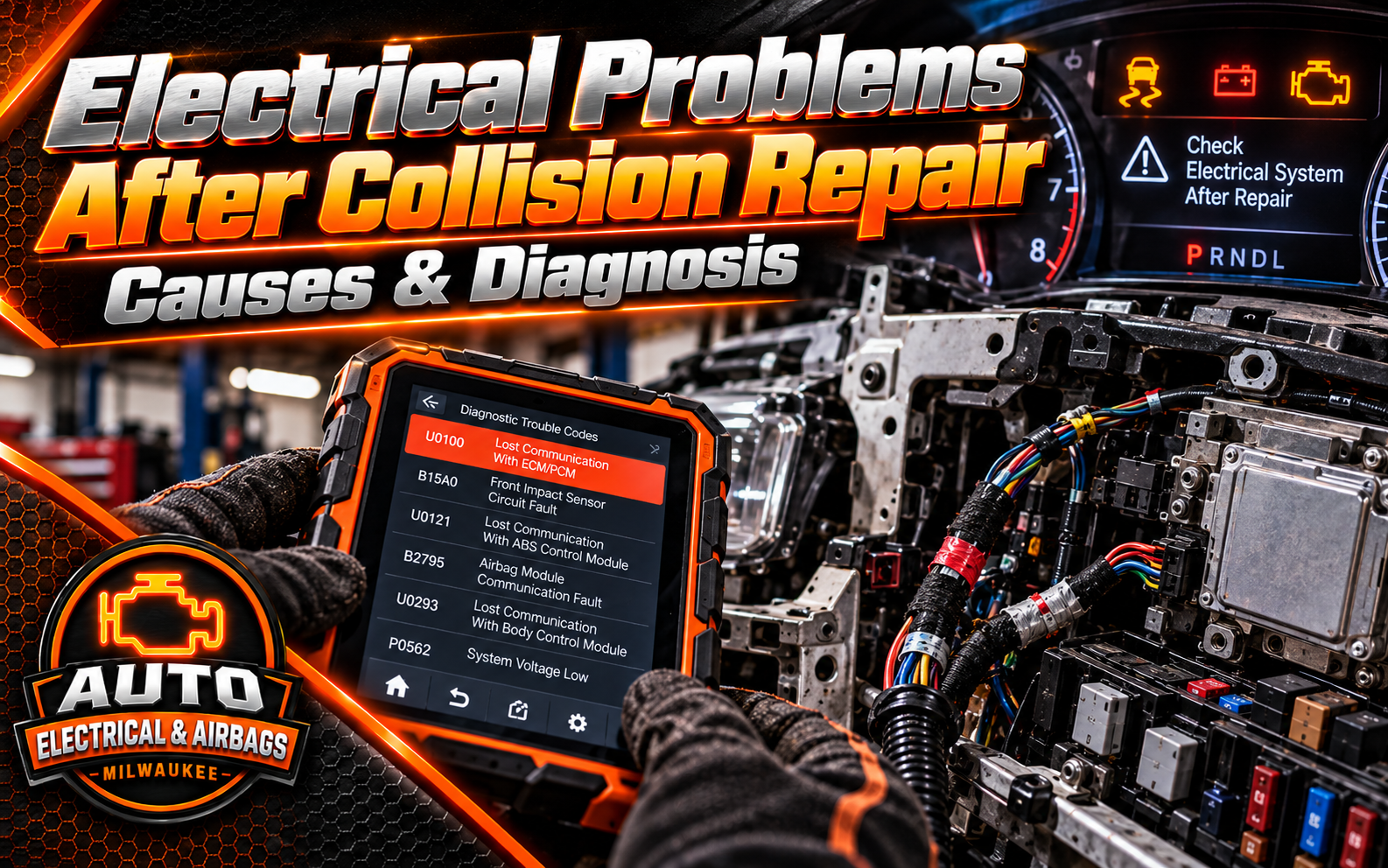
The bodywork looks finished. The damaged panels have been replaced. The paint matches. The vehicle drives again.
Then something electrical starts acting strangely.
The airbag light stays on. Blind-spot monitoring suddenly says it is unavailable. Parking sensors stop working. Several dashboard warning lights appear. A headlight, power window or door lock works intermittently. The battery begins dying. In some cases, the vehicle may even develop starting or communication problems.
Electrical problems after a collision are not unusual because modern vehicles contain wiring, sensors, modules and communication networks throughout the body.
An impact does not have to directly destroy an electronic control module to create an electrical fault.
A harness can be stretched. A connector can become partially unseated. A ground point can be damaged. Wiring may be pinched during reassembly. Sensors can be moved or replaced. Moisture can enter damaged areas. Electronic systems may also require calibration, programming or additional repairs after collision work.
This guide explains why electrical problems can appear after an accident or collision repair, which symptoms may point to hidden wiring or electronic damage, and how technicians determine whether the problem comes from wiring, connectors, sensors, grounds or vehicle modules.
Quick Answer: Why Can Electrical Problems Start After Collision Repair?
Electrical problems after collision repair can be caused by damage from the original impact or by electrical components that were disturbed while the vehicle was disassembled and repaired.
Possible causes include:
- Crushed or stretched wiring
- Pinched wiring during reassembly
- Loose electrical connectors
- Broken connector locks
- Poor ground connections
- Damaged sensors
- Damaged electronic modules
- Water intrusion
- Incorrect replacement parts
- Missing programming or calibration
- Airbag and SRS faults
- CAN bus communication problems
- Damaged fuse boxes or power distribution circuits
The exterior of a vehicle can look completely repaired while an electrical problem remains underneath.
Why Modern Collision Repairs Involve More Than Body Panels
Older vehicles contained far fewer electronic systems throughout the body.
Modern vehicles can place sensors, wiring and electronic modules in:
- Front bumpers
- Rear bumpers
- Doors
- Seats
- Steering columns
- Roof areas
- Quarter panels
- Trunk areas
- Engine compartments
- Dashboards
- Mirrors
A relatively minor impact may occur near components associated with:
- Airbag systems
- Blind-spot monitoring
- Parking sensors
- Lighting
- ABS
- Electronic power steering
- Keyless entry
- Door electronics
- Cameras
- Radar systems
- Vehicle communication networks
That means collision diagnosis sometimes continues after the visible structural and cosmetic repairs are finished.
What Electrical Problems Can Appear After an Accident?
Symptoms vary depending on where the vehicle was damaged.
Possible post-collision electrical symptoms include:
- Airbag or SRS warning light
- ABS light
- Traction-control warning
- Blind-spot monitoring unavailable
- Parking sensor warnings
- Power steering warning
- Check engine light
- Battery warning
- Multiple warning lights appearing together
- Headlight or taillight problems
- Turn signal problems
- Power windows not working
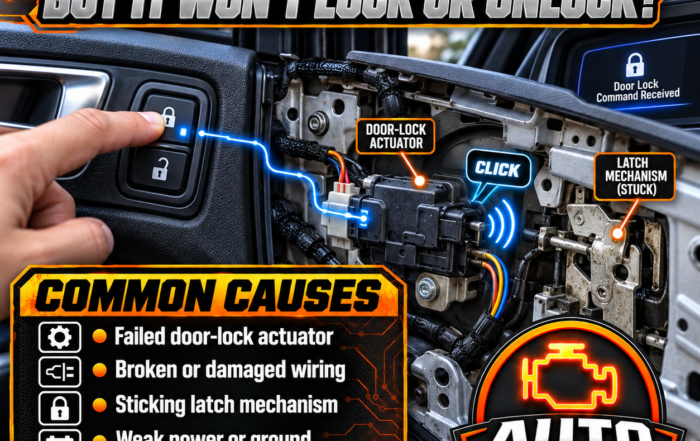
- Door locks acting strangely
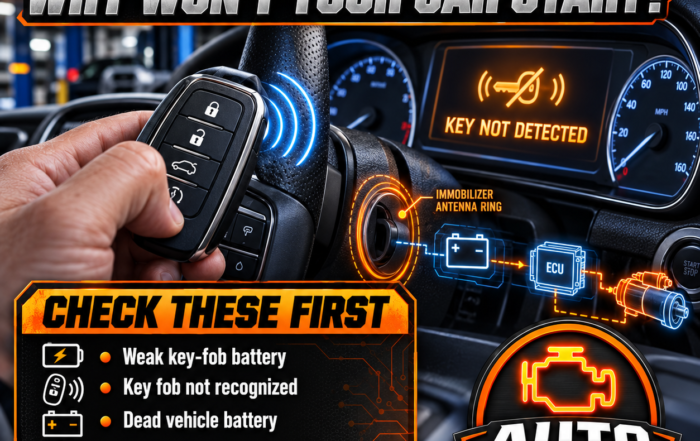
- Keyless entry problems
- Instrument cluster issues
- Battery drain
- No-start or intermittent starting
- Diagnostic communication codes
- Scanner unable to communicate with a module
Some problems begin immediately after the collision.
Others may appear days or weeks later.
Collision Damage Can Affect Wiring Without Breaking It Completely
Automotive wiring harnesses run through much of the vehicle.
During a collision, wiring can be:
- Stretched
- Crushed
- Pinched
- Cut
- Scraped
- Pulled from connectors
- Bent sharply
- Pressed against damaged metal
The wire may not completely separate.
Instead, internal strands can be damaged while the insulation still appears intact.
That can create an intermittent electrical problem.
For example, the circuit may work when the vehicle is parked but lose connection when:
- The vehicle hits a bump
- The body flexes
- Temperature changes
- A door opens
- A seat moves
- A harness shifts
This is one reason post-collision electrical faults can be difficult to reproduce.
Wiring Can Also Be Damaged During Reassembly
Not every post-collision problem comes directly from the impact.
Collision repair frequently requires removing and reinstalling parts of the vehicle.
Depending on the repair, technicians may remove:
- Bumpers
- Headlights
- Taillights
- Seats
- Interior trim
- Doors
- Dash components
- Sensors
- Wiring harness retainers
- Modules
A wire can accidentally become pinched between two panels or brackets during reassembly.
A connector may look connected but not be fully seated.
A harness clip may be installed incorrectly and allow wiring to rub against a sharp surface.
This does not automatically mean the collision repair was careless.
It simply means recent repair history is extremely useful when diagnosing a new electrical problem.
If a symptom started immediately after bodywork, tell the technician exactly which areas of the vehicle were repaired.
Loose or Damaged Electrical Connectors Can Create Intermittent Problems
Modern vehicles contain a large number of electrical connectors.
During collision repair, connectors may be unplugged to remove damaged parts or gain access to surrounding components.
Problems can occur when a connector has:
- A bent terminal
- A pushed-back terminal
- A loose pin
- A broken locking tab
- Corrosion
- Water inside it
- Heat damage
- Incomplete engagement
A loose connection may cause a circuit to work sometimes and fail at other times.
That can produce symptoms such as:
- Warning lights appearing and disappearing
- Sensor unavailable messages
- Power accessories failing intermittently
- Module communication faults
Connector condition should therefore be part of the diagnosis when a new electrical problem begins after a repair.
Ground Connections Can Be Disturbed During Collision Repair
Electrical circuits need both power and a reliable ground.
Vehicle ground connections are attached to the body and chassis in many locations.
Collision repair can involve areas near these connections.
A ground can become:
- Loose
- Corroded
- Damaged
- Painted over
- Installed on an unsuitable surface
- Left disconnected
- Reattached incorrectly
Poor grounding can produce surprisingly broad symptoms.
Possible effects include:
- Dim or flickering lights
- Communication faults
- Warning lights
- Intermittent accessories
- Module failures
- No-start problems
- Sensor faults
This is why electrical diagnosis should include voltage, power and ground testing—not only code reading.
Our auto electrical diagnostics and repair service focuses on identifying where an electrical circuit is actually failing before parts are replaced.
Why Can Multiple Warning Lights Appear After a Collision?
Several warning lights after an accident do not necessarily mean several unrelated components failed.
Modern vehicle systems share information.
For example, systems may exchange data involving:
- Vehicle speed
- Wheel speed
- Steering angle
- Brake status
- Engine status
- Occupant information
- Sensor information
If one important sensor, module or communication circuit stops functioning, several other systems may notice that data is missing.
That can lead to several warnings appearing together.
If your vehicle has numerous lights on at the same time, see our guide to multiple dashboard warning lights.
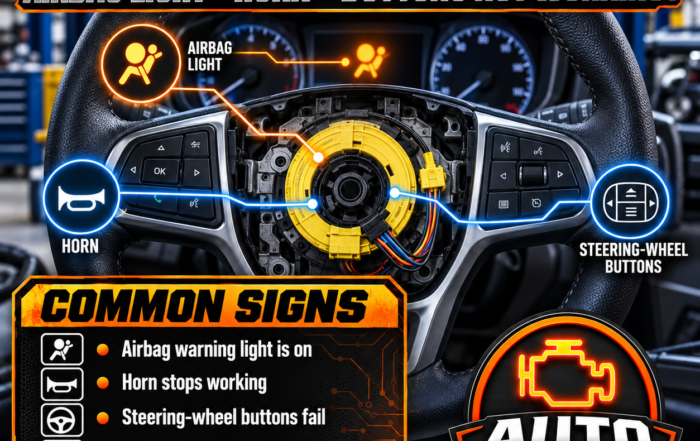
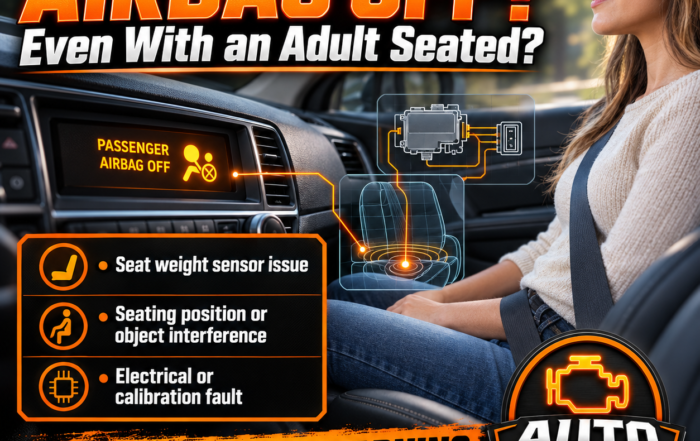
Airbag and SRS Problems After Collision Repair
The Supplemental Restraint System deserves special attention after a collision.
A crash can affect components such as:
- Airbags
- Seat belt pretensioners
- Impact sensors
- Occupancy sensors
- SRS module
- Seat wiring
- Clockspring circuits
- SRS wiring and connectors
The visible body repair does not automatically resolve these faults.
An airbag warning may remain because of:
- Stored collision-related faults
- Damaged wiring
- Activated pretensioner
- Sensor problem
- Connector problem
- Module issue
- Incomplete repair
- Incorrect replacement part
An SRS warning should be properly diagnosed rather than simply cleared.
For a deeper explanation, see our guide to airbag module reset vs. replacement after a crash.
You can also learn more about our airbag repair and diagnostics in Milwaukee.
Blind-Spot Monitoring Problems After Body Repair
Blind-spot monitoring systems commonly use sensors installed near the rear corners of a vehicle.
Depending on the vehicle, radar modules may be installed behind or near the rear bumper.
This makes rear collision repair particularly relevant.
A blind-spot problem after repair may involve:
- Sensor damage
- Wiring damage
- Connector problems
- Sensor mounting
- Calibration
- Incorrect bumper-related component
- Communication issue
A warning saying Blind Spot Monitoring Unavailable does not automatically mean the radar module itself failed.
The surrounding wiring, mounting, power and communication system also need to be considered.
Our guide to blind-spot monitoring unavailable warnings explains this system in more detail.
Parking Sensors May Stop Working After Bumper Repair
Parking sensors are commonly installed directly in vehicle bumpers.
A collision or bumper replacement can therefore affect:
- Sensor position
- Sensor wiring
- Connectors
- Mounting brackets
- Sensor orientation
- Paint thickness around certain sensor types
- Control-module communication
If a parking warning appears immediately after bumper repair, that repair history is useful diagnostic information.
Headlights and Exterior Lighting Can Develop Electrical Problems
Front- or rear-end collision repairs often involve exterior lighting.
Modern headlights can contain far more electronics than traditional bulbs.
Depending on the vehicle, a headlamp assembly may include:
- LED drivers
- Control modules
- Motors
- Leveling systems
- Daytime running light electronics
- Turn-signal electronics
A lighting problem after collision repair can result from more than a burned-out bulb.
Possible causes include:
- Damaged wiring
- Connector problem
- Incorrect assembly
- Module problem
- Missing power
- Ground fault
- Configuration issue
The circuit should be tested before the most expensive component is assumed to have failed.
Why Can an ABS or Traction-Control Light Appear After a Collision?
ABS and traction-control systems depend heavily on sensor information.
A collision near a wheel, suspension component or wiring harness can potentially affect:
- Wheel-speed sensor
- Sensor wiring
- Wheel bearing-related tone ring
- Connectors
- Steering-angle information
- Module communication
A fault in one wheel-speed signal may result in more than just an ABS warning.
Traction control and stability-control functions may also be disabled because they depend on the same data.
This is why multiple warnings can sometimes trace back to one fault.
Can a Collision Cause CAN Bus Communication Problems?
Yes.
Modern vehicle modules communicate over networks such as the CAN bus.
Communication wiring runs through the vehicle just like other electrical circuits.
Collision damage can:
- Break communication wires
- Crush a harness
- Damage a connector
- Disconnect a module
- Damage module power or ground
- Affect a gateway or network component
A module that loses power may also disappear from the network even if the communication wires themselves are intact.
Other modules can then store lost communication codes.
For more information, see our guide to CAN bus communication faults.
Can Collision Damage Cause a Battery Drain?
It can.
A battery drain after collision repair may result from a circuit or module remaining active when it should shut down.
Possible causes include:
- Lighting circuit staying powered
- Damaged switch
- Module remaining awake
- Door or latch input problem
- Wiring short
- Added repair equipment or accessory wiring
- Communication network remaining active
A parasitic battery drain should be measured and isolated rather than assumed to be caused by the battery itself.
Replacing the battery may temporarily hide the problem without fixing the electrical draw.
Why Can a Car Have Electrical Problems Weeks After an Accident?
Not all collision-related electrical damage appears immediately.
Consider a wire that was partially damaged during impact.
It may still carry current initially.
Over time:
- Vibration can worsen the break
- Moisture can enter damaged insulation
- Corrosion can spread
- A loose terminal can move
- A harness can rub against metal
The vehicle may therefore appear repaired for several weeks before the electrical fault becomes noticeable.
This is especially possible with intermittent circuits.
Water Intrusion After Collision Damage
Collision damage can change the way water is kept outside the vehicle.
Even after body repairs, water can sometimes enter through an area involving:
- Weather seals
- Body seams
- Trunk seals
- Door seals
- Lamp assemblies
- Windshield areas
- Drainage paths
Water may then reach electrical components.
Possible symptoms include:
- Warning lights
- Battery drain
- No-start
- Module communication codes
- Lighting problems
- Power-window issues
- Corroded connectors
If problems occur primarily after rain or a car wash, our guide to car electrical problems after rain explains why moisture-related faults can be so intermittent.
Why Replacing the Component Named in a Code May Not Fix the Problem
This is especially important after a collision.
Suppose a fault code mentions a sensor.
That does not prove the sensor itself is bad.
The problem could be:
- Broken sensor wire
- Missing sensor power
- Poor ground
- Damaged connector
- Network communication problem
- Incorrect sensor installation
- Wrong replacement part
The diagnostic code identifies the system where a problem was detected.
Testing determines what actually failed.
Random parts replacement can become particularly expensive when electronic modules, radar sensors or safety components are involved.
How Are Electrical Problems After Collision Repair Diagnosed?
The diagnostic process depends on the symptoms, but several steps are commonly useful.
Review the Collision and Repair History
Technicians should know:
- Where was the vehicle hit?
- How severe was the collision?
- Which body panels were replaced?
- Was a bumper removed?
- Were seats removed?
- Were airbags deployed?
- Were doors repaired?
- Were headlights or taillights replaced?
- Did the problem begin before or after the repair?
This information helps narrow the search area.
Perform a Complete Vehicle Scan
Modern vehicles may store diagnostic information in multiple modules.
A full-system scan can reveal faults involving:
- SRS
- ABS
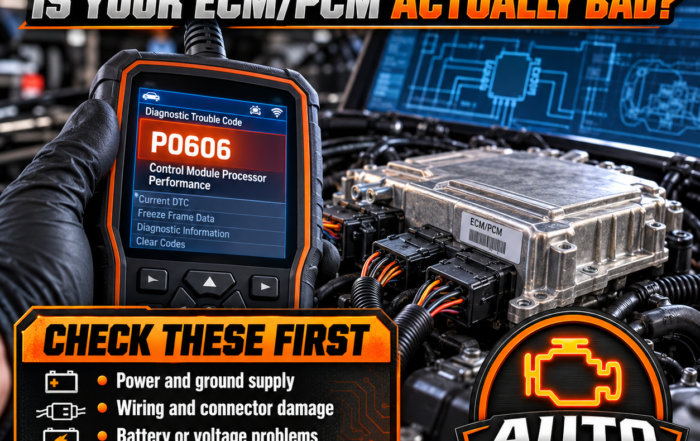
- BCM
- ECM
- Power steering
- Blind-spot system
- Parking system
- Door modules
- Lighting systems
- Communication networks
The pattern of codes can be more important than one individual code.
Determine Which Faults Are Current
Collision repair can leave historical codes from when components were unplugged.
For example, a module may have stored a communication fault while the vehicle was disassembled.
Technicians need to determine which faults remain active after the repair.
Inspect Recently Repaired Areas
The area involved in the collision should receive particular attention.
Technicians may look for:
- Pinched harnesses
- Loose connectors
- Damaged terminals
- Missing grounds
- Incorrect routing
- Corrosion
- Water intrusion
- Broken sensor mounts
Test Power and Ground
If a module or sensor does not communicate, its power and ground supplies should be verified.
A component without proper power cannot operate normally.
Test the Circuit
Depending on the fault, circuit diagnosis may involve:
- Voltage testing
- Ground testing
- Continuity checks
- Voltage-drop testing
- Communication-network testing
- Connector inspection
- Wiring-diagram review
The goal is to determine where the electrical path stops working correctly.
Electrical Problem After Collision Repair vs. Failed Component
| Symptom | Possible Collision-Related Electrical Cause | Possible Component Failure |
|---|---|---|
| Warning light after body repair | Wiring, connector, ground | Yes |
| Blind-spot system unavailable | Wiring, mounting, calibration | Sensor possible |
| Airbag light after accident | Wiring, pretensioner, sensor, crash-related fault | Module possible |
| Headlight not working after front repair | Connector, ground, wiring | Lamp/module possible |
| Multiple warning lights | Shared power, ground or communication issue | Module possible |
| Battery drain after repair | Wiring or module staying awake | Battery possible but should be tested |
| Intermittent fault over bumps | Loose connector or damaged harness | Component possible |
| No communication with a module | Power, ground, network wiring | Module possible |
Symptoms provide clues.
They do not replace testing.
Should You Return to the Collision Repair Shop?
If a new problem appeared immediately after collision repair, contact the repair facility and explain the symptom.
Provide specific information such as:
- Which warning appeared
- When it started
- Whether it is constant
- Whether it changes with rain or movement
- Which part of the vehicle was repaired
The collision shop may be able to identify whether the problem relates directly to the repair.
If the issue requires more detailed electronic or wiring diagnosis, an automotive electrical specialist may need to test the system.
When Should an Electrical Specialist Diagnose the Vehicle?
Consider electrical diagnosis when:
- Warning lights remain after collision repair
- Several systems fail together
- A module will not communicate
- The vehicle has intermittent electrical faults
- Wiring damage is suspected
- A battery begins dying after the accident
- Blind-spot or parking systems stop working
- Airbag or SRS faults remain
- The vehicle sometimes will not start
- Previous part replacement did not solve the problem
Modern collision-related electrical problems often involve finding a failure inside a circuit rather than simply replacing a visible damaged component.
Post-Collision Electrical Diagnostics in Milwaukee
At Auto Electrical & Airbag Specialist in Milwaukee, we diagnose electrical problems involving vehicle wiring, electronic modules, grounds, connectors and communication faults.
Post-collision electrical problems may involve:
- Damaged wiring
- Airbag and SRS faults
- Module communication problems
- ABS-related electronics
- Blind-spot monitoring
- Lighting
- Body electronics
- Power and ground circuits
- Battery drains
If you need help finding the source of an electrical problem after an accident or body repair, learn more about our auto electrical diagnostics in Milwaukee.
For damaged circuits, connectors or harnesses, see our car wiring repair services.
Auto Electrical & Airbag Specialist
2636 S 32nd St
Milwaukee, WI 53215
(414) 345-7568
Frequently Asked Questions About Electrical Problems After Collision Repair
Can a car accident cause electrical problems?
Yes. A collision can damage wiring, connectors, sensors, grounds and electronic modules even when the damage is not immediately visible.
Why did warning lights come on after body repair?
Warning lights may appear because a sensor, connector, wiring circuit, module or calibration-related issue remains after the repair. A complete scan can help identify which systems are reporting faults.
Can a bumper replacement cause electrical problems?
It can. Modern bumpers may contain parking sensors, radar systems, wiring and related electronic components. Problems may result from sensor mounting, damaged wiring, connectors or calibration requirements.
Can collision repair cause the airbag light to stay on?
Yes. An SRS warning after collision repair may involve crash-related faults, activated restraint components, sensors, wiring, connectors or the airbag control module.
Can an accident damage wiring without breaking the wire?
Yes. Wiring can be stretched, crushed or partially broken internally while the outside insulation still appears intact.
Can a loose ground cause several warning lights after an accident?
Yes. Poor grounds can affect several electrical systems and modules, potentially causing multiple warnings or communication faults.
Can a collision cause CAN bus faults?
Yes. Communication wiring, module power supplies, grounds and connectors can all be damaged in a collision and interrupt module communication.
Why does my electrical problem happen only sometimes after the repair?
Intermittent problems may come from partially damaged wiring, loose terminals, moisture, vibration or connectors that lose contact only under certain conditions.
Can a collision cause the battery to keep dying?
It can. Damaged circuits, incorrect inputs or modules that fail to enter sleep mode can create parasitic battery drain.
Does a warning light after collision repair mean the sensor needs replacement?
Not necessarily. The fault may involve wiring, a connector, power, ground, calibration or communication rather than the sensor itself.
Should electrical codes simply be cleared after body repair?
Codes may need to be cleared after appropriate repairs, but clearing codes should not replace diagnosis of an active fault.
Can an electrical specialist diagnose problems left after body repair?
Yes. When bodywork is complete but wiring, module, sensor or communication problems remain, automotive electrical diagnosis can help locate the underlying fault.
The Bottom Line
A vehicle can look completely repaired after a collision and still have an unresolved electrical problem.
Modern vehicles contain wiring, sensors, modules and communication networks throughout the body, so accident damage can affect far more than sheet metal and paint.
Post-collision electrical problems may come from:
- Damaged wiring
- Pinched harnesses
- Loose connectors
- Poor grounds
- Sensor problems
- Airbag-system faults
- Water intrusion
- Network communication problems
- Electronic modules
The important question is not simply:
“Which warning light is on?”
It is:
“What changed during the collision or repair that is preventing this electrical system from operating correctly?”
Following that question through proper circuit testing is often the most effective way to find the real problem without unnecessary parts replacement.