After a collision, an airbag warning light may stay on even after the visible body damage has been repaired.
A scan may show crash-related codes. The airbag control module may contain stored crash data. Seat belt pretensioners may have activated. One or more airbags may have deployed.
At that point, vehicle owners often hear two very different recommendations:
“The airbag module needs to be reset.”
or
“The airbag module needs to be replaced.”
The problem is that these statements are often treated as if they describe the entire Supplemental Restraint System, or SRS.
They do not.
The airbag control module is only one part of a larger safety system that can include airbags, impact sensors, seat belt pretensioners, occupancy sensors, wiring, connectors, clocksprings and other components.
Resetting or replacing the control module does not automatically restore the rest of the system.
This guide explains what an airbag module does, what people mean by “crash data,” when module reset or replacement may be possible, what other components need to be evaluated after a collision, and why the correct repair procedure depends on the specific vehicle.
What Is an Airbag Control Module?
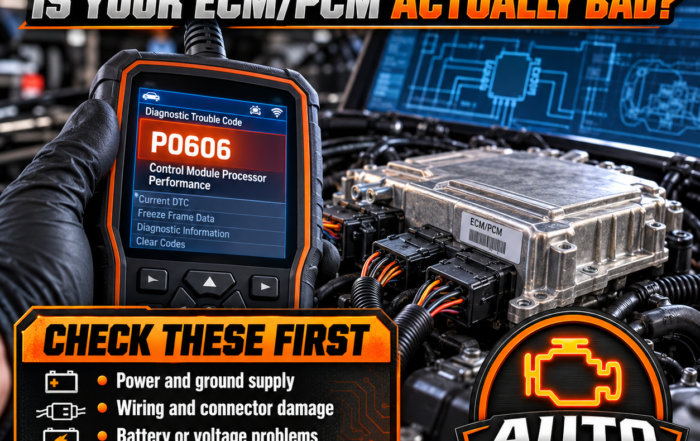
The airbag control module is one of the main electronic components of a vehicle’s Supplemental Restraint System.
Depending on the manufacturer, it may also be called:
- SRS module
- Airbag module
- Restraints control module
- Restraint control module
- Sensing and diagnostic module
- Occupant restraint controller
- Airbag control unit
Although terminology varies, the module generally monitors information from different parts of the restraint system and helps determine when deployment conditions are met.
Depending on the vehicle, the system may interact with components such as:
- Frontal airbags
- Side airbags
- Curtain airbags
- Knee airbags
- Seat belt pretensioners
- Crash or impact sensors
- Seat-position sensors
- Passenger occupancy sensors
- Clockspring circuits
- Seat wiring
- Seat belt buckle switches
- Other vehicle control modules
During a collision, the system evaluates crash information and, when the vehicle’s programmed deployment conditions are met, commands specific restraint devices to activate.
NHTSA explains that during a qualifying crash, the airbag system’s electronic control unit sends a signal that initiates airbag inflation. Airbags are designed to work together with seat belts rather than replace them.
What Happens to the Airbag System During a Crash?
What happens depends on the severity, direction and characteristics of the collision.
Not every collision causes every airbag to deploy.
A vehicle may experience:
- No airbag deployment
- Driver frontal airbag deployment
- Driver and passenger frontal deployment
- Side airbag deployment
- Curtain airbag deployment
- Seat belt pretensioner activation
- Multiple restraint-device deployments
The restraint control module may also store crash-related information or diagnostic trouble codes.
This is why two vehicles involved in seemingly similar collisions may require very different SRS repairs.
The repair should be based on the exact vehicle, the deployed components, diagnostic findings and the manufacturer’s service procedures—not a universal list of parts.
What Is Airbag Module Crash Data?
When a significant collision occurs, the airbag or restraint control module can store information related to the event.
People often refer to this broadly as crash data.
Depending on the system, stored information may include crash-related status information, deployment records, event information and diagnostic trouble codes.
Once certain crash conditions have been recorded, the module may remain in a fault state and the SRS warning light may stay illuminated.
This is where the term airbag module reset commonly enters the conversation.
However, crash data should not be confused with an ordinary fault code.
A code caused by a loose connector, damaged seat wire or failed sensor is different from a module that has recorded a deployment event.
What Does “Resetting an Airbag Module” Mean?
The phrase can be confusing because people use the word reset to describe several different things.
It may mean:
- Clearing ordinary diagnostic trouble codes
- Reprogramming or configuring a module
- Reinitializing an SRS-related component
- Clearing stored crash information from a module where an appropriate repair procedure allows it
- Restoring a repaired module for reuse
These are not necessarily the same procedure.
Simply connecting a scan tool and selecting Clear Codes is not the same thing as repairing a module that contains deployment-related data.
Likewise, disconnecting the battery is not a legitimate repair for a damaged SRS system.
If a fault remains present, the warning light or diagnostic code will generally return.
Can an Airbag Control Module Be Reset After a Crash?
Sometimes a module may be serviceable depending on its design, condition and applicable repair procedure.
In other situations, the manufacturer may specify module replacement.
The correct answer therefore depends on:
- Vehicle year
- Make
- Model
- Module type
- Collision circumstances
- Stored faults
- Deployment history
- Physical module condition
- Manufacturer repair procedures
There is no responsible universal rule saying:
“Every crashed airbag module can be reset.”
There is also no universal rule saying:
“Every airbag module must always be replaced after any collision.”
The vehicle-specific service information determines what is appropriate.
Airbag Module Reset vs. Replacement
The difference sounds simple, but it is important.
Airbag Module Reset
A reset or module-repair process generally refers to retaining the original module and restoring it to a usable state when an appropriate procedure allows that module to be reused.
The exact procedure varies.
Airbag Module Replacement
Replacement means removing the existing control module and installing another appropriate module.
That replacement may then require:
- Programming
- Configuration
- Vehicle identification information
- Calibration
- Initialization
- Security procedures
- Manufacturer-specific setup
A replacement module should not be assumed to be plug-and-play.
And most importantly:
Neither resetting nor replacing the module automatically repairs the rest of the SRS system.
A Reset Airbag Module Does Not Reset a Deployed Airbag
This distinction is critical.
A deployed airbag is physically activated during the collision.
Once an airbag has deployed, it cannot simply be folded back into place and electronically reset.
NHTSA states that airbags can deploy only once and that deployed airbags should be replaced after a crash.
Therefore:
Airbag module reset = work involving the electronic control module.
Airbag replacement = replacement of an airbag that physically deployed.
They are completely different repairs.
What Else May Need Attention After Airbag Deployment?
A proper post-collision SRS inspection involves more than the control module.
Depending on the vehicle and collision, additional components may need to be inspected, diagnosed, repaired or replaced.
These may include the following.
Deployed Airbags
Any airbag that has deployed requires proper replacement.
This can include:
- Driver steering-wheel airbag
- Passenger dashboard airbag
- Side seat airbag
- Curtain airbag
- Knee airbag
- Other supplemental airbags
NHTSA specifically recommends replacing used airbags promptly after deployment.
Seat Belt Pretensioners
Modern seat belts frequently include pretensioners.
During certain crashes, a pretensioner rapidly removes slack from the seat belt to help position the occupant properly.
A pretensioner can activate even when its appearance does not make the activation obvious.
Depending on vehicle design, pretensioners may be located in areas such as:
- Seat belt buckle assemblies
- Retractors
- Anchor assemblies
If a pretensioner has activated, simply resetting the control module does not restore that mechanical safety device.
Vehicle-specific repair information should be used to determine the required replacement and inspection procedures.
Impact Sensors
Many vehicles use one or more crash or impact sensors.
Depending on the manufacturer and collision, sensor inspection or replacement may be required.
A sensor should not be automatically replaced just because a collision occurred unless the manufacturer requires it.
At the same time, it should not automatically be assumed reusable.
The specific service procedure matters.
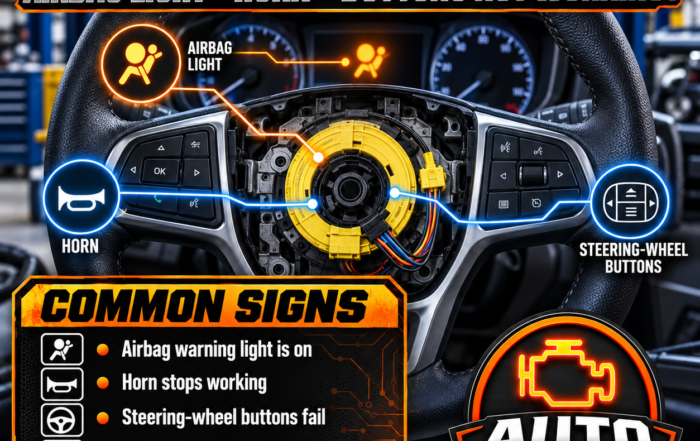
Clockspring
The clockspring provides electrical connections between steering-wheel components and the rest of the vehicle while allowing the steering wheel to turn.
The driver’s airbag circuit commonly passes through the clockspring.
A clockspring problem can trigger an airbag warning even without a collision.
After a crash, its condition may also need to be evaluated depending on the damage and manufacturer procedures.
Our airbag and SRS diagnostic services can help identify whether an illuminated airbag warning comes from a deployment-related problem, circuit fault or another SRS component.
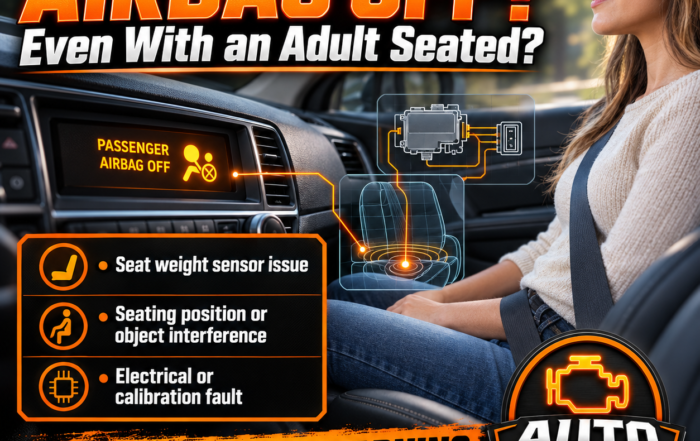
Seat and Occupancy Sensors
Modern passenger-airbag systems can use sensors to determine whether a seat is occupied and, on some vehicles, characteristics of the occupant.
Problems in these systems can produce SRS warnings even if no airbag deployed.
Possible causes include:
- Seat wiring
- Connector damage
- Occupancy sensor problems
- Seat replacement
- Collision damage
- Improper calibration
- Previous repairs
These systems may require specific calibration procedures following certain repairs.
Wiring and Connectors
SRS wiring deserves special attention after a collision.
The impact itself or subsequent body repair can damage:
- Wiring harnesses
- Connectors
- Terminals
- Grounds
- Seat wiring
- Steering-column wiring
Common problems include:
- Pinched wires
- Broken wires
- Loose terminals
- Corroded connectors
- Improper splices
- Damaged connector locks
- Wiring disturbed during seat removal
- Collision-damaged harnesses
This is why a persistent airbag light cannot always be solved by replacing or resetting a control module.
Sometimes the actual problem is in the circuit.
For vehicles with suspected wiring damage, see our automotive wiring diagnostics and repair service.
Can You Just Clear the Airbag Codes After a Crash?
Not if the underlying problem is still present.
A diagnostic scanner may be able to clear certain stored codes after the relevant repair has been completed.
But clearing a code does not physically repair:
- A deployed airbag
- An activated pretensioner
- Broken wiring
- A damaged sensor
- A faulty connector
- A failed control module
If an active fault remains, the warning light or code can return.
Diagnostic codes should be used to locate the problem—not hide it.
Is the Airbag Light Supposed to Turn Off After Repairs?
When the system has been repaired correctly and no active SRS faults remain, the warning indicator should perform according to the manufacturer’s normal startup sequence.
An SRS warning that remains on indicates that the system has detected a fault or has not successfully completed its normal checks.
Do not assume that the system is fully operational merely because someone cleared the warning temporarily.
The system should be scanned and tested to verify the actual condition.
Can You Drive With the Airbag Light On?
A vehicle may still physically drive with the warning illuminated, but that does not mean the restraint system should be ignored.
The airbag warning indicates that a problem has been detected within the Supplemental Restraint System.
Depending on the fault, one or more restraint functions may not operate as intended during another collision.
Because airbags and seat belt pretensioners are safety equipment, an active SRS fault should be diagnosed rather than treated as a cosmetic dashboard issue.
Does an Airbag Light Mean the Airbags Will Not Deploy?
Not necessarily.
This statement is frequently oversimplified.
An illuminated SRS light indicates that the control system has detected a fault.
The effect of that fault depends on:
- Which circuit failed
- Which component is involved
- Vehicle design
- Manufacturer programming
A problem in one portion of the restraint system does not allow someone to accurately predict the behavior of every other component without diagnosis.
The accurate conclusion is:
The system has detected a fault and proper restraint-system operation cannot simply be assumed until the fault is diagnosed.
What Should Be Checked After a Collision?
The exact checklist depends on the vehicle, but post-collision SRS diagnosis may involve:
- Identifying which airbags deployed.
- Checking which seat belt pretensioners activated.
- Scanning the complete SRS system.
- Recording current and stored diagnostic trouble codes.
- Determining whether crash data or deployment records are present.
- Inspecting impact-related sensors where required.
- Checking relevant wiring and connectors.
- Inspecting collision-damaged areas for harness damage.
- Determining whether the restraint control module is reusable.
- Following manufacturer replacement procedures for deployed components.
- Performing required programming or calibration.
- Clearing codes only after the underlying faults have been repaired.
- Rescanning the system and confirming normal operation.
The order and exact procedures can vary significantly by manufacturer.
Why Manufacturer Procedures Matter After Airbag Deployment
Airbag systems are engineered as part of the complete vehicle.
Repair requirements therefore vary between:
- Ford
- Chevrolet
- GMC
- Cadillac
- Toyota
- Honda
- Nissan
- Lexus
- Acura
- Chrysler
- Dodge
- Jeep
- Ram
- Other manufacturers
Even different models from the same manufacturer may use different components and procedures.
NHTSA has emphasized that airbag-system repairs should follow the procedures specified by the vehicle manufacturer and that repair can involve additional components such as sensors, wiring and electronics.
There is no responsible universal repair list for every vehicle.
Can You Install a Used Airbag Module?
This depends heavily on the vehicle.
A used module may have:
- Different programming
- Different option configuration
- Stored data from another vehicle
- VIN-related information
- Compatibility differences
- Existing faults
Some modules can be appropriately configured for another vehicle under certain circumstances, while others may not be suitable.
Compatibility should be verified using the correct part information and vehicle-specific procedures rather than assuming that two physically identical modules are interchangeable.
Does an Airbag Module Need Programming?
It may.
Depending on the vehicle and module, replacement can require:
- Programming
- Coding
- Configuration
- Initialization
- Calibration
- VIN setup
- Variant configuration
This is one reason airbag module replacement should not be approached as simply unplugging one box and plugging in another.
Can Crash Data Come Back After an Airbag Module Reset?
If the module has been appropriately repaired and the rest of the SRS system has also been restored correctly, old deployment-related information should not simply reappear as a new crash event.
However, active diagnostic trouble codes can return when an unresolved fault remains.
For example, the warning could return because of:
- Activated pretensioner
- Damaged wiring
- Failed sensor
- Connector fault
- Occupancy-system problem
- Incorrectly configured replacement component
This is why repairing only the module without diagnosing the entire system can leave the warning light on.
Airbag Module Problem vs. SRS Circuit Problem
One of the most important diagnostic questions after a collision is:
Is the control module actually the problem, or is it reporting a problem somewhere else?
A diagnostic trouble code associated with the airbag system may lead to:
- Airbag circuit
- Pretensioner circuit
- Impact sensor
- Occupancy sensor
- Seat connector
- Clockspring
- Wiring
- Communication circuit
- Power or ground supply
- Control module
The component mentioned in the code description should not automatically be replaced.
Electrical testing is often necessary to identify where the circuit has actually failed.
Our vehicle electrical diagnostic service in Milwaukee is designed for this type of problem, particularly when an SRS issue involves damaged wiring, communication faults or other electronic systems.
Why Cheap “Airbag Reset” Repairs Can Become Expensive
The least expensive repair is not always the repair with the lowest initial price.
For example, resetting a module without addressing activated pretensioners or damaged circuits can leave the vehicle with an unresolved SRS fault.
Likewise, replacing multiple components without testing can become expensive if the actual cause was:
- One damaged wire
- A connector problem
- Incorrect replacement part
- Calibration issue
- Failed sensor
- Module configuration issue
The goal should be to determine what the restraint system actually needs.
That may involve module work, but the module should be considered as part of the complete system.
Airbag and SRS Diagnostics in Milwaukee
Auto Electrical & Airbag Specialist diagnoses airbag and SRS problems in Milwaukee, including post-collision faults, airbag warning lights, module-related problems, seat belt pretensioner concerns, electrical faults and damaged restraint-system wiring.
The objective is not simply to turn off the warning light.
It is to determine why the system is reporting a fault and which components actually require attention.
If your vehicle has been in a collision or the airbag warning remains illuminated, learn more about our airbag repair and diagnostics in Milwaukee.
For module-specific SRS concerns, you can also review our SRS module repair service.
Auto Electrical & Airbag Specialist
2636 S 32nd St
Milwaukee, WI 53215
(414) 345-7568
Frequently Asked Questions About Airbag Module Reset and Replacement
Can an airbag module be reset after an accident?
Some modules may be serviceable depending on the vehicle, module condition and applicable repair procedure. Other vehicles or situations may require replacement. The correct procedure should be determined from vehicle-specific service information.
Do you need a new airbag module after airbags deploy?
Not universally. Requirements vary by manufacturer and system. The module should be diagnosed and the correct service procedure followed rather than automatically assuming reset or replacement.
Can a deployed airbag be reset?
No. A physically deployed airbag cannot simply be reset and reused. A deployed airbag requires appropriate replacement.
Is clearing airbag codes the same as resetting the module?
No. Clearing ordinary diagnostic codes after a repair is different from addressing deployment-related information stored in a restraint control module.
Do seat belt pretensioners need attention after a crash?
They may. Pretensioners can activate during certain collisions and should be inspected or replaced according to the vehicle manufacturer’s procedures.
Can a bad seat connector cause an airbag light?
Yes. Seat wiring and connector faults are common sources of restraint-system codes on some vehicles. Proper circuit diagnosis is necessary to distinguish a connection problem from a failed component.
Can damaged wiring cause the SRS light to stay on after collision repair?
Yes. Collision damage, seat removal, body repairs or damaged harnesses can create open circuits, high resistance or connector problems that keep the warning illuminated.
Can you erase crash data with a regular scan tool?
A regular code-clear function should not be assumed to remove deployment-related data. Capabilities and repair procedures vary by module and vehicle.
Will the airbag warning light disappear automatically after replacing deployed airbags?
Not necessarily. Other stored or active SRS faults may remain, and some repairs can require programming, calibration or code clearing before the system returns to normal operation.
Is it safe to ignore the airbag light if the vehicle drives normally?
No. Driving performance and restraint-system operation are separate issues. An SRS warning means the vehicle has detected a problem in a safety system and the fault should be diagnosed.
Should every crash sensor be replaced after an accident?
Not automatically. Requirements differ between manufacturers and vehicles. Follow the applicable service information for the specific collision and vehicle.
The Bottom Line
An airbag module reset and an airbag-system repair are not the same thing.
After a collision, the control module may contain crash-related information and may need to be serviced or replaced depending on the vehicle.
But the rest of the Supplemental Restraint System also matters.
Deployed airbags cannot simply be reset. Activated pretensioners, impact sensors, wiring, connectors, occupancy systems and other restraint components may require inspection, repair, calibration or replacement depending on the vehicle and collision.
The right question after a crash is therefore not simply:
“Can my airbag module be reset?”
It is:
“What does this vehicle’s complete SRS system require to be properly restored after this collision?”
That question leads to a much safer and more accurate repair.