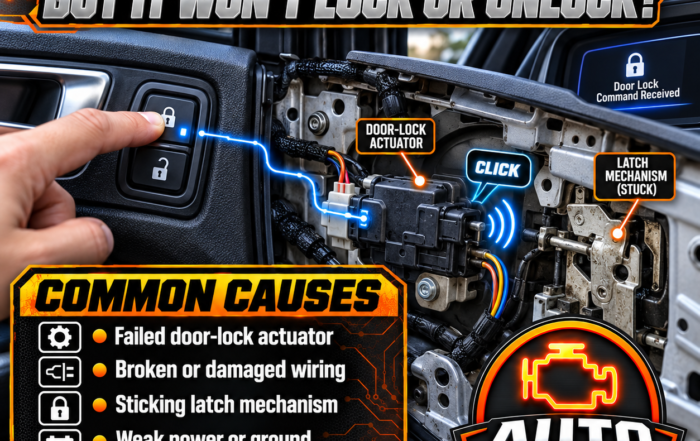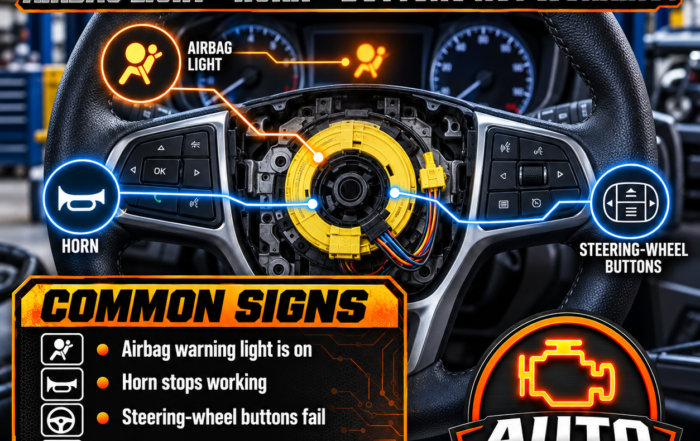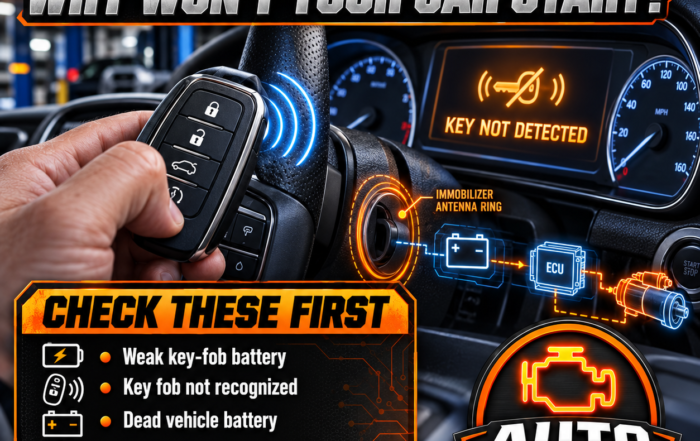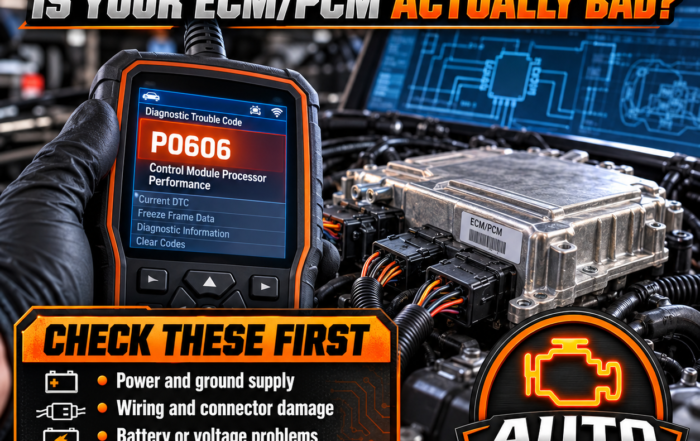
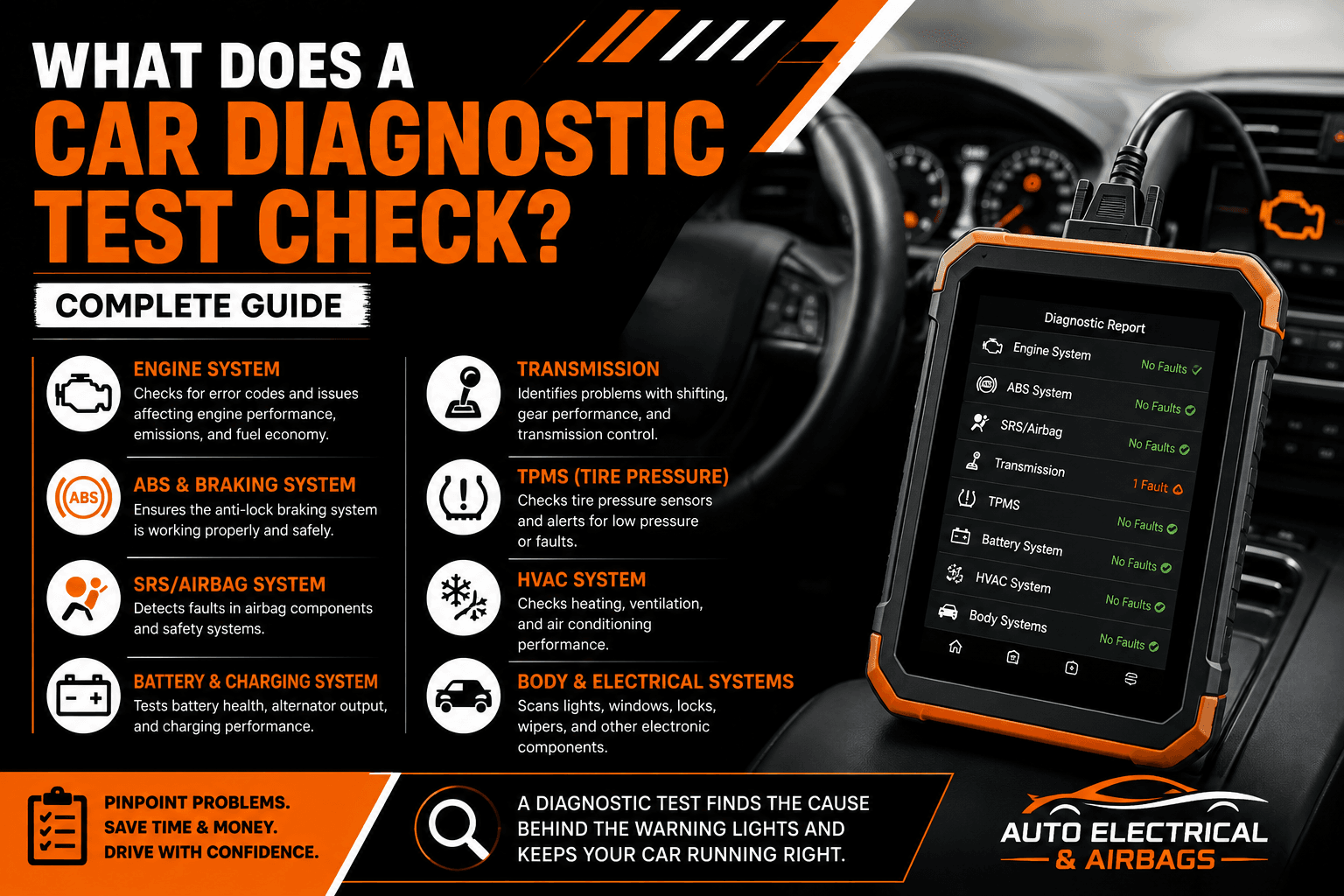
What Is a Car Diagnostic Test?
A car diagnostic test is used to determine why a vehicle is showing a warning light, running incorrectly, failing to start, draining the battery, or experiencing another electrical or electronic problem.
Many people think a diagnostic test simply means plugging a scanner into the vehicle and reading a trouble code.
That is only one part of the process.
Modern vehicles contain numerous computers, sensors, switches, wiring circuits, relays, and electronic modules. A scan tool can show what the vehicle’s computers have detected, but additional testing may be needed to determine why the fault occurred.
Depending on the problem, a professional diagnostic process may include:
- Reading stored diagnostic trouble codes
- Checking live vehicle data
- Testing battery and charging voltage
- Inspecting wiring and connectors
- Testing power and ground circuits
- Checking fuses and relays
- Evaluating sensor signals
- Testing switches and electrical components
- Checking communication between vehicle modules
- Reproducing intermittent symptoms
- Performing circuit-specific electrical testing
The goal is not simply to identify a code. The goal is to determine what is actually causing the vehicle’s problem.
Is a Code Scan the Same as a Diagnostic Test?
No.
A code scan and a diagnostic test are related, but they are not necessarily the same thing.
A Code Scan
A code scan retrieves diagnostic trouble codes stored by the vehicle’s computers.
For example, the scanner may show that:
- A sensor signal is too high
- A sensor signal is too low
- A circuit is open
- A circuit is shorted
- A cylinder is misfiring
- A module lost communication
- Voltage dropped below an expected level
That information can be extremely useful.
But it does not always identify the failed part.
A Diagnostic Test
A diagnostic test takes the information from the scan and investigates why the code or symptom occurred.
That may require testing:
- Wiring
- Connectors
- Voltage
- Grounds
- Sensors
- Relays
- Fuses
- Electronic modules
- Communication circuits
Think of the trouble code as a clue. Diagnostic testing determines what caused that clue to appear.
What Does the Diagnostic Scanner Check?
A professional scan tool can communicate with electronic control modules throughout the vehicle.
Depending on the vehicle, this may include:
- Engine control module
- Transmission control systems
- Body control module
- Airbag or SRS module
- ABS system
- Electric power steering
- Climate control
- Blind spot monitoring
- Lighting systems
- Security or immobilizer systems
- Other manufacturer-specific modules
The scanner may retrieve:
- Current trouble codes
- Pending trouble codes
- History codes
- Communication errors
- Live sensor readings
- Module status
- System voltage information
- Freeze-frame data
Not every vehicle provides the same information, and not every scanner can access every system.
What Is a Diagnostic Trouble Code?
A diagnostic trouble code, or DTC, is a code stored when a vehicle computer detects a condition outside its expected operating range.
A code might indicate that:
- Voltage is too high
- Voltage is too low
- A signal is missing
- A sensor reading is implausible
- A circuit has excessive resistance
- Communication with another module was lost
- An engine cylinder misfired
The code tells the technician where to begin looking.
It does not necessarily tell them what part to replace.
Why Doesn’t a Trouble Code Tell You Exactly What’s Wrong?
Because several different problems can cause the same abnormal reading.
Imagine the vehicle stores a code related to a sensor.
The cause could be:
- The sensor failed.
- The sensor wiring is damaged.
- The connector is loose.
- The connector is corroded.
- The sensor is missing power.
- The sensor has a poor ground.
- The signal circuit is shorted.
- Another component is affecting the reading.
- A control module has a problem.
Replacing the sensor immediately would solve only one of those possibilities.
This is why proper diagnostics can help prevent unnecessary parts replacement.
Does a Car Diagnostic Test Check the Battery?
It can, especially when the symptoms involve starting problems, multiple warning lights, battery drain, or unusual electronic behavior.
Battery-related testing may include:
- Battery voltage
- Voltage while attempting to start
- Battery connections
- Cable condition
- Ground connections
- Charging-system voltage
The vehicle’s computers depend on stable electrical power. If system voltage becomes too low or unstable, several electronic systems may begin reporting faults.
A weak battery can therefore sometimes contribute to warning lights or communication errors without being the only problem.
Does a Diagnostic Test Check the Alternator or Charging System?
Charging performance may be checked when the symptoms suggest a voltage problem.
Possible signs include:
- Battery warning light
- Battery repeatedly going dead
- Headlights becoming dim
- Multiple warning lights appearing
- Vehicle shutting off
- Electrical accessories behaving unpredictably
- Battery recently replaced but still losing power
The charging system needs to maintain enough electrical energy to operate the vehicle and recharge the battery.
If voltage is abnormal, further testing may be needed to determine why.
Can Diagnostics Find a Parasitic Battery Drain?
Yes, but parasitic battery drain testing can require a different process from simply scanning trouble codes.
A parasitic drain occurs when something continues using too much electrical power after the vehicle has been turned off.
Potential causes can include:
- Electronic modules
- Relays
- Interior or exterior lighting
- Aftermarket accessories
- Switches
- Wiring faults
- Control circuits
- Components that fail to shut down properly
One clue is a vehicle that starts normally after driving but has a dead battery after sitting overnight or for several days.
Electrical testing can help narrow down which circuit is drawing the power.
Does a Car Diagnostic Test Check Wiring?
When the symptoms or trouble codes point toward an electrical problem, wiring inspection and circuit testing can be an important part of diagnostics.
Automotive wiring problems can include:
- Broken wires
- Short circuits
- Open circuits
- Corroded wiring
- Loose terminals
- Damaged connectors
- Poor grounds
- Rodent damage
- Water intrusion
- Previous repair damage
A wire can look normal from the outside and still have an internal break or excessive resistance.
That is why visual inspection alone may not be enough. If testing identifies damaged wiring, poor grounds, corroded connectors, open circuits, or electrical shorts, our car wiring repair in Milwaukee service focuses on tracing and repairing the affected circuit.
What Is Voltage-Drop Testing?
Voltage-drop testing helps determine whether excessive resistance exists in an electrical circuit while current is flowing.
A connection can appear secure but still restrict electrical current because of:
- Corrosion
- Loose terminals
- Damaged cables
- Poor grounds
- Internal wire damage
This can cause symptoms such as:
- Slow or no cranking
- Flickering lights
- Intermittent electrical faults
- Module communication problems
- Electronic accessories failing
Voltage-drop testing can help find problems that might not be obvious from a basic visual inspection.
Does a Diagnostic Test Check Grounds?
Yes, when an electrical problem is suspected.
Ground circuits are essential because electrical current needs a complete path through the system.
A poor ground can contribute to:
- No-start conditions
- Intermittent starting
- Flickering lights
- Warning lights
- Sensor codes
- Communication faults
- Multiple systems failing at once
Ground problems can be especially confusing because one poor connection may affect several seemingly unrelated systems.
Does a Diagnostic Test Check Fuses and Relays?
Yes, when they are part of the affected circuit.
A blown fuse may explain why a system stopped working, but it may not explain why the fuse blew.
If the replacement fuse fails again, the circuit may have:
- A short
- Damaged wiring
- Failed component
- Moisture intrusion
- Connector damage
- Electrical overload
Relays can also fail or stop receiving the correct power or control signal.
Testing helps determine whether the fuse or relay is the cause or simply another symptom.
Does a Diagnostic Test Check Sensors?
Sensors are commonly involved in modern vehicle diagnostics.
A scan tool may show that a sensor reading is abnormal, but the sensor itself may not be bad.
Sensor testing can involve checking:
- Supply voltage
- Reference voltage
- Ground
- Signal output
- Wiring
- Connector condition
- Live sensor readings
This is particularly useful when a sensor has already been replaced but the same code keeps returning.
What Is Live Data?
Live data shows information being reported by vehicle sensors and electronic systems while the vehicle is operating.
Depending on the system, this may include readings related to:
- Temperature
- Voltage
- Engine speed
- Wheel speed
- Throttle position
- Airflow
- Pressure
- Switch status
- Module communication
Live data allows a technician to compare what the vehicle is reporting with what should normally be happening.
An abnormal reading can then be investigated further.
What Is Freeze-Frame Data?
Freeze-frame data captures certain vehicle conditions around the time a fault code was stored.
It may provide information such as:
- Engine speed
- Vehicle speed
- Temperature
- Engine load
- Sensor readings
This can be useful when a problem happens only under specific conditions.
For example, the vehicle may run normally in the shop but develop a warning light only during highway acceleration.
Freeze-frame information can help show what was happening when the problem occurred.
Can Diagnostics Find Intermittent Electrical Problems?
They can, although intermittent problems are often more difficult and time-consuming to isolate.
An electrical fault may occur only:
- After rain
- When the vehicle is cold
- After the engine warms up
- While driving over bumps
- After sitting overnight
- At highway speeds
- During acceleration
- Once every few days
If the problem is not occurring while the vehicle is being tested, stored codes and the driver’s description become especially important.
Tell the shop exactly when the problem happens.
Details that seem small can be extremely useful.
Can Diagnostics Determine Why a Car Won’t Start?
Yes, but the process depends on what the vehicle does when you try to start it.
A no-start diagnosis may involve:
- Battery testing
- Battery connections
- Grounds
- Fuses
- Relays
- Starting circuits
- Ignition or start-button signals
- Security systems
- Sensors
- Engine-control modules
- Wiring
A vehicle that does not crank at all requires different testing from a vehicle that cranks normally but never starts.
Our guide to why a car won’t start even though the lights work explains how those symptoms can point toward different problems.
Does a Diagnostic Test Check Dashboard Warning Lights?
Yes.
The diagnostic approach depends on which warning is illuminated.
Examples include:
- Check engine light
- ABS light
- Airbag or SRS light
- Power steering light
- Battery light
- Brake warning
- Traction-control warning
- Blind spot warning
Each system may store its own trouble codes.
If several warnings appear together, testing may also look for a shared problem involving voltage, grounds, wiring, sensors, or communication between modules.
For a broader explanation of individual symbols, read our guide to dashboard warning lights and what they mean. For check engine warnings specifically, our check engine light diagnostics in Milwaukee use trouble codes, live vehicle data, and circuit testing to determine what caused the warning instead of treating the code as an automatic parts replacement.
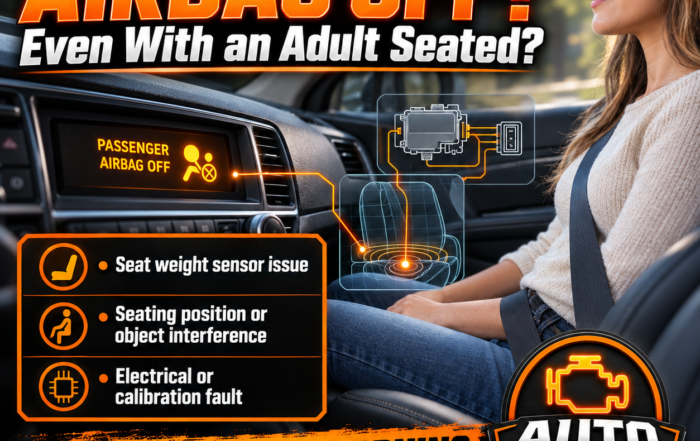
Can Diagnostics Check the Airbag or SRS System?
Yes, if the diagnostic equipment can communicate with the vehicle’s SRS module.
Airbag and SRS faults may involve:
- Airbag sensors
- Seat sensors
- Seat belt pretensioners
- Clock springs
- Wiring
- Connectors
- Module communication
- Stored restraint-system faults
Because the SRS system is safety-related, simply clearing the warning is not the same as repairing the problem.
Our Milwaukee facility provides dedicated SRS diagnostics and repair when testing involves the restraint system.
Can Diagnostics Check ABS Problems?
Yes.
ABS warning lights may involve:
- Wheel-speed sensors
- Sensor wiring
- Electrical connectors
- ABS control electronics
- Communication faults
- Power or ground problems
Because traction control and stability-control systems often use ABS information, one ABS-related fault can sometimes trigger several dashboard warnings.
Can Diagnostics Check Power Steering Problems?
Many newer vehicles use electronic power steering systems.
A warning may involve:
- Steering sensors
- Wiring
- Connectors
- Voltage problems
- Communication
- Electronic steering modules
When testing indicates an electronically controlled steering fault, power steering module diagnostics and repair may be needed.
Can Diagnostics Check the ECU, ECM or BCM?
Yes.
Modern vehicles contain multiple control modules, including the ECU, ECM, BCM, and many manufacturer-specific computers.
Module-related diagnostics may involve checking:
- Power supply
- Grounds
- Wiring
- Connectors
- Communication networks
- Inputs from sensors
- Outputs to components
A communication code involving a vehicle computer does not automatically mean that computer needs replacement.
For example, a BCM may stop communicating simply because it lost power or ground.
If testing points toward a vehicle computer, dedicated ECU diagnostics and repair or BCM diagnostics and repair may be required.
Why Did My Car Pass a Free Code Scan but Still Have a Problem?
A free code scan can be useful, but it usually answers only one question:
What codes are currently stored?
It may not answer:
- Why the code occurred
- Whether the sensor is actually bad
- Whether wiring is damaged
- Whether voltage is correct
- Whether the ground is good
- Whether the module is communicating properly
- Whether another system caused the code
This is why a parts-store scan and a full diagnostic process are not interchangeable.
A code gives direction. Testing provides evidence.
Can a Diagnostic Test Find a Problem if There Are No Warning Lights?
Sometimes.
Not every electrical or mechanical problem immediately triggers a dashboard warning.
For example, a vehicle may have:
- Battery drain
- Intermittent starting problem
- Flickering lighting
- Power seat issue
- Power window problem
- Wiring fault
- Door electrical problem
without necessarily displaying a check engine light.
Diagnostics should therefore begin with the symptoms, not just the dashboard.
How Long Does a Car Diagnostic Test Take?
There is no single amount of time that applies to every vehicle.
A straightforward fault that is present all the time may be relatively quick to identify.
A difficult intermittent electrical problem can take considerably longer.
Diagnostic time can depend on:
- Number of systems affected
- Accessibility of the wiring
- Whether the problem is currently happening
- Amount of circuit testing needed
- Vehicle design
- Previous repairs
- Aftermarket electrical equipment
- Whether several codes are related
A problem that appears only once every few days may require more investigation than a permanently failed component.
Why Do Mechanics Charge a Diagnostic Fee?
Diagnostic work takes time, equipment, training, and testing.
The fee is for determining what is wrong, not merely for plugging in a scanner.
A proper diagnosis may prevent someone from replacing:
- Sensors
- Modules
- Batteries
- Relays
- Switches
- Other expensive components
that were never bad in the first place.
Paying for testing can therefore save money compared with repeatedly replacing parts based on guesses.
How Much Does Auto Electrical Diagnostics Cost?
Electrical diagnostic pricing depends on how complex the fault is and how much testing is necessary.
At our Milwaukee shop, auto electrical diagnostics start at $135.
The starting diagnostic rate is not necessarily the final repair price.
A simple problem may require less testing than an intermittent wiring fault or module communication issue involving several systems.
For more information about pricing, see our guide to auto electrical diagnostic costs in Milwaukee.
What Information Should I Give the Shop Before Diagnostics?
The more information you provide, the better.
Tell the technician:
- Vehicle year
- Make
- Model
- Which warning lights are on
- Exact symptoms
- When the problem happens
- Whether the problem is intermittent
- Whether the battery was recently replaced
- Whether the vehicle recently needed a jump
- Whether another shop already worked on it
- Which parts were recently replaced
- Whether the problem changes after rain or temperature changes
Do not worry about diagnosing the car yourself.
Simply describe exactly what you observed.
What Makes a Good Car Diagnostic Test?
A good diagnostic process does more than retrieve fault codes.
It uses the codes and symptoms to decide what needs to be tested next.
Depending on the problem, that may mean checking voltage, wiring, sensors, grounds, connectors, modules, or communication between systems.
The most important question is not:
“What code did the scanner show?”
It is:
“What caused the vehicle to generate that code?”
Finding that answer is what separates a basic code scan from actual vehicle diagnostics.