You turn on your headlights and immediately notice something is wrong.
One side looks bright and clear.
The other headlight still works, but it appears noticeably dimmer.
It is tempting to assume the bulb is simply wearing out. Sometimes that is exactly what is happening.
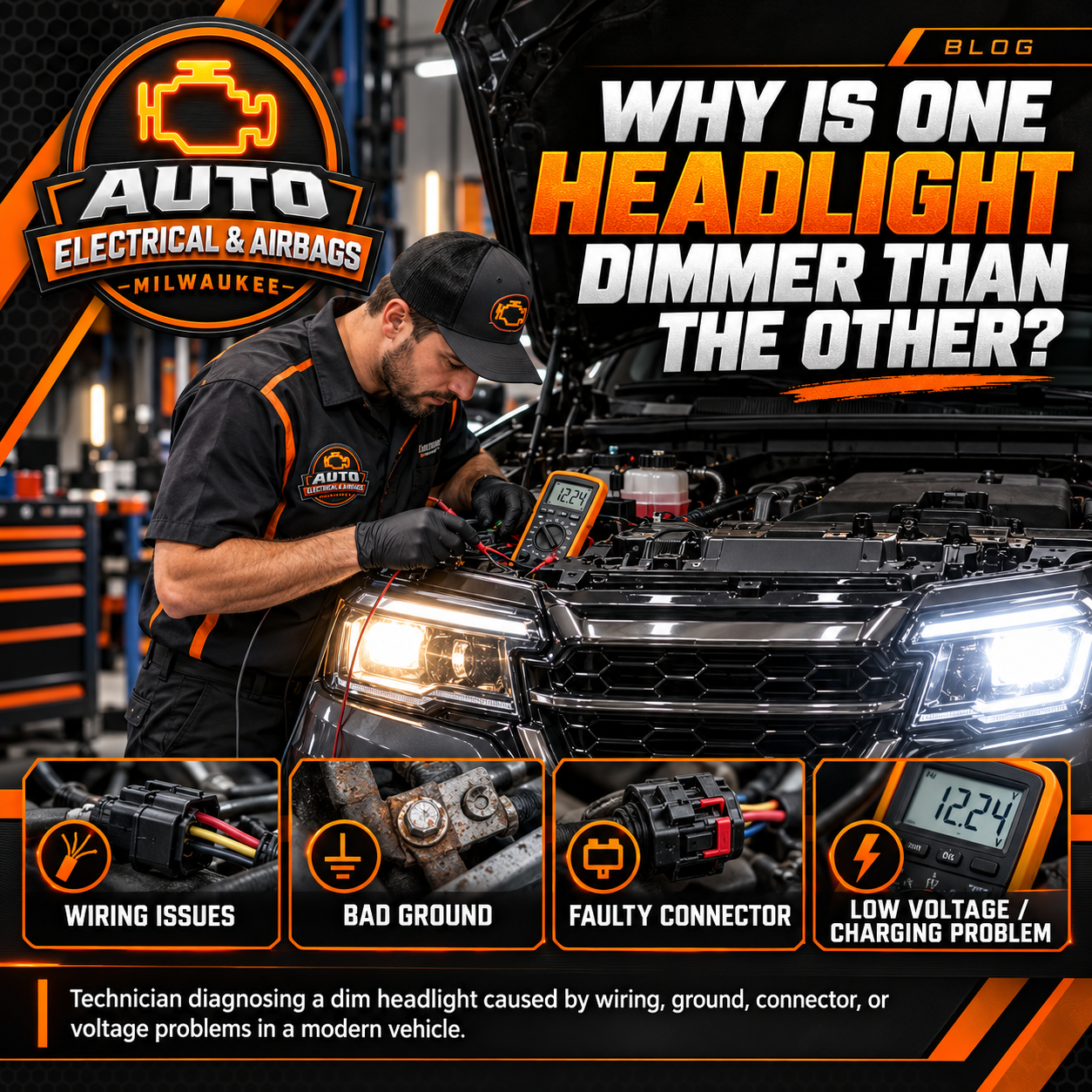
But uneven headlight brightness can also point to an electrical problem involving the ground circuit, connector, wiring, voltage supply or electronic headlight controls.
On newer vehicles, the problem can become even more complicated because headlights may use LEDs, HID systems, ballasts, drivers or lighting control modules rather than a traditional replaceable halogen bulb.
This guide explains why one headlight may be dimmer than the other, how electrical resistance can reduce headlight brightness, what symptoms suggest a wiring or ground problem, and why replacing the bulb does not always solve the issue.
Quick Answer: Why Is One Headlight Dimmer Than the Other?
Common causes include:
- Aging headlight bulb
- Mismatched bulbs
- Poor headlight ground
- Corroded connector
- Damaged wiring
- Excessive voltage drop
- Burned headlight socket
- Moisture inside the headlight
- Failing HID ballast
- LED driver or module problem
- Charging-system voltage problem
- Cloudy or damaged headlight lens
- Headlight assembly problem
If a new bulb is still noticeably dimmer than the other side, the electrical circuit should be checked rather than continuing to replace bulbs.
Does a Dim Headlight Always Mean the Bulb Is Bad?
No.
Bulbs can become dimmer as they age, particularly certain halogen and HID systems.
But the bulb is only one part of the circuit.
A headlight also depends on:
- Correct electrical power
- Reliable ground
- Good connector contact
- Proper wiring
- Appropriate control signal
- Functional lighting electronics
A perfectly good bulb supplied with inadequate voltage may still appear dim.
That distinction becomes important when a bulb has already been replaced and the brightness problem remains.
How Headlight Brightness Depends on the Electrical Circuit
A traditional headlight circuit needs electricity to travel through a complete path.
In simplified form:
Power source → fuse/control circuit → headlight → ground
If resistance develops anywhere in that path, the headlight may receive less usable voltage.
Resistance can develop from:
- Corrosion
- Loose terminals
- Damaged wiring
- Poor grounds
- Overheated connectors
The headlight may still illuminate, which can make the electrical problem less obvious.
Instead of being completely off, it simply looks weaker than the other side.
1. The Headlight Bulb Is Aging
The simplest explanation is sometimes the correct one.
Aging bulbs can lose brightness before they fail completely.
If one bulb was replaced more recently than the other, the difference can be noticeable.
Other clues may include:
- One bulb has different coloration
- One bulb takes longer to reach full brightness
- One bulb is visibly older
- Bulbs are different brands or types
Before diagnosing a complicated electrical problem, confirm that both headlights use the correct specification for the vehicle.
2. The Two Headlights Have Different Bulbs
Mismatched bulbs can produce different brightness or color temperatures.
This can happen when:
- Only one bulb was replaced
- Different bulb brands were installed
- One side uses a different wattage
- Incorrect aftermarket bulb was installed
For halogen systems, replacing bulbs in matched pairs may help maintain more consistent output when appropriate for the vehicle.
However, if identical new bulbs still produce noticeably different brightness, the circuit itself deserves attention.
3. The Headlight Has a Poor Ground Connection
A poor ground is one of the most important electrical causes of a dim headlight.
The bulb needs a reliable return path for electrical current.
If the ground connection develops excessive resistance because of:
- Corrosion
- Loose connection
- Damaged wire
- Poor terminal contact
the bulb may still illuminate while receiving inadequate electrical current.
Possible clues include:
- One headlight noticeably dimmer
- Brightness changes when hitting bumps
- Light flickers
- Problem becomes worse after rain
- Connector or ground becomes warm
- Other lights on the same side behave strangely
A visual inspection alone may not be enough.
A ground can look clean while still developing excessive resistance under electrical load.
Our guide to bad ground wire symptoms explains why voltage-drop testing can reveal ground problems that are difficult to see.
4. The Headlight Connector Is Corroded
Headlight connectors are exposed to heat, moisture and vibration.
Over time, terminals can develop:
- Corrosion
- Loose contact
- Heat damage
- Oxidation
- Backed-out pins
A poor connection creates resistance.
That resistance can reduce voltage available to the headlight and generate additional heat.
Possible symptoms include:
- Dim headlight
- Flickering
- Intermittent operation
- Light turning off after hitting bumps
- Burned smell
- Discolored connector
Connector problems should be repaired rather than simply pushing the plug back together and hoping the problem disappears.
5. The Headlight Socket Is Burned or Melted
Heat damage around a bulb socket is a strong clue that something is wrong.
Possible causes include:
- Loose terminal contact
- Excessive electrical resistance
- Incorrect bulb
- Previous wiring repair
- Overheating
Signs may include:
- Melted plastic
- Brown discoloration
- Burned terminal
- Brittle wiring
- Electrical odor
Installing a new bulb into a damaged socket may not solve the problem.
The damaged connector and surrounding circuit should also be evaluated.
6. Damaged Wiring Is Reducing Voltage
Headlight wiring can be damaged by:
- Collision damage
- Corrosion
- Previous repairs
- Rodents
- Heat
- Chafing
- Moisture
A partially damaged wire may still conduct electricity.
But if resistance is too high, voltage can be lost before it reaches the headlight.
This can create a light that works but remains weaker than the opposite side.
For suspected circuit damage, our car wiring repair in Milwaukee focuses on locating open circuits, shorts, damaged conductors, connectors and high-resistance wiring faults.
7. Voltage Drop Is Occurring in the Headlight Circuit
Voltage drop describes electrical voltage lost across resistance while a circuit is operating.
Some voltage drop across a working component is expected.
Excessive voltage drop across a wire, connector or ground is not.
For example, suppose both headlights should receive similar electrical voltage.
One receives proper voltage.
The other loses significant voltage through a corroded connector.
The second headlight may still turn on, but it will not perform normally.
This is why measuring voltage under load can be more useful than simply checking whether power exists.
8. Moisture Is Inside the Headlight Assembly
Not every brightness difference is electrical.
Water or condensation inside the headlight housing can reduce usable light output.
Moisture may enter because of:
- Damaged housing
- Failed seal
- Cracked lens
- Missing rear cover
- Collision damage
Persistent moisture can also contribute to corrosion of electrical connections.
If condensation repeatedly returns, the source of the leak should be identified rather than simply drying the housing.
9. The Headlight Lens Is Cloudy
A cloudy or yellowed exterior lens can make one headlight appear dim even when the bulb and electrical circuit are functioning correctly.
Compare both headlight assemblies during the daytime.
If one lens is significantly more:
- Yellow
- Cloudy
- Scratched
- Damaged
the apparent brightness difference may be optical rather than electrical.
10. An HID Ballast Is Failing
Vehicles equipped with HID or xenon headlights use additional electronic components to operate the lamp.
One important component is the ballast.
A failing ballast can cause symptoms such as:
- Headlight noticeably dimmer
- Flickering
- Headlight shutting off
- Delayed startup
- Different color between sides
Before replacing an expensive headlight assembly, the bulb, ballast, power supply and related wiring should be evaluated.
11. An LED Headlight Driver or Module Is Failing
Many newer vehicles use LED headlight assemblies.
These systems may use:
- LED driver
- Control module
- Integrated electronics
- Vehicle communication signals
A dim LED headlight does not necessarily have a replaceable bulb.
Depending on the design, diagnosis may involve determining whether the problem is:
- LED assembly
- Driver module
- Power circuit
- Ground
- Communication
- Headlight control module
This is one reason modern lighting diagnosis can be much more involved than simply changing a bulb.
Can a Bad Ground Make Only One Headlight Dim?
Yes.
The two headlights may use separate ground connections or circuits.
A poor ground affecting one side can therefore make that headlight dim while the other remains normal.
A technician may compare both sides electrically.
If the bright side has proper power and ground while the dim side shows excessive voltage drop, the difference helps identify the problem.
Can a Weak Battery Make One Headlight Dim?
A weak battery or charging problem can affect overall lighting performance.
However, a system-wide voltage problem would more commonly affect both headlights and other electrical systems.
If only one headlight is consistently dim, a problem local to that headlight circuit becomes more suspicious.
But system voltage should still be checked if there are other symptoms such as:
- Battery warning light
- Slow starting
- Flickering dashboard
- Electronics resetting
- Both headlights changing brightness
Can an Alternator Cause Dim Headlights?
A charging-system problem can cause headlights to become dim or change brightness.
Possible signs include:
- Both headlights dim
- Lights brighten when engine speed increases
- Battery warning light
- Battery repeatedly dies
- Several electronic warnings appear
- Interior lighting changes brightness
If only one headlight is affected, however, the individual headlight circuit should also be examined.
Why Does My Headlight Get Brighter When I Rev the Engine?
A noticeable change in overall lighting brightness with engine speed can point toward a charging or voltage issue.
The alternator should maintain appropriate system voltage while the engine is operating.
If lighting brightness changes dramatically, possible causes can include:
- Charging-system fault
- Weak electrical connection
- Poor battery connection
- Ground problem
This is different from one isolated dim headlight, although both problems can exist at the same time.
Why Does My Headlight Flicker?
A flickering headlight may be caused by:
- Loose connector
- Failing bulb
- Poor ground
- Damaged wiring
- HID ballast
- LED control electronics
- Charging-system voltage fluctuation
Pay attention to whether the flickering occurs:
- Over bumps
- During rain
- When turning the steering wheel
- When another electrical accessory turns on
- Only when the vehicle is cold
The conditions surrounding the problem can help narrow the diagnostic path.
Why Is One Headlight a Different Color?
Color differences can provide useful clues.
For example, one HID lamp may become more blue, purple or pink as it ages.
Different replacement bulbs can also have different color temperatures.
Possible causes include:
- Aging bulb
- Mismatched bulbs
- HID lamp deterioration
- LED assembly differences
- Replacement headlight not matching original equipment
Color difference alone does not always mean there is a wiring problem.
Brightness, voltage and circuit behavior should be considered separately.
Why Is the New Headlight Bulb Still Dim?
If the bulb has already been replaced and the same side remains dim, stop treating the bulb as the only suspect.
The problem may involve:
- Ground
- Power supply
- Connector
- Wiring
- Socket
- Headlight module
- Headlight assembly
This is when electrical testing becomes particularly useful.
Replacing another bulb will not repair resistance elsewhere in the circuit.
Why Does the Headlight Become Dim After It Has Been On for a While?
A connection problem can sometimes worsen as the circuit heats up.
Electrical resistance produces heat.
If a terminal or connector has poor contact, operating the headlight can increase temperature at that location.
Symptoms may then become worse after several minutes.
Possible clues include:
- Light starts normally and becomes dim
- Connector gets hot
- Light begins flickering
- Headlight eventually shuts off
Heat-related electrical symptoms should not be ignored.
Can Collision Repair Cause Uneven Headlight Brightness?
Yes.
Front-end collision repair can involve:
- Headlight assemblies
- Connectors
- Wiring harnesses
- Grounds
- Body panels
- Lighting modules
A replacement headlight may also differ from the opposite side depending on the part used.
If uneven lighting begins immediately after collision repair, that history should be considered.
Our guide to electrical problems after collision repair explains why electrical faults can remain after visible body damage has been repaired.
Can Rodent Damage Cause a Dim Headlight?
Yes.
Rodents can damage headlight wiring in the engine compartment.
A partially chewed conductor can increase resistance or create intermittent contact.
The circuit may still work while delivering inadequate electrical performance.
For signs to look for, see our guide to rodent damage to car wiring.
Why Does the Headlight Work When I Move the Connector?
If moving the headlight connector changes brightness or turns the light on and off, there is likely a connection-related problem that deserves inspection.
Possibilities include:
- Loose terminal
- Broken wire near connector
- Corrosion
- Damaged pin
- Heat-damaged socket
Moving the connector may temporarily restore contact, but that is not a repair.
The weak connection can return and potentially generate additional heat.
Can a Fuse Make a Headlight Dim?
A traditional fuse usually works or it does not.
If a fuse opens completely, the circuit generally loses power.
A dim light is more likely to involve resistance elsewhere, such as:
- Connector
- Ground
- Wiring
- Control circuit
However, fuse-box terminals and power-distribution connections can develop their own connection problems, so the entire power path matters.
Can a Relay Cause One Headlight to Be Dim?
Depending on vehicle design, relays may control lighting power.
A relay or relay connection could potentially contribute to electrical problems, but many modern vehicles use electronic modules instead of simple individual headlight relays.
The correct wiring diagram is important.
A technician should determine how the particular vehicle controls its lighting before assuming a relay is responsible.
What Is the Difference Between a Dim Headlight and a Headlight Alignment Problem?
These are two different issues.
A dim headlight produces less light.
A misaligned headlight may produce normal light but aim it in the wrong direction.
A poorly aimed headlight can make the road appear darker on one side even when both bulbs are equally bright.
Compare the lamps directly rather than judging only from the road pattern.
How Is a Dim Headlight Diagnosed?
A logical diagnosis can prevent unnecessary headlight or module replacement.
Compare Both Headlights
The unaffected side provides a useful reference.
Technicians can compare:
- Brightness
- Color
- Electrical voltage
- Ground performance
- Current behavior
Confirm the Correct Bulbs or Assemblies
Both sides should use appropriate components for the vehicle.
Mismatched bulbs should be ruled out early.
Inspect the Connector and Socket
Look for:
- Corrosion
- Burned terminals
- Melted plastic
- Loose pins
- Water contamination
Test Power at the Headlight
The electrical supply can be measured while the headlight is operating.
Simply finding voltage with the bulb disconnected may not reveal a high-resistance connection.
Test the Ground Circuit
Voltage-drop testing can determine whether the ground path is creating excessive resistance under load.
Inspect the Wiring
If voltage is being lost between the power source and headlight, wiring and intermediate connectors may need to be traced.
Scan Lighting Modules When Appropriate
Modern vehicles may store diagnostic trouble codes involving:
- Headlight module
- Body control module
- LED driver
- Adaptive lighting
- Communication
A full scan may therefore be helpful on electronically controlled lighting systems.
Bulb Problem vs. Electrical Problem
| Symptom | Bulb Problem Possible? | Electrical Problem Possible? |
|---|---|---|
| One headlight dim | Yes | Yes |
| New bulb still dim | Less likely | Strong clue |
| Flickers over bumps | Possible | Strong clue |
| Connector is melted | No | Strong clue |
| Headlight changes when connector moves | Less likely | Strong clue |
| Headlight different color | Strong clue | Possible |
| Light shuts off intermittently | Yes | Yes |
| Voltage lower on dim side | No | Strong clue |
The test results matter more than the symptom alone.
Should Both Headlight Bulbs Be Replaced Together?
It depends on the system.
On traditional replaceable-bulb systems, bulbs of similar age may produce more consistent brightness when replaced as a pair.
But replacing two bulbs will not solve:
- Wiring problems
- Poor grounds
- Damaged connectors
- Module faults
If one new bulb remains dim, further diagnosis is warranted.
Should You Install a Brighter Bulb to Fix a Dim Headlight?
Not as a diagnostic solution.
Installing a higher-output or incorrect-wattage bulb does not repair a poor electrical connection.
It may also place additional electrical or thermal load on a circuit that was designed for a specific bulb.
Use the correct bulb specification and determine why the original side is dim.
When Should a Headlight Electrical Problem Be Diagnosed?
Consider electrical diagnosis when:
- One new bulb is still dim
- Headlight flickers
- Light changes when connector moves
- Socket or connector looks burned
- Headlight works intermittently
- One side has noticeably lower voltage
- Headlight issue started after collision repair
- Several lighting functions fail together
- LED or HID system shows module-related faults
- Replacing bulbs has not fixed the problem
Persistent lighting problems should be diagnosed as a circuit rather than treated as an endless series of bulb replacements.
Vehicle Lighting Electrical Diagnostics in Milwaukee
At Auto Electrical & Airbag Specialist, we diagnose electrical faults involving headlights, taillights, brake lights, turn signals and other vehicle lighting systems.
Our Vehicle Lighting Electrical Repair in Milwaukee service covers wiring faults, connectors, fuses, switches, relays and lighting-control module problems.
When the fault extends into a damaged harness or high-resistance circuit, our car wiring repair service can help identify and repair the underlying wiring problem.
Auto Electrical & Airbag Specialist
2636 S 32nd St, Milwaukee, WI 53215
(414) 345-7568
Frequently Asked Questions About Dim Headlights
Why is one headlight dim but still working?
The bulb may be aging, but poor ground connections, corrosion, damaged wiring, connectors and electronic headlight controls can also reduce brightness.
Can a bad ground make a headlight dim?
Yes. Excessive resistance in the ground path can reduce current flow while still allowing the bulb to illuminate.
Why is my new headlight bulb still dim?
If a correct new bulb remains dim, the power supply, ground, wiring, connector and headlight electronics should be checked.
Can a corroded headlight connector cause dim lights?
Yes. Corrosion increases electrical resistance and can reduce the voltage available to the headlight.
Why does my headlight get brighter when I move the connector?
A loose terminal, damaged wire or corroded connection may temporarily make better contact when moved.
Can a bad alternator make headlights dim?
Yes, although charging-system problems commonly affect more than one light or electrical system.
Can a bad battery cause one headlight to be dim?
A weak battery generally affects overall system voltage rather than one isolated headlight. A local circuit problem becomes more suspicious when only one side is affected.
Why is one HID headlight dimmer than the other?
Possible causes include an aging HID bulb, ballast problem, wiring, connector or voltage issue.
Can an LED headlight become dim?
Yes. Depending on the design, problems may involve the LED assembly, driver electronics, power supply or control module.
Can moisture make a headlight look dim?
Yes. Water or condensation inside the assembly can reduce light output and may also contribute to electrical corrosion.
Can collision damage cause one dim headlight?
Yes. Front-end damage can affect wiring, grounds, connectors, headlight assemblies and electronic lighting modules.
How do technicians test a dim headlight circuit?
Testing may include comparing both sides, inspecting bulbs and connectors, measuring voltage under load, performing voltage-drop tests on power and ground circuits, inspecting wiring and scanning lighting-control modules when applicable.
The Bottom Line
One dim headlight does not automatically mean you need another bulb.
The actual cause may be:
- Aging bulb
- Mismatched bulb
- Poor ground
- Corroded connector
- Burned socket
- Damaged wiring
- Excessive voltage drop
- HID ballast
- LED control electronics
- Moisture or headlight assembly damage
The most useful clue is often what happens after the bulb has already been replaced.
If the same headlight is still dim, the better question becomes:
“Is this headlight receiving the correct power and ground while it is operating?”
Answering that question can separate a simple bulb problem from an electrical fault and prevent unnecessary replacement of expensive headlight components.