Your vehicle was running normally when you parked it.
A few days later, it will not start.
Or several warning lights suddenly appear. The check engine light comes on. A sensor code returns after the sensor was replaced. The engine runs poorly. A fuse keeps blowing. One electronic feature stops working while everything else seems normal.
Sometimes the problem is not a failed sensor, battery or control module.
It is damaged wiring.
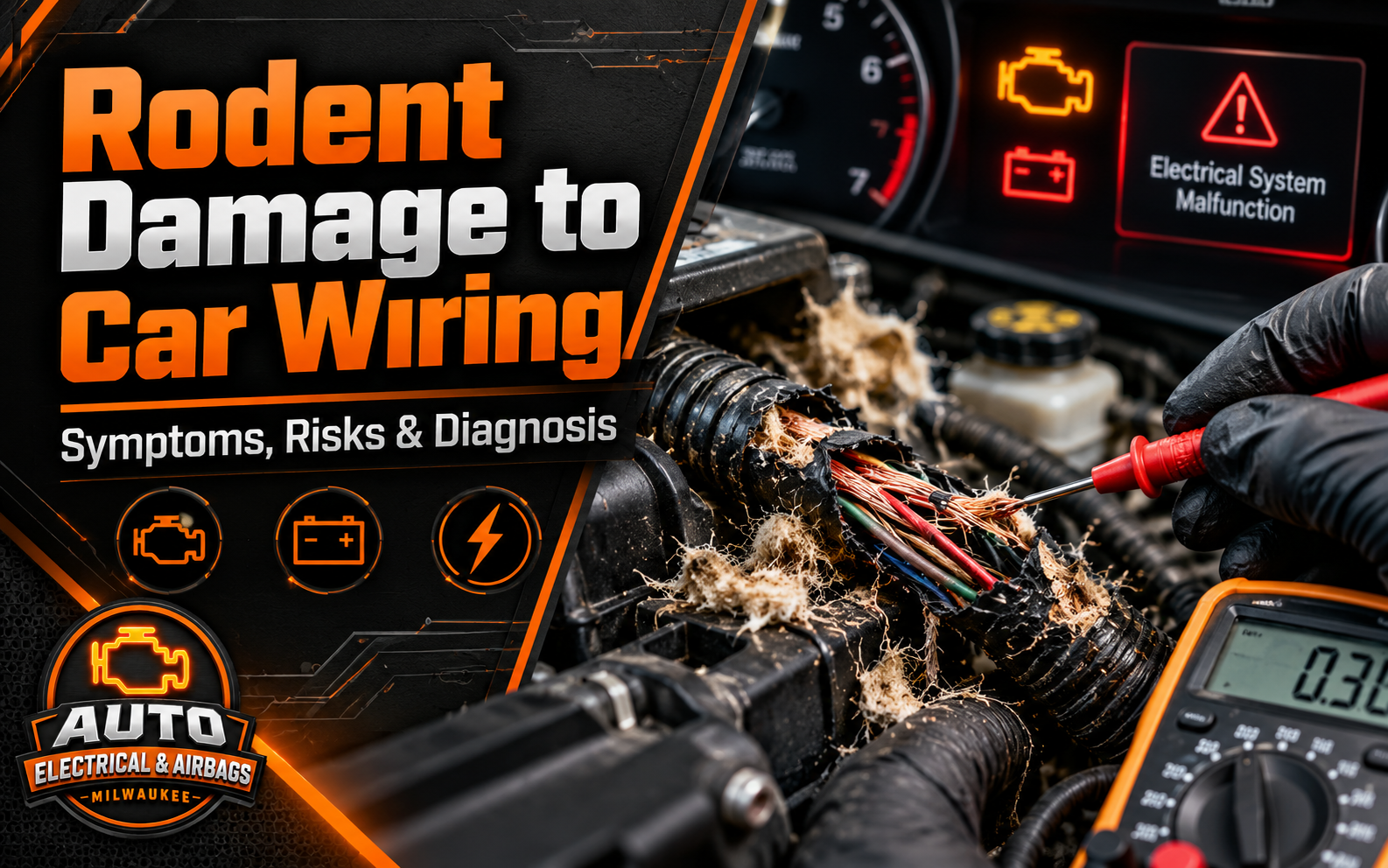
Rodents can enter engine compartments, wheel-well areas and other protected spaces in a vehicle and chew through wire insulation, electrical conductors and wiring harnesses.
The resulting damage can create open circuits, short circuits, communication failures and intermittent electrical problems that are difficult to diagnose from symptoms alone.
This guide explains the signs of rodent-damaged vehicle wiring, what electrical problems chewed wires can cause, why the damage is sometimes difficult to find and how technicians determine whether a wiring repair is actually needed.
Quick Answer: What Are the Signs of Rodent Damage to Car Wiring?
Possible signs of rodent-damaged automotive wiring include:
- Vehicle suddenly will not start
- Check engine light
- Multiple dashboard warning lights
- Sensor codes appearing unexpectedly
- Fuse repeatedly blowing
- Engine running poorly
- Electrical accessory stops working
- Module communication problems
- ABS or traction-control warning
- Airbag or SRS warning
- Power steering warning
- Intermittent electrical faults
- Visible chew marks on wiring
- Damaged wire insulation
- Nesting material under the hood
- Droppings in the engine compartment
- Electrical problems appearing after the vehicle sat unused
The exact symptom depends on which wire or circuit was damaged.
A single chewed wire can affect one sensor.
Damage to a larger wiring harness can affect several systems at once.
Why Do Rodents Get Into Cars?
A parked vehicle can provide rodents with a protected space away from weather and predators.
Areas under the hood can offer:
- Shelter
- Warmth
- Hidden spaces
- Nesting areas
- Access to soft materials
Vehicles that sit for extended periods can be particularly attractive because there is less movement and disturbance.
Rodent activity is not limited to old vehicles or vehicles stored in barns.
It can happen to cars parked:
- Outside
- In garages
- Near wooded areas
- Near fields
- Near garbage or food sources
- In residential neighborhoods
- In storage facilities
The electrical damage may occur before the vehicle owner ever realizes an animal was present.
Why Do Rodents Chew Vehicle Wiring?
Rodents naturally gnaw on materials.
Unfortunately, vehicle wiring can be accessible inside engine compartments and other protected areas.
They may damage:
- Wire insulation
- Individual conductors
- Harness coverings
- Connector wiring
- Vacuum lines
- Other underhood materials
Once insulation is damaged, the electrical conductor underneath may be exposed.
The wire can then:
- Break completely
- Partially break
- Touch another wire
- Contact metal
- Corrode after moisture exposure
Each of those conditions can create a different electrical problem.
What Happens When a Rodent Chews Through a Wire?
The result depends on how much of the wire is damaged.
Complete Wire Break
If the conductor is completely severed, the circuit becomes open.
The affected component may stop working entirely.
For example, a broken sensor wire could cause:
- Check engine light
- Sensor-related code
- Poor engine operation
- Disabled system
Partial Wire Damage
Sometimes only part of the conductor is damaged.
The circuit may continue working, but resistance can increase or the connection may become intermittent.
The problem may appear only:
- During vibration
- When the engine moves
- When temperatures change
- After moisture reaches the damaged area
Partial wire damage can be harder to find than a completely broken wire.
Short to Ground
If exposed wiring touches the metal vehicle body or engine, current can take an unintended path to ground.
This may:
- Blow a fuse
- Disable the circuit
- Cause intermittent failures
Your existing guide to car electrical shorts explains how damaged insulation, including rodent damage, can create a short circuit.
Wires Shorting Together
Two damaged conductors can also contact one another.
This can send voltage or signals into the wrong circuit and create unusual symptoms.
Can Rodent Damage Cause a Car Not to Start?
Yes.
Starting and engine operation depend on many electrical circuits.
Rodent damage could potentially affect wiring involving:
- Starter controls
- Fuel injectors
- Ignition coils
- Fuel pump controls
- Crankshaft sensor
- Camshaft sensor
- Engine control module power
- Security or authorization system
- Communication networks
The vehicle may:
- Not crank
- Crank but not start
- Start intermittently
- Stall shortly after starting
But rodent damage should not be assumed just because the vehicle will not start.
Battery condition, starter operation, fuses, relays, security systems and other causes still need to be considered.
Our guide to electrical no-start problems also identifies damaged wiring and rodent damage as possible causes of intermittent starting problems.
Can Rodent Damage Cause the Check Engine Light?
Yes.
Many engine sensors and actuators rely on electrical wiring for:
- Power
- Ground
- Signal
- Communication
If an animal damages one of those circuits, the engine computer may detect a fault and turn on the check engine light.
Possible symptoms can include:
- Rough idle
- Poor acceleration
- Misfire
- Hard starting
- Reduced power
- Increased fuel consumption
- No-start
The diagnostic trouble code may name a sensor or circuit.
That does not automatically mean the sensor itself failed.
A working sensor with a damaged wire can produce the same code.
Why Replacing the Sensor May Not Fix the Problem
This is an important diagnostic distinction.
Suppose a diagnostic scan reports a sensor circuit fault.
The sensor is replaced.
The warning light returns.
The actual problem may be:
- Broken wire
- Chewed signal circuit
- Missing power
- Damaged ground
- Connector problem
- Short circuit
The diagnostic code identifies the circuit where the vehicle detected a problem.
It does not always identify the exact failed part.
That is why recurring sensor codes may require wiring diagnosis.
Our guide to a check engine light that keeps coming back explains how damaged wiring can make the same code return even after a component has been replaced.
Can Rodent Damage Cause Multiple Warning Lights?
Yes, depending on the location of the damage.
A wiring harness may contain circuits for several systems.
If an animal damages:
- Shared power circuit
- Shared ground
- Communication wires
- Several wires inside one harness
multiple modules can report faults.
The driver may suddenly see warnings involving:
- ABS
- Traction control
- Airbag
- Power steering
- Check engine system
- Transmission
- Other electronics
Several warning lights do not necessarily mean several modules failed.
They may share one damaged electrical path.
Can Rodents Damage CAN Bus Wiring?
Yes.
Vehicle control modules communicate through network wiring such as the CAN bus.
If rodents damage CAN communication wires, modules may lose the ability to exchange information.
Possible symptoms include:
- Multiple U-codes
- Lost communication codes
- Scanner cannot access a module
- Several warning lights
- No-start condition
- Electronic systems becoming unavailable
Your CAN bus communication fault guide already explains that rodent damage is one possible cause of broken network wiring.
Can Rodent Damage Cause a Fuse to Keep Blowing?
Yes.
If a rodent chews through insulation and allows a powered conductor to touch ground, the circuit may draw excessive current.
The fuse opens to protect the wiring.
Replacing the fuse may restore the circuit briefly.
But if the damaged wire still touches ground, the new fuse may blow again.
That is why repeatedly installing larger or replacement fuses without identifying the fault is not a repair.
Your existing article on why a car fuse keeps blowing also lists rodent-damaged wiring as a possible cause of repeated short circuits.
Can Rodent Damage Cause Airbag or SRS Problems?
Potentially.
Airbag and restraint systems contain wiring and connectors throughout areas such as:
- Seats
- Center console
- Dashboard
- Pillars
- Engine compartment
- Front and side impact areas
If restraint-system wiring becomes damaged, the SRS module may detect a circuit fault.
An airbag warning should always be properly diagnosed because it involves a safety system.
Rodent damage is one of several wiring-related causes that can contribute to an SRS warning.
Can Rodent Damage Affect ABS or Traction Control?
Yes.
ABS and traction-control systems depend on electrical signals from components such as:
- Wheel-speed sensors
- ABS module
- Related wiring
- Communication circuits
If a wire becomes open or shorted, the control module may lose a sensor signal.
This can cause:
- ABS light
- Traction-control warning
- Stability-control warning
One damaged sensor circuit may therefore affect several related systems.
Why Can Rodent Wiring Damage Be Intermittent?
A wire does not need to be completely severed to cause trouble.
Imagine a rodent chews through most of the copper strands inside a wire but leaves a few intact.
The circuit may still operate.
Then engine vibration moves the harness slightly.
The remaining strands separate.
The component stops working.
Later, the wire shifts again and makes contact.
The problem disappears.
This can produce symptoms that occur:
- Only while driving
- Over bumps
- During acceleration
- When the engine is hot
- After the vehicle sits
- When the harness moves
Intermittent electrical problems require careful testing because the failure may not be present when the vehicle first reaches the shop.
Can Rodent Damage Get Worse Over Time?
Yes.
Exposed copper is vulnerable to:
- Moisture
- Road salt
- Corrosion
- Heat
- Continued vibration
A small chew mark may initially cause no noticeable symptoms.
Later, corrosion or movement can turn it into an intermittent or complete circuit failure.
Rodents may also continue returning to the vehicle and damage additional wires.
Where Do Rodents Commonly Damage Vehicle Wiring?
Rodent activity can occur wherever wiring is accessible.
Potential locations include:
- Engine compartment
- Under intake components
- Near the firewall
- Around fuse boxes
- Near battery wiring
- Around headlights
- Wheel-well areas
- Underbody
- Behind interior panels
- Trunk area
Damage may be obvious when it occurs at the top of the engine compartment.
It can be much more difficult to find when it occurs deep inside a harness.
Signs There May Be a Rodent Under the Hood
Electrical symptoms may be the first clue, but physical evidence can include:
- Droppings
- Nesting material
- Leaves or paper collected in one area
- Food debris
- Chewed insulation
- Tooth marks
- Damaged hood insulation
- Strong unusual odor
- Visible exposed copper
If these signs appear along with a new electrical problem, wiring damage becomes more suspicious.
Does Visible Chewing Tell You the Full Extent of the Damage?
Not necessarily.
Finding one damaged wire proves there has been rodent activity.
It does not prove that is the only damaged wire.
A nearby harness may contain additional:
- Chewed conductors
- Partially damaged insulation
- Damaged connectors
A careful inspection of the surrounding area can therefore be important.
Some manufacturers have repair guidelines that become more restrictive when many wires in the same harness are damaged. For example, Mercedes-Benz service information has instructed replacement of a harness branch when damage exceeds certain limits, reinforcing that extensive rodent damage can require more than simply repairing one visible conductor.
How Is Rodent-Damaged Car Wiring Diagnosed?
The exact process depends on the symptoms and location of the damage.
Inspect for Physical Evidence
Technicians may begin by checking likely areas for:
- Chewed insulation
- Broken wires
- Exposed copper
- Nesting material
- Droppings
- Damaged connectors
Visible damage can immediately narrow the search.
Perform a Full Vehicle Scan
A scan may reveal faults involving:
- Sensors
- Modules
- Communication networks
- Power circuits
- Safety systems
The pattern of codes can help identify which portion of the wiring needs investigation.
Use Wiring Diagrams
Wiring diagrams help determine:
- Where the circuit travels
- Which connectors it passes through
- Which modules share the harness
- Which power and ground circuits are involved
This is especially important when several systems fail together.
Test Power, Ground and Signal Circuits
Depending on the circuit, technicians may test:
- Voltage
- Ground
- Continuity
- Resistance
- Voltage drop
- Signal integrity
A damaged wire may look visually intact while failing electrically.
Trace the Harness
When the fault points toward wiring, the harness may need to be followed through the vehicle to locate the actual damage.
This can be simple if the wire is visibly chewed near the top of the engine.
It can be much more difficult when the damaged section is buried inside:
- Wrapped harness
- Dashboard
- Engine components
- Body panels
Can Chewed Automotive Wires Be Repaired?
Sometimes.
The appropriate repair depends on:
- Number of damaged wires
- Location
- Wire type
- Circuit involved
- Extent of damage
- Manufacturer repair guidance
A repair may involve restoring individual conductors using an appropriate automotive wiring-repair method.
In other situations, a connector, sub-harness or larger wiring harness may need replacement.
Safety-related circuits and specialized communication wiring can also have specific repair requirements.
The repair method should match the exact circuit rather than using a universal approach for every wire.
Why Twisting Wires Together Is Not a Proper Long-Term Repair
A quick temporary connection may make a component operate again.
But automotive wiring is exposed to:
- Heat
- Vibration
- Moisture
- Movement
An unreliable splice can later create:
- High resistance
- Corrosion
- Intermittent connection
- Another open circuit
- Short circuit
The goal should be to restore the electrical and mechanical integrity of the circuit.
Can Insurance Cover Rodent Wiring Damage?
Coverage depends on the individual insurance policy and circumstances.
Some comprehensive auto insurance policies may cover certain types of animal-related damage, but policies, deductibles and exclusions vary.
If the damage is extensive, contact your insurer directly and ask whether rodent or animal damage is included under your coverage.
The repair facility can document visible damage and diagnostic findings, but insurance coverage is determined by the policy and insurer.
How Can You Reduce the Risk of Rodent Damage?
No prevention method can guarantee that rodents will never enter a vehicle.
However, reducing conditions that attract them may help.
Consider:
- Avoid leaving food in or around the vehicle
- Keep the parking area clean
- Remove nearby nesting material
- Address known rodent activity around garages or storage areas
- Check vehicles that sit unused for extended periods
- Inspect under the hood periodically
- Move or operate stored vehicles regularly when appropriate
If rodents are repeatedly entering a garage or storage area, addressing the underlying pest problem is generally more useful than focusing only on the vehicle.
Should You Start the Car If You See Chewed Wiring?
If wires are visibly damaged or exposed, it may be safer to have the damage evaluated before repeatedly operating the vehicle.
The effect depends on which circuit was damaged.
Some damaged wires may simply disable a nonessential accessory.
Others may involve:
- Engine controls
- Starting circuits
- Charging system
- Safety systems
- Communication networks
Exposed conductors can also create a short circuit.
When the extent of the damage is unknown, diagnosis can help determine whether the vehicle is safe to operate.
Rodent Damage vs. Failed Component
| Symptom | Rodent-Damaged Wiring Possible? | Component Failure Also Possible? |
|---|---|---|
| Check engine light | Yes | Yes |
| No-start | Yes | Yes |
| Fuse keeps blowing | Yes | Yes |
| Sensor code | Yes | Yes |
| Multiple warning lights | Yes | Yes |
| Lost module communication | Yes | Yes |
| Problem began after vehicle sat unused | Strong clue | Still possible |
| Visible chew marks | Very strong clue | Other faults can still coexist |
| New sensor did not fix code | Wiring becomes more suspicious | Yes |
The important point is that the symptoms alone usually cannot identify the exact failed wire.
Testing is still required.
When Should Rodent-Damaged Wiring Be Professionally Diagnosed?
Consider professional electrical diagnosis when:
- Vehicle suddenly will not start
- Warning lights appeared after the vehicle sat unused
- Same sensor code keeps returning
- A fuse repeatedly blows
- Several systems fail at once
- Module communication codes appear
- Visible chew marks are present
- Exposed wiring is visible
- Engine runs poorly with unexplained electrical codes
- Previous parts replacement did not solve the fault
The problem may involve one accessible wire or a larger section of the vehicle harness.
The sooner the affected circuit is identified, the easier it is to determine the proper repair.
Rodent-Damaged Car Wiring Diagnosis in Milwaukee
At Auto Electrical & Airbag Specialist in Milwaukee, we diagnose automotive wiring problems involving open circuits, shorts, damaged conductors, connectors and vehicle communication systems.
Rodent damage can imitate problems involving sensors, modules and other expensive components, which is why the circuit should be tested before parts are replaced unnecessarily.
For wiring-related problems, learn more about our car wiring repair in Milwaukee.
If the symptoms involve several electronic systems or the location of the fault is unknown, our auto electrical diagnostics and repair service focuses on identifying the underlying electrical failure.
Auto Electrical & Airbag Specialist
2636 S 32nd St
Milwaukee, WI 53215
(414) 345-7568
Frequently Asked Questions About Rodent-Damaged Car Wiring
How do I know if a rodent chewed my car wires?
Look for exposed copper, damaged insulation, tooth marks, nesting material or droppings under the hood. Electrical symptoms such as new warning lights, no-start conditions or sensor faults may also appear.
Can mice chewing wires cause a check engine light?
Yes. If a rodent damages wiring for an engine sensor, actuator, power supply or communication circuit, the engine computer may detect a fault and illuminate the check engine light.
Can rodent damage cause a car not to start?
Yes. Chewed wiring can affect starter controls, sensors, fuel systems, ignition circuits, security systems or control-module communication.
Can squirrels damage car wiring too?
Yes. Various rodents and small animals can damage wiring and other underhood materials.
Can rodent damage make a fuse keep blowing?
Yes. If a chewed powered wire contacts ground, the resulting short circuit can repeatedly blow the protective fuse.
Can rodent damage cause electrical problems that come and go?
Yes. Partially damaged wires may make and lose contact as the vehicle vibrates, heats up or moves.
Can a chewed wire make a sensor look bad?
Yes. A sensor may be functional while its power, ground or signal wire is damaged. This can produce a diagnostic code that appears to involve the sensor.
Can rodents damage CAN bus wiring?
Yes. Damage to communication wiring can create lost-communication codes, multiple warnings and modules that cannot communicate with diagnostic equipment.
Does every damaged wire require the whole harness to be replaced?
No. The correct repair depends on the number of damaged wires, circuit type, location and manufacturer procedures. Some individual wires can be repaired while more extensive damage may require harness replacement.
Can rodent damage cause an airbag light?
Potentially. If SRS wiring or related circuits are damaged, the restraint system may detect a fault and illuminate the warning light.
Can rodent damage cause ABS warning lights?
Yes. Damage to wheel-speed sensor wiring, ABS-related circuits or vehicle communication wiring can trigger ABS and related warnings.
Should I replace a sensor if rodents damaged the wiring near it?
Not automatically. The sensor and circuit should be tested. Repairing the damaged wiring may resolve the fault if the sensor itself is still functional.
The Bottom Line
Rodent damage can create electrical problems that look much more complicated than they really are.
A chewed wire can cause:
- No-start conditions
- Check engine lights
- Sensor codes
- Blown fuses
- Multiple warning lights
- Communication faults
- Intermittent electrical problems
The challenge is that the damaged wire may be hidden inside a harness while the diagnostic code points toward a sensor or electronic module.
That is why the best question is not simply:
“Which part does the code name?”
It is:
“Is the wiring allowing that component to receive power, ground and communicate correctly?”
Finding that answer can prevent unnecessary parts replacement and lead directly to the damaged circuit.