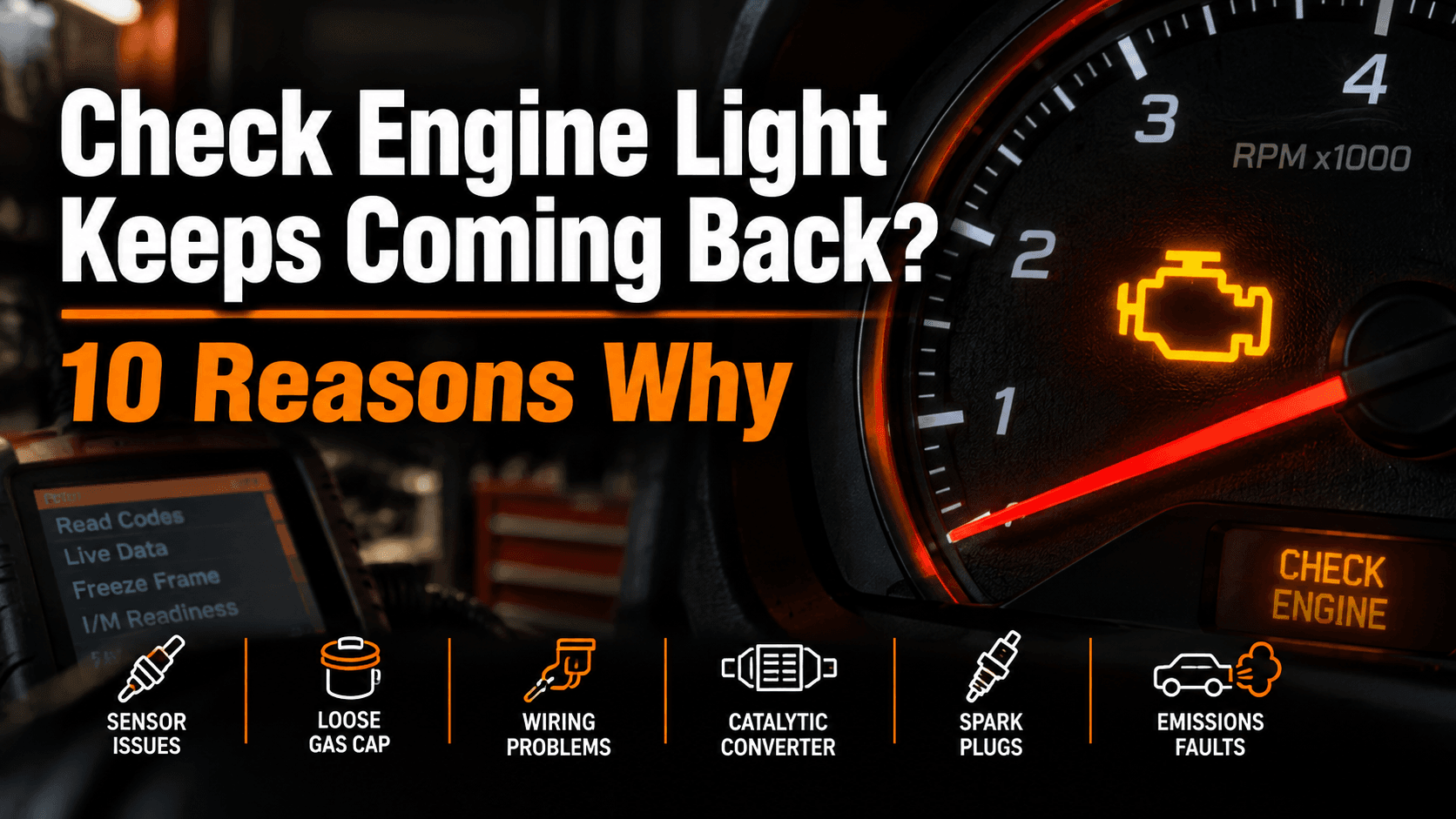
Why Does My Check Engine Light Keep Coming Back After It Was Fixed?
If your check engine light comes back after a repair, one of four things is usually happening: the original fault was not completely corrected, another problem is affecting the same system, the new warning is for a different trouble code, or the fault only occurs under certain driving conditions.
The biggest mistake is assuming that a returning check engine light automatically means the replacement part failed.
A trouble code tells you what condition the vehicle’s computer detected. It does not always identify the exact part that caused the condition.
For example, a code related to a sensor can be caused by:
- The sensor itself
- Damaged wiring
- A loose or corroded connector
- Missing power
- Poor ground
- Incorrect reference voltage
- Another engine problem affecting the sensor reading
- A control-module or communication problem
That is why a check engine light can return even after the part named in a code description has already been replaced.
If the warning keeps returning, professional check engine light diagnostics in Milwaukee can help determine whether the remaining problem is electrical, mechanical, sensor-related, wiring-related, or connected to the engine-control system.
Quick Answer: What Should I Do if the Check Engine Light Comes Back?
Do not immediately replace another part.
Instead:
- Read the trouble codes again.
- Compare the new codes with the original codes.
- Determine whether the same fault returned or a new one appeared.
- Review what part or repair was previously performed.
- Check wiring and connectors around the affected component.
- Look at live data and freeze-frame information when available.
- Test power, grounds, and related circuits.
- Consider mechanical causes if electrical testing is normal.
- Verify the repair under the conditions that originally triggered the warning.
The most important question is:
Did the exact same diagnostic trouble code return?
That answer changes what should be checked next.
Same Check Engine Light Does Not Always Mean the Same Problem
The dashboard only has one check engine symbol.
That single light can represent hundreds of different monitored faults.
Your check engine light may first come on because of:
- A misfire
- A sensor circuit
- An emissions-system problem
- An electrical fault
- Low voltage
- A fuel-control issue
Then, weeks later, the same dashboard light may illuminate for an entirely different reason.
So when someone says:
“My check engine light came back.”
The first diagnostic question should be:
“Did the same code come back?”
If the previous code was related to a sensor and the new code indicates a completely different system, the original repair may have worked correctly.
What if the Exact Same Code Comes Back?
If the identical code returns after a repair, the affected system deserves deeper investigation.
That does not automatically mean the replacement part is bad.
Possible explanations include:
- Original diagnosis focused on the part instead of the circuit
- Wiring fault remains
- Connector has poor contact
- Component does not have proper power
- Ground is weak or missing
- Another system is causing the abnormal reading
- Replacement component is incorrect or defective
- Required calibration was not performed
- Mechanical problem is creating the same sensor condition
- Engine-control module is receiving incorrect information
The next step should usually be testing, not another guess.
Why Replacing the Part Named in the Code May Not Fix the Problem
Diagnostic trouble codes are often misunderstood.
Imagine a code indicating that a sensor circuit has low voltage.
It is tempting to conclude:
Low sensor voltage = bad sensor.
But the vehicle computer only knows that the voltage arriving from that circuit is lower than expected.
Possible causes might include:
- Failed sensor
- Broken signal wire
- Short to ground
- Corroded connector
- Missing reference voltage
- Poor ground
- Connector terminal pushed backward
- Module or circuit fault
All of those situations could produce a similar diagnostic result.
A new sensor will fix only one of them.
This is why our guide to what a car diagnostic test actually checks emphasizes the difference between reading a code and diagnosing its cause.
Why Does My Check Engine Light Keep Coming Back After Replacing a Sensor?
This is one of the most common situations drivers encounter.
The sensor may have been replaced because the trouble code mentioned that sensor or its circuit.
But the underlying problem could still be:
- Damaged sensor wiring
- Corroded connector
- Loose terminal
- Missing power
- Poor ground
- Incorrect sensor reference voltage
- Vacuum or exhaust leak
- Fuel-control problem
- Another sensor influencing the reading
- ECU or ECM circuit problem
Before replacing another sensor, the electrical circuit and related system should be tested.
If wiring or connector damage is identified, our car wiring repair in Milwaukee focuses on tracing open circuits, shorts, poor grounds, damaged connectors, and other wiring faults that can cause codes to keep returning.
Why Did the Check Engine Light Return Immediately After the Repair?
A warning that returns almost immediately can be especially useful diagnostically.
It may indicate that the fault is still active.
Possible reasons include:
- Circuit remains open
- Electrical short remains
- Connector is unplugged or poorly connected
- Component still has no power or ground
- Wrong component was replaced
- Replacement component is incompatible
- Another current fault exists
If the warning returns within seconds or minutes of starting the vehicle, the problem may be easier to reproduce than a fault that appears only once every few weeks.
Why Did the Check Engine Light Come Back a Few Days Later?
Some faults cannot be detected immediately.
Vehicle computers run different self-tests under different operating conditions.
Certain tests may require:
- Engine fully warmed up
- Cold start
- Highway driving
- Steady cruising
- Specific vehicle speed
- Certain fuel level
- Several complete drive cycles
That means a repair can appear successful at first.
Then, once the vehicle repeats the conditions required for the monitor to run, the computer may detect the problem again.
A warning that returns several days later does not necessarily mean something suddenly broke again. It may mean the system finally had the opportunity to retest itself.
Why Does My Check Engine Light Turn Off and Then Come Back On?
A check engine light that comes and goes often suggests an intermittent fault.
Possible causes include:
- Loose connector
- Partially broken wire
- Corrosion
- Temperature-sensitive sensor
- Intermittent ignition problem
- Poor ground
- Voltage fluctuations
- Moisture intrusion
The vehicle may stop detecting the problem long enough for the light to turn off.
Then the fault returns under the right conditions.
Those conditions are extremely important.
Record whether the warning appears:
- On cold starts
- After the engine gets hot
- During acceleration
- At highway speed
- At idle
- After rain
- After hitting bumps
- After the vehicle sits overnight
Intermittent electrical problems often make much more sense once a pattern is identified.
Can Bad Wiring Make the Check Engine Light Keep Coming Back?
Yes.
Engine sensors and control components rely on electrical wiring for power, ground, signals, and communication.
Damaged wiring can create:
- Open circuits
- Short circuits
- High resistance
- Signal loss
- Voltage drop
- Intermittent connections
Common causes of automotive wiring damage include:
- Heat
- Engine vibration
- Corrosion
- Water intrusion
- Rodents
- Collision damage
- Previous repairs
- Harnesses rubbing against metal
A wire can also be damaged internally even when the insulation looks normal from the outside.
This is why visual inspection alone may not be enough.
If you want to understand how wiring faults such as shorts are diagnosed, see our guide to electrical shorts in cars.
Can a Bad Connector Cause the Same Code to Keep Returning?
Absolutely.
Electrical connectors contain small terminals that must maintain reliable contact.
A connector problem can involve:
- Corrosion
- Loose pins
- Bent terminals
- Water intrusion
- Terminal pushed backward
- Broken locking tab
- Heat damage
- Poor previous repair
The connector may appear attached while one terminal inside makes inconsistent contact.
This can create a fault that appears:
- During vibration
- After rain
- During acceleration
- When the engine moves
- Only occasionally
Replacing the sensor connected to that damaged plug will not repair the connector.
Can a Poor Ground Cause a Recurring Check Engine Light?
Yes.
Ground circuits are often overlooked.
Electrical components require both a proper power supply and a reliable ground path.
A poor ground can affect:
- Sensors
- Ignition components
- Injectors
- Electronic modules
- Communication networks
Possible symptoms include:
- Repeated trouble codes
- Multiple warning lights
- Intermittent starting
- Flickering lights
- Sensor readings that do not make sense
- Modules losing communication
Ground connections may look tight but still have excessive electrical resistance.
Voltage-drop testing can help identify that type of problem.
Can Low Battery Voltage Make Check Engine Codes Return?
It can contribute to certain faults.
Modern vehicles contain many control modules and sensors that require stable electrical voltage.
Low or unstable voltage can sometimes result in:
- Communication codes
- Sensor faults
- Module resets
- Multiple warning lights
- Starting problems
- Incorrect electronic behavior
This becomes especially important when the check engine light appears together with:
- Battery warning
- ABS light
- Power steering warning
- Traction-control warning
- Airbag or SRS warning
Several warnings appearing simultaneously can sometimes point toward one shared electrical problem rather than several failed components.
For broader electrical-system testing, our auto electrical diagnostics and repair in Milwaukee covers voltage, power, ground, wiring, communication, and difficult intermittent faults.
Why Did My Check Engine Light Return After Replacing the Battery?
A replacement battery does not automatically erase another vehicle problem.
The warning may return because:
- Low-voltage fault occurred before replacement
- Battery terminal is loose
- Ground connection is poor
- Charging voltage is abnormal
- Another existing fault remains
- Module communication was disrupted
- Battery was never the original cause
If the previous battery repeatedly died, it is also important to determine why.
A new battery can temporarily hide an electrical drain without correcting it.
Why Does the Check Engine Light Keep Coming Back After Replacing Spark Plugs?
Spark plugs are only one possible cause of a misfire.
If a misfire-related code returns after spark plug replacement, other possible causes include:
- Ignition coil
- Coil wiring
- Fuel injector
- Injector wiring
- Vacuum leak
- Fuel-delivery problem
- Compression issue
- Sensor fault
- Engine-control problem
The cylinder showing the misfire should be diagnosed rather than automatically receiving another new part.
Why Did My Check Engine Light Come Back After Replacing an Ignition Coil?
An ignition coil can certainly fail.
But a misfire may continue even after coil replacement if the real cause is elsewhere.
Possible causes include:
- Spark plug
- Coil connector
- Coil wiring
- Injector
- Injector circuit
- Low compression
- Vacuum leak
- Engine-control fault
If the exact same cylinder continues misfiring, the next step should be deeper testing of that cylinder and its related circuits.
Why Does My Oxygen Sensor Code Keep Coming Back?
An oxygen-sensor code does not always mean the oxygen sensor itself is bad.
The sensor is reporting conditions in the exhaust.
Its readings may be affected by:
- Exhaust leak
- Vacuum leak
- Fuel mixture problem
- Wiring
- Connector
- Heater circuit
- Power or ground
- Another engine problem
If a new oxygen sensor still produces the same code, the surrounding system needs to be checked.
Replacing the same type of component repeatedly is rarely a good diagnostic strategy.
Why Does My EVAP Code Keep Coming Back?
EVAP faults involve the vehicle’s evaporative emissions system.
Depending on the code and vehicle, possible areas include:
- Gas cap or sealing issue
- EVAP hoses
- Purge valve
- Vent valve
- Leak detection system
- Wiring
- Connectors
- Electrical control circuits
EVAP problems can be especially frustrating because some faults only trigger after the vehicle performs specific self-tests.
That can explain why the check engine light stays off for several days after clearing and then suddenly returns.
Why Does My Misfire Code Keep Coming Back?
Recurring misfire codes deserve a systematic approach.
Possible causes may involve:
- Spark plugs
- Ignition coils
- Injectors
- Fuel supply
- Wiring
- Connectors
- Air leaks
- Compression
- Mechanical timing
- Engine-control electronics
If the check engine light is flashing while the engine is misfiring, treat that differently from a normal solid warning.
A flashing check engine light can indicate an active condition capable of causing additional damage.
Read our guide to what a flashing check engine light means if the warning is blinking rather than staying solid.
What if the Check Engine Light Is Back On but the Car Runs Fine?
That is completely possible.
Some faults do not produce obvious drivability symptoms.
Your vehicle may:
- Start normally
- Idle normally
- Accelerate normally
- Make no unusual noise
while still storing a legitimate fault.
Examples may involve:
- Emissions monitoring
- Sensor circuit
- Intermittent electrical issue
- Minor fuel-control fault
- EVAP system
- Communication code
Our detailed guide to a check engine light that is on while the car runs fine explains why a vehicle can seem normal while the computer still detects a problem.
What Is Freeze-Frame Data and Why Is It Important?
Freeze-frame data can capture information about the vehicle when a fault was detected.
Depending on the vehicle, it may show:
- Engine RPM
- Vehicle speed
- Engine temperature
- Engine load
- Fuel-control information
- Sensor readings
Imagine a vehicle that runs normally almost all the time.
The check engine light appears only on the highway.
Freeze-frame data may show that the fault occurred:
At 68 mph, with the engine fully warmed up, during moderate acceleration.
That gives the technician much more useful information than simply knowing:
“The light came back sometime yesterday.”
What Is a Pending Trouble Code?
A pending code is a fault the vehicle has noticed but may not yet have confirmed enough times to illuminate the check engine light.
Pending codes can be useful when:
- Warning comes and goes
- Repair was recently performed
- Problem is intermittent
- Light has not returned yet but symptoms remain
A pending code can sometimes reveal that the same condition is beginning to reappear before the dashboard warning returns.
Why You Should Not Clear the Code Before Diagnosis
It may be tempting to clear the light before bringing the vehicle in.
That can remove useful evidence.
Diagnostic information can include:
- Stored codes
- Pending codes
- Freeze-frame information
- Fault history
For an intermittent problem, that information may be especially valuable.
Unless there is a specific reason to clear the code, leaving it stored can make diagnosis easier.
Free Code Scan vs. Professional Diagnosis
A basic scanner can tell you which codes are stored.
That is helpful.
But it may not tell you:
- Whether wiring is damaged
- Whether the sensor has proper power
- Whether the ground is good
- Whether a connector is corroded
- Whether the component is actually responding correctly
- Whether another problem is affecting the sensor
- Whether a module is communicating properly
The code narrows down the investigation.
Testing identifies the cause.
That distinction becomes especially important when the vehicle has already had parts replaced and the warning keeps returning.
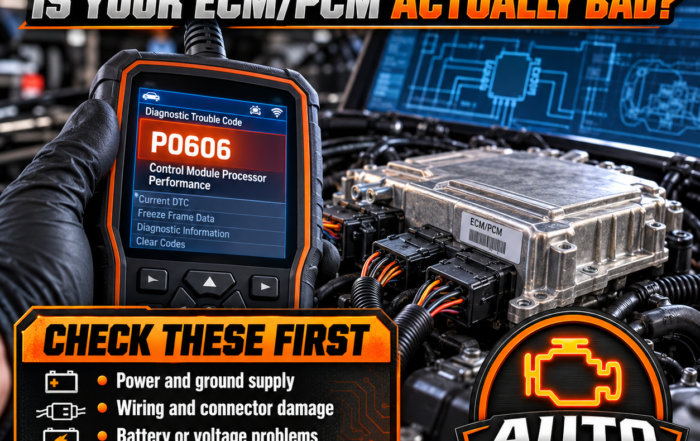
Could the ECU or ECM Be Causing the Problem?
It is possible, but the engine computer should generally not be the first component blamed.
Before condemning an ECU or ECM, testing may need to verify:
- Module power
- Ground
- Connectors
- Related wiring
- Sensor inputs
- Communication network
- Output circuits
A module with a missing ground can look like a bad module.
A module with damaged communication wiring can appear offline.
When testing points toward the computer itself, our ECU diagnostics and repair and ECM diagnostics and repair pages explain those systems in more detail.
How Should a Check Engine Light That Keeps Returning Be Diagnosed?
A good diagnostic process follows evidence instead of repeatedly replacing parts.
Step 1: Scan All Relevant Codes
Retrieve:
- Current codes
- Pending codes
- History codes
Record them before clearing anything.
Step 2: Compare With the Previous Repair
Determine:
- What code existed before
- Which component was replaced
- What testing was performed
- Whether the same code returned
Step 3: Review Freeze-Frame Data
Identify the conditions present when the fault occurred.
Step 4: Look at Live Data
Live vehicle information can show whether sensor readings make sense while the engine is operating.
Step 5: Inspect Wiring and Connectors
Look for:
- Corrosion
- Damaged insulation
- Broken wires
- Loose terminals
- Water intrusion
- Previous repairs
Step 6: Verify Power and Grounds
Confirm the affected sensor, actuator, or module has the electrical supply it needs.
Step 7: Test the Actual Circuit
The code should guide testing, not replace it.
Step 8: Consider Mechanical Causes
If the electrical circuit is functioning normally, determine whether a mechanical engine condition is producing the abnormal sensor reading.
Step 9: Verify the Repair
The vehicle should be tested under the conditions that previously produced the fault whenever practical.
That final step matters.
Turning the warning light off is not the same as confirming that the fault no longer occurs.
What Should You Tell the Repair Shop?
If another shop already attempted the repair, bring as much information as possible.
Useful details include:
- Vehicle year, make, and model
- Original diagnostic code
- New diagnostic code
- Previous repair invoice
- Parts already replaced
- How long the warning stayed off
- Whether symptoms changed
- Whether the problem happens hot or cold
- Whether it appears after rain
- Whether it happens at idle or while accelerating
- Whether the battery was recently replaced
- Whether any electrical work was performed
Do not worry about explaining the technical cause yourself.
Describe exactly what the vehicle does.
How Much Does Recurring Check Engine Light Diagnosis Cost in Milwaukee?
At our Milwaukee shop, electrical diagnostic testing starts at $135.
The amount of diagnostic time depends on factors including:
- Number of stored codes
- Previous repairs
- Wiring accessibility
- Whether the problem is intermittent
- Number of affected systems
- Whether mechanical testing is required
A fault that is present constantly may be easier to isolate than one that appears only once every several days.
Our guide to auto electrical diagnostic costs in Milwaukee explains why diagnostic time can vary significantly between vehicles and problems.
When Should You Get a Recurring Check Engine Light Diagnosed?
Schedule testing when:
- Same code repeatedly returns
- Sensor has already been replaced
- Multiple parts have already been replaced
- Warning comes and goes
- Light appears after rain or temperature changes
- Warning appears with starting problems
- Several dashboard lights appear together
- Vehicle runs poorly
- Check engine light begins flashing
- You need to determine the fault before emissions testing
If the check engine light keeps returning after previous repairs, our Milwaukee check engine light diagnostic service is designed to determine what is actually triggering the warning instead of simply clearing the code again.
Frequently Asked Questions About a Check Engine Light That Keeps Coming Back
Why does my check engine light come back after I clear it?
Because clearing a trouble code does not repair the underlying fault. Once the vehicle detects the same condition again, it can store the code and turn the warning back on.
Why did my check engine light return after replacing a sensor?
The sensor may not have been the root cause. Wiring, connectors, power, ground, another system, or a mechanical problem may be creating the abnormal sensor reading.
How quickly can a check engine light return after a repair?
Some faults return immediately. Others require a specific temperature, speed, engine load, or several drive cycles before the vehicle can test the system again.
Does the same dashboard light mean the same problem came back?
No. The same check engine symbol represents many different faults. Compare the new trouble code with the original code.
Can wiring make a check engine code keep coming back?
Yes. Broken wires, electrical shorts, poor grounds, corroded connectors, and intermittent connections can repeatedly trigger sensor and circuit-related codes.
Can a bad replacement part make the light come back?
Yes. A replacement part can potentially be defective, incorrect, poorly connected, or require calibration depending on the component and vehicle.
Can low battery voltage cause check engine codes?
Low or unstable voltage can contribute to certain sensor, module, and communication faults, particularly when several electronic warnings occur simultaneously.
Should I clear the code before taking the vehicle to a shop?
Usually not. Stored codes, pending codes, and freeze-frame information may help diagnose the problem.
What if my check engine light keeps coming back but my car runs fine?
A legitimate sensor, emissions, electrical, or intermittent fault may exist even if you do not notice a change in how the vehicle drives.
Is a recurring check engine light an electrical problem?
It can be, but not always. The cause may be electrical, mechanical, ignition-related, fuel-related, emissions-related, or involve another monitored system.
Where can I get a check engine light diagnosed in Milwaukee?
Auto Electrical & Airbag Specialist provides check engine light and vehicle electrical diagnostics at 2636 S 32nd St, Milwaukee, WI 53215, including recurring codes, sensor circuits, wiring problems, voltage issues, and engine-control faults.
If the Light Keeps Coming Back, Stop Treating the Code Like a Parts List
A recurring check engine light is frustrating, especially after money has already been spent on repairs.
But the fact that the warning returned is itself diagnostic information.
Ask:
Did the same code return?
How quickly did it return?
Was the component tested before it was replaced?
Could wiring, connectors, power, or ground be involved?
Does the problem occur only under certain conditions?
A scan tool can tell you what the vehicle detected.
The real diagnostic work is determining why it detected it.
That distinction is what prevents the repair process from becoming an expensive cycle of replacing sensors, coils, modules, and other parts until something happens to work.