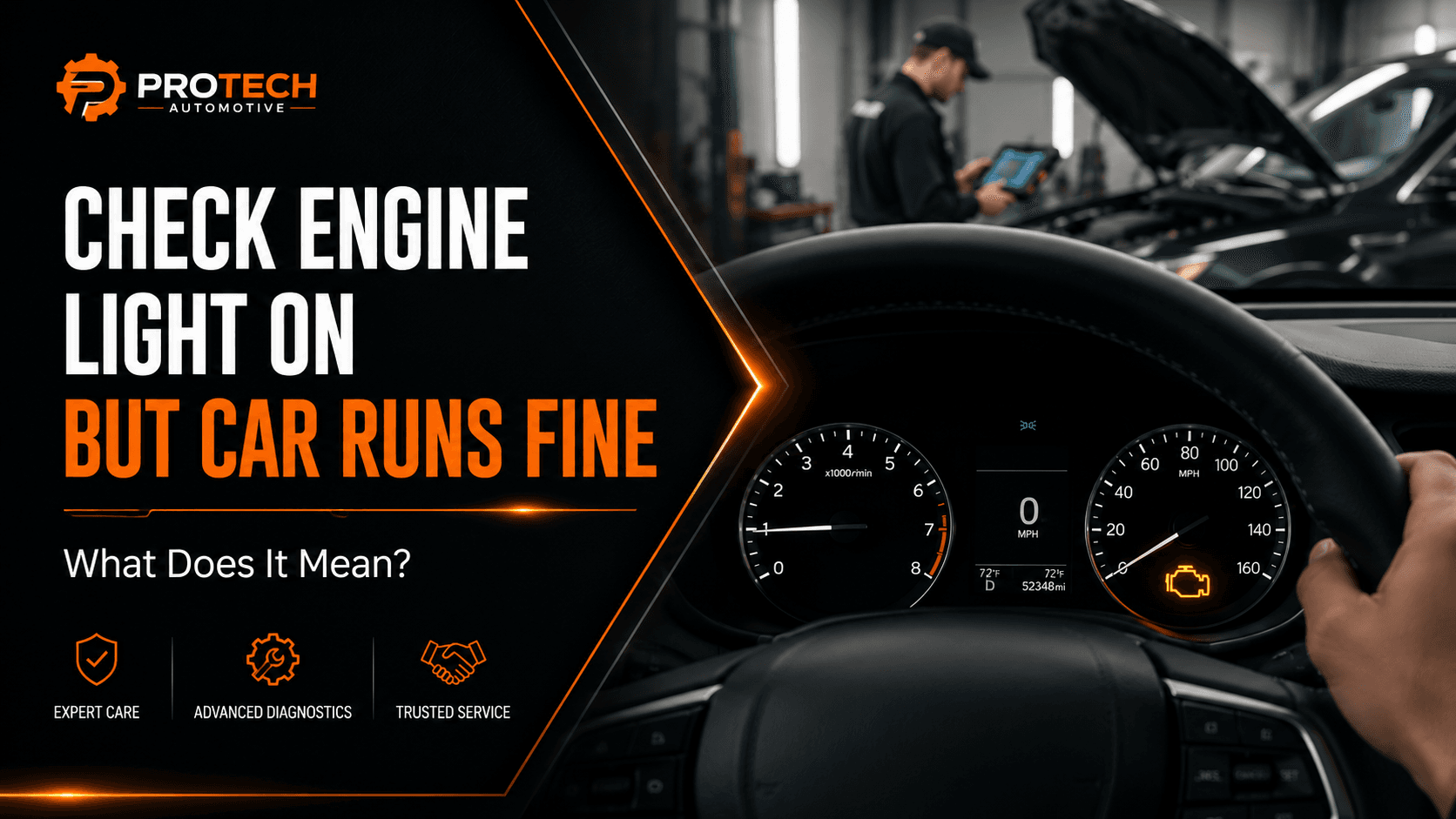
Why Is My Check Engine Light On if My Car Runs Fine?
It is common for a check engine light to appear even when the vehicle starts normally, accelerates normally, and does not seem to have anything wrong with it.
That does not necessarily mean the warning is harmless.
The check engine light turns on when the vehicle’s onboard computer detects a condition outside the expected operating range. Some faults immediately affect how the engine runs, while others can be present without creating an obvious symptom.
A vehicle may seem completely normal while the computer detects a problem involving a sensor, electrical circuit, emissions system, wiring, voltage, or engine-control system.
The important thing is to determine why the light came on instead of guessing based on how the vehicle feels.
What Does a Solid Check Engine Light Mean?
A solid check engine light generally means the vehicle has detected a fault and stored a diagnostic trouble code.
The code provides information about the system that reported the problem.
That may involve:
- Engine sensors
- Sensor circuits
- Ignition components
- Fuel-system operation
- Emissions-related systems
- Electrical wiring
- Voltage
- Module communication
- Engine-control electronics
A solid light is generally different from a flashing check engine light, which can indicate a more urgent active problem.
However, a solid warning should still be investigated, particularly when it remains illuminated or continues returning after being cleared.
Can a Car Really Run Normally With the Check Engine Light On?
Yes.
Many faults do not immediately affect how the vehicle feels from the driver’s seat.
For example, the vehicle may compensate for an incorrect sensor reading by using information from other sensors or predetermined values. In other situations, the fault may affect an emissions-related system without noticeably changing engine performance.
The problem could also be intermittent.
A sensor or electrical connection may have failed briefly, caused the vehicle to store a code, and then started working normally again.
That is why “the car feels fine” does not necessarily mean “nothing is wrong.”
Common Reasons the Check Engine Light Is On but the Car Runs Fine
There are many possible causes, and the stored diagnostic trouble code is usually the best place to begin.
Possible reasons include:
- Sensor readings outside the expected range
- Sensor wiring faults
- Loose or damaged electrical connectors
- Minor emissions-system problems
- Fuel-vapor system faults
- Intermittent ignition problems
- Low or unstable voltage
- Poor electrical grounds
- Communication errors between modules
- Engine-control circuit problems
- A fault that occurred previously but is not happening at this exact moment
Some causes are relatively simple. Others require circuit testing before the actual problem can be identified.
Could It Just Be a Loose Gas Cap?
On some vehicles, a loose, damaged, or improperly sealing fuel cap can contribute to an emissions-related check engine light.
If your vehicle uses a traditional removable gas cap, check that it is installed correctly.
However, do not assume every check engine light is caused by the gas cap.
If the light stays on or returns, reading the stored trouble code is a better next step than repeatedly tightening the cap and hoping the warning disappears.
Newer vehicles may also use capless fuel systems, so this explanation does not apply to every car.
Can a Bad Sensor Turn On the Check Engine Light Without Affecting Driving?
Yes.
Modern engines use many sensors to monitor operating conditions and provide information to the engine computer.
Depending on the vehicle, these may monitor things such as:
- Engine temperature
- Airflow
- Oxygen levels
- Crankshaft or camshaft position
- Throttle position
- Pressure
- Engine speed
- Fuel-system operation
A sensor may begin producing an abnormal reading before the vehicle develops obvious drivability symptoms.
But a sensor-related code does not automatically prove the sensor itself is bad.
The problem could also involve:
- Broken wiring
- Shorted wiring
- A loose connector
- Corroded terminals
- Missing power
- Missing ground
- Incorrect reference voltage
- Another system affecting the sensor reading
Proper diagnosis checks the circuit before assuming a replacement sensor will solve the problem.
Can Electrical Problems Cause a Check Engine Light?
Yes.
The engine-control system depends heavily on electrical circuits.
Sensors, actuators, relays, wiring, grounds, connectors, and control modules all need proper electrical power and communication.
Possible electrical causes include:
- Short circuits
- Open circuits
- Damaged sensor wiring
- Poor grounds
- Loose electrical connections
- Corroded connectors
- Voltage drops
- Low battery voltage
- Module power-supply problems
- Communication-network faults
If the check engine light is accompanied by other electrical symptoms, auto electrical diagnostics and repair can help determine whether the fault originates in a sensor circuit, wiring, voltage supply, ground, or electronic control system.
Can a Weak Battery Cause the Check Engine Light to Come On?
Low or unstable voltage can sometimes contribute to diagnostic trouble codes.
Vehicle computers and sensors are designed to operate within specific voltage ranges. If voltage drops too far, electronic systems may temporarily behave abnormally or lose communication.
You may notice other symptoms such as:
- Slow starting
- Multiple warning lights
- Flickering interior or exterior lights
- Electronic accessories behaving strangely
- Communication codes
- Battery warning light
- Power steering or ABS warnings
That does not mean every check engine light should be blamed on the battery.
If voltage problems are suspected, the battery, charging system, electrical connections, and grounds should be tested along with the system that generated the code.
Why Did the Check Engine Light Come On After the Battery Died?
A dead or severely discharged battery can sometimes leave low-voltage or communication-related trouble codes stored in the vehicle.
Possible reasons include:
- Voltage became too low while starting
- Vehicle modules temporarily lost communication
- Sensors received unstable voltage
- A battery connection is poor
- Charging-system voltage remains abnormal
- A separate preexisting problem exists
If the check engine light appeared immediately after a battery problem, that timing is worth mentioning during diagnostics.
If the warning stays on or returns, the codes should be checked rather than assuming they are all caused by the battery.
Why Did the Check Engine Light Come On After a Jump Start?
A jump start can restore enough power to start the vehicle, but it does not explain why the battery went dead.
If the check engine light appears afterward, there may be stored information associated with the low-voltage event.
The vehicle may also have:
- A weak battery
- Charging-system trouble
- Poor battery terminals
- Ground problems
- A parasitic electrical drain
- An unrelated engine-control fault
If the vehicle needs repeated jump starts, the underlying electrical problem should be investigated.
Why Is My Check Engine Light On With No Other Symptoms?
Sometimes the computer detects a problem before the driver can feel it.
The vehicle may still:
- Start normally
- Idle smoothly
- Accelerate normally
- Maintain normal fuel economy
- Make no unusual noises
- Show no additional dashboard warnings
The fault could still be present.
Examples include an intermittent electrical circuit, an emissions-related issue, a sensor reading slightly outside its expected range, or a problem the computer is temporarily compensating for.
This is one reason diagnostic trouble codes are useful even when there are no obvious symptoms.
Is It Safe to Drive With a Solid Check Engine Light?
It depends on the situation.
If the check engine light is solid and the vehicle is running normally, you may have time to schedule diagnostics rather than immediately stopping the vehicle.
However, pay attention to any changes.
Stop driving and investigate sooner if you notice:
- Check engine light begins flashing
- Severe shaking
- Significant loss of power
- Overheating
- Smoke
- Strong fuel smell
- Engine repeatedly stalling
- Unusual mechanical noises
- Oil-pressure warning
- Other serious dashboard warnings
A vehicle that feels normal today can still have a fault that should be corrected before it develops into a larger problem.
What If the Check Engine Light Comes On and Then Goes Off?
A check engine light that turns itself off does not necessarily mean the problem permanently disappeared.
Some faults are intermittent.
For example, the problem may only happen:
- During cold starts
- At highway speed
- While accelerating
- After rain
- When the engine reaches operating temperature
- After the vehicle sits overnight
- Under heavy engine load
If the vehicle no longer detects the problem for a certain period, the warning may turn off even though diagnostic information remains stored.
If the light repeatedly comes and goes, record when it happens. Those details can be extremely useful when diagnosing an intermittent problem.
Why Does My Check Engine Light Keep Coming Back?
If the warning is cleared without correcting the underlying problem, the vehicle can turn it back on as soon as the fault is detected again.
A recurring light may mean:
- The original fault was never repaired
- Wiring damage remains
- A connector has poor contact
- The wrong component was replaced
- Another fault exists in the same circuit
- Voltage remains unstable
- A problem occurs only intermittently
- A module communication problem remains
- Several related faults are present
Repeatedly clearing the light is not a substitute for identifying why the code is being generated.
Why Did the Check Engine Light Return After Replacing a Sensor?
This is an important situation because it demonstrates why a trouble code should not automatically be treated as a parts list.
Suppose a diagnostic code identifies a sensor circuit.
Replacing the sensor may not fix the problem if the actual cause is:
- Broken wiring
- Corrosion inside the connector
- Poor terminal contact
- Missing power
- Missing ground
- Incorrect reference voltage
- Another sensor affecting the reading
- Control-module or communication problem
When the same code returns after a sensor has been replaced, the circuit behind the sensor should be tested.
Does a Check Engine Code Tell Me What Part to Replace?
Not necessarily.
A diagnostic trouble code describes a condition the vehicle computer detected.
For example, a code might indicate:
- Voltage is too high
- Voltage is too low
- A signal is missing
- A sensor reading is outside range
- A cylinder is misfiring
- Communication with a module was lost
- A circuit is open or shorted
That information helps narrow down the problem.
But several different failures may produce the same code.
Think of a trouble code as a diagnostic clue, not an automatic repair instruction.
Can I Read the Check Engine Code Myself?
Basic code readers are widely available and can provide useful information.
Knowing the code can help you understand which system reported a problem.
However, a code reader usually cannot determine why the fault occurred.
Professional testing may still be needed to evaluate:
- Wiring
- Voltage
- Grounds
- Connectors
- Sensor signals
- Live data
- Control circuits
- Module communication
A free or inexpensive code scan can therefore be a useful first step, but it is not always the same thing as diagnosing the vehicle.
Should I Clear the Check Engine Light and See if It Comes Back?
Clearing the code may temporarily turn off the warning, but it also removes useful diagnostic information.
If the underlying problem still exists, the vehicle may simply generate the same code again.
Before clearing the light, it can be helpful to record:
- The exact trouble code
- Whether the code is current or pending
- When the light appeared
- Whether the vehicle was hot or cold
- Driving conditions when it occurred
- Other warning lights
- Any starting or electrical problems
The more information available, the easier it can be to understand an intermittent fault.
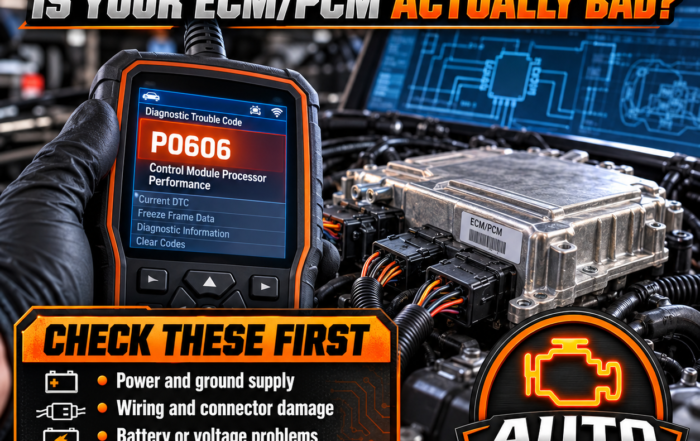
Can the ECU Cause a Check Engine Light?
Yes, but a code involving the ECU does not automatically mean the ECU needs replacement.
The ECU depends on power, grounds, wiring, connectors, sensors, and communication circuits.
A working computer may appear faulty if:
- It loses power
- It loses ground
- Wiring is damaged
- A connector is corroded
- Communication is interrupted
- Another circuit is shorted
When testing points toward the engine-control computer, ECU diagnostics and repair can help determine whether the computer itself is responsible or whether the problem exists elsewhere in the circuit.
Can the ECM Cause a Check Engine Light?
The ECM monitors and controls many engine-related functions, so ECM faults can contribute to warning lights and trouble codes.
But just like the ECU, the ECM should not be condemned based only on a code.
Testing may need to verify:
- Module power
- Ground circuits
- Wiring integrity
- Connector condition
- Communication with other modules
- Sensor inputs and outputs
If the testing points toward the module, further ECM repair and diagnostics may be appropriate.
Why Are Other Dashboard Lights On With the Check Engine Light?
Multiple dashboard warnings can sometimes share a common cause.
Modern vehicle systems exchange information with one another. A fault affecting voltage, communication, or a shared sensor can potentially trigger warnings in several systems.
Possible causes include:
- Low system voltage
- Charging problems
- Poor grounds
- Communication-network faults
- A module losing power
- Sensor failures
- Damaged wiring
For example, the check engine, ABS, traction-control, or power steering warnings may appear together under certain fault conditions.
If you are seeing several unfamiliar symbols, our guide to dashboard warning lights and their meanings explains the major warning categories and what they can indicate.
Can a Check Engine Light Affect an Emissions Test?
A check engine warning can be important when preparing for emissions testing.
The light indicates that the vehicle’s onboard diagnostic system has detected a fault.
Simply clearing the code immediately before testing may not solve the underlying problem and can also reset onboard readiness information.
If the light returns, the fault still exists.
When an electrical or sensor-circuit problem is responsible for the warning, diagnosing that problem before testing makes more sense than repeatedly clearing the code.
What Happens During Check Engine Light Diagnostics?
The process depends on the stored codes and symptoms.
Testing may include:
- Reading stored and pending trouble codes.
- Reviewing available freeze-frame information.
- Checking live sensor data.
- Confirming whether the problem is currently present.
- Testing battery and charging voltage when appropriate.
- Inspecting wiring and electrical connectors.
- Checking circuit power and grounds.
- Testing sensor signals.
- Evaluating communication between vehicle modules.
- Performing mechanical testing if the fault is not electrical.
The goal is to identify the cause of the warning rather than simply turn the light off.
How Much Does Check Engine Light Diagnostic Testing Cost?
Diagnostic pricing depends on how much testing is required.
A fault that is present all the time may be easier to isolate than a problem that occurs only once every few days.
Intermittent wiring and communication problems can require additional testing because the fault may not be active when the vehicle arrives.
Electrical diagnostics at our Milwaukee facility start at $135.
You can read our guide to auto electrical diagnostic costs in Milwaukee for a more detailed explanation of what affects diagnostic time and pricing.
When Should I Have a Solid Check Engine Light Diagnosed?
Schedule diagnostics when:
- The light stays on
- The warning keeps returning
- A code returns after replacing a part
- Several dashboard lights appear together
- The vehicle has battery or starting problems
- You notice intermittent electrical symptoms
- The light comes and goes repeatedly
- You need to understand the problem before an emissions test
- You simply do not know why the warning appeared
A car can run perfectly fine while storing a legitimate fault.
The check engine light is the vehicle’s way of telling you that the computer detected something outside normal operation. Reading the code is the first step. Determining why the code occurred is what tells you what actually needs to be repaired. If the light stays on or keeps returning, our check engine light diagnostics in Milwaukee can help determine whether the problem involves a sensor, wiring, voltage, engine-control system, or another fault.