What Is an Electrical Short in a Car?
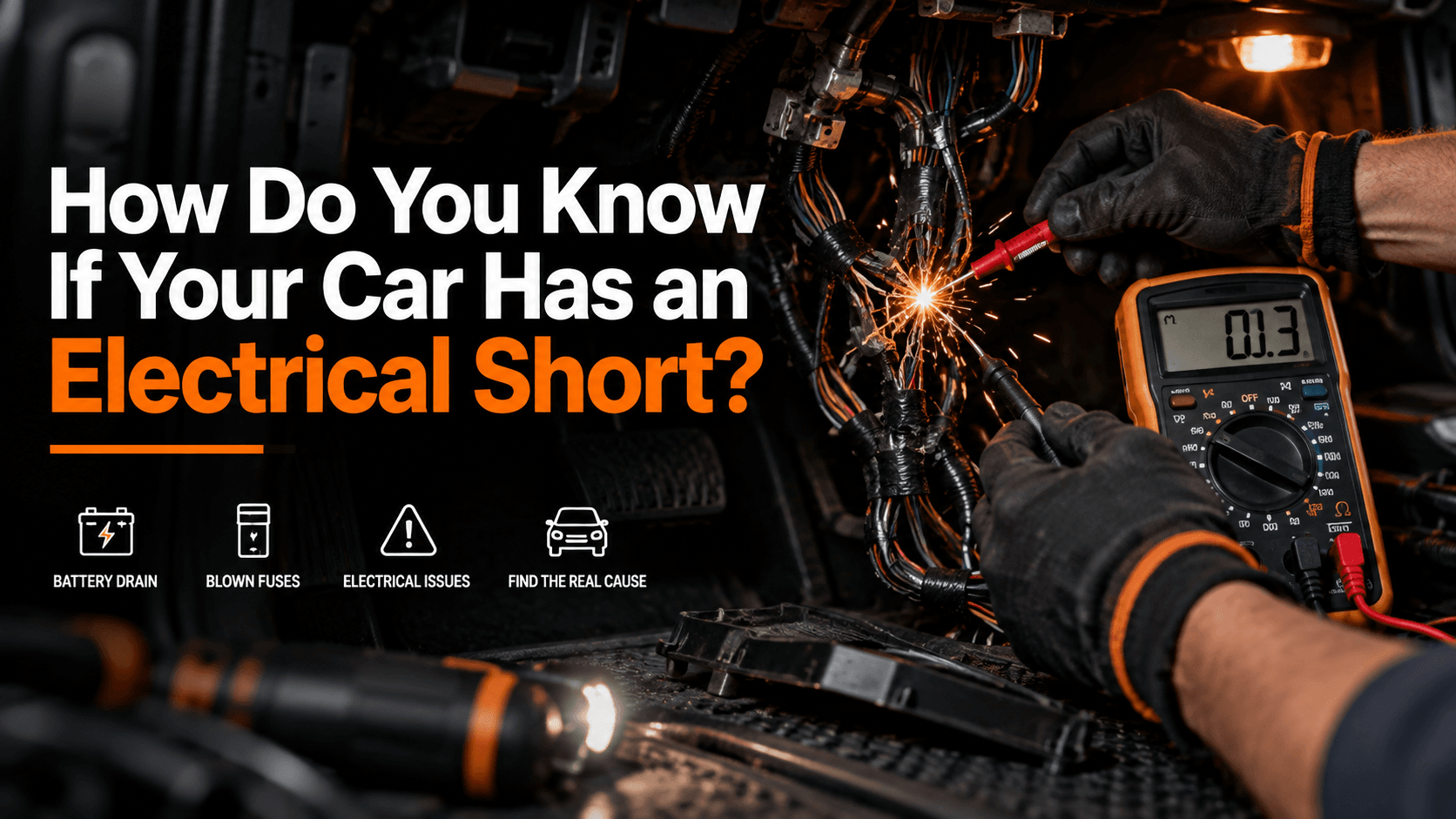
A car electrical short happens when electrical current travels through a path it was not intended to use. Instead of flowing normally through a component and its circuit, electricity may contact another wire, ground, metal surface, or damaged section of wiring.
The result can range from a blown fuse or malfunctioning accessory to an intermittent no-start problem, battery drain, overheated wiring, or several electronic systems behaving unpredictably.
Common signs of a possible electrical short include:
- A fuse that keeps blowing
- Burning plastic or electrical smells
- Flickering or dimming lights
- Battery repeatedly going dead
- Electrical accessories working intermittently
- Warning lights that appear and disappear
- A circuit failing only after rain or moisture
- Wiring that becomes unusually warm
- A component suddenly losing power
- Electrical problems that began after repairs or aftermarket equipment was installed
An electrical short should not be diagnosed by replacing fuses until one stops blowing. The affected circuit needs to be tested to determine where current is going and why.
What Does “Short Circuit” Actually Mean?
An automotive circuit is designed to move electricity through a specific path.
A simplified circuit may contain:
Battery or electrical supply → fuse → switch or module → component → ground
A short circuit can occur when current takes an unintended shortcut somewhere in that path.
For example, damaged insulation could allow a powered wire to contact the vehicle body. Because the body is part of the vehicle’s grounding system, a large amount of current may suddenly flow through the circuit.
The fuse is designed to protect the wiring by opening the circuit when current becomes excessive.
That is why a blown fuse can sometimes be the result of the problem rather than the problem itself.
What Are the Most Common Signs of an Electrical Short in a Car?
An electrical short does not always create the same symptom.
The result depends on which circuit is affected, how severe the fault is, and whether the short is constant or intermittent.
Some of the most useful warning signs include the following.
1. The Same Fuse Keeps Blowing
A fuse that repeatedly fails is one of the strongest reasons to investigate the circuit.
A fuse may blow because of:
- Damaged wiring
- A wire contacting ground
- Water inside an electrical connection
- Failed motor or electrical component
- Damaged connector
- Incorrect aftermarket wiring
- Pinched wiring
- Internal component failure
Replacing the fuse may temporarily restore power, but if the cause remains, the new fuse can fail again.
Never install a higher-amperage fuse simply because the correct fuse continues to blow. The specified fuse rating is intended to protect the circuit and wiring.
If a fuse repeatedly fails, the question should be:
What is causing excessive current in this circuit?
—not—
What larger fuse can I install?
2. You Smell Burning Plastic or Electrical Insulation
A burning electrical smell deserves immediate attention.
Electrical current flowing through damaged wiring or a poor connection can create heat.
Possible sources include:
- Overheated wiring
- Melted connector
- Shorted motor
- Damaged relay socket
- Loose electrical terminal
- Incorrect aftermarket wiring
- Circuit carrying more current than intended
If you notice smoke, visible melting, or a strong burning smell, safely stop using the affected system.
If the vehicle appears unsafe, stop driving when it is safe to do so.
Continuing to operate an overheating electrical circuit can cause additional wiring and component damage.
3. Your Battery Keeps Dying
A short circuit can sometimes contribute to excessive electrical draw, although a battery drain does not automatically mean there is a short.
Other causes can include:
- Electronic module staying awake
- Light remaining on
- Relay staying energized
- Aftermarket accessory
- Charging-system problem
- Weak battery
- Poor electrical connection
The pattern is useful.
If the battery repeatedly goes dead after the vehicle sits overnight or for several days, testing may be needed to determine whether something is continuing to use electrical power while the vehicle is off.
Our auto electrical diagnostics in Milwaukee include testing for battery drains, voltage problems, wiring faults, grounds, and other difficult electrical conditions.
4. Headlights or Interior Lights Flicker
Flickering does not automatically mean there is a short, but it can indicate unstable electrical power.
Possible causes include:
- Loose connection
- Poor ground
- Damaged wiring
- Charging-system problem
- Connector fault
- Voltage fluctuation
Pay attention to the pattern.
Do the lights flicker when:
- You hit a bump?
- The engine is idling?
- Another accessory turns on?
- It rains?
- A door opens?
- The steering wheel turns?
- You accelerate?
A problem that changes with vibration, moisture, movement, or electrical load may provide an important clue about where the circuit should be inspected.
5. An Electrical Accessory Works Only Sometimes
Intermittent electrical failures are common with damaged wiring and poor connections.
Examples include:
- Window works only occasionally
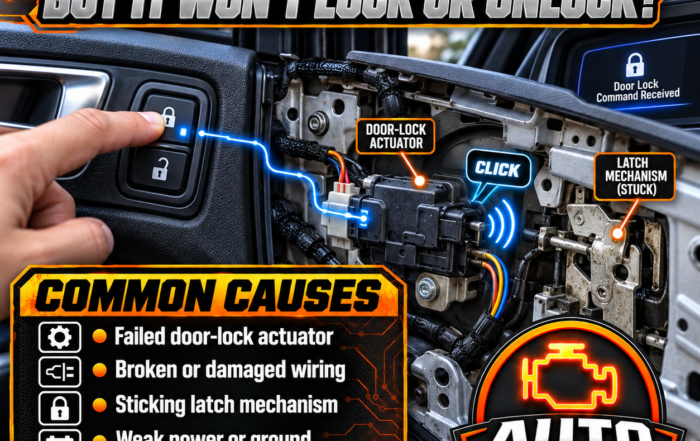
- Door lock works one day and fails the next
- Radio randomly resets
- Power seat stops moving
- Mirror controls stop responding
- Exterior light turns on and off
- Wipers behave unpredictably
A partially broken wire can make contact in one position and lose contact in another.
This is especially common in areas where wiring repeatedly moves, such as:
- Door jambs
- Trunk lids
- Hatchbacks
- Steering-column areas
- Moving seat assemblies
The fact that the accessory starts working again does not mean the electrical fault disappeared.
6. Warning Lights Appear and Disappear
Electrical faults can also affect sensors and vehicle-control systems.
A damaged wire, poor ground, loose connector, or unstable voltage may cause a module to temporarily lose information.
That can potentially contribute to warnings involving:
- Check engine system
- ABS
- Traction control
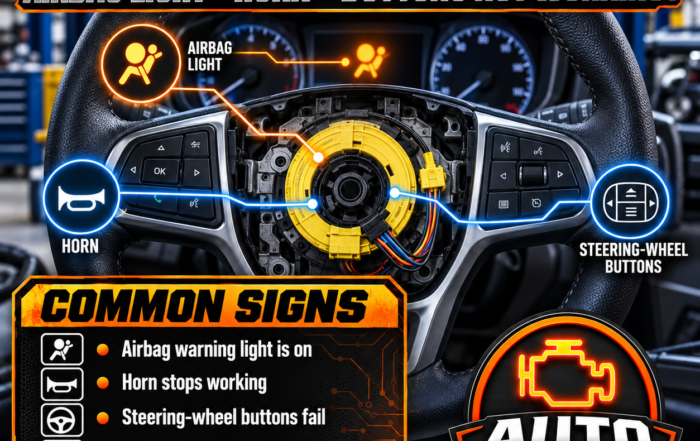
- Airbag or SRS
- Power steering
- Driver-assistance systems
If a warning appears and disappears without a clear pattern, the stored diagnostic information may still help determine what happened.
For check engine warnings specifically, our check engine light diagnostics in Milwaukee focus on the code, live vehicle data, related circuits, and the reason the fault was stored.
7. The Problem Appears After Rain or a Car Wash
Water and electricity do not work well together when wiring insulation, seals, or connectors are already compromised.
Moisture may enter:
- Damaged connector
- Cracked wiring insulation
- Fuse or relay area
- Door wiring
- Sensor connector
- Module connector
- Aftermarket wiring connection
The vehicle may work normally while dry and develop problems only after rain.
Possible symptoms include:
- No-start
- Warning lights
- Blown fuse
- Failed accessories
- Battery drain
- Flickering lights
- Module communication errors
A weather-related pattern is extremely useful diagnostic information.
Tell the technician if the problem consistently appears after rain, snow, high humidity, or a car wash.
8. The Vehicle Starts Sometimes but Not Others
Starting problems can involve many systems, including the battery, starter circuit, ignition system, security system, wiring, switches, relays, and vehicle computers.
Electrical wiring becomes especially important when the problem is intermittent.
You might experience:
- One click
- Rapid clicking
- Complete silence
- Dashboard lights but no crank
- Vehicle starts after several attempts
- Starting failure only when hot or cold
A loose connection or damaged wire may carry current normally sometimes and fail under other conditions.
If the lights work but the engine will not start, remember that accessories require far less current than the starting system.
9. The Problem Began After a Repair or Accident
When an electrical issue starts soon after another repair, tell the technician exactly what work was performed.
Potential causes can include:
- Wire pinched during reassembly
- Connector not fully seated
- Ground connection left loose
- Harness damaged during body repair
- Wire rubbed against a sharp surface
- Sensor wiring damaged near a repaired component
This does not automatically mean the previous repair was performed incorrectly.
It simply gives the technician useful information about where to begin inspecting the vehicle.
Collision damage can also affect wiring in ways that are not immediately visible.
10. The Problem Started After Installing Aftermarket Electronics
Aftermarket electrical equipment can be installed correctly and operate without problems.
But poor installation can introduce electrical faults.
Examples include:
- Remote starters
- Alarm systems
- Stereos
- Amplifiers
- Lighting
- Dash cameras
- GPS equipment
- Accessories connected directly to fuse circuits
Problems can occur when wiring is:
- Spliced incorrectly
- Connected to the wrong circuit
- Poorly grounded
- Left exposed
- Not properly fused
- Pinched behind panels
If an electrical problem started shortly after aftermarket equipment was installed, mention that during diagnosis.
Short Circuit vs. Open Circuit: What’s the Difference?
These two terms describe different electrical problems.
Short Circuit
A short circuit occurs when electricity follows an unintended path.
This may cause:
- Blown fuse
- Excessive current
- Heat
- Component failure
- Circuit shutting down
Open Circuit
An open circuit means the electrical path is broken.
Possible causes include:
- Broken wire
- Disconnected connector
- Corroded terminal
- Failed switch
- Internal component failure
An open circuit may result in a component simply not receiving power or completing its electrical path.
Both problems can create similar symptoms from the driver’s perspective, which is why testing is important.
What Is a Short to Ground?
A short to ground occurs when a powered portion of the circuit contacts ground before the electricity reaches the intended component.
For example, if insulation wears away from a powered wire and the conductor touches the metal body of the vehicle, current may take that unintended path.
Depending on the circuit, this may immediately blow a fuse.
Potential causes include:
- Damaged wire insulation
- Harness rubbing against metal
- Pinched wiring
- Collision damage
- Poor previous repair
- Rodent damage
- Wiring melted by heat
Finding the exact location of the short may require tracing the circuit through the vehicle.
Can a Short Circuit Drain the Battery?
It can, but not every battery drain is caused by a short.
A parasitic battery drain occurs when excessive electrical current continues flowing after the vehicle should have entered its normal sleep state.
Potential sources include:
- Module staying awake
- Relay stuck on
- Light remaining on
- Accessory drawing power
- Wiring fault
- Aftermarket equipment
A direct short severe enough to draw large current may blow a fuse quickly.
A smaller unintended draw may discharge the battery slowly instead.
The exact behavior depends on the circuit and fault.
Can a Bad Ground Act Like an Electrical Short?
A poor ground is different from a short circuit, but both can cause confusing electrical symptoms.
A bad ground can create excessive resistance and interfere with the proper return path for electrical current.
Possible symptoms include:
- Slow starting
- Flickering lights
- Multiple warning lights
- Sensor codes
- Electronics behaving unpredictably
- Modules losing communication
- Accessories operating slowly
A visual inspection alone does not always identify a poor ground.
A connection can look secure while still having excessive electrical resistance.
That is why voltage-drop testing can be useful.
Can a Short Cause the Check Engine Light?
Yes, if the short affects a circuit monitored by the engine-control system.
For example, a short involving:
- Sensor wiring
- Injector circuit
- Ignition circuit
- Control wiring
- Module power supply
- Reference voltage circuit
may cause the vehicle computer to detect abnormal voltage or missing information and store a diagnostic trouble code.
However, a check engine light can have many mechanical and electrical causes.
A trouble code should be used to guide testing rather than treated as proof that a particular part has failed.
Can a Short Cause Multiple Dashboard Warning Lights?
Potentially.
Modern vehicle systems communicate and often share electrical power, grounds, sensors, and network wiring.
If one fault affects a shared electrical circuit, multiple systems may report errors.
For example, low voltage, a poor ground, or interrupted communication may cause several electronic modules to generate warnings.
This is why replacing a different component for every dashboard light can be the wrong approach.
Sometimes several warnings have one shared electrical cause.
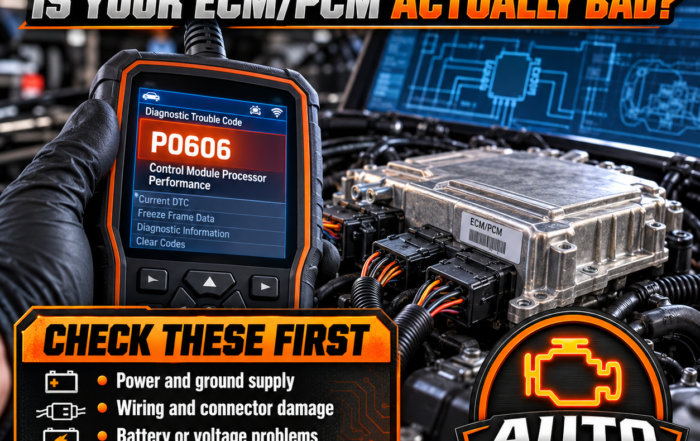
Can a Short Circuit Damage the ECU, ECM, or BCM?
Electrical faults can potentially affect electronic modules, depending on the circuit and severity of the problem.
But a module-related code does not automatically mean the module itself is damaged.
Before replacing an ECU, ECM, or BCM, diagnosis may need to verify:
- Module power
- Ground
- Wiring
- Connectors
- Communication network
- Sensor or output circuits
A module cannot communicate correctly if it is not receiving proper electrical power or ground.
What Causes Electrical Shorts in Cars?
Automotive wiring operates in a difficult environment.
Common causes of electrical shorts and wiring damage include:
Heat
Engine compartments can expose wiring to significant heat.
Over time, insulation may become brittle or damaged.
Vibration
Vehicles constantly vibrate and move.
Wiring that is not properly supported can rub against brackets, metal surfaces, or other components.
Water and Corrosion
Moisture can enter connectors and damaged wiring.
Corrosion can create resistance or interfere with electrical contact.
Rodent Damage
Rodents can chew wire insulation and conductors.
The resulting damage may create open circuits, shorts, or intermittent faults.
Collision Damage
Even relatively minor accidents can pinch, stretch, or damage wiring harnesses.
Previous Electrical Repairs
Improper splices, connectors, insulation, or routing can create future problems.
Moving Components
Wiring around doors, trunks, seats, steering systems, and other moving components can fatigue over time.
How Do Mechanics Find an Electrical Short?
There is no single test that identifies every automotive electrical short.
The diagnostic process depends on the symptoms and affected circuit.
Testing may include:
- Identifying which fuse or circuit is affected.
- Reading diagnostic trouble codes when applicable.
- Inspecting visible wiring and connectors.
- Checking for signs of heat, corrosion, moisture, or previous repairs.
- Testing power and ground.
- Measuring voltage and resistance where appropriate.
- Isolating sections of the circuit.
- Checking related components.
- Moving or flexing wiring when investigating intermittent faults.
- Confirming the repair after the cause is found.
Professional diagnostics should narrow down the circuit rather than randomly disconnecting or replacing components.
Our car wiring repair in Milwaukee focuses on damaged wiring, electrical shorts, open circuits, grounds, connectors, wiring harness problems, and intermittent vehicle electrical faults.
Can a Scan Tool Find an Electrical Short?
A scan tool may provide important clues, but it generally does not physically locate a broken or shorted wire for you.
It may show:
- Circuit high code
- Circuit low code
- Open-circuit code
- Communication fault
- Sensor signal fault
- Module not responding
Those codes help identify the affected system.
The wiring itself may still need to be inspected and electrically tested.
That distinction is important.
A scan tool identifies what the vehicle computer detected. Circuit testing determines why it happened.
Our guide to what a car diagnostic test checks explains this difference in more detail.
How Long Does It Take to Find an Electrical Short?
There is no standard amount of time.
A visible damaged wire near a connector may be straightforward.
A short hidden deep inside a wiring harness may require considerably more testing.
Diagnostic time can depend on:
- Location of the wiring
- Accessibility
- Number of systems affected
- Whether the fault is constant
- Whether the fault is intermittent
- Previous electrical repairs
- Aftermarket equipment
- Vehicle design
Intermittent faults are often more difficult because the problem may disappear while the vehicle is being tested.
Can You Find an Electrical Short Yourself?
Basic visual checks can sometimes reveal obvious problems, such as damaged insulation or loose battery connections.
But electrical circuits can be damaged in places that are difficult to access or identify visually.
Incorrect testing can also damage electronic components or wiring.
Avoid:
- Installing oversized fuses
- Bypassing fuse protection
- Randomly jumping power between circuits
- Cutting wiring without circuit information
- Probing airbag or SRS circuits without proper procedures
Modern vehicles contain sensitive electronic systems.
If you are not familiar with automotive electrical testing, professional diagnosis is often safer and more efficient.
Is a Car Electrical Short Dangerous?
It can be.
The risk depends on the circuit and severity of the fault.
Potential concerns include:
- Overheated wiring
- Melted connectors
- Loss of lighting
- Loss of starting ability
- Battery drain
- Failure of an important electronic system
- Smoke or burning smell
Do not continue operating a circuit that is visibly overheating or producing smoke.
If an electrical problem affects your ability to safely drive the vehicle, stop driving when it is safe to do so.
Why Milwaukee Vehicles Can Develop Wiring Problems
Milwaukee vehicles experience conditions that can expose existing electrical weaknesses.
These include:
- Road salt
- Snow and slush
- Moisture
- Freeze-thaw cycles
- Potholes and vibration
- Large seasonal temperature changes
These conditions do not mean Wisconsin weather causes every electrical fault.
But corrosion, moisture, vibration, and temperature changes may make a damaged connector, weak ground, or deteriorated wire more noticeable.
If your electrical problem happens only in winter, after rain, or after driving through wet conditions, mention that pattern during diagnostics.
When Should You Schedule Car Wiring Diagnostics?
Consider professional wiring diagnostics when:
- The same fuse keeps blowing
- Battery repeatedly dies
- Electrical accessories work intermittently
- Warning lights keep returning
- A sensor code remains after the sensor was replaced
- Wiring damage is visible
- You smell overheated electrical insulation
- Vehicle has problems after rain
- Electrical issue started after repair or collision
- Multiple systems fail together
- Problem changes when a wiring harness or connector moves
- Previous repairs have not solved the issue
The goal should be to determine which circuit has failed, where the failure is located, and why it happened.
Frequently Asked Questions About Car Electrical Shorts
What is the easiest way to tell if a car has an electrical short?
There is no single symptom that confirms a short. A repeatedly blown fuse, damaged wiring, overheated connector, intermittent electrical failure, or abnormal current draw can all point toward an electrical circuit problem.
Will an electrical short always blow a fuse?
No. Some faults may create intermittent problems or smaller unintended current flows without immediately blowing a fuse. The behavior depends on the circuit and severity of the fault.
Why does my fuse blow as soon as I replace it?
An immediate fuse failure can indicate a significant short, failed electrical component, damaged wiring, or another high-current fault in that circuit.
Can rain cause an electrical short in a car?
Moisture can contribute when wiring, connectors, seals, or insulation are already damaged. A problem that repeatedly appears after rain is valuable diagnostic information.
Can a bad wire drain my battery overnight?
Yes. Certain wiring faults can contribute to abnormal current draw, although relays, modules, lights, accessories, and charging problems can also cause overnight battery drain.
Can a short make my car not start?
Yes, depending on the affected circuit. A short involving the starting system, engine-control circuit, sensor wiring, security system, or another essential circuit may prevent the vehicle from starting.
Can damaged wiring cause a sensor code?
Yes. A working sensor may generate a fault if its wiring has missing power, missing ground, a short, an open circuit, excessive resistance, or a damaged connector.
Can an electrical short cause warning lights?
Yes. If a short affects sensors, modules, power supplies, or communication circuits, one or more dashboard warnings may appear.
How much does electrical diagnostic testing cost in Milwaukee?
Electrical diagnostic testing at our Milwaukee shop starts at $135. Diagnostic time depends on the affected circuit, wiring accessibility, and whether the problem is constant or intermittent.
Do you repair automotive wiring in Milwaukee?
Yes. Our car wiring repair and electrical troubleshooting service in Milwaukee covers damaged wires, electrical shorts, poor grounds, corroded connectors, wiring harness faults, and intermittent vehicle electrical problems.
A Blown Fuse Is a Clue, Not the Final Diagnosis
Electrical problems become expensive when troubleshooting turns into guessing.
A fuse blows, so another fuse is installed.
A sensor code appears, so the sensor is replaced.
The warning comes back, so another component is replaced.
But if damaged wiring, a corroded connector, poor ground, or electrical short is still present, the symptom can return.
The better approach is to follow the electrical evidence.
Identify the affected circuit. Determine whether power and ground are correct. Inspect the wiring and connectors. Reproduce the conditions that make the problem appear. Then repair the actual fault.
That process is what turns a frustrating electrical mystery into a repair based on evidence instead of another guess.