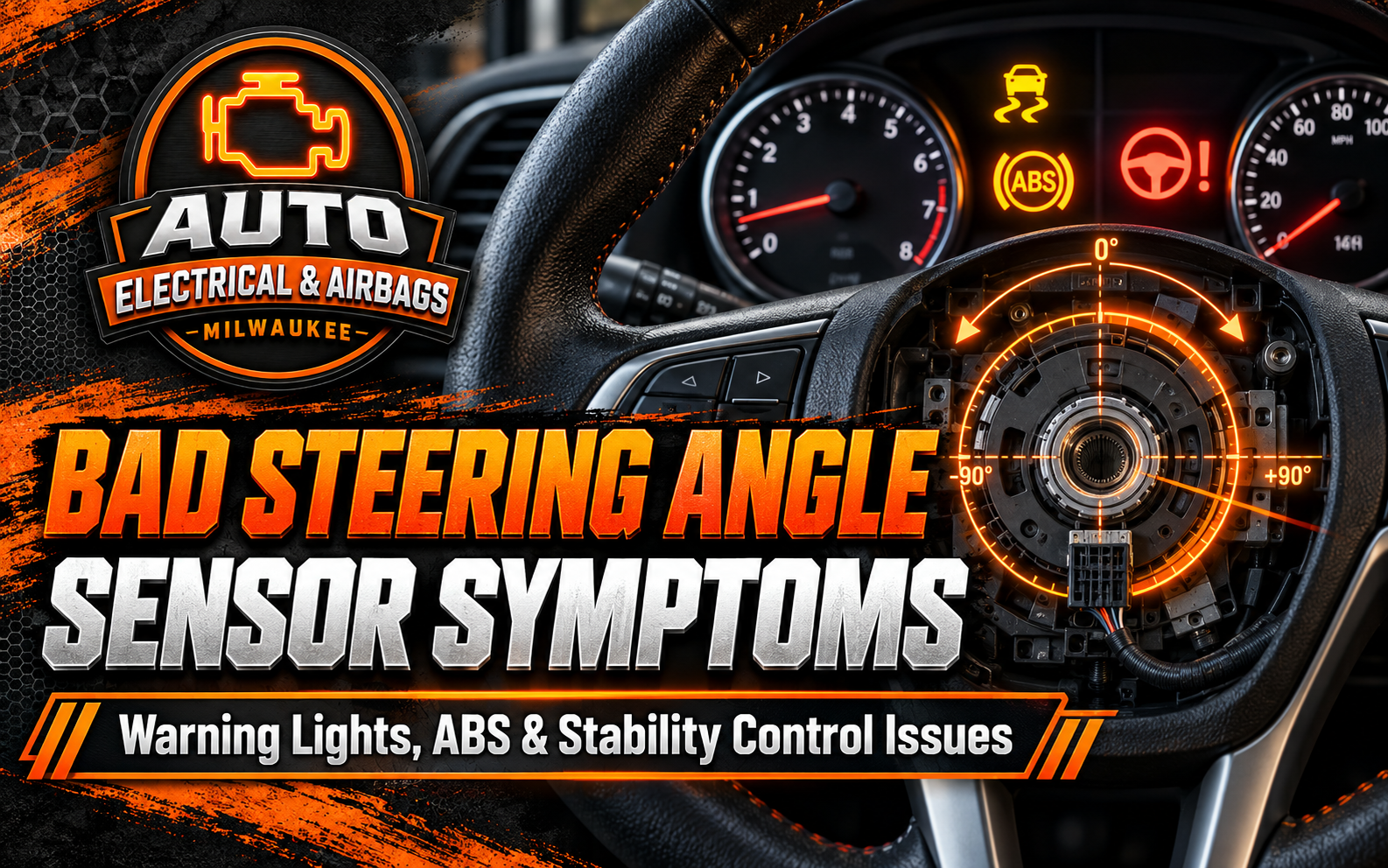
The steering wheel feels normal, but a warning light suddenly appears.
Maybe the traction-control light comes on. The stability-control system becomes unavailable. The power steering warning appears. In some vehicles, several of those warnings show up at the same time.
One possible cause is a problem with the steering angle sensor.
The steering angle sensor helps the vehicle understand the direction and amount the driver is turning the steering wheel. That information can be used by electronic stability control, traction control, electric power steering and other vehicle systems.
When the signal becomes inaccurate, disappears or loses calibration, several electronic systems may react even though the steering wheel itself still turns.
But a trouble code mentioning the steering angle sensor does not automatically mean the sensor itself needs replacement.
The problem may involve calibration, wiring, connectors, low voltage, communication faults or another steering-related component.
This guide explains what a steering angle sensor does, common symptoms of a bad or improperly calibrated sensor, why several warning lights can appear together and how technicians determine what is actually causing the fault.
Quick Answer: What Are the Symptoms of a Bad Steering Angle Sensor?
Possible steering angle sensor symptoms include:
- Traction-control warning light
- Electronic stability-control warning
- Power steering warning light
- ABS-related warning
- Steering assist behaving inconsistently
- Stability-control system unavailable
- Steering wheel position showing incorrectly on scan data
- Warning lights appearing after wheel alignment
- Warning lights appearing after battery replacement
- Warning lights after steering or suspension work
- Diagnostic trouble codes related to steering angle
- Sensor calibration that will not complete
- Intermittent warnings that return after turning the wheel
The exact symptoms depend on the vehicle and how the steering angle information is used.
A steering angle sensor code should be diagnosed before the sensor is automatically replaced.
What Is a Steering Angle Sensor?
The steering angle sensor measures the position and movement of the steering wheel.
Depending on the vehicle, it may provide information such as:
- Steering direction
- Steering wheel angle
- Rate of steering movement
- Center position
This information helps other electronic systems understand what the driver is asking the vehicle to do.
For example, if the steering wheel is turned left but the vehicle begins moving in a way that does not match the expected path, the electronic stability-control system may use braking or engine-control strategies to help maintain stability.
Accurate steering information is therefore important to several modern safety and steering systems.
Where Is the Steering Angle Sensor Located?
Location varies by vehicle.
The sensor may be integrated into or located near:
- Steering column
- Clock spring
- Steering column control module
- Steering rack
- Electronic steering assembly
On some vehicles, the steering angle sensor is not serviced as a simple standalone component.
It may be part of a larger steering or clock-spring assembly.
This is one reason the exact vehicle design should be identified before replacement is recommended.
What Systems Use Steering Angle Information?
Steering angle data may be used by systems such as:
- Electronic stability control
- Traction control
- ABS
- Electric power steering
- Lane-related driver assistance
- Parking assistance
- Adaptive lighting on some vehicles
- Other vehicle dynamics systems
That means one steering-angle problem may create warnings in systems that seem unrelated at first.
Why Can a Steering Angle Sensor Cause Traction-Control or Stability Lights?
Electronic stability-control systems compare several pieces of vehicle information.
Depending on the vehicle, those may include:
- Steering angle
- Wheel speed
- Vehicle yaw
- Lateral acceleration
- Brake application
The vehicle uses steering angle to estimate the direction the driver intends to travel.
If the steering angle information is missing or incorrect, the stability-control system may not be able to make reliable decisions.
The vehicle may then disable the system and illuminate a warning.
Can a Steering Angle Sensor Cause a Power Steering Warning?
Yes, on vehicles where the electronic power steering system uses steering position or steering-related data.
Electric power steering systems may depend on several inputs and components, including:
- Steering angle
- Torque sensor
- Vehicle speed
- EPS module
- Power and ground
- Communication networks
If steering information becomes unavailable, the EPS system may store a fault or alter assistance.
However, a power steering warning has many possible causes.
Our Power Steering Module Repair & EPS Diagnostics in Milwaukee page covers steering-assist problems involving sensors, wiring, module communication and electrical faults.
Why Can ABS, Traction and Steering Lights Appear Together?
Modern vehicle safety systems share information.
A steering angle problem can therefore affect more than one system.
For example:
- The steering angle sensor reports invalid information.
- Stability control can no longer accurately compare driver input with vehicle movement.
- The system stores a fault.
- Traction or stability functions may be disabled.
- Other related modules may also report a problem.
You may then see:
- ABS warning
- Traction-control light
- Stability-control warning
- Power steering warning
That does not necessarily mean four different components failed at the same time.
Your existing guide to multiple dashboard warning lights explains why shared sensor or communication problems can create several warnings at once.
What Causes a Steering Angle Sensor Problem?
Several different conditions can affect the steering angle signal.
Internal Sensor Failure
The sensor itself can fail electronically or mechanically.
Possible symptoms include:
- No steering-angle signal
- Signal that jumps unexpectedly
- Sensor position that does not match the steering wheel
- Calibration that repeatedly fails
Sensor Out of Calibration
The sensor may still function but no longer correctly recognize the straight-ahead position.
For example, the steering wheel may be physically centered while scan data shows the vehicle is turning several degrees left or right.
That can confuse systems that depend on an accurate center reference.
Low Battery Voltage
Low voltage can affect electronic modules and stored calibration information.
After:
- Dead battery
- Jump start
- Battery replacement
- Charging-system failure
the vehicle may store electronic faults or require relearning procedures depending on the design.
Low voltage does not automatically mean the steering angle sensor needs replacement.
Wiring or Connector Problems
A sensor needs proper electrical connections.
Problems may include:
- Broken wiring
- Loose connector
- Corroded terminals
- Damaged connector pins
- Poor power supply
- Poor ground
The sensor can be perfectly functional while the circuit prevents its signal from reaching the appropriate module.
Communication Faults
Steering angle information may travel through vehicle communication networks.
If a module cannot transmit or receive that information, other systems may report the steering-angle data as missing.
That can happen because of:
- CAN bus wiring problem
- Module power loss
- Ground fault
- Gateway problem
- Communication-module fault
For more information, see our guide to CAN bus communication faults.
Steering or Suspension Repairs
Some steering-angle problems appear after work involving:
- Steering rack
- Steering column
- Tie rods
- Suspension
- Wheel alignment
If components are changed or the steering position changes, the sensor may need verification or calibration according to the vehicle’s procedure.
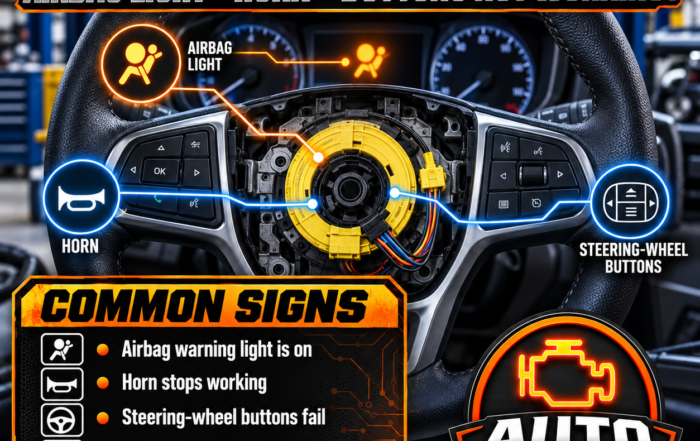
Clock Spring Problems
On some vehicles, the steering angle sensor is associated with the clock spring or steering-column electronics.
A clock-spring problem can potentially affect:
- Steering angle information
- Airbag circuit
- Horn
- Steering-wheel buttons
The exact relationship varies by vehicle design.
Why Can the Warning Light Come On After a Wheel Alignment?
A wheel alignment changes the relationship between the steering wheel and the direction of the road wheels.
If the steering wheel was not centered correctly or if the sensor requires recalibration after the procedure, steering angle information may no longer agree with the vehicle’s actual path.
Possible symptoms include:
- Stability-control warning
- Traction-control light
- Steering warning
- Vehicle pulling while steering wheel appears off-center
The solution is not automatically sensor replacement.
The alignment, steering-wheel position and calibration status should be checked.
Can Battery Replacement Cause a Steering Angle Warning?
It can on some vehicles.
Battery disconnection or low voltage can sometimes cause electronic systems to lose learned information or require initialization.
A warning appearing immediately after battery work may result from:
- Low-voltage history
- Lost calibration
- Loose battery connection
- Ground problem
- Steering relearn requirement
However, if the warning remains or returns, it should be scanned rather than assumed to be normal.
Can a Steering Angle Sensor Make the Steering Wheel Feel Heavy?
Potentially, if the fault affects an electronic power steering system.
EPS systems use sensor information to determine how much steering assistance to provide.
A sensor or communication fault may cause the system to:
- Reduce assistance
- Disable assistance
- Enter a protective mode
The steering wheel may then feel noticeably heavier.
However, stiff steering can also result from:
- EPS motor problem
- Steering torque sensor fault
- Low system voltage
- Wiring
- Mechanical steering problem
- EPS control module fault
A steering-angle fault should therefore be considered as one possible cause, not the only one.
Can a Steering Angle Sensor Cause the Car to Pull?
A sensor fault by itself does not necessarily create a mechanical pull.
A vehicle that physically pulls to one side may have issues involving:
- Wheel alignment
- Tires
- Suspension
- Brakes
- Steering components
However, incorrect steering-angle data can affect systems that use steering information.
If the vehicle pulls and the steering wheel is off-center, alignment and sensor calibration may both need to be evaluated.
Can the Steering Wheel Be Straight While the Sensor Is Wrong?
Yes.
This is possible when the physical steering wheel position and the electronic center reference no longer agree.
For example:
Actual steering wheel: straight
Sensor data: 12 degrees left
The vehicle may interpret that information incorrectly.
A scan tool that displays steering-angle data can help identify this condition.
Does a Steering Angle Sensor Code Mean the Sensor Is Bad?
No.
A steering-angle-related code may result from:
- Sensor failure
- Calibration problem
- Wiring fault
- Connector problem
- Low voltage
- Communication fault
- Steering component replacement
- Alignment problem
The code provides a diagnostic direction.
It does not automatically identify the part that must be replaced.
What Is Steering Angle Sensor Calibration?
Calibration teaches the vehicle what steering position should be considered the correct reference or straight-ahead position.
Depending on the vehicle, calibration may require:
- Diagnostic scan tool
- Steering wheel centered
- Correct wheel alignment
- Vehicle driven under specific conditions
- Manufacturer-specific initialization procedure
The exact process varies.
Some vehicles may learn portions of the steering position automatically.
Others require a scan-tool procedure.
Can You Calibrate a Bad Steering Angle Sensor?
Calibration cannot repair a sensor that has physically or electronically failed.
If the sensor produces an unstable or impossible signal, calibration may fail.
This is why technicians need to determine whether the problem is:
incorrect calibration
or
actual sensor/circuit failure.
How Is a Steering Angle Sensor Problem Diagnosed?
A systematic diagnostic process can prevent unnecessary replacement.
Read the Fault Codes
The first step is scanning the appropriate vehicle systems.
Codes may be stored in:
- ABS module
- Stability-control system
- EPS module
- Steering-column module
- Other related modules
The complete code pattern is important.
Check Live Steering Angle Data
A diagnostic scanner may display the steering angle in real time.
With the steering wheel straight, the technician can determine whether the value appears reasonable.
The wheel can then be turned left and right while watching the signal.
Possible abnormal findings include:
- No change
- Sudden signal jumps
- Impossible values
- Center position significantly incorrect
- Signal disappearing during rotation
Check Battery and System Voltage
Electronic diagnosis should be performed with stable system voltage.
Low voltage can create misleading faults and communication problems.
Inspect Wiring and Connectors
The relevant circuit may need inspection for:
- Loose connections
- Corrosion
- Damage
- Previous steering repairs
- Pinched wiring
Verify Wheel Alignment and Steering Position
If the steering wheel is physically off-center, calibration alone may not address the underlying issue.
The mechanical steering position should make sense before an electronic zero point is established.
Perform Calibration When Appropriate
If the sensor signal is healthy but the reference position is incorrect, the appropriate calibration procedure may solve the fault.
Confirm the Repair
After repair or calibration, technicians may:
- Clear relevant codes
- Recheck live data
- Road test the vehicle
- Verify warnings do not return
The purpose is to confirm that the system now receives plausible steering information.
Steering Angle Sensor vs. EPS Module Problem
These two faults can produce overlapping symptoms.
| Finding | Steering Angle Sensor Possible? | EPS Module Possible? |
|---|---|---|
| Stability-control warning | Yes | Possible |
| Traction-control light | Yes | Possible |
| Steering warning | Yes | Yes |
| Incorrect steering-angle scan data | Strong clue | Less likely |
| No EPS module communication | Less likely | Possible |
| Heavy steering assist | Possible | Yes |
| Calibration fails | Yes | Possible |
| Communication codes | Possible | Yes |
Testing is what separates the two.
Steering Angle Sensor vs. Wheel Speed Sensor
Both sensors can contribute to ABS and stability warnings.
A wheel speed sensor tells the vehicle how fast a wheel is rotating.
A steering angle sensor tells the vehicle where the driver is steering.
Electronic stability systems may compare both.
That means:
- Incorrect wheel speed can create stability warnings.
- Incorrect steering angle can create stability warnings.
The warning light alone cannot tell you which sensor is responsible.
Our guide to bad wheel speed sensor symptoms explains the wheel-speed side of that relationship.
Can a Bad Ground Cause Steering Sensor Problems?
Potentially.
Sensors and control modules require reliable electrical power and ground.
A poor ground may contribute to:
- Unstable voltage
- Communication faults
- Sensor errors
- Module resets
This is one reason technicians may verify supporting circuits before replacing an expensive electronic component.
For more information, read our guide to bad ground wire symptoms.
Can CAN Bus Problems Look Like a Bad Steering Angle Sensor?
Yes.
A steering angle signal may be generated correctly but fail to reach another module.
If communication is interrupted, a receiving module may report that the steering information is missing or invalid.
This is why electrical diagnosis should distinguish between:
- Bad sensor data
- Missing sensor data
- Communication failure
Those are different problems.
Can You Drive With a Steering Angle Sensor Fault?
The vehicle may still be physically drivable, but systems that depend on steering-angle information may be disabled or operate differently.
Those can include:
- Electronic stability control
- Traction control
- Electric steering assistance
A steering or stability-system warning should therefore be diagnosed rather than ignored.
If steering assistance becomes significantly reduced or the vehicle behaves unpredictably, continued driving may not be appropriate.
Should You Replace the Steering Angle Sensor Yourself?
Replacement may be more complicated than it appears.
Depending on the vehicle, the sensor may be:
- Integrated with the clock spring
- Integrated with a steering module
- Located inside steering components
- Dependent on calibration after installation
Incorrect steering-column work can also affect safety systems.
The proper procedure depends on the vehicle.
Why Replacing the Sensor May Not Fix the Warning Light
Replacing a steering angle sensor will not correct:
- Incorrect alignment
- Broken wiring
- Poor connector
- Low voltage
- Communication fault
- EPS module problem
A new sensor may also still require calibration.
That is why the recommended sequence is:
Codes → live data → circuit checks → mechanical position → calibration → replacement if confirmed
rather than immediately replacing the sensor.
When Should You Have a Steering Angle Sensor Problem Diagnosed?
Consider professional diagnosis when:
- ABS, traction or stability warnings appear together
- Power steering warning is present
- Warning appeared after an alignment
- Warning appeared after suspension or steering work
- Warning appeared after battery replacement
- Steering assist becomes inconsistent
- Steering-angle codes keep returning
- Calibration will not complete
- Replacing another sensor did not solve the problem
The important goal is identifying whether the system has a sensor, calibration, electrical or communication problem.
Steering Angle and EPS Diagnostics in Milwaukee
At Auto Electrical & Airbag Specialist in Milwaukee, we diagnose electronic steering problems involving steering sensors, EPS modules, wiring, power and ground circuits, and vehicle communication faults.
If your vehicle has a steering warning light, intermittent assist, steering sensor fault or EPS-related code, learn more about our Power Steering Module Repair & EPS Diagnostics in Milwaukee. The service page specifically covers steering-angle sensor faults, wiring issues and module communication problems.
For broader circuit or communication problems, our auto electrical diagnostics service can help determine whether the fault is coming from the sensor itself or the electrical system supporting it.
Auto Electrical & Airbag Specialist
2636 S 32nd St, Milwaukee, WI 53215
(414) 345-7568
Frequently Asked Questions About Steering Angle Sensors
What is the most common symptom of a bad steering angle sensor?
Common symptoms include traction-control, stability-control or steering warning lights. The exact warning depends on the vehicle and which systems use the steering-angle information.
Can a steering angle sensor cause an ABS light?
It can contribute to ABS or stability-system warnings on vehicles where the ABS/ESC system uses steering-angle information.
Can a bad steering angle sensor cause heavy steering?
Potentially, particularly if the fault causes an EPS system to reduce or disable steering assistance. Other EPS and mechanical problems can create the same symptom.
Why did my steering warning come on after an alignment?
The steering wheel position and electronic steering-angle reference may no longer agree, or calibration may be required depending on the vehicle.
Can disconnecting the battery affect steering angle calibration?
On some vehicles, battery disconnection or a low-voltage event may lead to stored faults or relearn requirements.
Does a steering angle code always mean the sensor needs replacement?
No. Calibration, wiring, connectors, voltage and communication faults can create steering-angle-related codes.
Can a steering angle sensor be recalibrated?
Often, yes, when the sensor is functioning properly but the reference position is incorrect. Procedures vary by vehicle.
Can a bad wheel speed sensor look like a steering angle problem?
Both can trigger traction and stability warnings. Diagnostic codes and live data help determine which input is incorrect.
Can CAN bus problems cause steering-angle codes?
Yes. A communication problem can prevent valid steering-angle data from reaching other modules.
Is the steering angle sensor part of the clock spring?
On some vehicles it may be integrated with or located near the clock spring, but designs vary.
Will replacing the steering angle sensor automatically turn off the warning lights?
Not necessarily. Calibration may still be required, and the warning will remain if wiring, alignment or another system is causing the fault.
How do technicians test a steering angle sensor?
They typically review fault codes, monitor live steering-angle data, check system voltage and related circuits, verify steering alignment and perform calibration when appropriate.
The Bottom Line
A steering angle sensor is a small part with a large role in modern vehicle electronics.
Its information may be used by:
- Stability control
- Traction control
- ABS
- Electronic power steering
When the signal becomes incorrect or unavailable, several warning lights can appear even though only one underlying problem exists.
But a steering-angle code does not automatically mean the sensor is bad.
The real problem could involve:
- Calibration
- Wiring
- Connector
- Low voltage
- Communication
- Alignment
- The sensor itself
The better diagnostic question is:
“Is the steering angle information actually wrong, or is the vehicle unable to receive or interpret it correctly?”
Answering that question first helps avoid unnecessary sensor or module replacement.