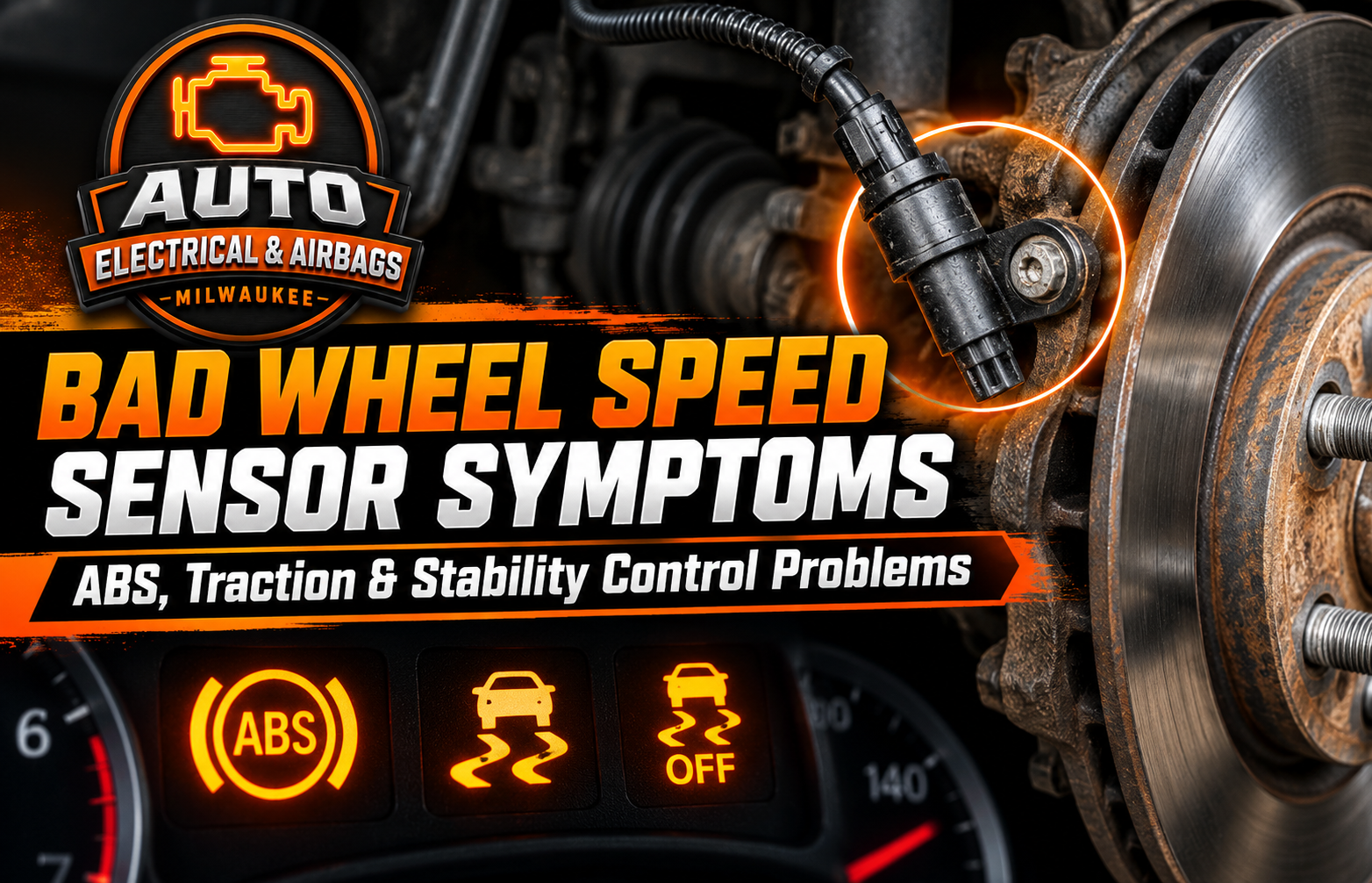
The ABS light comes on.
Then the traction-control light appears.
Maybe the stability-control warning follows.
It can look like three separate systems have failed at the same time.
In reality, all three systems may depend on information from one small component: a wheel speed sensor.
Wheel speed sensors tell the vehicle how fast each wheel is rotating. That information is used by the anti-lock braking system and can also be shared with traction-control and electronic stability-control systems.
When one wheel speed signal becomes inaccurate or disappears, several safety systems may disable themselves or illuminate warning lights.
But a trouble code mentioning a wheel speed sensor does not automatically mean the sensor itself needs replacement.
Damaged wiring, corrosion, wheel-bearing problems, connector faults and even debris can sometimes create the same symptoms.
This guide explains what wheel speed sensors do, common symptoms of failure, why several warning lights may appear together and how technicians determine whether the real problem is the sensor, wiring or another part of the ABS system.
Quick Answer: What Are the Symptoms of a Bad Wheel Speed Sensor?
Possible symptoms include:
- ABS warning light
- Traction-control light
- Electronic stability-control warning
- ABS activating unexpectedly at low speeds
- Traction control activating when the wheels are not slipping
- Cruise-control problems on some vehicles
- Speed-related diagnostic trouble codes
- Warning lights that appear and disappear
- Problems beginning after wheel bearing or brake work
- Wheel speed data that drops out on a scan tool
The symptoms depend on the vehicle and which wheel signal is affected.
A sensor fault should be diagnosed before the sensor is automatically replaced.
What Does a Wheel Speed Sensor Do?
A wheel speed sensor monitors the rotational speed of a wheel.
The vehicle uses that information to understand whether the wheels are rotating at similar speeds.
During normal driving, wheel speed values should generally make sense compared with one another.
During braking, if one wheel begins slowing much faster than the others, the ABS system may interpret that as wheel lockup.
During acceleration, if one driven wheel begins spinning faster than expected, traction control may detect wheel slip.
Wheel speed information may therefore contribute to:
- Anti-lock braking
- Traction control
- Electronic stability control
- Hill-assist functions
- Certain all-wheel-drive systems
- Other vehicle control strategies
Because several systems can depend on the same data, one wheel speed problem may cause multiple warnings.
Why Do the ABS and Traction-Control Lights Often Come On Together?
ABS and traction control use related information.
The ABS system monitors wheel speed to help prevent wheel lock during braking.
Traction control monitors wheel behavior to help reduce excessive wheel spin.
If one wheel speed signal becomes unreliable, both systems may lose information they need.
The vehicle may then:
- Turn on the ABS warning light
- Turn on the traction-control light
- Disable electronic stability control
- Store diagnostic trouble codes
This is why your vehicle can suddenly display several warnings even though only one underlying fault exists.
Our guide to ABS and traction control lights coming on together explains the broader relationship between these systems.
Where Are Wheel Speed Sensors Located?
Wheel speed sensors are typically located near each wheel.
Depending on the vehicle, the sensor may read wheel rotation using a tone ring or magnetic encoder associated with:
- Wheel hub
- Wheel bearing
- Axle
- CV joint
- Other rotating component
The exact design varies by manufacturer.
The sensor must be able to generate or transmit an accurate signal as the wheel rotates.
If the signal becomes inconsistent, the ABS module may detect a fault.
What Causes a Wheel Speed Sensor to Fail?
Several problems can affect wheel speed information.
Internal Sensor Failure
The sensor itself can fail electrically.
An internal fault may cause:
- No signal
- Weak signal
- Intermittent signal
In that situation, replacement may be necessary.
Damaged Sensor Wiring
Wiring near the wheel is exposed to:
- Road debris
- Moisture
- Salt
- Heat
- Suspension movement
- Steering movement
A wire can become:
- Broken
- Stretched
- Chafed
- Corroded
- Pinched
A damaged wire can create the same diagnostic symptoms as a bad sensor.
Corroded Connector
A connector near the wheel can develop corrosion or water contamination.
This may create:
- High resistance
- Intermittent connection
- Complete loss of signal
Damaged Tone Ring or Magnetic Encoder
The sensor needs something to read.
Depending on vehicle design, that may be a toothed tone ring or magnetic encoder.
If that component becomes:
- Cracked
- Rusted
- Damaged
- Contaminated
the wheel speed signal can become inaccurate even though the sensor itself is functional.
Wheel Bearing Problems
On some vehicles, the wheel speed encoder is integrated into the wheel bearing or hub assembly.
A bearing problem can therefore affect wheel speed information.
This is one reason a wheel speed code should not automatically result in sensor replacement.
Debris or Contamination
Heavy rust, metallic debris or contamination near the sensor and encoder can sometimes interfere with the signal.
Collision or Suspension Damage
An impact near the wheel area can damage:
- Sensor wiring
- Connector
- Hub
- Tone ring
- Mounting position
If the warning lights appeared after collision or suspension work, that history should be considered.
Can a Bad Wheel Speed Sensor Make the ABS Light Come On?
Yes.
A missing or implausible wheel speed signal is a common reason for an ABS warning.
When the ABS module can no longer trust information from one wheel, it may disable anti-lock braking functions and illuminate the warning light.
The normal hydraulic brakes may still function, but ABS assistance may be unavailable depending on the fault.
Because braking systems are safety-critical, an ABS warning should be diagnosed rather than ignored.
Can a Bad Wheel Speed Sensor Cause the Traction-Control Light?
Yes.
Traction control depends on accurate wheel-speed comparison.
If one sensor reports the wrong speed, the control system may not be able to determine whether a wheel is actually slipping.
The vehicle may then disable traction control and turn on the warning light.
Can a Wheel Speed Sensor Cause the Stability-Control Light?
Yes.
Electronic stability control may use information including:
- Wheel speed
- Steering angle
- Yaw information
- Brake status
If wheel speed data is missing or inaccurate, the stability-control system may also become unavailable.
This explains why one sensor problem can produce three warnings:
- ABS
- Traction control
- Stability control
Can a Bad Wheel Speed Sensor Cause ABS to Activate at Low Speed?
It can.
This is an important symptom.
Imagine the vehicle is slowing normally at a low speed.
Three wheel sensors report approximately the same wheel speed.
One sensor suddenly reports zero or an unexpectedly low value.
The ABS module may interpret that signal as the wheel locking.
It may activate ABS even though the wheel is not actually skidding.
The driver may feel:
- Brake pedal pulsation
- ABS vibration
- Unexpected ABS activation just before stopping
This type of symptom may involve:
- Wheel speed sensor
- Tone ring
- Encoder
- Sensor gap
- Wiring
- Wheel bearing
Live wheel speed data can help identify which wheel signal behaves incorrectly.
Can a Wheel Speed Sensor Cause the Speedometer to Stop Working?
On some vehicles, possibly.
Vehicle speed may be calculated using information from the ABS system or other sensors.
However, speedometer operation varies by manufacturer and vehicle architecture.
A failed wheel speed sensor does not universally cause the speedometer to stop working.
The vehicle’s specific data path must be considered.
Can a Bad Wheel Speed Sensor Affect Cruise Control?
On some vehicles, yes.
Cruise control may depend on accurate vehicle-speed information.
If ABS or stability-control faults are present, the vehicle may disable cruise control as a precaution.
But cruise-control failure has many possible causes, so a wheel speed sensor should not be assumed without diagnostic evidence.
Can a Wheel Speed Sensor Cause a Check Engine Light?
Usually, wheel speed sensor faults are more directly associated with ABS, traction and stability systems.
However, modern vehicles share information between control modules.
Depending on the vehicle, networked systems may store related faults when wheel-speed information becomes unavailable.
The exact warning lights and codes depend on the manufacturer.
Why Can a Wheel Speed Sensor Code Come and Go?
Intermittent wheel speed sensor problems are common.
The fault may depend on:
- Vehicle movement
- Steering angle
- Suspension travel
- Temperature
- Moisture
- Vibration
A damaged wire may make contact in one position and lose it in another.
Corrosion may also create a connection that works sometimes but not others.
This can cause warning lights that:
- Come on during driving
- Disappear after restarting
- Return after hitting bumps
- Appear after rain or snow
Intermittent faults often require live-data testing or circuit inspection rather than simply reading one stored code.
Why Can the ABS Light Come On After Wheel Bearing Replacement?
If an ABS warning begins immediately after wheel bearing or hub replacement, several possibilities should be considered.
These can include:
- Wrong bearing or hub
- Damaged encoder
- Sensor damaged during repair
- Sensor wiring disturbed
- Connector left loose
- Incorrect installation
- Encoder installed in the wrong orientation on designs where orientation matters
That does not automatically mean the new bearing is defective.
The wheel speed signal should be checked.
Why Can the ABS Light Come On After Brake Work?
Routine brake pad or rotor replacement does not normally require wheel speed sensor replacement.
However, work performed near the wheel can sometimes disturb:
- Sensor wiring
- Connector routing
- Harness clips
If the warning appeared immediately after brake or suspension work, the recently serviced area should be inspected.
Does an ABS Code Mean the Wheel Speed Sensor Is Bad?
Not necessarily.
This is one of the most important points in this article.
A code associated with a wheel speed circuit may result from:
- Failed sensor
- Broken wire
- Loose connector
- Corrosion
- Tone-ring damage
- Wheel-bearing encoder problem
- Power or ground fault
- ABS module issue
The code identifies the system that detected the fault.
Testing identifies the failed part.
How Is a Wheel Speed Sensor Problem Diagnosed?
Diagnosis depends on the specific code and vehicle.
Perform a Full ABS Scan
A diagnostic scanner can retrieve ABS-related trouble codes.
Technicians may look for:
- Specific wheel circuit codes
- Signal plausibility codes
- Communication faults
- Voltage-related faults
The code helps narrow the area that requires testing.
Compare Live Wheel Speed Data
One of the most useful tests is comparing wheel speed readings while the wheels rotate.
For example:
- Left front: 20 mph
- Right front: 20 mph
- Left rear: 20 mph
- Right rear: 0 mph
That pattern gives a strong clue.
Other problems are more subtle.
One wheel may briefly drop from 20 mph to 5 mph while the others remain steady.
That kind of dropout can explain intermittent ABS activation.
Inspect Sensor Wiring
The wiring can be checked for:
- Cuts
- Chafing
- Stretching
- Corrosion
- Loose connectors
- Previous repairs
A sensor near a moving suspension component can have wiring that looks normal at rest but fails as the wheel turns or suspension moves.
Inspect the Tone Ring or Encoder
If the sensor tests correctly but the signal remains wrong, the surface it reads may need inspection.
Possible problems include:
- Cracks
- Rust
- Missing sections
- Physical damage
- Bearing-related encoder failure
Check the Wheel Bearing
Bearing looseness or damage can affect the relationship between the sensor and encoder on certain designs.
If wheel bearing noise, play or recent hub work is present, that information matters.
Test the Electrical Circuit
Depending on sensor type, technicians may evaluate:
- Power
- Ground
- Signal
- Resistance
- Waveform
- Circuit continuity
The correct test depends on the sensor design.
Wheel Speed Sensor vs. Wheel Bearing Problem
These problems can overlap.
| Symptom | Wheel Speed Sensor Possible? | Wheel Bearing/Encoder Possible? |
|---|---|---|
| ABS warning light | Yes | Yes |
| Traction-control warning | Yes | Yes |
| Wheel speed drops out | Yes | Yes |
| Grinding or humming noise | Less typical | Stronger clue |
| Wheel play | No | Stronger clue |
| Sensor circuit fault | Yes | Possible indirectly |
| Problem began after hub replacement | Possible | Strong clue |
| ABS activates at low speed | Yes | Yes |
This is why diagnosis should consider both the electrical sensor and the mechanical component it reads.
Can Wiring Make a Good Wheel Speed Sensor Look Bad?
Absolutely.
A perfectly functional sensor cannot send useful data through a broken or corroded circuit.
Common wiring problems include:
- Open circuit
- Short to ground
- Short to voltage
- High resistance
- Connector corrosion
Replacing the sensor will not repair a damaged wire.
For vehicles with suspected harness problems, our car wiring repair in Milwaukee focuses on locating and repairing the actual circuit fault.
Can Low Battery Voltage Cause ABS Warning Lights?
Yes, low voltage can sometimes contribute to ABS and electronic-system warnings.
ABS modules require stable electrical power.
A weak battery, poor connection or charging problem can cause modules to:
- Reset
- Store low-voltage codes
- Temporarily stop communicating
However, a specific recurring wheel speed fault should still be diagnosed rather than automatically blamed on the battery.
Can CAN Bus Problems Cause ABS Warnings?
Yes.
The ABS module communicates with other electronic systems through vehicle networks.
A communication fault may cause:
- ABS warning
- Traction-control warning
- Stability-control warning
- Lost communication codes
If several modules cannot communicate, the fault may be broader than one wheel sensor.
Our guide to CAN bus communication faults explains why module communication problems can create multiple warning lights.
Can You Drive With a Bad Wheel Speed Sensor?
The vehicle may still move and the basic hydraulic braking system may still operate, but ABS, traction-control or stability-control functions may be disabled depending on the fault.
Those systems are designed to assist vehicle control in conditions such as:
- Hard braking
- Slippery roads
- Wheel slip
- Emergency maneuvers
Because the warning can indicate reduced electronic braking assistance, the fault should be diagnosed rather than ignored.
Should You Replace All Four Wheel Speed Sensors?
No.
There is generally no reason to replace every wheel speed sensor simply because one circuit has a fault.
Diagnosis should identify:
- Which wheel is affected
- Whether the sensor is actually faulty
- Whether wiring or another component caused the problem
Replacing multiple functioning sensors increases repair cost without necessarily solving the underlying issue.
Why Cheap Sensor Replacement Sometimes Does Not Fix the ABS Light
Wheel speed sensors can sometimes be relatively easy to replace.
That makes them tempting to replace before proper testing.
But the warning may return when the actual problem is:
- Wiring
- Hub encoder
- Corroded connector
- Wheel bearing
- ABS module
- Communication issue
A better repair strategy is:
Code → live data → circuit inspection → component testing → repair
rather than:
Code → immediately replace sensor
When Should You Have an ABS or Wheel Speed Sensor Problem Diagnosed?
Consider professional diagnosis when:
- ABS light stays on
- ABS and traction-control lights appear together
- Stability-control warning is also present
- ABS activates unexpectedly at low speeds
- Warning began after wheel or brake work
- Warning appears intermittently
- A wheel speed sensor code keeps returning
- Replacing the sensor did not solve the problem
- Several electronic warnings are present
The sooner the actual fault is identified, the less likely you are to replace good components unnecessarily.
ABS and Wheel Speed Sensor Diagnostics in Milwaukee
At Auto Electrical & Airbag Specialist in Milwaukee, we diagnose electronic brake-system problems involving wheel speed sensors, ABS warning lights, traction-control faults, wiring, connectors and ABS-related communication problems.
Our Brake Services & ABS Diagnostics in Milwaukee page covers both mechanical brake concerns and electronic ABS-related faults. The service page specifically includes ABS warning lights and brake-sensor diagnostics, making it the natural next step when a wheel speed problem needs professional testing.
If testing points toward damaged wiring rather than the sensor itself, our car wiring repair service can address circuit and connector faults.
Auto Electrical & Airbag Specialist
2636 S 32nd St
Milwaukee, WI 53215
(414) 345-7568
Frequently Asked Questions About Wheel Speed Sensors
What is the most common symptom of a bad wheel speed sensor?
An ABS warning light is common, often accompanied by traction-control or stability-control warnings because those systems share wheel speed information.
Can one bad wheel speed sensor cause several warning lights?
Yes. ABS, traction control and stability control may all depend on the same wheel speed signal.
Can a wheel speed sensor cause ABS to activate when stopping slowly?
Yes. If one sensor incorrectly reports that a wheel has stopped rotating, the ABS system may interpret that as wheel lockup and activate.
Does a wheel speed sensor code always mean the sensor is bad?
No. Damaged wiring, a corroded connector, tone-ring problems or wheel-bearing encoder issues can create similar codes.
Can a bad wheel bearing cause an ABS light?
Yes, on vehicles where the wheel speed encoder is part of or closely associated with the hub or bearing assembly.
Can a bad wheel speed sensor cause traction control to stop working?
Yes. Traction control uses wheel speed information to detect wheel spin.
Can a wheel speed sensor problem be intermittent?
Yes. Wiring damage, corrosion or encoder problems can cause the signal to drop out only under certain conditions.
Can an ABS light come on after brake work?
It can if wheel speed sensor wiring or connectors were disturbed, although ordinary brake service itself should not automatically create an ABS fault.
Can low battery voltage cause an ABS light?
It can. ABS modules need stable voltage, and low-voltage events can cause electronic-system warnings or stored faults.
Should all four wheel speed sensors be replaced together?
No. Only the actual failed component or circuit should be repaired unless there is another specific reason to replace additional sensors.
How do technicians test a wheel speed sensor?
Testing may include reading ABS trouble codes, comparing live wheel-speed data, inspecting the wiring and encoder, and electrically testing the sensor circuit.
Is a bad wheel speed sensor a brake problem or an electrical problem?
It can involve both. The sensor is part of the electronic ABS system, while its data affects braking and stability functions. Diagnosis may therefore involve both brake-system and electrical testing.
The Bottom Line
A bad wheel speed signal can make a vehicle look like it has several separate failures.
One problem may cause:
- ABS warning light
- Traction-control warning
- Stability-control warning
- Unexpected ABS activation
But a wheel speed code does not automatically mean the sensor itself has failed.
The real cause could be:
- Sensor
- Wiring
- Connector
- Tone ring
- Magnetic encoder
- Wheel bearing
- ABS system fault
The better diagnostic question is not:
“Which wheel speed sensor should I replace?”
It is:
“Why is the ABS module receiving the wrong wheel speed information?”
Answering that question first helps identify the actual fault and prevents unnecessary parts replacement.
ABS and Wheel Speed Sensor Diagnostics in Milwaukee
At Auto Electrical & Airbag Specialist in Milwaukee, we diagnose electronic brake-system problems involving wheel speed sensors, ABS warning lights, traction-control faults, wiring, connectors and ABS-related communication problems.
Our Brake Services & ABS Diagnostics in Milwaukee page covers both mechanical brake concerns and electronic ABS-related faults. If testing points toward damaged wiring rather than the sensor itself, our car wiring repair service can address circuit and connector faults.
Auto Electrical & Airbag Specialist
2636 S 32nd St, Milwaukee, WI 53215
(414) 345-7568