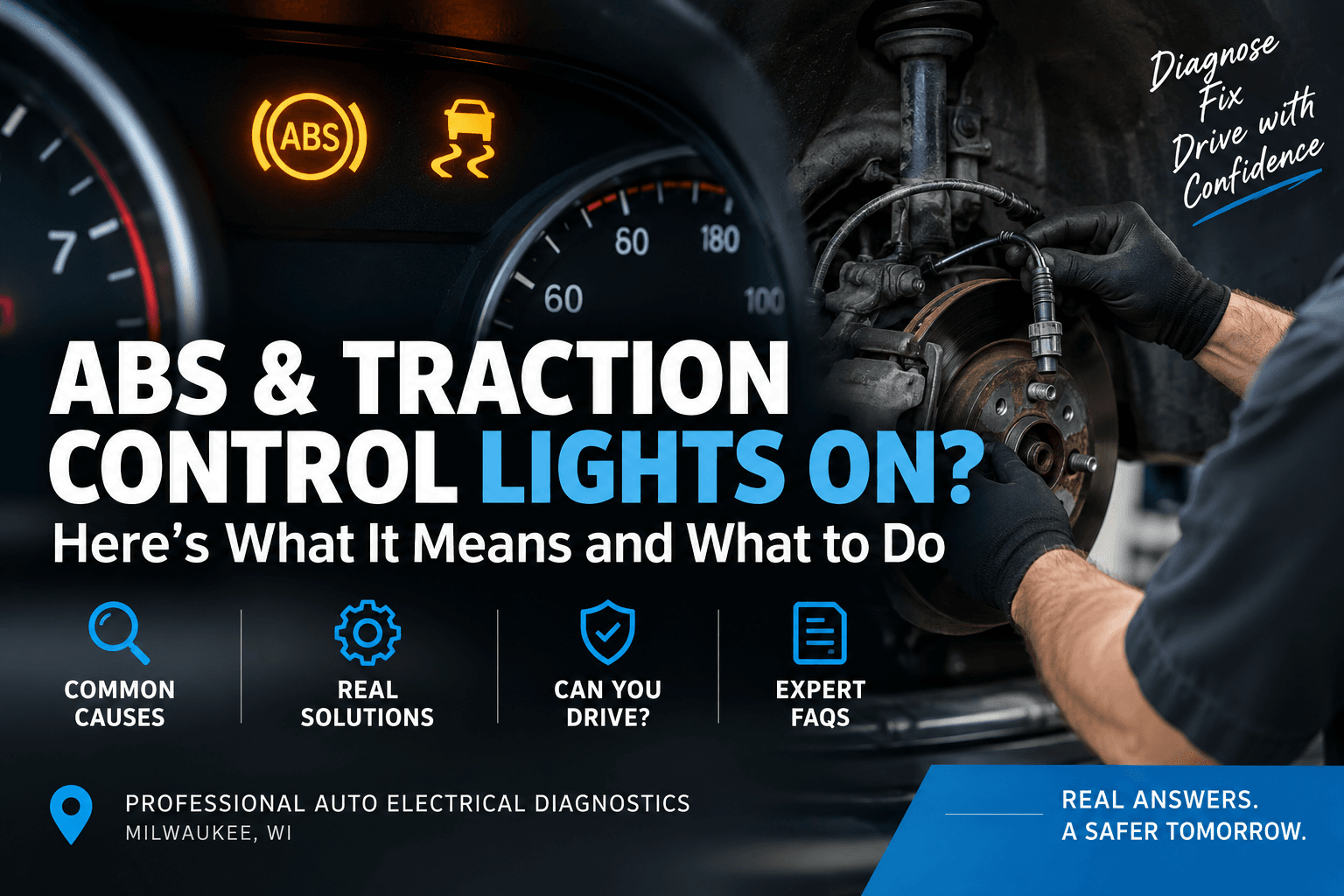
Why Are My ABS and Traction Control Lights On at the Same Time?
When the ABS light and traction control light come on together, the two warnings may be connected rather than representing two completely separate problems.
That is because the Anti-lock Braking System and traction-control system share information from several of the same sensors and electronic systems. One missing or unreliable signal—such as a wheel-speed signal—can cause the vehicle to disable both functions and illuminate both warning lights.
Common causes include a failed wheel-speed sensor, damaged sensor wiring, a bad electrical connection, a damaged tone ring or wheel-bearing-related problem, low system voltage, steering-angle information that is missing or incorrect, or an ABS module, power, ground, or communication fault.
The warning lights tell you which systems detected a problem. They do not automatically tell you which part needs replacement.
Quick Answer: What Should You Do First?
If both lights appear:
- Pay attention to whether the vehicle brakes and handles normally.
- Look for a red brake warning light or other serious warnings.
- Do not assume the ABS module has failed.
- Do not automatically replace a wheel-speed sensor based only on a code.
- Have the ABS system scanned with equipment capable of accessing ABS data.
- Inspect the affected sensor circuit, wiring, connectors, voltage, and related components before replacing parts.
If the red brake warning light is also on, the brake pedal feels abnormal, braking performance has changed, or the vehicle feels unsafe to control, stop driving when it is safe to do so and have the vehicle inspected.
What Is the Difference Between ABS and Traction Control?
Although the two systems work together, they perform different jobs.
ABS
ABS stands for Anti-lock Braking System.
During hard braking, ABS is designed to help prevent the wheels from locking completely. The system monitors wheel speed and can rapidly adjust brake pressure when it detects that a wheel is about to stop rotating.
Traction Control
Traction control is designed to help reduce excessive wheel spin during acceleration.
If one driven wheel begins spinning much faster than the others, the vehicle may use braking or engine-management controls to help restore traction.
Both systems need reliable information about what the wheels are doing.
That shared information is why one sensor problem can potentially affect ABS, traction control, and electronic stability control at the same time.
The Most Common Causes of ABS and Traction Control Lights Together
Several problems can trigger both warnings. The exact cause depends on the vehicle and the diagnostic codes stored.
1. Wheel-Speed Sensor Problem
A wheel-speed sensor is one of the first components that may need to be investigated when ABS and traction-control warnings appear together.
Each sensor monitors the rotational speed of a wheel and sends that information to the ABS system.
If one sensor stops producing a reliable signal, the vehicle may no longer know whether that wheel is:
- Rotating normally
- Locking during braking
- Spinning during acceleration
- Moving at the same speed as the other wheels
The system may then disable functions that depend on that information.
Possible wheel-speed-sensor symptoms include:
- ABS and traction-control lights together
- Stability-control warning
- Warnings that appear and disappear
- ABS activating unexpectedly at low speeds
- Warning appearing after rain or snow
- Warning beginning after wheel, brake, suspension, or bearing work
However, a trouble code mentioning a wheel-speed sensor does not automatically prove the sensor itself is bad.
The wiring and circuit connected to that sensor can create the same result.
2. Damaged Wheel-Speed Sensor Wiring
Wheel-speed sensor wiring lives in a difficult environment.
It may be exposed to:
- Water
- Road salt
- Snow
- Ice
- Heat
- Road debris
- Suspension movement
- Steering movement
- Previous repair work
A broken, rubbed-through, stretched, corroded, or poorly connected wire can interrupt the signal even when the sensor itself still works.
This is particularly important for Milwaukee-area vehicles, where winter conditions, moisture, road salt, and repeated freeze-thaw cycles can expose existing connector and wiring weaknesses.
Possible signs of wiring trouble include warnings that:
- Come on after hitting bumps
- Appear only occasionally
- Become worse after rain
- Began after suspension or brake work
- Disappear and later return
- Change while turning the steering wheel
Electrical testing helps determine whether the problem is the sensor or the circuit feeding it.
3. Damaged Connector or Corrosion
An electrical connector can look intact from the outside while having poor contact inside.
Possible connector problems include:
- Corroded terminals
- Water intrusion
- Loose pins
- Bent terminals
- Broken locking tabs
- Dirt or contamination
- Previous improper repairs
A small amount of additional resistance or an intermittent connection can make the sensor signal unreliable.
This is one reason simply replacing the sensor may not fix the warning.
If the new sensor plugs into the same damaged connector, the fault can return.
4. Tone Ring or Wheel-Bearing Problem
The wheel-speed sensor needs something to read.
Depending on the vehicle, the system may use a magnetic encoder or tone ring associated with the wheel hub, bearing, axle, or another rotating component.
If that target becomes:
- Damaged
- Cracked
- Corroded
- Contaminated
- Misaligned
the sensor may produce incorrect wheel-speed information even though the sensor itself is functioning.
Some wheel-bearing assemblies also incorporate the wheel-speed sensing surface.
That means a warning related to one wheel should not automatically result in a sensor replacement without inspecting the related wheel components.
5. Low Battery Voltage or Charging-System Problems
ABS and traction-control systems are electronic.
They depend on stable vehicle voltage just like other control modules.
If system voltage becomes too low or unstable, electronic modules may:
- Store voltage-related fault codes
- Temporarily lose communication
- Disable certain functions
- Illuminate multiple warning lights
You may notice the ABS and traction-control lights together with:
- Battery warning light
- Power-steering warning
- Check-engine light
- Airbag or SRS warning
- Driver-assistance warnings
When several warnings suddenly appear together, it becomes especially important to look for a shared electrical problem rather than assuming several unrelated components failed simultaneously.
Our guide to multiple dashboard warning lights coming on together explains this relationship in more detail.
6. Steering-Angle Sensor or Calibration Problem
Electronic stability and traction-control systems may use information about the direction the driver intends to steer.
The steering-angle sensor helps provide that information.
Problems can sometimes appear after:
- Wheel alignment
- Steering repairs
- Suspension work
- Battery disconnection
- Collision repairs
- Steering-component replacement
Depending on the vehicle, the sensor may have a fault or the system may require calibration or relearning.
This does not mean every ABS and traction-control warning after an alignment is caused by steering-angle calibration.
It simply becomes another piece of diagnostic information worth checking.
7. ABS Module, Power, Ground, or Communication Fault
The ABS control system needs:
- Electrical power
- Good grounds
- Proper wiring
- Reliable communication
- Valid sensor information
If the module loses one of these, it may stop communicating or disable ABS-related functions.
Possible causes include:
- Blown fuse
- Poor module ground
- Damaged wiring
- Corroded connector
- Low voltage
- Communication-network problem
- Internal module fault
The important distinction is that an ABS module communication code does not automatically mean the ABS module itself is bad.
A perfectly functional module cannot communicate if it has lost power or ground.
Testing should confirm those supporting circuits before an expensive module is replaced.
Can Low Brake Fluid Cause the ABS and Traction Control Lights?
Depending on the vehicle, brake-fluid level and other braking-system conditions may contribute to brake or ABS warnings.
If a red brake warning accompanies the ABS light, check the vehicle manufacturer’s instructions and have the braking system inspected.
Low brake fluid should not simply be topped off repeatedly without determining why the level is low.
Brake-pad wear, hydraulic leaks, or another brake-system condition may require attention.
Why Are the ABS, Traction Control, and Stability Control Lights All On?
This combination makes sense once you understand that these systems often share information.
ABS uses wheel-speed information during braking.
Traction control uses wheel-speed information to detect wheel spin.
Electronic stability control may use:
- Wheel speed
- Steering angle
- Vehicle movement information
- Brake-system information
If one important input disappears, the vehicle may disable several systems because it no longer has enough reliable information to operate them correctly.
So three dashboard lights do not necessarily mean three failed parts.
One missing wheel-speed signal may be enough to affect all three systems.
What If the ABS, Traction Control, and Check Engine Lights Are On?
When the check-engine light joins the ABS and traction-control warnings, the relationship becomes more vehicle-specific.
Some vehicles may disable traction control when certain engine-management faults are present because traction control can depend on the engine computer’s ability to reduce engine torque.
Other possibilities include:
- Low system voltage
- Communication problems
- Multiple stored faults
- Shared sensor information
- Separate unrelated problems
The correct approach is to scan all affected modules rather than reading only the engine computer.
A basic engine-code scanner may show one part of the story while completely missing the ABS fault.
What If the ABS, Traction Control, and Power Steering Lights Are On?
Electronic power-steering systems also communicate with other vehicle modules.
If ABS, traction-control, and steering warnings appear together, possible areas to investigate may include:
- System voltage
- Wheel-speed information
- Steering-angle information
- Module communication
- Power and grounds
- Network wiring
This is another situation where replacing the component represented by each dashboard symbol can quickly become expensive.
The vehicle should be diagnosed as an interconnected electronic system.
Why Did the ABS and Traction Control Lights Come On After Replacing the Battery?
Battery replacement can sometimes be followed by several warning lights.
Possible reasons include:
- Voltage became very low before the old battery was replaced
- Low-voltage codes remain stored
- A battery connection is loose
- Ground connection is poor
- A sensor needs recalibration
- A module lost learned information
- The original electrical problem still exists
Some warnings may clear after the vehicle performs its normal system checks.
Others remain because an actual fault is still present.
If multiple warning lights continue after battery replacement, do not assume the battery replacement damaged several systems.
Check the electrical connections, system voltage, stored trouble codes, and affected circuits.
Our auto electrical diagnostics in Milwaukee service covers voltage, power, ground, wiring, and module-related faults when the problem extends beyond the brake system.
Why Did the Lights Come On After a Wheel Bearing Replacement?
This is useful information to tell the repair shop.
Depending on the vehicle, wheel-bearing or hub service can involve components located close to the wheel-speed sensor.
A warning after wheel-bearing work may involve:
- Sensor connection
- Sensor wiring
- Sensor damage
- Incorrect or damaged encoder
- Wheel-bearing installation issue
- Connector not fully seated
This does not prove the previous repair was performed incorrectly.
It simply means the timing of the warning can help narrow down what should be checked first.
Why Did the ABS Light Come On After Brake Work?
Brake work can occur near wheel-speed sensors, wiring, hubs, and related components.
If the warning began immediately after brake service, tell the technician.
Useful information includes:
- Which wheel was serviced
- Whether rotors or pads were replaced
- Whether wheel bearings or hubs were involved
- Whether suspension work was performed
- Whether the warning appeared immediately or later
The recent repair history can make diagnosis more efficient.
Why Did My ABS and Traction Control Lights Come On After an Alignment?
A wheel alignment itself does not necessarily create an ABS fault.
However, steering-angle data may be important to stability-control systems on some vehicles.
If a warning appears immediately after alignment or steering work, possible areas to check include:
- Steering-angle sensor readings
- Calibration
- Wheel-speed data
- Sensor wiring disturbed during related repairs
- Existing fault that became apparent at the same time
Again, the timing is diagnostic information—not proof of the cause.
Why Do the ABS and Traction Control Lights Come On Only Sometimes?
Intermittent warnings often point toward a problem that is not permanently present.
Possible causes include:
- Loose connector
- Broken wire making intermittent contact
- Corrosion
- Weak electrical connection
- Sensor beginning to fail
- Damaged tone ring
- Voltage fluctuation
- Moisture intrusion
Write down when the warning appears.
Does it happen:
- After rain?
- During cold weather?
- At highway speed?
- While turning?
- After hitting bumps?
- During startup?
- Only after driving for a while?
A pattern can help identify the affected circuit.
Why Do the Lights Come On After Rain or Snow?
Moisture can expose electrical weaknesses that may not be obvious in dry conditions.
Water may reach:
- Wheel-speed sensor connectors
- Damaged sensor wiring
- Corroded terminals
- Ground connections
- Module connectors
Winter conditions can also expose sensors and wiring near the wheels to road salt, snow, slush, and debris.
If the warning disappears after the vehicle dries, that does not necessarily mean the problem fixed itself.
Moisture-related electrical problems often return.
Why Does the ABS Light Come On at Low Speeds?
If ABS activates unexpectedly or the warning appears at low speeds, inaccurate wheel-speed information may be one area worth investigating.
For example, one wheel may briefly report a speed different from the others because of:
- Weak sensor signal
- Damaged tone ring
- Wheel-bearing-related issue
- Sensor gap problem
- Wiring fault
Viewing live wheel-speed information while reproducing the problem can help identify whether one wheel is reporting something abnormal.
Can You Drive With the ABS and Traction Control Lights On?
It depends on the vehicle, which warning lights are present, and how the vehicle is behaving.
When only the amber ABS and traction-control warnings are illuminated, the vehicle’s basic braking system may still function, but ABS, traction control, or stability-control assistance may be reduced or unavailable.
That matters most during:
- Emergency braking
- Slippery roads
- Snow
- Ice
- Heavy rain
- Loss-of-traction situations
Milwaukee drivers should take this especially seriously during winter conditions, when traction and anti-lock braking assistance can become particularly important.
Do not continue normal driving if:
- The red brake warning is on
- Brake pedal feels different
- Braking performance has changed
- Steering control is affected
- Vehicle feels unstable
- You hear severe grinding or other abnormal braking noises
If the vehicle feels unsafe, stop driving when it is safe to do so.
Will the ABS Light Reset Itself?
Sometimes a warning light turns off when the vehicle no longer detects the fault.
That does not necessarily mean the underlying problem has permanently disappeared.
An intermittent sensor or wiring problem may work normally for several trips before failing again.
The vehicle may also retain history codes that provide useful information even after the warning turns off.
If the warning repeatedly appears and disappears, diagnosis is still worthwhile.
Should I Disconnect the Battery to Reset the ABS Light?
Disconnecting the battery is not a repair.
It may:
- Clear certain stored information
- Create additional low-voltage or calibration issues
- Temporarily turn off a warning
But if the underlying sensor, wiring, voltage, or module problem remains, the warning will return.
Clearing codes can also erase useful diagnostic information.
It is generally better to identify and record the faults before resetting the system.
Can a Free Code Scan Diagnose an ABS Light?
Not always.
Many inexpensive or basic code readers primarily communicate with the engine computer.
The check-engine light uses engine-related diagnostic information, but ABS faults are stored in the ABS system.
A scanner used for ABS diagnosis may need to:
- Communicate with the ABS module
- Read ABS-specific codes
- Display individual wheel speeds
- View switch and sensor data
- Check module communication
A free engine-code scan that shows “no codes” does not necessarily mean the ABS system has no stored faults.
Our guide explaining what a car diagnostic test actually checks explains why reading a code and diagnosing the cause are different processes.
Does an ABS Code Mean I Need a New Wheel-Speed Sensor?
No.
Suppose a trouble code reports a problem with the left-front wheel-speed sensor circuit.
The possible cause could be:
- Failed sensor
- Broken wire
- Corroded connector
- Missing power
- Poor ground
- Damaged tone ring
- Wheel-bearing issue
- ABS-module circuit problem
Replacing the sensor addresses only one possibility.
If the wiring is damaged, the same code may return immediately with the new sensor installed.
How Are ABS and Traction Control Problems Diagnosed?
The exact process depends on the vehicle and stored faults.
Diagnosis may include:
1. Scan the ABS System
Retrieve current, history, and communication codes from the appropriate modules.
2. Review Live Wheel-Speed Data
Compare all wheel-speed sensor readings while the wheels are rotating or during a controlled road test when appropriate.
If three sensors show similar speeds and one suddenly drops out, that becomes an important clue.
3. Inspect the Sensor and Related Components
Check:
- Sensor mounting
- Sensor wiring
- Connector condition
- Wheel hub
- Tone ring or encoder
- Evidence of physical damage
4. Test the Electrical Circuit
Depending on the system, testing may evaluate:
- Wiring integrity
- Power
- Ground
- Signal
- Connector resistance
- Voltage
5. Check System Voltage
If several warnings are present, battery and charging voltage may need to be evaluated.
6. Check Module Communication
If the ABS computer cannot communicate, its power, grounds, network wiring, and connectors may need to be tested before concluding the module has failed.
7. Verify the Repair
After correcting the actual fault, codes and live data can be reviewed again to confirm that the affected systems are communicating and operating as expected.
Wheel-Speed Sensor vs. ABS Module: How Can You Tell?
Symptoms alone may not provide enough information.
A wheel-speed sensor problem may affect one wheel’s data.
A module problem may involve:
- Multiple sensor circuits
- Communication loss
- Power or ground faults
- Internal module codes
But those are only general patterns.
The decision should come from scan data and electrical testing rather than the cost or convenience of the replacement part.
Replacing a relatively inexpensive sensor based on a guess may still waste money.
Replacing an expensive ABS module based on a guess can waste considerably more.
What Other Warning Lights Should You Pay Attention To?
The combination of lights can provide useful context.
For example:
| Warning Combination | What May Need Investigation |
|---|---|
| ABS + traction control | Wheel-speed information, sensor wiring, ABS system |
| ABS + traction + stability control | Shared wheel-speed or stability-system information |
| ABS + red brake light | Brake system requires prompt attention |
| ABS + battery light | System voltage or charging system may be involved |
| ABS + power steering | Voltage, sensor data, or module communication may be involved |
| ABS + several unrelated lights | Shared voltage, ground, wiring, or network fault becomes more important |
This table is a guide—not a diagnosis.
Different manufacturers use different system designs.
If you are seeing unfamiliar symbols beyond ABS and traction control, our dashboard warning light guide explains the major warnings and what they generally mean.
Why Milwaukee Weather Can Make ABS Electrical Problems More Noticeable
Wheel-speed sensors and their wiring operate close to the road.
In Wisconsin, those components may regularly encounter:
- Snow
- Ice
- Water
- Road salt
- Slush
- Potholes
- Temperature changes
These conditions do not automatically cause every ABS problem.
However, they can expose an existing weakness such as damaged wiring, a corroded connector, or deteriorated sensor components.
A warning that appears only during winter or wet conditions is worth mentioning when the vehicle is diagnosed.
Do not wait until summer and simply assume the fault disappeared.
When Should Milwaukee Drivers Schedule ABS Diagnostics?
Schedule testing if:
- ABS light stays on
- Traction-control light stays on
- Both lights repeatedly return
- Stability-control warning appears too
- Warning began after brake or suspension work
- Warning appears after rain or snow
- ABS activates when it should not
- Several dashboard lights appear together
- A basic scanner cannot find the problem
- A wheel-speed sensor has already been replaced but the light returned
Our Milwaukee shop provides brake services and ABS diagnostics for ABS warning lights, wheel-speed sensor concerns, electronic brake faults, and related system problems.
The purpose of diagnosis is to determine which signal or circuit has failed and why before replacing components.
Frequently Asked Questions About ABS and Traction Control Lights
Why are my ABS and traction control lights on together?
The systems share information, including wheel-speed data. A failed sensor, damaged wiring, connector problem, tone-ring or wheel-bearing issue, low voltage, steering-angle issue, or ABS-system fault can cause both warnings.
Is a wheel-speed sensor the most likely cause?
Wheel-speed sensor and sensor-circuit problems are common causes, but the code and circuit should be tested before the sensor is replaced. Wiring or the component the sensor reads can produce similar symptoms.
Can a bad battery cause ABS and traction control lights?
Low or unstable voltage can cause vehicle modules to store faults, lose communication, or disable electronic systems. Battery and charging voltage are especially important to check when several warnings appear together.
Can cold weather cause the ABS light?
Cold weather itself does not necessarily mean the ABS system is faulty, but low temperatures, moisture, snow, salt, weak voltage, and existing wiring or connector problems may make a fault more noticeable.
Why do my ABS and traction control lights turn off and come back on?
The underlying fault may be intermittent. Loose wiring, corrosion, a weak sensor signal, moisture, voltage changes, or connector problems can cause the warning to appear only under certain conditions.
Can I still brake if the ABS light is on?
Basic braking may still function in many situations, but anti-lock braking and related stability features may be reduced or unavailable. If braking feels abnormal or a red brake warning is also on, stop driving when safe and have the vehicle inspected.
Will replacing the wheel-speed sensor turn the lights off?
Only if the sensor is actually the cause. If the fault comes from wiring, a connector, tone ring, bearing, power, ground, or another system, replacing the sensor may not solve the problem.
Does an ABS light always mean the ABS module is bad?
No. Module power, grounds, wiring, connectors, communication networks, and sensors should be evaluated before concluding that the ABS module itself has failed.
Why did the ABS light come on right after my battery was replaced?
The vehicle may have experienced low voltage, retained stored faults, developed a loose connection, or require certain system calibrations. The timing should be mentioned during diagnosis.
How much does electrical diagnostic testing start at?
Auto electrical diagnostic testing at our Milwaukee facility starts at $135. Diagnostic time depends on the vehicle, the stored faults, and whether the problem is constant or intermittent.
ABS and Traction Control Lights Are Often Connected
Two dashboard warnings can look like two separate failures.
With ABS and traction control, that is often not the best way to think about the problem.
Both systems depend on shared information. If one wheel-speed sensor stops reporting correctly, a wire becomes damaged, system voltage drops, or the ABS computer loses communication, several electronic safety features may be disabled at once.
The most useful next step is not to guess whether you need a sensor, wheel bearing, or ABS module.
It is to determine:
Which information is missing? Which circuit is affected? And why did it fail?
That approach gives you a much better chance of fixing the actual problem the first time instead of replacing parts until the warning happens to disappear.