Your vehicle starts normally one day.
The next day, several warning lights appear at once.
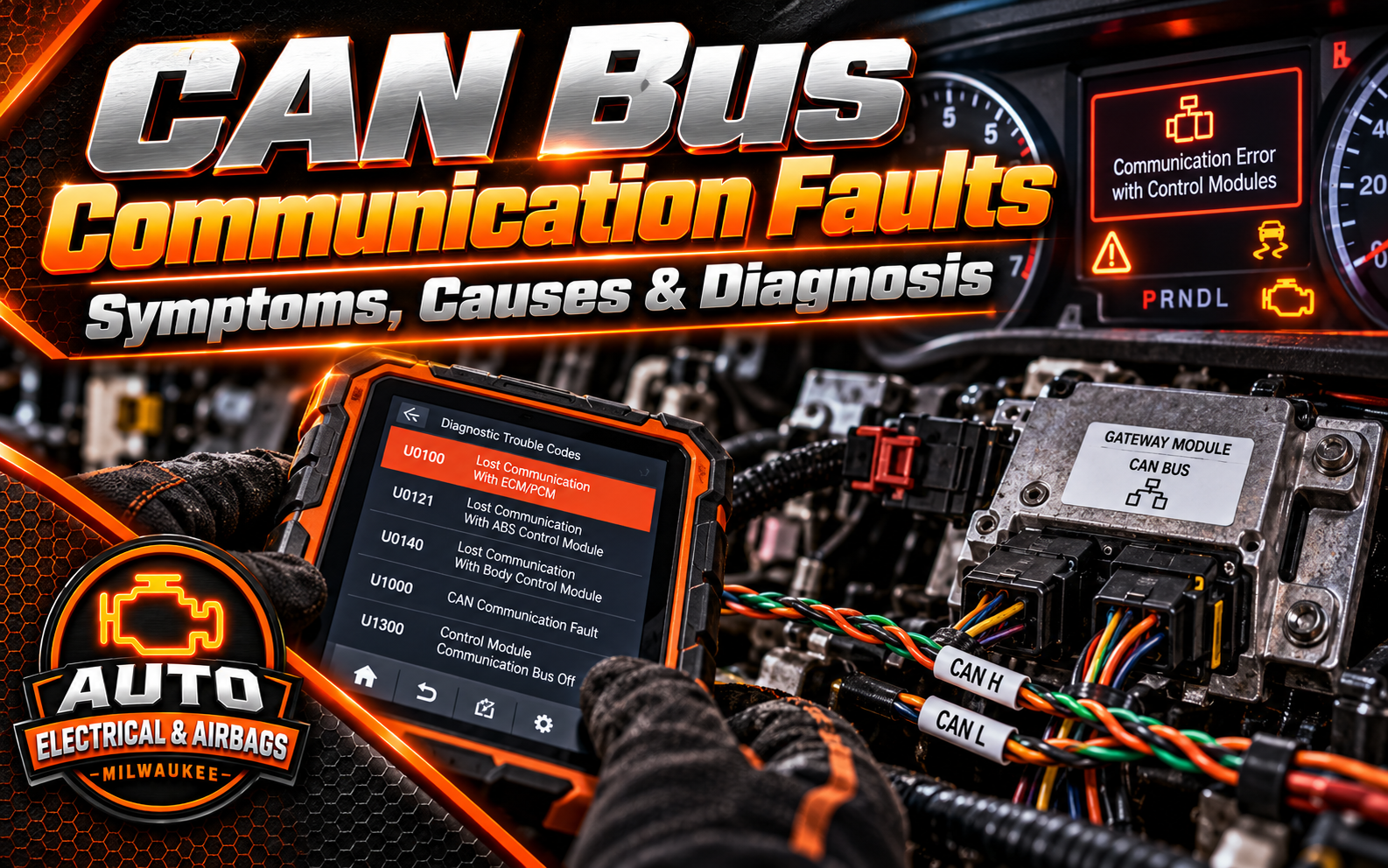
The ABS light comes on. Traction control is disabled. The power steering warning appears. The airbag light may illuminate. Certain accessories stop working. A diagnostic scan may show several codes beginning with the letter U.
It can look like several different vehicle systems have failed at the same time.
Sometimes they have not.
The real problem may be that those electronic systems are no longer communicating correctly.
Modern vehicles contain numerous electronic control modules. Instead of operating independently, many of these computers exchange information over vehicle communication networks.
One of the most widely used is the Controller Area Network, commonly called the CAN bus.
When communication on that network is interrupted, one electrical fault can create symptoms throughout the vehicle.
This guide explains what a CAN bus communication fault is, the symptoms it can cause, what U-codes mean, why multiple modules can suddenly stop communicating, and how technicians determine whether the problem comes from wiring, power, ground, a connector, or one of the modules connected to the network.
Quick Answer: What Is a CAN Bus Communication Fault?
A CAN bus communication fault means one or more electronic control modules are unable to properly exchange information over the vehicle’s communication network.
Possible causes include:
- Damaged CAN bus wiring
- Open circuits
- Shorted wiring
- Poor electrical connections
- Corroded connectors
- Loss of module power
- Poor grounds
- Low battery voltage
- Water intrusion
- Collision damage
- A failed electronic control module
- Network gateway problems
- Previous wiring or aftermarket accessory installation
A communication code does not automatically mean the module named in the code has failed.
The network and the module’s supporting electrical circuits need to be tested.
What Is a CAN Bus in a Car?
CAN stands for Controller Area Network.
It is a communication system that allows electronic control units throughout a vehicle to exchange information.
Think of it as a digital communication highway.
Instead of every component needing a separate wire running directly to every other component, electronic modules can share information over a network.
Depending on the vehicle, modules connected through CAN or related networks may include:
- Engine Control Module
- Transmission Control Module
- Body Control Module
- ABS module
- Airbag or SRS module
- Electronic power steering module
- Instrument cluster
- Climate-control module
- Door modules
- Blind-spot monitoring systems
- Parking-assistance modules
- Gateway module
- Other electronic control units
Modern vehicles may contain several communication networks rather than one single CAN bus.
These networks may communicate through a central gateway.
That interconnection is why an electrical problem in one area can sometimes create warning messages in systems that appear unrelated.
If you are trying to understand the different vehicle computers themselves, read our guide to ECU vs. ECM vs. BCM.
Why Do Vehicle Computers Need to Communicate?
Many vehicle functions depend on information from another electronic system.
Consider vehicle speed.
The ABS system may determine wheel-speed information using wheel-speed sensors.
Other modules may need that information for functions such as:
- Traction control
- Stability control
- Instrument cluster displays
- Transmission operation
- Driver-assistance systems
Instead of each system using its own separate set of wheel-speed sensors, information can be shared electronically.
Another example is engine information.
Different control modules may need to know:
- Engine speed
- Throttle position
- Vehicle speed
- Brake application
- Steering angle
- Gear position
- Door status
- Ignition status
Vehicle communication networks allow those modules to share data.
If communication disappears, a module may no longer receive information it needs.
It may then disable a function, turn on a warning light, or store a diagnostic trouble code.
What Are CAN High and CAN Low?
A high-speed CAN network commonly communicates over two wires called:
CAN High
and
CAN Low
These wires are typically arranged as a twisted pair.
The two-wire design helps the communication system resist electrical interference.
The network sends information through changes in the electrical relationship between those two circuits.
This means the physical condition of both wires matters.
Problems can occur if a wire becomes:
- Broken
- Shorted to ground
- Shorted to voltage
- Shorted to the other CAN circuit
- Corroded
- Damaged inside a harness
- Poorly repaired
A very small wiring defect can therefore affect communication between several expensive electronic modules.
What Does a CAN Bus Fault Feel Like?
There is no single symptom.
CAN communication problems can affect different systems depending on which network or module is involved.
Possible symptoms include:
- Multiple dashboard warning lights
- ABS warning
- Traction-control warning
- Electronic stability-control warning
- Power steering warning
- Airbag or SRS warning
- Check engine light
- Security warning
- Transmission warning
- No-start condition
- Intermittent starting
- Instrument cluster problems
- Gauges dropping to zero
- Power windows or locks failing
- Climate controls malfunctioning
- Blind-spot system unavailable
- Electronic parking-brake faults
- Several modules showing communication codes
- Diagnostic scanner unable to communicate with certain modules
One network fault can therefore look like several individual component failures.
Why Can One Fault Cause Multiple Warning Lights?
This is one of the most confusing aspects of modern electrical diagnosis.
Suppose an ABS module stops communicating.
Other modules may depend on information produced by the ABS system.
Those modules recognize that the information is missing.
They may store their own communication codes and disable features that depend on the missing data.
You could then see:
- ABS light
- Traction-control light
- Stability-control warning
- Power steering warning
- Other messages
That does not automatically mean four different systems have failed.
They may all be responding to one missing piece of information.
This is why our guide to multiple dashboard warning lights recommends looking for shared electrical causes rather than assuming every warning represents a separate failure.
What Are U-Codes?
Diagnostic trouble codes are often grouped by letter.
For example:
- P codes generally relate to powertrain systems
- B codes generally relate to body systems
- C codes generally relate to chassis systems
- U codes generally relate to network communication
A U-code commonly indicates that a module has detected a communication problem.
Examples may describe conditions such as:
- Lost communication with a control module
- Invalid data received
- Communication bus fault
- Network communication interruption
The exact definition depends on the code and vehicle.
Does a U-Code Mean a Module Is Bad?
No.
This is extremely important.
Suppose a scan reports:
Lost Communication With Body Control Module
The BCM could be faulty.
But the BCM could also:
- Have no power
- Have a blown fuse
- Have a poor ground
- Have damaged wiring
- Have a corroded connector
- Be disconnected
- Be affected by low voltage
- Be unable to communicate because of a network problem
The code tells technicians which communication failed.
It does not necessarily identify the failed component.
The same principle applies to ECU, ECM, ABS, SRS and other module communication codes.
Common Causes of CAN Bus Communication Problems
Several different electrical problems can disrupt network communication.
Low Battery Voltage
Modern electronic modules need stable voltage.
A weak battery or low-voltage event can cause modules to:
- Shut down
- Reset
- Temporarily stop communicating
- Store communication codes
- Produce multiple warning lights
This is why communication diagnosis often begins with basic system-voltage checks.
If a vehicle suddenly develops numerous electronic faults after a dead battery, jump start or battery replacement, low voltage may be part of the history.
That does not mean every stored communication code can automatically be ignored.
The technician still needs to determine which codes are current and which resulted from the previous voltage event.
Loss of Module Power
A module cannot communicate if it is not turned on.
Before assuming a module has internally failed, technicians may need to verify:
- Battery power
- Ignition power
- Fuses
- Relays
- Power distribution
- Connector terminals
Sometimes a scan tool cannot communicate with a module simply because the module has lost its electrical supply.
Poor Ground Connection
Electronic modules also require reliable grounds.
A loose, corroded or damaged ground can cause:
- Intermittent module operation
- Voltage fluctuations
- Communication loss
- Multiple warning lights
- No communication
- Unusual accessory behavior
Ground problems can be especially frustrating because the vehicle may behave normally sometimes and fail at other times.
Broken CAN Bus Wiring
An open circuit in the communication wiring can separate modules from the network.
Possible causes include:
- Harness damage
- Collision damage
- Rodent damage
- Previous electrical repair
- Wiring rubbed through against metal
- Connector damage
- Corrosion
- Water intrusion
The location of the break determines which portions of the network are affected.
CAN Wire Shorted to Ground
If one of the communication circuits becomes shorted to ground, network communication may become disrupted.
The symptoms can range from one module becoming unavailable to a much larger portion of the vehicle losing communication.
CAN Wire Shorted to Voltage
A communication wire can also become shorted to a voltage source.
This may prevent modules from correctly interpreting network signals.
Finding the cause can require tracing wiring through the vehicle and isolating portions of the network.
CAN High and CAN Low Shorted Together
Damage inside a wiring harness or connector can allow the two communication circuits to contact one another.
When that happens, network communication may be severely affected.
Corroded or Loose Connectors
The network may be intact while a connector prevents one module from communicating.
Connector problems can include:
- Loose terminals
- Bent pins
- Corrosion
- Water contamination
- Backed-out terminals
- Broken connector locks
- Heat damage
This is why connector inspection is part of electrical diagnosis.
A perfectly functional module cannot communicate through a bad electrical connection.
Water Intrusion
Moisture can create difficult electrical problems throughout modern vehicles.
Water can enter from areas such as:
- Windshield leaks
- Sunroof drains
- Body seams
- Flooding
- Collision damage
- Damaged weather seals
Once inside, moisture may reach:
- Wiring harnesses
- Module connectors
- Fuse boxes
- Ground locations
- Electronic modules
Corrosion can then create intermittent or permanent communication faults.
Problems may appear only after rain or high humidity before eventually becoming constant.
For related electrical symptoms, our automotive wiring repair service in Milwaukee covers wiring, connector and circuit problems.
Collision Damage
A collision does not need to directly break an electronic module to create network problems.
Impact damage can:
- Stretch wiring
- Crush a harness
- Damage connectors
- Break ground locations
- Damage electronic modules
- Allow water intrusion
- Affect sensors and communication circuits
Communication problems sometimes appear after the body damage itself has already been repaired.
Aftermarket Electronics or Previous Wiring Repairs
Problems can also start after installation of:
- Remote starters
- Alarm systems
- Audio equipment
- Tracking devices
- Lighting accessories
- Other aftermarket electronics
That does not mean aftermarket equipment always creates problems.
But improperly connected wiring or previous modifications can complicate the original vehicle circuits.
Technicians need to know about modifications when diagnosing an unusual communication fault.
A Faulty Module
Sometimes the module itself is the cause.
A module may fail internally and stop communicating.
In some network configurations, an internal module fault may even affect communication for other modules.
But because electronic modules can be expensive and may require programming, the module should generally not be condemned until its supporting power, grounds, wiring and communication circuits have been evaluated.
Can One Bad Module Shut Down the CAN Bus?
It is possible for a malfunctioning module or its circuitry to interfere with network communication.
The exact effect depends on the vehicle’s network architecture.
A vehicle may contain:
- Several CAN networks
- Separate high- and low-speed networks
- Subnetworks
- LIN networks
- Ethernet communication
- A central gateway connecting different networks
Therefore, one faulty module may affect only one portion of the vehicle while another problem may interfere with a much larger communication network.
Technicians may need to isolate portions of the network to determine which circuit or component is causing the disruption.
What Is a Gateway Module?
Modern vehicles can contain several different communication networks.
A gateway allows information to move between them.
Think of it like a router inside the vehicle.
For example, one vehicle network may contain powertrain modules while another handles body electronics.
The gateway allows necessary information to pass between those networks.
A gateway problem can therefore create unusually broad communication symptoms.
The exact architecture varies significantly between manufacturers and model years.
Why Does My Scanner Say “No Communication”?
A scanner reporting no communication with a particular module does not automatically mean the module needs replacement.
The module may:
- Have no power.
- Have no ground.
- Be disconnected from the communication network.
- Have damaged network wiring.
- Have a connector problem.
- Be affected by another network fault.
- Have internally failed.
Proper diagnosis determines which one is happening.
This distinction is important because replacing an expensive module will not solve a broken wire or missing power supply.
How Are CAN Bus Communication Faults Diagnosed?
Network diagnosis needs to be systematic.
The exact procedure depends on the vehicle, codes and symptoms, but the process may include the following.
Step 1: Perform a Complete Vehicle Scan
The technician scans all accessible modules rather than looking only at engine codes.
This helps answer questions such as:
- Which modules communicate?
- Which modules do not?
- Which modules report losing communication?
- Are the same communication codes stored in several modules?
- Are voltage-related codes also present?
The pattern can help identify which part of the network needs investigation.
Step 2: Determine Which Codes Are Current
Not every stored communication code represents an active problem.
A vehicle that previously had a dead battery may contain historical low-voltage and communication codes.
Technicians need to determine:
- Current codes
- Stored codes
- History codes
- Codes that return immediately
Clearing codes without first recording or understanding them can remove useful diagnostic information.
Step 3: Check System Voltage
Battery and charging-system condition may need to be verified.
Network diagnosis becomes unreliable if system voltage is unstable.
Step 4: Verify Power and Ground at Offline Modules
If one module cannot communicate, its electrical supplies are checked before the module is condemned.
No power means no communication.
A poor ground can produce similar problems.
Step 5: Inspect Communication Wiring
Depending on the fault, technicians may inspect or test:
- CAN High
- CAN Low
- Connectors
- Harness routing
- Junctions
- Splices
- Gateway connections
Visible damage is useful when present, but not every wiring fault can be found visually.
Step 6: Test Network Electrical Characteristics
Depending on the vehicle and circuit, technicians can take electrical measurements to determine whether the communication network has characteristics consistent with a properly connected circuit.
High-speed CAN networks commonly use termination at the network ends to maintain signal integrity.
Network resistance and voltage measurements can therefore provide important diagnostic clues.
However, expected readings depend on the network and vehicle design.
Technicians should use appropriate wiring diagrams and manufacturer information rather than assuming every communication network is identical.
Step 7: Isolate the Fault
If the entire network is affected, sections of the circuit may need to be isolated.
The goal is to determine whether communication returns when:
- A section of wiring is isolated
- A connector is repaired
- A faulty circuit is disconnected
- A specific module is removed from the affected network according to an appropriate diagnostic procedure
This helps narrow the problem instead of replacing modules randomly.
What Does Normal CAN Bus Resistance Mean?
High-speed CAN networks often use two terminating resistors at opposite ends of the communication bus.
With power removed and the network configured normally, two 120-ohm termination resistors operating in parallel commonly result in a reading around 60 ohms across CAN High and CAN Low.
That measurement can provide useful diagnostic information.
For example, an unexpected resistance reading may suggest:
- Missing termination
- Open circuit
- Short circuit
- Wiring problem
- Network configuration issue
However, 60 ohms is not a universal test for every network in every vehicle.
Vehicles can contain different network designs, gateways and communication protocols.
Technicians should identify the exact circuit before interpreting resistance measurements.
Why Random Module Replacement Is a Bad Diagnostic Strategy
Communication faults can create misleading symptoms.
Imagine a scan tool cannot communicate with an ABS module.
Replacing the ABS module might appear logical.
But what happens if the real problem is:
- A blown fuse supplying the ABS module
- Corroded ground
- Broken CAN wire
- Damaged connector
The new ABS module would still fail to communicate.
The vehicle owner would now have paid for an expensive part without fixing the problem.
A more reliable diagnostic sequence is:
Power → Ground → Wiring → Connectors → Communication → Module
The module is part of the diagnosis.
It should not automatically be the first conclusion.
Can Low Voltage Create CAN Communication Codes?
Yes.
Low system voltage can interfere with normal electronic module operation.
A module that shuts down temporarily may disappear from the network.
Other modules can then store codes reporting lost communication with it.
This can happen during:
- Weak battery conditions
- Failed starting attempts
- Jump starting
- Charging-system faults
- Poor battery connections
A technician may need to determine whether communication codes represent an active network failure or are simply history from a previous voltage event.
Can a CAN Bus Fault Cause a No-Start?
Yes, depending on the affected network and vehicle architecture.
Starting may require communication between systems involving:
- Key or security authorization
- BCM
- ECM or PCM
- Transmission module
- Gateway
- Other control modules
If required authorization or data cannot reach the appropriate module, the vehicle may fail to crank or start.
But a no-start condition has many possible causes.
A CAN bus problem should therefore be diagnosed rather than assumed.
For related symptoms, see our guide explaining why a car may not start even when the lights still work.
Can CAN Bus Problems Be Intermittent?
Absolutely.
Intermittent network faults can be among the more difficult vehicle electrical problems to diagnose.
A damaged connection may change with:
- Vibration
- Temperature
- Moisture
- Vehicle movement
- Harness position
- Connector movement
The vehicle may function normally during a shop visit and fail later.
Information from the driver can be extremely useful.
If the problem occurs only:
- After rain
- On cold mornings
- After hitting bumps
- After driving for an hour
- After interior work
- When moving the seat
- Following collision repair
tell the technician.
Patterns help narrow the diagnostic process.
CAN Bus Fault vs. Bad Control Module
| Finding | Possible Network/Wiring Problem | Possible Module Problem |
|---|---|---|
| Multiple modules lose communication | Yes | Possible |
| One module is offline | Yes | Yes |
| Module has no power | Yes | No evidence of internal failure yet |
| Poor module ground | Yes | No evidence of internal failure yet |
| Communication returns when wiring moves | Strong clue | Less typical |
| Connector corrosion found | Strong clue | Module may still be good |
| Network voltage abnormal | Strong clue | Possible contributor |
| Proper power, ground and communication circuits confirmed | Less likely | Module becomes more suspect |
| Several modules report losing the same module | Possible | Possible |
This is why scan results are only the beginning of the diagnosis.
When Should You Have a Communication Fault Professionally Diagnosed?
Consider professional electrical diagnosis when:
- Several dashboard warnings appear together
- A scan shows multiple U-codes
- A scanner cannot communicate with one or more modules
- The vehicle intermittently will not start
- Warning lights come and go
- Electrical problems began after a collision
- Problems started after water intrusion
- Several unrelated electronic features stop working together
- Previous module replacement did not fix the problem
- A shop suspects the ECU, ECM, BCM, ABS or another control module
- Electrical problems started after aftermarket equipment installation
The more systems involved, the more important it becomes to diagnose the shared electrical and communication paths.
CAN Bus and Vehicle Communication Diagnostics in Milwaukee
Modern vehicle electrical problems are no longer limited to simple switches, fuses and individual wires.
Electronic modules throughout the vehicle exchange information over communication networks, which means one wiring or network fault can affect several systems at once.
At Auto Electrical & Airbag Specialist in Milwaukee, our auto electrical diagnostics and repair service includes troubleshooting electrical faults involving vehicle wiring, power, grounds, connectors and control-module communication.
Depending on the diagnosis, network-related symptoms may lead to testing involving systems such as:
- ECU or ECM
- Body control module
- ABS
- SRS
- Electronic power steering
- Vehicle wiring
- Other electronic modules
If the underlying problem is wiring-related, our car wiring repair in Milwaukee page explains more about circuit and harness diagnosis.
Auto Electrical & Airbag Specialist
2636 S 32nd St
Milwaukee, WI 53215
(414) 345-7568
Frequently Asked Questions About CAN Bus Communication Faults
What does CAN bus mean in a car?
CAN stands for Controller Area Network. It is a communication system that allows electronic control modules throughout the vehicle to exchange information.
What causes CAN bus communication errors?
Common causes include damaged communication wiring, poor connections, loss of module power or ground, low battery voltage, corrosion, water damage, collision damage and electronic module faults.
Can a weak battery cause U-codes?
Yes. Low voltage can cause modules to temporarily shut down or stop communicating, which may lead other modules to store communication-related codes.
Does a U-code mean the control module needs replacement?
No. U-codes indicate communication problems. The module may be faulty, but it could also have lost power, ground or network connectivity.
Can one bad module affect several other systems?
It can. Depending on the network architecture, a malfunctioning module or associated circuit can interfere with data needed by other electronic systems.
Why are several warning lights on at the same time?
Several warnings may appear when multiple systems depend on information that has become unavailable. Shared voltage, ground or network problems can also affect several modules simultaneously.
Can damaged wiring cause a module to stop communicating?
Yes. An open, shorted or corroded communication circuit can prevent an otherwise functional module from communicating.
What are CAN High and CAN Low?
They are the two communication circuits commonly used by a high-speed CAN network. Their electrical relationship allows electronic modules to transmit and receive digital information.
Can water damage cause CAN communication problems?
Yes. Water intrusion can corrode wiring, connectors, splices and electronic modules, producing intermittent or permanent communication faults.
Can a CAN bus problem prevent a vehicle from starting?
It can, depending on which modules and networks are affected. Some vehicles require several electronic systems to communicate before starting is authorized.
Can CAN bus problems come and go?
Yes. Loose connectors, damaged wiring, corrosion, heat, moisture and vibration can all produce intermittent communication failures.
Can a scan tool diagnose a CAN bus problem?
A capable scan tool is very useful for identifying which modules communicate and which codes are stored, but network diagnosis often also requires electrical testing, wiring diagrams and circuit inspection.
The Bottom Line
Modern vehicles depend on their electronic control modules communicating with one another.
The CAN bus is one of the networks that makes this communication possible.
When that communication fails, a vehicle can display multiple warning lights, lose electronic functions, store U-codes or even refuse to start.
But a communication code does not automatically mean an expensive control module has failed.
The actual cause may be:
- Low voltage
- Missing power
- Poor ground
- Broken wiring
- Corrosion
- Connector damage
- Water intrusion
- Collision damage
- A faulty module
The right diagnostic question is not simply:
“Which computer should be replaced?”
It is:
“Why is this module unable to communicate?”
Answering that question first can prevent unnecessary module replacement and lead to the actual electrical fault.