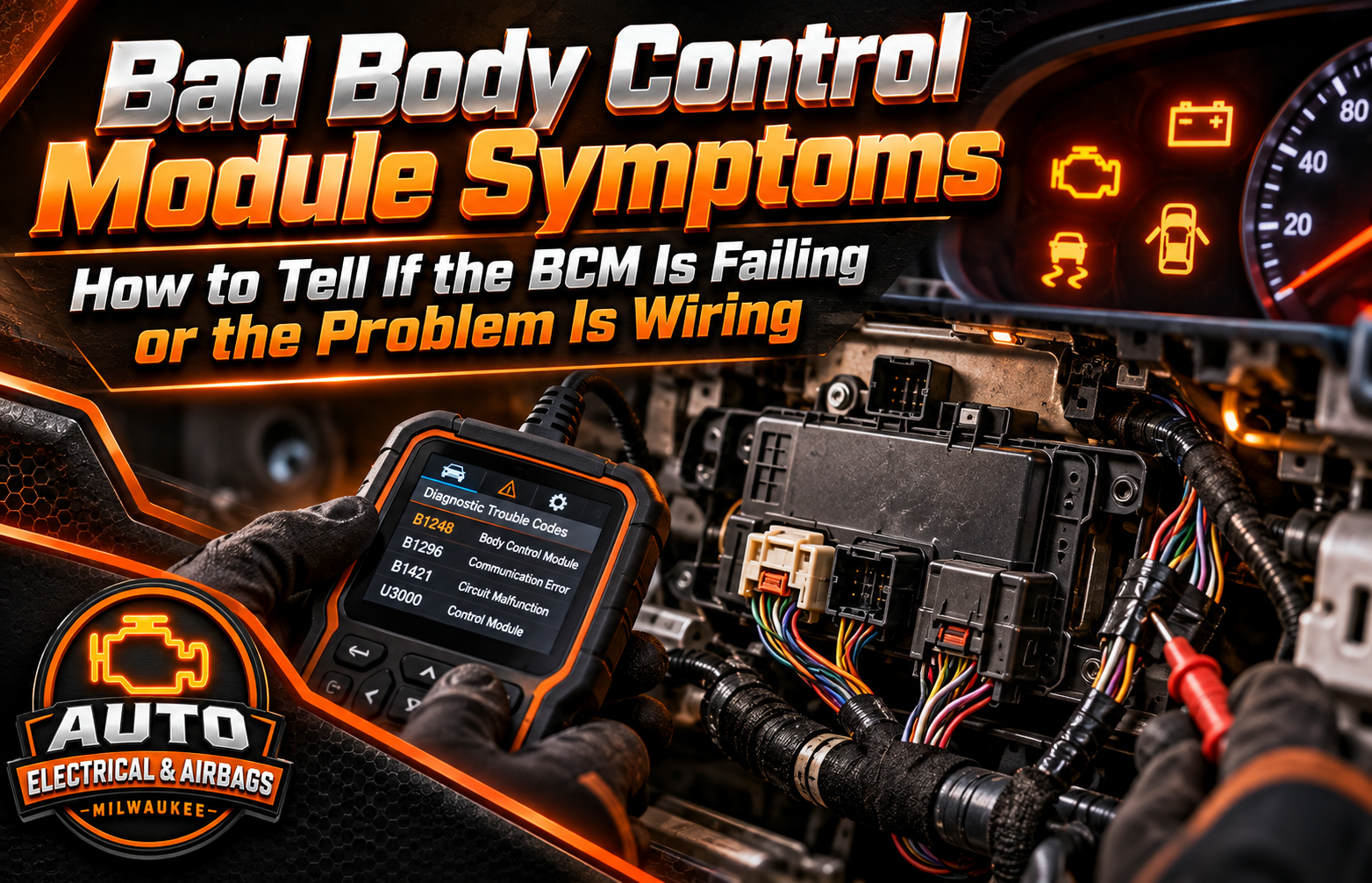
Power windows stop working. The door locks behave unpredictably. Interior lights stay on when they should turn off. The security system suddenly stops recognizing the key. Several unrelated electrical problems appear at the same time.
It is easy to assume the body control module has failed.
Sometimes it has.
But many problems that look like a bad BCM are actually caused by something else: low battery voltage, a poor ground, damaged wiring, corroded connectors, a blown fuse, water intrusion, or a communication problem between vehicle modules.
That distinction matters because replacing a body control module without confirming the cause can result in an expensive repair that does not solve the problem.
This guide explains the common symptoms of a bad body control module, what a BCM actually controls, which electrical problems can imitate BCM failure, and how technicians determine whether the module itself is really at fault.
What Is a Body Control Module?
The body control module, or BCM, is an electronic control module responsible for managing or communicating with many of the body-related electrical systems in a vehicle.
Exactly what the BCM controls depends on the vehicle, but its responsibilities may include:
- Power door locks
- Power windows
- Interior lighting
- Exterior lighting
- Keyless entry
- Vehicle security and anti-theft functions
- Trunk or liftgate functions
- Windshield wipers
- Horn operation
- Warning chimes
- Remote-start functions
- Battery-saving functions
- Heated mirrors
- Certain dashboard messages
- Accessory power
- Communication with other electronic modules
Modern vehicles contain numerous computers rather than one central computer controlling everything.
The BCM commonly communicates with other modules such as the engine control module, ABS module, instrument cluster, restraint control module, steering module, transmission control module, and other electronic systems.
If you are unsure how these modules differ, our guide to ECU vs. ECM vs. BCM explains the basic roles of the different vehicle computers.
Quick Answer: What Are the Symptoms of a Bad BCM?
Possible symptoms of a body control module problem include:
- Power windows that stop working or operate intermittently
- Door locks that lock or unlock unexpectedly
- Interior lights that stay on or fail to illuminate
- Exterior lighting problems
- Windshield wipers behaving incorrectly
- Key fob or keyless-entry problems
- Security or anti-theft warnings
- Battery drain
- Multiple body-electrical features failing at once
- Unusual dashboard messages
- Intermittent electrical problems
- No communication with the BCM during diagnostic scanning
- BCM-related diagnostic trouble codes
- Problems communicating with other vehicle modules
- A no-start condition on certain vehicles when security or authorization functions are involved
However, none of these symptoms proves the BCM itself has failed.
Testing the module’s power supply, grounds, wiring, connectors and communication circuits is usually necessary before condemning the BCM.
1. Several Electrical Features Stop Working at the Same Time
One of the more important clues in a possible BCM problem is when several body-electrical functions begin failing together.
For example, you may notice:
- Power locks no longer respond
- Interior lights behave strangely
- The key fob becomes unreliable
- Power windows stop responding
- A security warning appears
When several seemingly unrelated features fail together, technicians look for something those systems share.
That shared point could be the BCM.
But it could also be a common fuse, power supply, ground connection, wiring harness, connector or network problem.
This is why diagnosing several electrical failures individually can sometimes lead in the wrong direction.
If your vehicle suddenly develops numerous warnings or electrical symptoms, our guide to multiple dashboard warning lights explains why several systems can report problems from one underlying electrical fault.
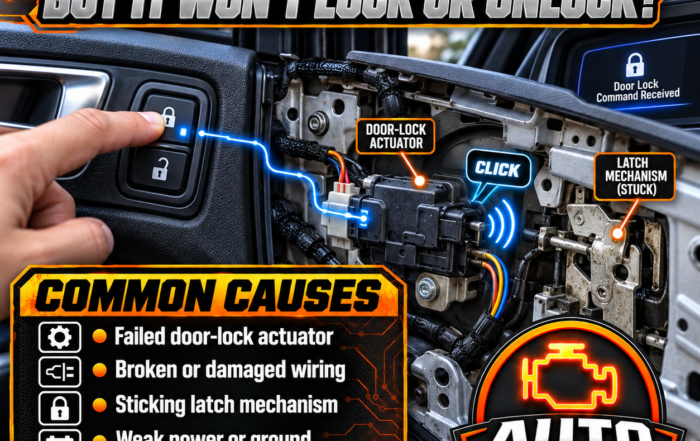
2. Power Door Locks Act Erratically
Door locks are commonly associated with the BCM on many vehicles.
Possible symptoms include:
- One or more doors will not lock
- Doors lock but immediately unlock
- Remote locking works only occasionally
- Automatic locking functions stop working
- Locks operate without being commanded
- Keyless entry stops responding
A BCM may be involved, but the module is not the only possibility.
A technician may also need to investigate:
- Door-lock actuators
- Door wiring
- Broken wires near door hinges
- Switches
- Fuses
- Connectors
- Power supplies
- Grounds
- Key fob or receiver problems
The symptom tells us which system is affected. It does not automatically identify which part caused the failure.
3. Power Windows Stop Working or Become Intermittent
Window problems can also appear during BCM or body-electrical faults.
Depending on vehicle design, you may experience:
- All windows stop working
- Several windows stop responding
- Windows work only intermittently
- One-touch functions stop operating
- Windows behave differently after battery replacement
- Window switches stop communicating correctly
Again, a failed BCM is only one possibility.
Window motors, switches, door modules, wiring, connectors, circuit protection and communication faults can create similar symptoms.
When diagnosing a window problem, it is important to determine whether the switch request is being received, whether the appropriate module is responding and whether power is reaching the motor.
4. Interior or Exterior Lights Behave Strangely
Lighting behavior is another possible sign of a body-electrical or BCM issue.
You might notice:
- Interior lights stay on
- Interior lights do not turn on
- Headlights or parking lights behave incorrectly
- Courtesy lights operate intermittently
- Lights remain on after the vehicle is shut down
- Automatic lighting stops working
- Dashboard illumination behaves unpredictably
These symptoms can occur when the BCM is unable to control a circuit correctly.
But technicians must also consider switches, sensors, relays, wiring, connectors, grounds and related components.
A wiring problem can look remarkably similar to a control-module problem.
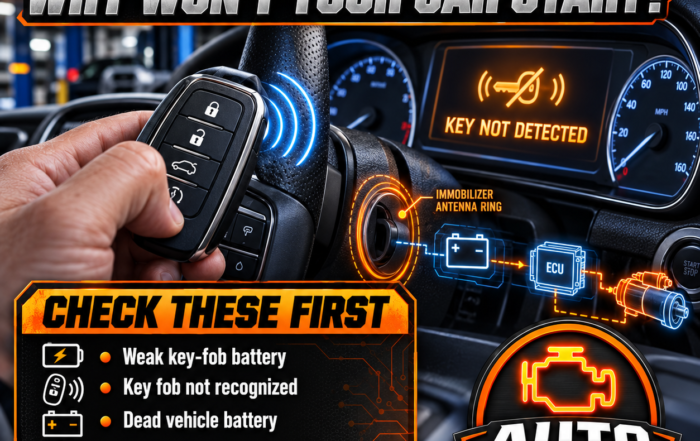
5. Key Fob, Security or Anti-Theft Problems
On some vehicles, the BCM participates in keyless-entry, security or vehicle-authorization functions.
Possible symptoms can include:
- Key fob stops locking or unlocking the vehicle
- Security warning remains illuminated
- Alarm activates unexpectedly
- Vehicle does not recognize a key correctly
- Remote-start functions stop working
- Vehicle intermittently refuses to start
A security-related problem does not automatically mean the BCM has failed.
Possible causes can include:
- Weak key-fob battery
- Key or transponder problem
- Antenna or receiver issue
- Wiring fault
- Low vehicle battery voltage
- Programming or synchronization problem
- Communication fault
- Another security-related module
If the car will not start but the lights still work, our guide to why a car won’t start even when the lights work explains why modern starting systems require much more than a functioning battery.
6. Windshield Wipers Behave Incorrectly
Depending on vehicle design, the BCM may receive or process requests involving the windshield wiper system.
Symptoms may include:
- Wipers will not turn on
- Wipers will not shut off
- Intermittent mode stops working
- Wipers operate at the wrong speed
- Wipers stop in the wrong position
Before assuming a module failure, the wiper switch, motor, relays, wiring, grounds and related circuits should also be considered.
7. The Battery Keeps Dying
A BCM-related problem can sometimes contribute to battery drain, but this symptom requires especially careful diagnosis.
Modern vehicles contain modules that remain active for a period after the ignition is switched off. Eventually, the vehicle’s electronics should enter their normal sleep state and electrical consumption should decrease.
If a module or circuit remains awake when it should not, the battery can discharge while the vehicle is parked.
However, repeated battery drain can also result from:
- Weak or failing battery
- Charging-system problem
- Interior or exterior light staying on
- Aftermarket electronics
- Wiring fault
- Short circuit
- Poor connection
- Another control module staying awake
- Accessory remaining powered
- Network communication keeping multiple modules active
Replacing the BCM simply because the battery dies overnight would be premature.
A proper parasitic-draw diagnosis should determine where current is being consumed before a module is blamed.
8. Multiple Warning Lights or Messages Appear
A module problem can sometimes generate several warnings because modern vehicle computers exchange information with one another.
A BCM communication problem may be accompanied by messages or codes involving other systems.
For example, you might see:
- Security warning
- Lighting warning
- Door or trunk messages
- Battery-related warning
- Service vehicle messages
- Communication-related fault codes
- Several electronic features failing simultaneously
That does not necessarily mean several modules have failed at the same time.
A common voltage, ground, wiring or communication issue can affect several systems.
This is one reason professional auto electrical diagnostics are important when several electronic symptoms appear together.
9. The Problem Comes and Goes
Intermittent electrical problems are particularly difficult to diagnose.
The vehicle may work perfectly in the morning and fail later that day.
Symptoms may appear:
- After driving over bumps
- During rain or high humidity
- In very hot or cold weather
- After the vehicle sits overnight
- After opening or closing a door
- After moving a wiring harness
- After a battery has been disconnected
- Following previous electrical work
Intermittent BCM-like symptoms can be caused by loose terminals, damaged wiring, connector problems, moisture, corrosion, poor grounds or an internal module problem.
Because the fault is not always present, diagnosis may require testing under the conditions that cause the symptom.
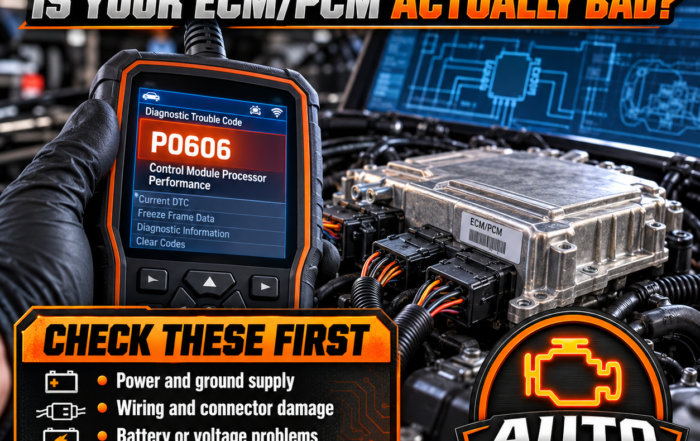
10. The Scan Tool Shows BCM Fault Codes
A diagnostic scan may reveal trouble codes associated with the body control module.
This is useful information.
It is not a final diagnosis.
A diagnostic trouble code tells the technician where the vehicle detected a problem or which circuit or communication path requires investigation.
It does not necessarily say:
Replace the BCM.
A BCM code may be caused by:
- Low system voltage
- Loss of BCM power
- Poor BCM ground
- Blown fuse
- Damaged wiring
- Loose connector
- Corroded terminal
- Water intrusion
- Communication network fault
- Another module
- Previous repair or aftermarket wiring
- Programming or configuration issues
- Internal BCM failure
Codes should guide testing—not replace it.
What Can Look Like a Bad BCM?
This is the most important part of diagnosing a suspected body control module failure.
Several common electrical problems can imitate BCM failure extremely well.
Low Battery Voltage
Electronic modules require stable voltage to operate correctly.
When battery voltage becomes too low, modules may:
- Reset
- Stop communicating
- Store fault codes
- Generate warning messages
- Behave unpredictably
- Temporarily disable certain functions
This can create the appearance of several failed electronic systems even though the underlying problem is simply insufficient or unstable voltage.
Battery and charging-system condition should therefore be considered before deciding a control module has failed.
Poor Ground Connections
Every electronic module needs a reliable electrical ground.
A ground connection with corrosion, excessive resistance, looseness or physical damage can prevent the BCM from operating normally.
A poor ground can cause:
- Intermittent operation
- Flickering lights
- Failed accessories
- Communication faults
Unusual voltage readings
- No communication with the module
- Multiple warning messages
This is why power and ground testing is such an important part of module diagnosis.
Damaged Wiring
A broken, shorted or high-resistance wire can create symptoms nearly identical to module failure.
Common wiring problems include:
- Broken wires
- Chafed insulation
- Pinched harnesses
- Heat damage
- Rodent damage
- Collision damage
- Incorrect previous repairs
- Aftermarket alarm or remote-start wiring
- Corrosion
- Water intrusion
Our car wiring repair and electrical troubleshooting page explains why testing the circuit is usually more reliable than replacing whatever component happens to be named in a trouble code.
Connector Problems
A module can be perfectly functional but unable to operate because its electrical connection is poor.
Connector-related problems can involve:
- Loose terminals
- Bent pins
- Backed-out terminals
- Corrosion
- Moisture
- Heat damage
- Broken connector locks
A visual inspection alone may not always reveal an electrical connection problem. Depending on the fault, additional circuit testing may be necessary.
Blown Fuses or Power-Supply Problems
The BCM may have more than one power or ignition feed.
If one required feed is missing, certain BCM-controlled features may stop working while others continue operating.
This can make the failure appear inconsistent or random.
The important question is not simply:
Does the BCM have power?
It is:
Does the BCM have all of the correct power and ground supplies required under the conditions when the problem occurs?
Water Intrusion and Corrosion
Water and vehicle electronics are a bad combination.
Leaks, condensation or previous water exposure can damage:
- Wiring
- Connector terminals
- Grounds
- Fuse boxes
- Splices
- Electronic modules
A vehicle may initially develop intermittent symptoms before the problem becomes permanent.
If symptoms started after heavy rain, flooding, windshield work, a leaking sunroof, collision damage or interior water intrusion, that history can be important during diagnosis.
BCM Failure vs. Wiring Problem: What Is the Difference?
The symptoms can overlap significantly.
| Symptom | Possible BCM Issue | Possible Wiring/Power Issue |
|---|---|---|
| Several accessories fail | Yes | Yes |
| Intermittent operation | Yes | Yes |
| No communication with BCM | Yes | Yes |
| BCM-related trouble codes | Yes | Yes |
| Battery drain | Possible | Possible |
| Security problems | Possible | Possible |
| Windows or locks malfunction | Possible | Possible |
| Failure changes when harness moves | Less typical | Strong wiring clue |
| Visible corrosion or damaged wiring | Not necessarily | Strong wiring clue |
| Missing module power or ground | Module may be good | Strong circuit clue |
The table illustrates why symptoms alone are rarely enough to condemn a body control module.
The supporting circuits must be tested.
How Is a Suspected BCM Problem Diagnosed?
The exact procedure depends on the vehicle and symptoms, but a logical diagnostic process may include several steps.
1. Confirm the Customer’s Symptoms
The first step is understanding exactly what the vehicle is doing.
Useful details include:
- Which features stopped working?
- Did several problems start at once?
- Is the problem constant or intermittent?
- Did it begin after another repair?
- Was the battery recently replaced?
- Has the vehicle experienced water intrusion?
- Was an aftermarket alarm, stereo or remote start installed?
- Has the vehicle been involved in a collision?
The circumstances surrounding the failure can help determine where testing should begin.
2. Perform a Full Vehicle Scan
A capable diagnostic scanner can communicate with multiple modules rather than only reading engine codes.
Technicians may examine:
- Current trouble codes
- Historical codes
- Communication codes
- Module status
- Live data
- Input and output information
The goal is not simply to find a code saying “BCM.”
The goal is to understand what the module and the rest of the vehicle are reporting.
3. Check Battery and System Voltage
Before trusting unusual electronic behavior, battery and charging voltage should be considered.
Low or unstable voltage can cause misleading module symptoms and communication codes.
4. Verify BCM Power and Grounds
If the BCM cannot communicate or operate correctly, its required power and ground circuits should be verified.
A module with no power cannot communicate.
A module with a poor ground may communicate intermittently or behave unpredictably.
If a required supply is missing, replacing the module would not correct the underlying circuit failure.
5. Inspect Wiring and Connectors
The wiring connected to the affected system should be evaluated for damage, corrosion, loose terminals and other faults.
This is particularly important when the vehicle has a history of:
- Collision repair
- Water intrusion
- Rodent activity
- Aftermarket electronics
- Previous wiring repairs
6. Evaluate Module Communication
Modern vehicle modules communicate with each other over data networks.
If the BCM cannot communicate, technicians need to determine whether:
- The BCM itself is offline
- The BCM lacks power or ground
- Network wiring is damaged
- Another module is affecting communication
- A connector problem exists
- A larger vehicle-network fault is present
This distinction will become especially important in our separate guide to CAN bus communication faults, because one network problem can sometimes produce symptoms across multiple systems.
7. Test the Affected Inputs and Outputs
Suppose the power locks do not work.
Simply knowing that the BCM is associated with the locks does not prove the module has failed.
A technician may need to determine whether:
- The lock request reaches the appropriate module.
- The module recognizes the request.
- The module commands the output.
- The electrical circuit carries that command.
- The door-lock actuator responds.
Finding where that chain stops is much more useful than guessing.
Does a Bad BCM Always Need to Be Replaced?
No.
The required repair depends entirely on what testing finds.
A BCM-related concern could ultimately require:
- Wiring repair
- Connector repair
- Ground repair
- Fuse or power-supply repair
- Correction of water or corrosion damage
- Repair of another component causing the symptom
- Module programming or configuration
- BCM repair where appropriate
- BCM replacement where appropriate
The important point is that BCM replacement should be the result of diagnosis—not the starting assumption.
If you are experiencing BCM-related electrical problems in Milwaukee, our BCM diagnostic and repair service focuses on determining whether the issue actually originates inside the module or elsewhere in the vehicle’s electrical system.
Does a Replacement BCM Need to Be Programmed?
Often, but requirements vary by vehicle.
A replacement body control module may need programming, configuration, initialization, security relearning or other vehicle-specific procedures before it can operate correctly.
The module may need information relating to the vehicle’s options or other electronic systems.
For that reason, replacing a BCM is not always the same as replacing a simple plug-in electrical component.
A used module from another vehicle may also create compatibility or configuration concerns depending on the vehicle and module design.
Always determine the correct service procedure for the specific year, make, model and module involved.
Can You Drive With a Bad BCM?
It depends on which functions are affected.
Some BCM-related faults may initially affect convenience features such as interior lights or power locks.
Other faults can interfere with:
- Security functions
- Starting authorization
- Exterior lighting
- Wipers
- Warning messages
- Communication with other electronic systems
Electrical problems can also worsen or become intermittent.
If important lighting, visibility, starting or other vehicle functions are affected, the problem should be diagnosed rather than ignored.
Can Disconnecting the Battery Reset a BCM?
Disconnecting the battery may temporarily reset electronic behavior on some vehicles, but it does not repair damaged wiring, corrosion, a poor ground or an internally failed module.
It can also erase learned settings or require certain systems to relearn or initialize.
If the same electrical symptoms return, a battery disconnect should not be treated as a repair.
The underlying fault still needs to be identified.
Can a Bad BCM Cause a Car Not to Start?
On some vehicles, yes.
The BCM may participate in security, key recognition, start authorization or communication required for the vehicle to start.
However, a no-start condition has many other possible causes, including:
- Weak battery
- Starter circuit problem
- Ignition switch or start-request problem
- Fuse or relay failure
- Security-system issue
- ECU or ECM power problem
- Wiring problem
- Sensor issue
- Communication fault
That is why a no-start condition should be diagnosed as a system rather than immediately attributed to the BCM.
Can a Bad BCM Drain the Battery?
A BCM-related fault can potentially contribute to battery drain if the module or a related circuit fails to enter its normal low-power state.
But many other components can cause parasitic battery drain.
Proper testing should determine which circuit or module is consuming current before any electronic module is replaced.
Can a Bad Battery Cause BCM Codes?
Yes, low voltage can contribute to electronic-module faults and communication problems.
A weak battery, poor battery connection or charging-system problem can cause modules to behave unpredictably or store voltage and communication-related trouble codes.
This is one reason battery and system voltage should be evaluated during electrical diagnosis.
Does a BCM Code Mean the Body Control Module Is Bad?
No.
This is one of the most important points in this guide.
A BCM-related trouble code means the vehicle detected a problem involving a particular circuit, function or communication path.
The code can be caused by the module, but it can also result from:
- Wiring
- Power
- Ground
- Connector problems
- Low voltage
- Another electronic component
- Network communication issues
The cause has to be tested.
When Should You Have a BCM Problem Diagnosed?
Consider professional electrical diagnostics when:
- Several electrical systems stop working together
- Power windows or locks behave unpredictably
- Security warnings appear
- The vehicle intermittently refuses to start
- Interior or exterior lights behave strangely
- Battery drain continues after the battery has been tested
- BCM-related codes keep returning
- The BCM will not communicate with diagnostic equipment
- The problem started after water intrusion or collision damage
- Previous parts replacement did not solve the issue
- Electrical problems keep disappearing and returning
Electrical problems become expensive when diagnosis turns into parts swapping.
Testing the circuit first can help determine whether the real problem is the BCM, wiring, voltage, ground, connector, another module or another component entirely.
BCM Diagnostics in Milwaukee, WI
At Auto Electrical & Airbag Specialist in Milwaukee, we diagnose difficult body control module and vehicle electrical problems involving warning lights, power accessories, wiring, grounds, connectors and communication between electronic modules.
Our approach is to determine what is actually failing before recommending module replacement.
If your vehicle has multiple electrical problems, BCM-related fault codes, intermittent accessories or a problem that has continued after previous repairs, start with auto electrical diagnostics and repair in Milwaukee.
For a problem specifically involving the body control module, learn more about our BCM repair and diagnostic services in Milwaukee.
Auto Electrical & Airbag Specialist
2636 S 32nd St
Milwaukee, WI 53215
(414) 345-7568
Frequently Asked Questions About Body Control Module Problems
What is the most common sign of a bad BCM?
There is no single symptom that confirms BCM failure. Multiple body-electrical features failing together, unusual lock or lighting behavior, security problems and module communication faults can all point toward the BCM, but wiring, voltage and ground problems can produce the same symptoms.
How do I know if my BCM is bad or if I have a wiring problem?
Proper diagnosis involves checking fault codes, module communication, battery voltage, BCM power supplies, grounds, wiring and connectors. If those supporting circuits test correctly but the module cannot correctly process inputs, control outputs or communicate, suspicion of an internal module fault becomes stronger.
Can a bad BCM cause multiple warning lights?
It can contribute to multiple warnings or messages, especially if the BCM communicates information to other modules. However, low voltage, bad grounds and communication-network problems can also cause several warning lights to appear together.
Will replacing the BCM fix electrical problems?
Only if the BCM has actually been confirmed as the cause. Replacing a module will not repair damaged wiring, poor grounds, corroded connectors, missing power supplies or other components that created similar symptoms.
Can water damage a body control module?
Yes. Moisture can damage electronic modules, connectors, terminals and surrounding wiring. Water intrusion can cause intermittent problems, corrosion and eventually complete circuit or module failure.
Can a BCM fail intermittently?
Yes, but intermittent symptoms can also come from loose terminals, damaged wiring, heat, moisture, corrosion and poor grounds. Intermittent problems need to be tested before the module itself is blamed.
What should be checked before replacing a BCM?
At minimum, diagnosis should consider battery and charging voltage, required module power supplies, grounds, fuses, connectors, wiring, relevant fault codes and vehicle-network communication. Vehicle-specific testing may require additional procedures.
Do all vehicles use the same type of BCM?
No. Vehicle electronic architecture varies significantly between manufacturers, models and model years. The systems controlled by the BCM, module location, programming requirements and diagnostic procedures depend on the specific vehicle.
Should I replace a BCM just because a scan tool shows a BCM code?
No. A diagnostic code is a starting point for testing. It does not automatically prove that the module named in the code has internally failed.
The Bottom Line
A body control module can cause strange electrical behavior—but so can many other parts of the vehicle’s electrical system.
Power-window problems, unpredictable locks, lighting issues, battery drain, security warnings and several failed accessories can all point toward the BCM. They can also be caused by low voltage, damaged wiring, poor grounds, bad connectors or communication faults.
The most reliable approach is not to ask only:
“Is the BCM bad?”
The better question is:
“What part of the circuit or communication path is preventing the system from operating correctly?”
Once that is answered through proper electrical testing, the appropriate repair becomes much clearer.