Written by: Auto Electrical & Airbag Specialist Editorial Team
Reviewed by: Auto Electrical & Airbag Specialist Technical Team
Updated: October 21, 2026
Reading time: 12 minutes
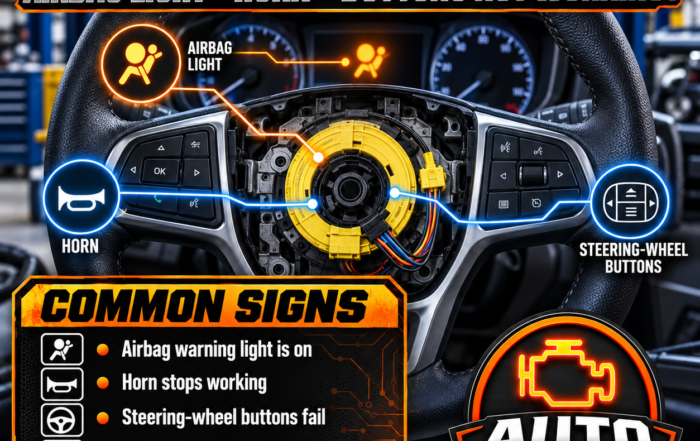
Quick answer: If your airbag light comes on at the same time the horn, cruise-control buttons, audio controls, or other steering-wheel functions stop working, a damaged clock spring is one possible cause. The clock spring carries electrical circuits between the stationary steering column and components that rotate with the steering wheel. However, wiring, switches, connectors, steering-column modules, and SRS faults can cause similar symptoms, so the clock spring should be tested before replacement.
Key Takeaways
- The clock spring allows electrical connections to remain intact while the steering wheel rotates.
- Depending on the vehicle, it may carry circuits for the driver airbag, horn, steering-wheel buttons, cruise control, heated steering wheel, and other controls.
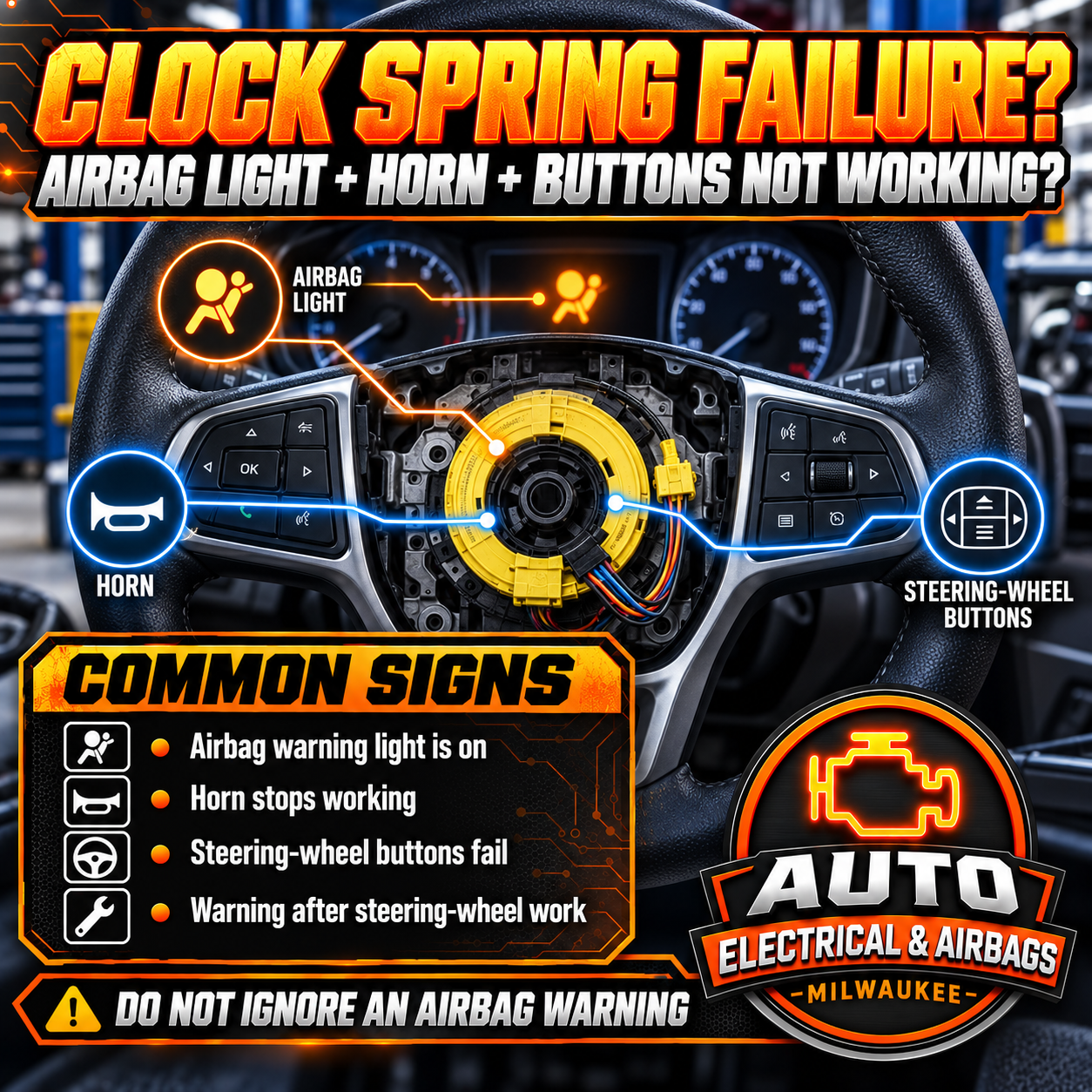
- A combination of airbag light + horn failure + steering-wheel button problems is a particularly useful diagnostic clue.
- Clicking, rubbing, or popping while turning the steering wheel can sometimes occur with clock-spring problems.
- A clock spring can fail partially; not every steering-wheel function has to stop working at once.
- An airbag-related code does not automatically prove the clock spring itself is defective.
- Steering wheel and SRS work should follow the correct vehicle-specific safety procedure because the driver’s airbag is involved.
What Is a Clock Spring in a Car?
A clock spring is an electrical connection assembly located in the steering-column area behind the steering wheel.
Its job is unusual.
The steering wheel has to rotate left and right, but electrical circuits still need to connect components on the rotating steering wheel to the stationary wiring in the vehicle.
A normal rigid wire would twist every time the steering wheel turned.
Eventually, it would break.
The clock spring solves that problem by using a flexible ribbon-style electrical connection arranged so it can move as the wheel rotates.
Depending on the vehicle, the clock spring may carry circuits for:
- Driver airbag
- Horn
- Cruise-control switches
- Audio controls
- Phone buttons
- Driver information controls
- Heated steering wheel
- Other steering-wheel electronics
That makes one relatively small component capable of creating several seemingly unrelated symptoms when something goes wrong.
Why Is It Called a Clock Spring?
The name comes from the way the internal ribbon cable is wound inside the housing.
It can wind and unwind as the steering wheel turns, somewhat like a coiled spring inside a clock.
The component may also be called:
- Spiral cable
- Spiral cable assembly
- Clockspring
- Clock spring assembly
- Steering wheel contact reel
- Cable reel
The terminology varies by manufacturer.
What Are the Most Common Symptoms of a Bad Clock Spring?
Common symptoms can include:
- Airbag or SRS warning light
- Horn stops working
- Steering-wheel audio buttons stop working
- Cruise-control buttons stop working
- Phone controls stop responding
- Steering-wheel controls work intermittently
- Clicking or rubbing noise while turning
- Warning appears only at certain steering-wheel positions
One symptom alone does not prove clock-spring failure.
The combination of several steering-wheel electrical failures is usually more informative.
Why Is Airbag Light + Horn Not Working Such an Important Clue?
The driver airbag and horn are both located in or around the steering wheel.
Both need an electrical path through the rotating steering assembly.
If the airbag warning appears at approximately the same time the horn stops working, a common steering-wheel electrical connection becomes worth investigating.
This is especially true if additional functions also fail, such as:
- Cruise control
- Volume controls
- Phone button
- Heated steering wheel
A single failed horn can have many causes.
A single airbag light can have many causes.
But several steering-wheel functions failing together creates a much more useful diagnostic pattern.
Can the Clock Spring Cause the Airbag Light to Come On?
Yes.
The driver airbag electrical circuit may pass through the clock spring.
If that circuit develops an open connection or excessive resistance, the SRS module may detect a fault and illuminate the airbag warning light.
Depending on the vehicle, a scan may identify a code related to:
- Driver airbag circuit
- Driver squib circuit
- Resistance too high
- Open circuit
- Steering-wheel airbag circuit
The exact code language varies by manufacturer.
A driver-airbag circuit code still does not automatically prove the clock spring is bad.
The circuit also includes:
- Airbag module
- Connectors
- Wiring
- SRS control module
Testing determines where the circuit is actually interrupted.
Can a Bad Clock Spring Stop the Horn From Working?
Yes.
On many vehicles, the horn-switch circuit passes through the clock spring.
A damaged internal ribbon circuit may prevent the horn command from reaching the rest of the system.
However, a dead horn can also be caused by:
- Horn fuse
- Horn relay
- Horn itself
- Horn switch
- Wiring
- BCM or control-module problem
The clock spring becomes more suspicious when horn failure happens with other steering-wheel electrical symptoms.
Can a Clock Spring Cause Steering-Wheel Buttons to Stop Working?
Yes.
Steering-wheel controls may also depend on electrical circuits passing through the clock spring.
Symptoms can include:
- Volume buttons dead
- Track controls dead
- Cruise control not responding
- Phone button not working
- Information controls intermittent
Sometimes every button stops working.
Other times only one group of controls is affected.
That depends on which internal circuit has failed.
Can a Clock Spring Fail Partially?
Yes.
A clock spring contains multiple electrical paths.
One circuit can fail while others continue functioning.
For example:
Airbag circuit: fault present
Horn: still works
Audio buttons: still work
Or:
Horn: dead
Audio controls: intermittent
Airbag: warning not yet present
A clock spring does not always fail all at once.
In fact, some failures can progress.
NHTSA recall documentation involving certain Ford Super Duty vehicles described clock-spring ribbon-cable problems that could initially affect steering-wheel controls or the horn before progressing far enough to affect the driver-airbag circuit.
That is an important example of why several steering-wheel symptoms appearing together should not be dismissed.
Can a Bad Clock Spring Make a Clicking or Popping Noise?
It can.
Possible noises include:
- Clicking
- Popping
- Rubbing
- Scraping
These noises may occur while turning the steering wheel.
However, steering-column noises can have many causes.
They may also come from:
- Trim panels
- Steering-column components
- Turn-signal mechanism
- Steering-wheel wiring
- Other mechanical parts
Noise by itself is not enough to diagnose a clock spring.
But noise combined with electrical steering-wheel failures becomes more meaningful.
Why Would the Airbag Light Change When I Turn the Steering Wheel?
This is another useful clue.
If an internal ribbon conductor is partially damaged, the electrical connection may change as the steering wheel rotates.
For example:
Wheel centered: circuit makes contact
Wheel turns: ribbon moves
Damaged section separates: circuit opens
You may notice:
- Airbag warning appears during a turn
- Horn works only at certain wheel positions
- Steering controls cut in and out while turning
That pattern strongly suggests an electrical problem associated with steering-wheel movement.
The clock spring is one component that should be evaluated.
Can Steering-Wheel Buttons Work Only When the Wheel Is Turned?
Yes.
A partially damaged clock-spring circuit can sometimes make or lose connection depending on steering-wheel position.
For example:
- Cruise works with wheel centered
- Stops during left turn
- Returns when wheel straightens
That type of repeatable relationship between wheel position and electrical operation is diagnostically useful.
It suggests that movement is influencing the circuit.
Can a Clock Spring Affect Cruise Control?
Yes, if the cruise-control switches are mounted on the steering wheel and their circuits pass through the clock spring.
Possible symptoms include:
- Cruise buttons dead
- Cruise turns on intermittently
- Cancel or set button stops working
But cruise-control faults can also involve:
- Brake switch
- Engine-control system
- Steering-wheel switch
- Module communication
Again, multiple steering-wheel symptoms are more useful than one isolated failure.
Can a Clock Spring Affect the Heated Steering Wheel?
On vehicles with a heated steering wheel, the heating circuit may also rely on connections through the rotating steering assembly.
A problem can potentially cause:
- Heated wheel not working
- Intermittent heating
- Steering-column fault
Vehicle design varies, so the wiring diagram for the exact model matters.
Can a Bad Clock Spring Affect Steering Assist?
Usually not directly.
The clock spring primarily provides electrical pathways for steering-wheel components.
Electric power steering uses separate:
- Steering motor
- EPS module
- Torque sensor
- Power and ground circuits
However, some steering-column assemblies contain several sensors and electronic components close together.
That means an EPS warning should not automatically be blamed on the clock spring.
For steering-assist problems, diagnosis should focus on the EPS system.
What Causes a Clock Spring to Fail?
Possible causes include:
- Internal ribbon wear
- Excessive rotation
- Incorrect installation
- Steering wheel installed off-center
- Collision repair
- Previous steering-column work
- Contamination
- Internal connector failure
- Age and repeated steering movement
Some vehicle-specific failures have also been the subject of manufacturer recalls.
Can a Clock Spring Break After Steering-Wheel Removal?
Yes.
Clock springs are designed to operate within a limited rotational range.
If the steering wheel is removed and the clock spring is allowed to rotate beyond its intended center position, the internal ribbon cable can become:
- Overwound
- Unwound too far
- Damaged
That is why correct centering procedures matter when steering-wheel or column work is performed.
What Happens if the Clock Spring Is Installed Off-Center?
A clock spring needs enough travel for full steering movement in both directions.
If installed incorrectly, it may reach the end of its internal travel before the steering system reaches full lock.
Continuing to turn the wheel can then damage the ribbon cable.
Possible results include:
- Sudden airbag light
- Horn failure
- Button failure
- Internal cable damage
Proper centering is therefore an important part of replacement.
Can an Alignment Cause a Clock Spring Problem?
A normal wheel alignment does not usually damage a clock spring.
However, steering-system work that leaves the steering wheel or steering shaft in an incorrect relationship can contribute to problems if the clock spring is no longer centered within its operating range.
The actual cause should be determined from the repair history and inspection.
Can a Collision Damage the Clock Spring?
Potentially.
A collision may affect:
- Steering wheel
- Driver airbag
- Steering column
- Clock spring
- Related wiring
If the driver’s airbag deployed, repairs may involve several components.
The clock spring should not automatically be assumed reusable or defective solely based on the collision.
Vehicle-specific post-collision inspection and replacement procedures should be followed.
Does a Deployed Driver Airbag Mean the Clock Spring Must Be Replaced?
Not universally.
The required post-collision parts depend on the manufacturer’s procedures for the exact vehicle.
Depending on the model and collision, required repairs may involve:
- Driver airbag
- Clock spring
- SRS module
- Impact sensors
- Seat belt pretensioners
- Wiring
This is why post-collision SRS repairs should be based on the manufacturer’s service information rather than a universal parts list.
Can a Bad Clock Spring Cause an SRS Code After Airbag Repair?
Yes, but it is only one possibility.
If a driver’s airbag has been replaced and an SRS code remains, possible causes include:
- Clock spring
- Connector
- Wiring
- Incorrect component
- SRS module condition
The remaining code should guide the next diagnostic step.
Does a Driver Airbag Circuit Code Mean the Clock Spring Is Bad?
No.
This is one of the most important diagnostic points.
Suppose a scanner shows a code involving the driver’s airbag circuit.
That circuit may include:
SRS module → wiring → clock spring → connector → driver airbag
Any interruption in that path can affect the circuit.
The code identifies the affected circuit.
It does not automatically identify which component is defective.
Can a Loose Airbag Connector Cause Similar Symptoms?
Yes.
Loose or damaged connectors can create:
- Open-circuit codes
- High-resistance codes
- Intermittent SRS warning
This may occur after:
- Steering-wheel repair
- Airbag replacement
- Column work
- Collision repair
The connectors should be inspected according to proper SRS procedures.
Can a Wiring Problem Mimic a Bad Clock Spring?
Yes.
Wiring outside the clock spring can cause similar electrical symptoms.
Possible locations include:
- Steering column
- Dash harness
- SRS wiring
- Horn circuit
This is why circuit testing is important before replacing the clock spring.
Can a Steering Column Control Module Cause Similar Problems?
Yes.
Some modern vehicles integrate steering-wheel electronics with a steering-column control module.
A module problem may affect:
- Switch inputs
- Turn signals
- Wipers
- Steering-wheel controls
- Communication
Depending on the vehicle, the clock spring may even be incorporated into a larger steering-column electronics assembly.
The system design should be identified before parts are ordered.
Can a CAN Bus Fault Cause Steering-Wheel Button Problems?
Potentially.
On some vehicles, steering-wheel switch information is processed by a steering-column module and then transmitted electronically to other modules.
If the module loses:
- Power
- Ground
- Communication
multiple functions can fail.
Our guide to CAN bus communication faults explains why a module that stops communicating is not automatically internally defective.
How Is a Bad Clock Spring Diagnosed?
A proper diagnosis begins by identifying exactly which steering-wheel functions have failed.
Check the Symptom Pattern
Technicians may test:
- Horn
- Audio buttons
- Cruise buttons
- Phone controls
- Airbag warning
Several failures occurring together can point toward a common connection.
Scan the SRS System
A capable scanner may reveal codes involving:
- Driver airbag circuit
- Steering-wheel components
- Steering-column modules
The exact code matters.
Check Whether Symptoms Change With Steering Position
Technicians may observe whether:
- Horn cuts out while turning
- Controls become intermittent
- Warning changes with wheel position
Repeatable changes with steering movement are valuable clues.
Inspect Related Wiring and Connectors
The entire affected circuit should be considered.
That includes wiring outside the clock spring.
Verify the Clock Spring Circuit
Vehicle-specific electrical testing can determine whether the necessary circuits remain continuous through the steering-wheel assembly.
Check Vehicle-Specific Information
Manufacturer service information may contain:
- Diagnostic procedures
- Revised components
- Technical bulletins
- Recall information
This is especially important because some clock-spring failures are vehicle-specific.
Clock Spring vs. Bad Horn
| Symptom | Clock Spring Possible? | Horn/Horn Circuit Possible? |
|---|---|---|
| Horn alone does not work | Yes | Strong clue |
| Horn + airbag light | Strong clue | Possible |
| Horn + steering buttons fail | Strong clue | Less likely one horn fault |
| Horn changes with steering position | Strong clue | Possible |
| Horn fuse blown | Less likely initially | Strong clue |
A dead horn alone is not enough to condemn the clock spring.
Clock Spring vs. Steering-Wheel Switch
| Symptom | Clock Spring Possible? | Switch Possible? |
|---|---|---|
| One single button fails | Possible | Strong clue |
| Entire button group fails | Yes | Yes |
| Several unrelated steering controls fail | Strong clue | Less likely |
| Airbag light also appears | Strong clue | Less likely |
| Problem changes while turning wheel | Strong clue | Possible |
The more systems affected, the more important the shared electrical path becomes.
Clock Spring vs. SRS Module
A clock spring problem often creates a fault concentrated around the driver’s steering-wheel circuit.
An SRS module problem can potentially affect several restraint-system circuits.
For example:
Clock spring pattern:
- Driver airbag code
- Horn failure
- Steering controls failure
Broader SRS problem:
- Multiple airbag circuits
- Pretensioner faults
- Communication problems
- Internal module code
The complete scan helps separate the two.
Why Replacing the Clock Spring Without Testing Can Waste Money
Consider this sequence:
- Airbag light appears.
- Someone assumes the clock spring is bad.
- Clock spring is replaced.
- Airbag light remains.
- A damaged driver’s airbag connector is finally found.
The replacement did not solve the actual fault.
A better sequence is:
Symptoms → full SRS scan → steering-wheel function testing → wiring/connectors → clock spring verification → replacement if confirmed
That keeps the diagnosis based on evidence instead of guessing.
Is It Safe to Drive With a Suspected Bad Clock Spring?
A suspected clock-spring problem becomes particularly important when the airbag warning light is on.
If the SRS module detects an active fault in the driver-airbag circuit, normal operation of that portion of the restraint system should not be assumed until the fault is diagnosed.
A horn failure also creates a separate safety concern because the horn is an important warning device.
The vehicle should be evaluated rather than relying on the assumption that the problem only affects convenience buttons.
Should You Test a Clock Spring Yourself?
SRS and steering-wheel components require special caution because the driver airbag is located in the same assembly.
Improper handling can create:
- Accidental deployment risk
- New SRS codes
- Damaged connectors
- Clock-spring misalignment
Follow manufacturer procedures for the exact vehicle.
NHTSA also advises against casual handling or tampering with steering-wheel airbag components.
Can a Clock Spring Be Repaired?
Replacement is generally the appropriate approach when the internal flexible conductor assembly has failed, although the exact repair strategy depends on the vehicle.
An internal ribbon-cable failure is not the same as repairing an external wire or connector.
Vehicle-specific replacement and setup procedures should be followed.
Does a New Clock Spring Need Calibration?
Sometimes additional procedures may be necessary depending on the vehicle and what components are integrated into the assembly.
Possible requirements can include:
- Correct clock-spring centering
- Steering-angle sensor calibration
- Module initialization
- Fault-code clearing
Do not assume every clock spring is simply plug-and-play.
Can the Steering Angle Sensor Be Part of the Clock Spring Assembly?
On some vehicles, yes.
The steering-angle sensor may be:
- Integrated with the clock spring
- Mounted in the same assembly
- Located immediately adjacent to it
That matters because replacement may affect:
- ABS
- Stability control
- Steering-related systems
Our guide to bad steering angle sensor symptoms explains how steering-angle information is used by several vehicle safety systems.
Why Vehicle-Specific Diagnosis Matters
A clock spring is a good example of why automotive electrical diagnosis cannot rely only on a symptom list.
Two vehicles can both have:
- Airbag light
- Dead horn
- Dead steering controls
but use different electronic architectures.
One may have a simple clock spring.
Another may integrate:
- Steering-column module
- Steering-angle sensor
- Communication electronics
The symptoms may look identical while the required testing and repair are different.
When Should a Clock Spring Problem Be Professionally Diagnosed?
Consider professional diagnosis when:
- Airbag light is on
- Horn stopped working
- Steering-wheel buttons stopped working
- Several steering controls failed together
- Symptoms change when steering wheel turns
- Clicking or popping occurs in steering wheel
- Driver-airbag circuit code is stored
- Problem began after steering-wheel repair
- Problem began after collision
- Clock spring was replaced but warning remains
The combination of symptoms is usually more informative than any single failure.
Clock Spring and SRS Diagnostics in Milwaukee
At Auto Electrical & Airbag Specialist, we diagnose SRS and steering-wheel electrical problems involving clock springs, driver-airbag circuits, connectors, wiring, steering-column electronics, and related fault codes.
Our SRS Repair & Airbag Light Diagnostics in Milwaukee service covers airbag warning lights, steering-wheel airbag circuits, connectors, wiring, and restraint-system diagnostics.
Our Airbag Repair & Diagnostics in Milwaukee service also addresses airbag warnings associated with steering-wheel components and post-collision restraint-system concerns.
If testing shows that the problem is located in external wiring rather than the clock spring itself, our Car Wiring Repair & Electrical Troubleshooting service focuses on damaged conductors, connectors, grounds, and intermittent circuits.
Auto Electrical & Airbag Specialist
2636 S 32nd St, Milwaukee, WI 53215
(414) 345-7568
Frequently Asked Questions About Bad Clock Springs
What are the most common symptoms of a bad clock spring?
Common symptoms include an airbag light, horn failure, steering-wheel controls not working, intermittent buttons, or clicking and rubbing sounds while turning the wheel.
Can a bad clock spring turn on the airbag light?
Yes. The driver-airbag circuit may pass through the clock spring, so an open or high-resistance connection can trigger an SRS warning.
Can a bad clock spring stop the horn from working?
Yes, if the horn circuit passes through the clock spring.
Can a clock spring affect steering-wheel buttons?
Yes. Audio, cruise-control, phone, and other steering-wheel circuits may pass through the assembly.
Can the clock spring fail partially?
Yes. One internal circuit may fail while other steering-wheel functions continue working.
Why does my horn work only when the steering wheel is turned?
A circuit that changes operation with steering-wheel position can indicate a movement-related electrical fault, including a partially damaged clock spring.
Can a bad clock spring make a clicking noise?
It can. Clicking, popping, or rubbing from the steering-wheel area may occur with certain failures, although other steering-column components can create similar sounds.
Does a driver-airbag circuit code automatically mean the clock spring is bad?
No. Wiring, connectors, the driver-airbag module, and other circuit components can produce similar codes.
Can a clock spring break after steering-wheel removal?
Yes. Incorrect centering or excessive rotation during repair can damage the internal ribbon cable.
Does a new clock spring need to be centered?
Yes. Proper centering is critical so the internal cable has sufficient travel in both steering directions.
Can a bad clock spring affect the steering angle sensor?
On vehicles where the sensor is integrated with or located near the clock-spring assembly, related procedures may be necessary after replacement.
Should I ignore the problem if only my steering-wheel buttons stopped working?
No. If other symptoms such as an airbag warning or horn failure are also present, the shared steering-wheel electrical circuits should be diagnosed.
The Bottom Line
A bad clock spring can create a very recognizable group of symptoms:
Airbag light + horn problem + steering-wheel controls not working
That happens because several electrical circuits may share the same rotating connection between the steering wheel and steering column.
But a clock spring should not be replaced simply because an airbag code mentions the driver’s steering-wheel circuit.
The correct diagnostic question is:
“Which steering-wheel circuits have failed, and where is electrical continuity being lost?”
Testing the complete circuit helps distinguish a clock spring failure from a bad switch, damaged connector, external wiring fault, or steering-column module problem—and avoids replacing parts based only on symptoms.