You press the seat switch and nothing happens.
Or the seat moves forward but will not move backward.
Maybe the recline function works while the seat will not move up or down. One adjustment works perfectly while another suddenly stops.
It is easy to assume the entire power seat motor has failed.
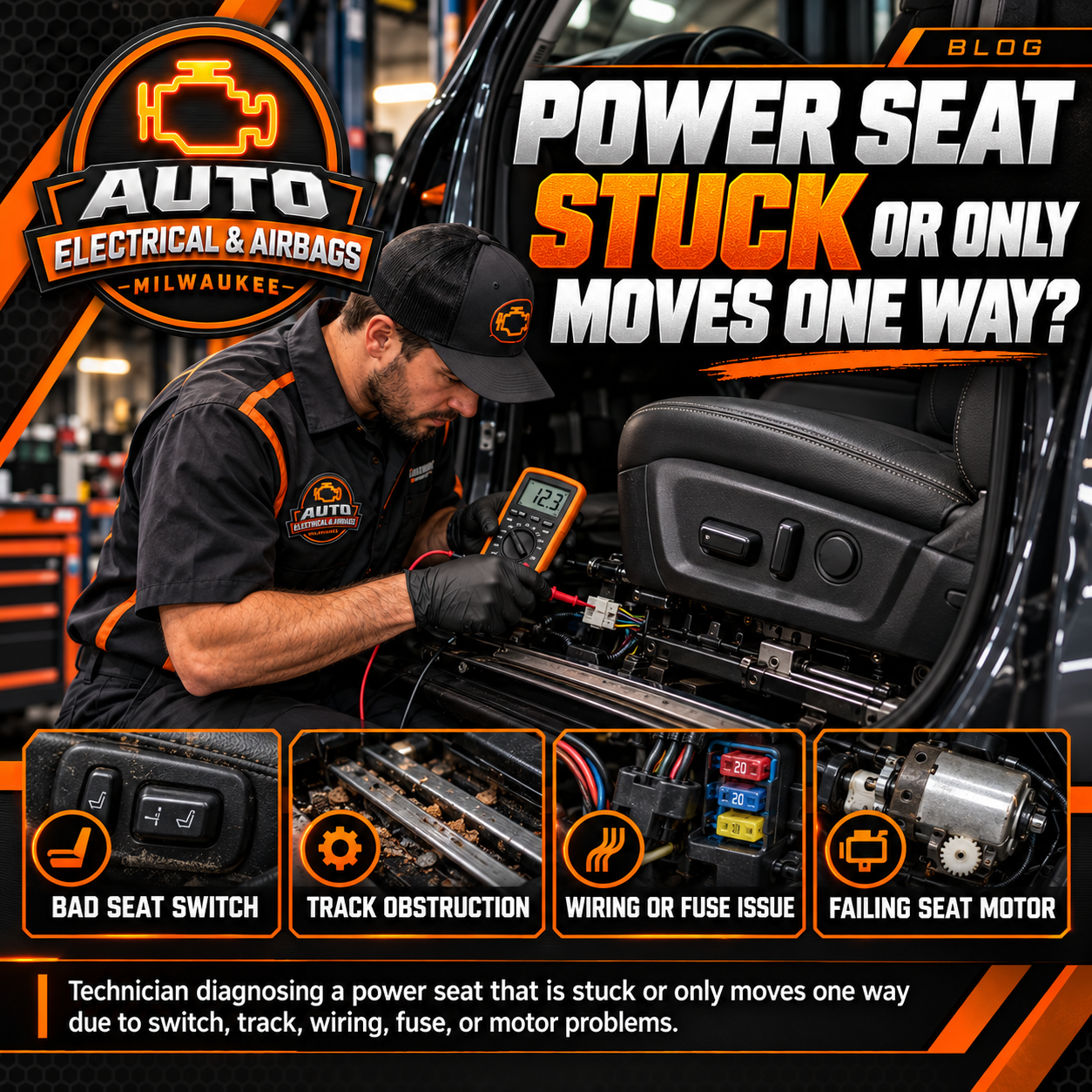
But power seats are made up of several electrical and mechanical components. A problem may involve the switch, one specific motor, wiring, a fuse, connector, power or ground circuit, seat track, position sensor, or electronic control module.
The way the seat fails can provide useful clues.
A completely dead seat may point toward a different problem than a seat that moves in one direction but not the other.
This guide explains how power seat systems work, why only one movement may fail, what causes intermittent seat problems, and how technicians determine whether the issue is electrical or mechanical before replacing parts.
Quick Answer: Why Is My Power Seat Not Working?
Common causes include:
- Blown fuse
- Failed seat switch
- Bad power seat motor
- Damaged wiring
- Loose electrical connector
- Poor power or ground connection
- Jammed seat track
- Object blocking the seat track
- Position sensor problem
- Memory-seat control module fault
- Damaged seat wiring under the seat
- Mechanical gearbox or cable problem
If the seat moves in one direction but not the opposite direction, the issue may involve one switch contact, one motor circuit, or one portion of the seat mechanism rather than the entire power seat system.
How Does a Power Seat Work?
A power seat uses electric motors to move different parts of the seat.
Depending on the vehicle, separate motors may control:
- Forward and backward movement
- Seat height
- Front cushion tilt
- Rear cushion tilt
- Recline
- Lumbar support
- Headrest position
More advanced systems may also include:
- Seat position sensors
- Memory functions
- Seat control modules
- Heated seats
- Ventilated seats
- Driver profile integration
When you press a seat switch, electrical power is directed to the appropriate motor.
To reverse movement, the circuit may reverse electrical polarity or change the command sent to a control module.
That is why a seat may move forward but not backward even though the motor can still operate.
Why Does the Power Seat Move Forward but Not Backward?
This is one of the most useful symptoms for diagnosis.
If the seat moves normally in one direction but not the other, the main power supply may still be working.
Possible causes include:
- Failed switch contact
- Wiring problem in one direction circuit
- Motor issue
- Mechanical binding
- Control module problem
For example, the same seat motor may be capable of rotating in both directions.
The switch changes the electrical circuit to tell the motor which way to turn.
If the switch can command forward movement but not reverse movement, one part of the switch may have failed.
However, that should be tested rather than assumed.
Can a Power Seat Switch Fail in Only One Direction?
Yes.
Power seat switches contain electrical contacts that control different movements.
One contact can wear or fail while the others continue working.
Possible symptoms include:
- Seat moves forward but not backward
- Recline works in one direction
- Seat moves up but not down
- One switch position feels loose
- Seat works when the switch is moved repeatedly
- Seat works only when pressure is applied to the switch in a certain way
The switch can therefore be partially faulty rather than completely dead.
Can the Power Seat Motor Work in One Direction but Not the Other?
It can, but the motor should not automatically be blamed.
Depending on the design, the same motor can operate in both directions by reversing electrical polarity.
If the motor works in one direction, that proves it is capable of operating at least partially.
The problem may instead involve:
- Switch output
- Wiring
- Connector
- Module command
- Mechanical load
Testing voltage at the motor while commanding both directions can help determine whether the motor is receiving the correct electrical command.
Why Is My Power Seat Completely Dead?
A completely dead power seat may have a broader electrical problem.
Possible causes include:
- Blown fuse
- Missing power supply
- Poor ground
- Failed master seat switch
- Disconnected connector
- Damaged wiring
- Seat control module problem
Before replacing a motor, technicians may verify whether the seat is receiving electrical power.
If every movement suddenly stops at the same time, it is less likely that several individual motors failed simultaneously.
A shared electrical supply becomes more suspicious.
Can a Blown Fuse Stop the Power Seat?
Yes.
Power seats usually have circuit protection through a fuse, circuit breaker, or similar device depending on the vehicle.
A blown fuse can cause the entire seat to stop working.
But the more important question is:
Why did the fuse fail?
Possible causes include:
- Short circuit
- Damaged wiring
- Motor drawing excessive current
- Pinched wire
- Electrical component failure
Repeatedly replacing the fuse without identifying the cause can leave the underlying problem unresolved.
Can Something Under the Seat Stop It From Moving?
Absolutely.
Power seat tracks can become blocked by:
- Coins
- Pens
- Toys
- Bottles
- Floor mats
- Debris
- Small personal items
An object in the track may prevent movement even though the electrical system is trying to operate the motor.
Possible clues include:
- Motor noise but no movement
- Seat moves slightly then stops
- One side of the seat moves more than the other
- Grinding or clicking sound
Before assuming an electrical failure, visually inspect the seat track for obvious obstructions.
Do not place hands near moving seat mechanisms while operating the seat.
Why Does My Power Seat Make Noise but Not Move?
If you can hear the motor running, electrical power may be reaching the motor.
That can shift suspicion toward a mechanical problem involving:
- Seat track
- Gearbox
- Drive cable
- Mechanical linkage
- Broken gear
Possible sounds include:
- Clicking
- Grinding
- Motor spinning
- Repeated tapping
A motor that runs without moving the seat does not necessarily need replacement.
The mechanical connection between the motor and seat track may be the actual problem.
Why Does One Side of the Seat Move but the Other Does Not?
Some power seat designs use cables or mechanical drives to move both sides of the seat track together.
If one side moves and the other does not, possible causes include:
- Broken drive cable
- Damaged gear
- Jammed track
- Mechanical misalignment
The seat can then become crooked or bind during movement.
Continuing to operate a seat that is noticeably twisting or binding may worsen the damage.
Can Wiring Under the Seat Cause Power Seat Problems?
Yes.
The area underneath a seat contains wiring that moves whenever the seat is adjusted.
Depending on the vehicle, wiring beneath the seat may serve:
- Power seat motors
- Memory seat systems
- Heated seats
- Ventilated seats
- Occupancy sensors
- Seat belt circuits
- Airbag or SRS components
Repeated movement can place stress on wiring and connectors.
Possible problems include:
- Stretched wiring
- Pinched wiring
- Loose connectors
- Damaged insulation
- Broken conductors
A wiring fault can cause the seat to work only in certain positions.
Why Does My Power Seat Work Sometimes?
Intermittent seat operation can be caused by:
- Worn switch
- Loose connector
- Broken wire
- Failing motor
- Poor ground
- Control module problem
Pay attention to the conditions when the seat works.
For example:
- Works only when the door is open
- Works after moving the switch several times
- Works only when the seat is in a certain position
- Stops when the seat reaches one area of the track
- Works after hitting a bump
Those details can help narrow the diagnosis.
Can a Broken Wire Cause the Seat to Work Only in Certain Positions?
Yes.
Because the seat moves forward and backward, its wiring harness must move with it.
A partially broken wire may make contact in one seat position and separate in another.
For example:
Seat forward: wiring makes contact
Seat moves backward: harness stretches
Connection opens: seat stops working
This type of fault can appear random until the relationship between seat position and electrical failure is recognized.
For damaged circuits, our car wiring repair in Milwaukee focuses on wiring, connectors, grounds, and intermittent electrical faults.
Can a Bad Ground Cause Power Seat Problems?
Yes.
Electric motors require a strong electrical ground.
A poor ground can cause:
- Slow seat movement
- Intermittent operation
- Complete loss of movement
- Motor struggling under load
Ground problems can also create symptoms that make the motor appear weak.
A ground connection should therefore be tested electrically rather than judged only by appearance.
Our guide to bad ground wire symptoms explains why high-resistance grounds can affect electric motors and other vehicle electronics.
Why Is My Power Seat Moving Slowly?
A slow power seat may be caused by either an electrical or mechanical problem.
Possible causes include:
- Weak motor
- High resistance in wiring
- Poor ground
- Damaged connector
- Mechanical binding
- Dirty or damaged track
- Worn gears
- Low system voltage
The motor may be receiving electrical power but not enough usable voltage while under load.
That is why testing under operating conditions can be more useful than simply checking whether voltage exists.
Can Low Battery Voltage Affect the Power Seat?
Yes.
Power seat motors use significant electrical current.
Low battery voltage can cause:
- Slow movement
- Weak motor operation
- Electronic control issues
If several high-current accessories become weak at the same time, system voltage should be considered.
But if only one seat adjustment is affected, the problem is more likely local to that specific circuit or mechanism.
Can a Power Seat Motor Overheat?
Yes.
A motor can become hot if:
- Seat is mechanically jammed
- Track is binding
- Motor is worn
- Circuit is operated continuously
Many systems have protection designed to reduce damage, but repeated operation of a stuck seat can still place extra stress on the motor and wiring.
If the motor sounds strained or the seat barely moves, repeated operation may not be helpful.
What Causes a Power Seat Motor to Fail?
Electric motors wear over time.
Possible causes include:
- Worn brushes
- Internal winding failure
- Mechanical drag
- Overheating
- Water damage
- Excessive load
- Age and repeated use
But because several different electrical faults can imitate motor failure, confirming power and ground at the motor is important before replacement.
Why Does Tapping the Seat Make It Start Working?
If tapping or moving the seat causes it to begin working again, the problem may involve:
- Loose connector
- Intermittent wiring
- Worn motor
- Worn switch
Movement temporarily restores electrical contact.
That may provide a diagnostic clue, but it is not a reliable repair.
Can a Power Seat Switch Be Tested?
Yes.
Testing methods depend on the vehicle.
A technician may evaluate:
- Switch input power
- Output voltage
- Continuity
- Command data on electronically controlled systems
On simple circuits, the switch may directly reverse polarity to the motor.
On newer systems, it may send a signal to a seat control module.
This is another reason vehicle-specific wiring information matters.
What Is a Memory Seat Module?
Vehicles with memory seats may use an electronic control module to remember and reproduce seat positions.
The system may interact with:
- Seat position sensors
- Seat motors
- Door modules
- Key fobs
- Driver profiles
- Mirrors
Possible memory-seat problems include:
- Saved positions disappear
- Seat will not return to programmed position
- One memory button does not work
- Seat moves incorrectly during recall
- Seat stops before reaching the stored position
This can involve sensors or electronic control rather than a basic motor failure.
Why Are My Memory Seat Settings Not Working?
Possible causes include:
- Seat position sensor fault
- Control module problem
- Battery voltage loss
- Lost initialization
- Wiring issue
- Switch problem
If the normal manual seat controls still work while memory functions do not, the motors themselves may be fine.
That difference can help narrow the diagnostic path.
Can a Seat Position Sensor Fail?
Yes.
Memory and electronically controlled seat systems may use position sensors to determine where the seat is located.
A faulty sensor can cause:
- Incorrect memory recall
- Seat stops unexpectedly
- Stored position does not match actual position
- Module-related codes
But wiring and calibration problems can create similar symptoms.
Can a Power Seat Problem Cause an Airbag Light?
Potentially.
Seats often contain components related to the Supplemental Restraint System.
Depending on the vehicle, those may include:
- Side airbag
- Occupancy sensor
- Seat belt pretensioner
- Seat belt buckle sensor
- SRS wiring
If wiring under the seat is damaged or disconnected, an airbag warning may appear.
This does not mean the power seat motor itself caused the airbag problem.
It means several electrical systems may share the same physical area.
Airbag wiring should be handled according to appropriate vehicle service procedures.
Why Did My Airbag Light Come On After Moving the Seat?
If the airbag warning changes when the seat is moved, wiring or connectors underneath the seat deserve attention.
Possible issues include:
- Loose connector
- Stretched wiring
- Damaged harness
- Connector contamination
Because SRS components are safety-related, those circuits should be professionally diagnosed.
Can Water Damage a Power Seat?
Yes.
Water entering the passenger compartment can reach:
- Seat motors
- Wiring
- Connectors
- Seat control modules
Possible sources include:
- Flooding
- Leaking sunroof
- Door leak
- Windshield leak
Moisture may cause immediate failure or corrosion that develops gradually.
If several electrical problems began after interior water intrusion, broader electrical inspection may be needed.
Why Did My Power Seat Stop Working After Interior Repair?
Seat removal is sometimes necessary for:
- Carpet replacement
- Body repair
- Audio installation
- Interior repair
If the problem began immediately afterward, possible causes include:
- Connector not fully reinstalled
- Wiring pinched
- Harness damaged
- Fuse blown
- Seat initialization issue
Recent work should always be part of the diagnostic history.
Does a Power Seat Code Mean the Seat Module Is Bad?
Not necessarily.
Electronic seat systems may store codes involving:
- Motor circuit
- Position sensor
- Communication
- Power supply
- Control module
The code indicates where the system detected a problem.
Testing determines whether the module itself is actually defective.
This is the same principle used throughout modern vehicle diagnostics: a component named in a code is not automatically the failed part.
How Is a Stuck Power Seat Diagnosed?
A logical diagnostic process starts with the way the seat is failing.
Determine Which Functions Still Work
A technician may test:
- Forward/backward
- Up/down
- Recline
- Tilt
- Lumbar
This helps identify whether the problem affects:
- Whole seat
- One motor
- One switch circuit
- One mechanical movement
Inspect the Seat Track
The track may be checked for:
- Obstructions
- Misalignment
- Broken mechanical parts
A motor should not be blamed for a seat that is physically jammed.
Check the Fuse or Circuit Protection
If the entire seat is dead, the main power supply should be verified.
Test Power and Ground
Voltage should be checked while the system is under load.
If the motor receives proper power and ground but does not operate, the motor becomes more suspicious.
Test the Switch
If the motor works in one direction, the switch circuit can be tested in both directions.
This helps determine whether the switch is failing to send the reverse command.
Inspect Wiring and Connectors
Particular attention may be given to wiring under the seat because it moves constantly.
Scan the Seat Module When Applicable
Vehicles with memory or electronic seat modules may store diagnostic data.
A scan can help identify:
- Position sensor faults
- Communication issues
- Motor circuit problems
- Module errors
Power Seat Motor vs. Switch Problem
| Symptom | Motor Possible? | Switch Possible? |
|---|---|---|
| Seat completely dead | Yes | Yes |
| Moves one direction only | Possible | Strong clue |
| Motor clicks but does not move | Yes | Less likely |
| Works when switch is moved repeatedly | Possible | Strong clue |
| Only one adjustment fails | Yes | Yes |
| All adjustments fail at once | Less likely multiple motors failed | Possible/shared power issue |
| Proper voltage reaches motor but it will not move | Strong clue | Less likely |
The exact circuit should be tested before parts are replaced.
Power Seat Electrical Problem vs. Mechanical Problem
| Symptom | Electrical Cause Possible? | Mechanical Cause Possible? |
|---|---|---|
| No sound at all | Strong clue | Possible |
| Motor runs but seat does not move | Possible | Strong clue |
| Seat twists while moving | Less likely | Strong clue |
| Works in one direction only | Yes | Yes |
| Seat moves slowly | Yes | Yes |
| Fuse blows | Strong clue | Mechanical binding may cause overload |
| Seat track visibly blocked | No | Strong clue |
This is why diagnosis should evaluate both sides of the system.
Should You Force a Stuck Power Seat?
No.
Do not force a powered seat by hand while the mechanism is engaged.
Doing so can damage:
- Track
- Gear
- Cable
- Motor assembly
If the seat is stuck, identify whether the issue is electrical or mechanical first.
Is a Stuck Driver Seat a Safety Concern?
Potentially.
Proper seat position matters for:
- Reaching pedals
- Steering control
- Seat belt fit
- Airbag position
If the driver seat is stuck in a position that prevents safe operation of the vehicle, it should be corrected before driving.
Why Replacing the Motor First Can Waste Money
Suppose a seat will not move backward.
A motor is replaced.
The problem remains.
The actual problem may have been:
- Failed reverse switch contact
- Broken wire
- Bad connector
This is why the symptom should lead to electrical testing rather than immediate motor replacement.
The preferred sequence is:
Symptom → power/ground → switch command → wiring → motor/mechanical test
rather than:
Seat does not move → replace motor
When Should a Power Seat Problem Be Professionally Diagnosed?
Consider electrical diagnosis when:
- Seat moves only one direction
- Seat is completely dead
- Seat works intermittently
- Seat moves slowly
- Motor makes noise but seat does not move
- Fuse repeatedly fails
- Seat works only in certain positions
- Memory settings no longer function
- Airbag light changes when seat is moved
- Replacing the switch or motor did not solve the issue
The exact failure pattern helps determine where testing should begin.
Power Seat Electrical Diagnostics in Milwaukee
At Auto Electrical & Airbag Specialist, we diagnose power seat problems involving motors, switches, wiring, connectors, fuses, position sensors, memory systems, and control modules.
Our Power Seat Electrical Repair in Milwaukee service is designed for seats that are stuck, move only one direction, operate intermittently, or have memory and electrical-control problems.
If testing shows damaged wiring or connectors underneath the seat, our car wiring repair service can address the underlying circuit problem.
Auto Electrical & Airbag Specialist
2636 S 32nd St, Milwaukee, WI 53215
(414) 345-7568
Frequently Asked Questions About Power Seats
Why does my power seat move forward but not backward?
Possible causes include a failed switch contact, wiring fault, motor circuit problem, or mechanical binding. Because the seat still moves in one direction, the entire electrical supply is not necessarily lost.
Can a power seat switch fail in only one direction?
Yes. Individual contacts inside the switch can fail while other seat movements continue to work.
Why is my power seat completely dead?
A completely dead seat may have a blown fuse, missing power, poor ground, failed switch, wiring problem, disconnected connector, or control-module issue.
Can a power seat motor work in one direction only?
It is possible, but the switch and electrical circuit should also be tested because the motor may not be receiving the reverse command.
Why does my seat motor make noise but the seat does not move?
The motor may be operating while a gear, cable, track, or other mechanical part is damaged or jammed.
Can something under the seat stop it from moving?
Yes. Objects in the seat track can block movement and place extra load on the motor.
Can damaged wiring under the seat cause intermittent problems?
Yes. The wiring moves whenever the seat changes position, and a partially broken wire may work in one position but fail in another.
Why does my power seat work when I move the switch repeatedly?
A worn switch contact, loose connector, or intermittent motor can cause this behavior.
Can a power seat problem cause an airbag light?
Wiring underneath the seat may include SRS circuits. A damaged or loose SRS connector can trigger an airbag warning even though the seat-movement problem itself is separate.
Why are my memory seat settings not working?
Possible causes include a position sensor, control module, wiring, switch, battery-voltage issue, or lost initialization.
Can low battery voltage make a power seat move slowly?
Yes. Power seat motors require significant current, so low voltage can reduce motor performance.
Should I replace the power seat motor first?
Not without testing. A stuck seat may have a switch, fuse, wiring, connector, ground, or mechanical problem rather than a failed motor.
The Bottom Line
A power seat that is stuck or moves only one direction does not automatically need a new motor.
The problem could be:
- Seat switch
- Motor
- Fuse
- Wiring
- Connector
- Ground
- Track
- Mechanical drive
- Position sensor
- Seat control module
The failure pattern itself can provide important clues.
A completely dead seat points toward different possibilities than a seat that moves forward but not backward.
The best diagnostic question is:
“Is the seat receiving the correct electrical command, and can the mechanism respond to it?”
Answering both sides of that question helps determine whether the repair belongs in the electrical circuit, motor, switch, or seat mechanism.