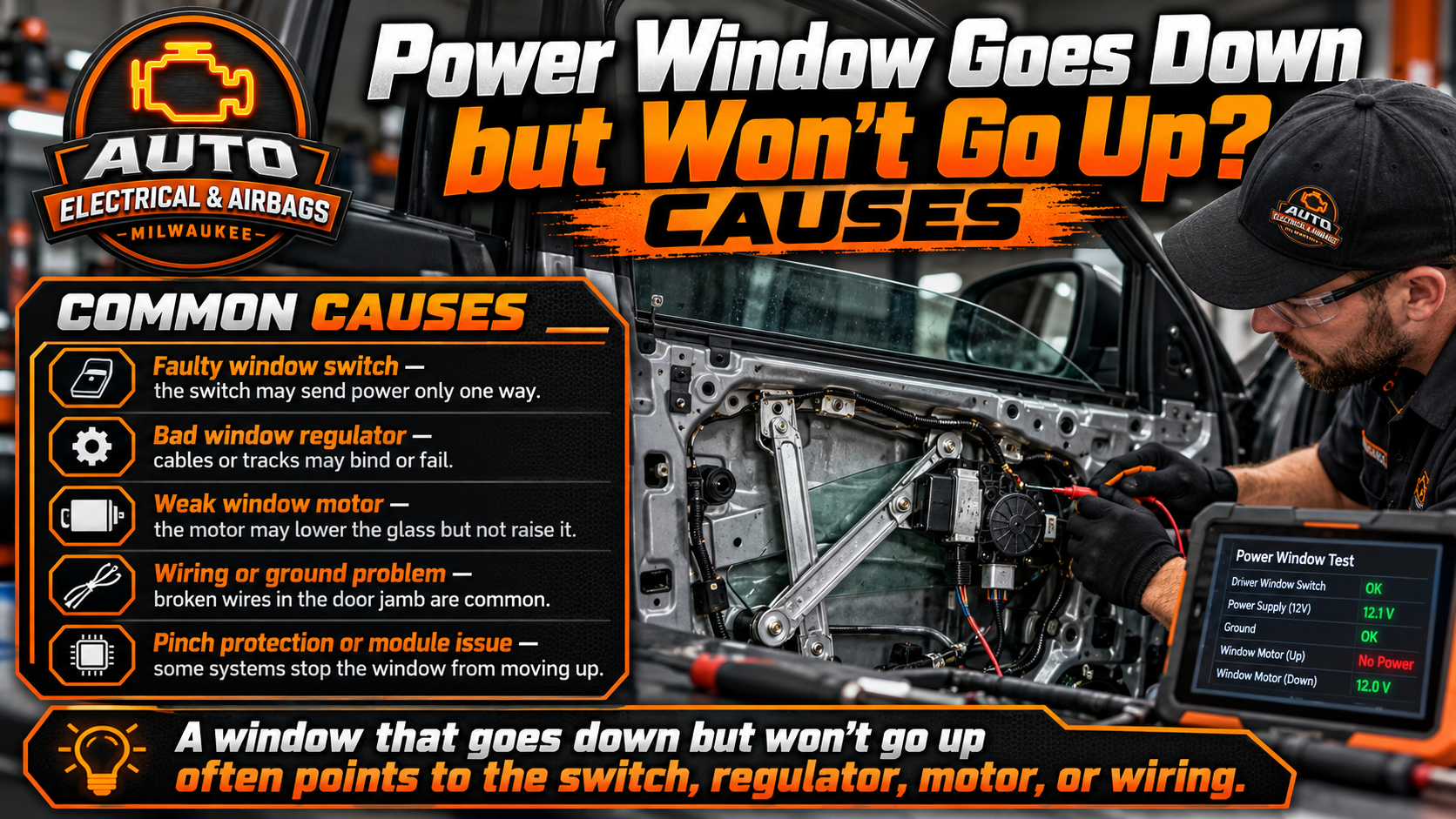
You press the window switch and the glass lowers normally.
Then you try to raise it.
Nothing happens.
Maybe the window moves slightly and stops. Maybe it works from one switch but not another. Sometimes it will go back up after several tries, after slamming the door, or only when the vehicle has been sitting for a while.
When a power window moves in one direction but not the other, it can seem obvious that the window motor has failed.
But that is not always the case.
A power window system includes the motor, switch, regulator, wiring, connectors, power and ground circuits, and on many newer vehicles, a door module or body control module.
Because the motor often operates in both directions by reversing the electrical circuit, a window that goes down but will not come back up can point to a very specific type of fault.
This guide explains why a power window may work in only one direction, how technicians separate switch problems from motor and regulator failures, and why replacing the window motor first does not always solve the problem.
Quick Answer: Why Does My Window Go Down but Not Up?
Possible causes include:
- Failed window switch contact
- Faulty master window switch
- Weak or failing window motor
- Damaged window regulator
- Broken wiring in the door
- Loose or corroded connector
- Door module fault
- BCM-related control problem
- Mechanical binding in the window track
- Window initialization or anti-pinch issue
The exact symptom matters.
If the same motor can move the glass downward, that tells us the system still has at least some electrical and mechanical function.
Testing is needed to determine why the reverse direction is failing.
How Does a Power Window Move Up and Down?
A power window uses an electric motor connected to a regulator that moves the glass.
On many systems, the same motor is used for both directions.
To lower the window, electrical current flows through the motor one way.
To raise the window, the circuit reverses polarity and the motor turns in the opposite direction.
In a simplified system:
Down command → motor turns one direction
Up command → polarity reverses → motor turns the other direction
That is why a window can move down normally but fail to go back up.
The motor may be capable of running, while the reverse electrical command or mechanical load is failing.
Why Is a Window That Works in One Direction an Important Clue?
A power window that does absolutely nothing may have lost:
- Fuse protection
- Power
- Ground
- Main switch input
- Motor operation
But when the window works in one direction, several parts of the system have already proven they can operate at least partially.
For example, the system likely has:
- Some electrical power
- At least partial motor function
- Some regulator movement
- At least one working switch circuit
That can narrow the diagnosis.
It does not prove the motor is good, but it makes a complete power-supply failure less likely.
Can a Bad Window Switch Cause the Window to Go Down but Not Up?
Yes.
This is one of the most common possibilities.
A window switch contains separate electrical contacts or commands for different directions.
The down portion of the switch can work while the up portion fails.
Possible clues include:
- Window consistently goes down but never up
- Switch feels loose in one direction
- Window works when switch is pressed or moved a certain way
- Window works intermittently after repeated switch operation
- Other windows still work normally
A failed switch should be tested rather than assumed because a wiring or motor problem can create similar symptoms.
Can the Driver Master Switch Cause One Window to Stop Working?
Yes.
The driver door often contains a master switch that controls several windows.
Depending on vehicle design, another door’s window circuit may pass through or communicate with the master switch.
A failing master switch can therefore affect one or more windows even if the local door switch itself is good.
A useful clue is comparing operation from both switches.
For example:
Passenger switch: window does not go up
Driver master switch: window goes up normally
That pattern suggests a different problem than:
Neither switch can raise the window.
The exact circuit depends on the vehicle.
Why Does the Window Work From One Switch but Not the Other?
If a passenger window works from the driver switch but not the passenger switch, the local switch or related circuit becomes more suspicious.
If the opposite is true, the master switch circuit may need attention.
Possible causes include:
- Failed switch contact
- Broken wiring
- Connector problem
- Door module issue
Testing both controls can help determine where the command is being lost.
Can a Window Motor Work Down but Not Up?
Yes.
An electric motor can fail partially.
The motor may be worn enough that it can move the glass with gravity helping it downward but struggle when lifting the glass upward.
Possible motor-related symptoms include:
- Window lowers normally but rises slowly
- Window stops halfway up
- Motor sounds strained
- Window works better when vehicle is warm
- Window works after tapping inside the door
- Motor becomes hot
A motor that technically still operates can therefore still be failing.
Why Is Raising the Window Harder Than Lowering It?
Gravity assists the glass as it moves downward.
Raising the glass requires the motor to lift the weight of the window against:
- Gravity
- Weatherstripping
- Track resistance
- Regulator friction
If the motor is weak or the regulator binds, the system may still lower the window but struggle to raise it.
This is one reason one-direction operation does not automatically prove the electrical switch is at fault.
The mechanical load matters too.
What Is a Window Regulator?
The window regulator is the mechanical assembly that moves the glass.
Depending on vehicle design, it may use:
- Cables
- Gears
- Scissor mechanism
- Tracks
- Slides
The motor drives the regulator, and the regulator moves the glass.
If the regulator is damaged, the motor may still run while the glass does not move correctly.
What Are Symptoms of a Bad Window Regulator?
Possible regulator symptoms include:
- Window tilts while moving
- Glass falls into the door
- Grinding noise
- Clicking sound
- Motor runs but glass does not move
- Window moves unevenly
- Window jams partway
- One side of the glass rises before the other
A regulator problem is primarily mechanical, although it can place extra electrical load on the motor.
Can a Bad Regulator Cause the Window to Go Down but Not Up?
Yes.
A damaged cable, gear or track can bind more heavily when lifting the glass.
The motor may be capable of lowering the window but unable to overcome the resistance when raising it.
If the motor can be heard running when you press the up switch, the mechanical regulator becomes more suspicious.
Why Does the Motor Make Noise but the Glass Does Not Move?
If you can clearly hear the motor operating, the electrical command may be reaching it.
The problem may then involve:
- Broken regulator cable
- Stripped gear
- Disconnected glass attachment
- Jammed track
The motor itself can also fail mechanically while still producing noise.
The door panel may need to be removed to inspect the mechanism.
Why Does the Window Move Slowly Going Up?
Slow upward movement can point toward increasing resistance in the system.
Possible causes include:
- Weak motor
- Binding regulator
- Dirty window tracks
- Tight weatherstripping
- High resistance in wiring
- Poor ground
- Damaged connector
- Low system voltage
The key question is whether the problem is mechanical resistance or electrical voltage loss.
Both can produce similar symptoms.
Can Damaged Door Wiring Cause One-Direction Window Problems?
Yes.
Door wiring is especially vulnerable because it moves every time the door opens and closes.
The wiring harness usually passes between the body and the door through a flexible rubber boot.
Over thousands of door cycles, wires can:
- Flex
- Crack
- Partially break
- Break completely
One conductor in the window circuit may fail while others remain intact.
That can produce symptoms such as:
- Window works only in one direction
- Window works only with door open
- Window works only with door partly closed
- Window works intermittently
- Door locks or mirrors also act strangely
Your wiring service page already emphasizes that door-related wiring faults can create intermittent power-window failures.
Why Does My Window Work When the Door Is Open?
This is a strong clue for a door-harness problem.
When the door moves, the wiring inside the door jamb flexes.
A partially broken conductor may:
- Make contact when door is open
- Lose contact when door closes
or the opposite.
If window behavior changes consistently with door position, technicians may inspect the wiring between the door and body.
Can a Loose Connector Cause the Window to Work Intermittently?
Yes.
Window systems include connectors at components such as:
- Window motor
- Switch
- Door module
- Main door harness
A loose or corroded terminal can create intermittent operation.
The connection may change with:
- Door movement
- Vibration
- Temperature
- Moisture
This can make the window seem completely random until the connector is tested.
Can Rain Cause the Window to Stop Working?
Yes.
Moisture inside a door can affect:
- Window switches
- Connectors
- Wiring
- Door modules
- Grounds
Water inside a door is not unusual because some moisture can enter past the outer glass seals and is normally directed out through drains.
Problems occur when moisture reaches electrical components or drainage is compromised.
If window problems become noticeably worse after rain or a car wash, water intrusion becomes an important clue.
Your existing article on electrical problems after rain discusses how moisture can affect door switches, connectors and modules.
Can a Bad Ground Cause the Window to Move Slowly?
Yes.
Window motors draw significant current.
A high-resistance ground can reduce the voltage available to the motor under load.
Symptoms may include:
- Slow movement
- Motor struggling
- Intermittent operation
- Window stops before reaching the top
Ground problems can look like motor failures.
That is why voltage-drop testing can be useful when the motor operates but appears weak.
Can a Bad BCM Cause Power Window Problems?
Potentially.
The Body Control Module may be involved in power-window functions on some vehicles.
Depending on the design, the BCM may manage or communicate with:
- Master window controls
- Door modules
- Retained accessory power
- One-touch window functions
- Lockout functions
However, one window failing does not automatically mean the BCM is bad.
A localized problem such as a switch, motor or door wire is often more likely when only one window is affected.
Our guide to bad body control module symptoms explains why wiring and power problems can imitate BCM failure.
What Is a Door Module?
Some newer vehicles use electronic door control modules.
A door module may control or communicate with:
- Window motor
- Door lock
- Mirror
- Memory function
- Lighting
- Other door electronics
A module problem can therefore affect more than one feature in the same door.
For example:
- Window stops working
- Door lock stops responding
- Mirror stops adjusting
That pattern may suggest a broader door-electronics problem rather than one failed window motor.
Can a CAN Bus Problem Affect a Power Window?
On some modern vehicles, yes.
Door modules may communicate with the BCM or other modules through vehicle networks.
A communication fault can potentially prevent electronic commands from reaching the door module.
However, a CAN bus fault would often create additional codes or symptoms.
A single slow window is much more likely to involve the local window system than a full vehicle communication problem.
Why Does the Window Stop Halfway Up?
Possible causes include:
- Weak motor
- Binding track
- Regulator problem
- Anti-pinch system activation
- Low voltage
- Calibration issue
Watch what happens when it stops.
Does the motor continue running?
Does the window reverse automatically?
Does it stop at exactly the same position every time?
Those details help distinguish electrical and mechanical causes.
What Is Anti-Pinch Protection?
Many modern power windows include anti-pinch or anti-trap protection.
The system is designed to detect unusual resistance while the window is closing.
If excessive resistance is detected, the window may stop or reverse.
This safety function can sometimes be triggered by:
- Binding window tracks
- Calibration problem
- Incorrect window position
- Mechanical resistance
A window that automatically reverses after moving upward may therefore have a different problem than one that receives no up command at all.
Why Does My Window Go Up and Then Come Back Down?
This can occur when the anti-pinch system believes something is obstructing the window.
Possible causes include:
- Dirty or binding track
- Calibration lost
- Window glass misalignment
- Regulator resistance
Some vehicles require a window initialization procedure after:
- Battery disconnection
- Window motor replacement
- Regulator replacement
The procedure varies by manufacturer.
Can Battery Replacement Cause a Power Window Problem?
On some vehicles, yes.
Disconnecting the battery can cause learned window positions to be lost.
One-touch or anti-pinch functions may require reinitialization.
Possible symptoms include:
- Auto-up no longer works
- Auto-down no longer works
- Window reverses at the top
- One-touch function stops working
The basic window motor may still operate normally.
Can the Window Need Relearning Instead of Repair?
Sometimes.
If the window moves normally using manual switch operation but the automatic feature no longer works, initialization may be required.
That is different from:
- Motor failure
- Wiring fault
- Regulator damage
The exact relearn procedure depends on the vehicle.
Can a Fuse Cause the Window to Go Down but Not Up?
A typical fuse generally supplies the circuit rather than controlling direction.
If the same motor still operates downward, a completely blown main window fuse becomes less likely.
However, vehicle designs vary, and some systems have multiple circuits or modules.
The wiring diagram should be used rather than assuming all power window systems operate the same way.
Can a Relay Cause This Problem?
Some older or specific window systems may use relays.
Many modern vehicles control windows through switches and electronic modules instead.
A relay should not be replaced simply because a window is not working.
Technicians need to determine how the specific vehicle controls motor direction.
Why Does Slamming the Door Make the Window Work?
Door impact can temporarily move:
- Loose connector
- Broken wire
- Worn motor brushes
- Switch contacts
If the window starts working after the door is slammed, that strongly suggests an intermittent electrical or mechanical connection.
Slamming the door is not a repair.
Repeated impact can cause additional damage.
Why Does Tapping the Window Motor Make It Work?
A worn motor may have internal brushes or contacts that fail to make reliable electrical contact.
Tapping the motor can temporarily move those internal parts enough to restore operation.
This is a useful clue that the motor may be failing.
However, wiring and connectors should still be tested before replacement.
How Do Technicians Diagnose a Window That Only Moves One Direction?
The diagnostic process starts by reproducing the exact symptom.
Test Both Window Switches
If applicable, technicians compare:
- Local door switch
- Driver master switch
The difference can help isolate the command circuit.
Listen for Motor Operation
If the motor runs while the glass does not move, the regulator becomes more suspicious.
If there is no sound, the electrical circuit needs more attention.
Check Power and Ground at the Motor
Technicians may measure voltage while commanding:
- Window down
- Window up
If the motor receives the correct reversed electrical command but fails to move upward, the motor or mechanical system becomes more suspicious.
If the command is missing in one direction, the switch, wiring or module requires further testing.
Inspect Door-Jamb Wiring
If the symptom changes with door position, wiring inside the flexible door boot may need inspection.
Inspect the Window Regulator
Mechanical problems may include:
- Broken cable
- Damaged gear
- Binding track
- Glass misalignment
Scan Door or BCM Modules When Applicable
Electronically controlled systems may store codes or live data showing whether the up/down command is being received.
Switch Problem vs. Motor Problem
| Symptom | Switch Possible? | Motor Possible? |
|---|---|---|
| Works down but not up | Strong clue | Yes |
| Works from one switch only | Strong clue | Less likely |
| Motor receives correct voltage but does not move | Less likely | Strong clue |
| Works after tapping motor | Less likely | Strong clue |
| Switch feels loose | Strong clue | Less likely |
| Window moves very slowly | Possible | Stronger clue |
Testing provides a much better answer than guessing from symptoms alone.
Motor Problem vs. Regulator Problem
| Symptom | Motor Possible? | Regulator Possible? |
|---|---|---|
| No motor sound | Yes | Possible |
| Motor runs but glass does not move | Possible | Strong clue |
| Window tilts | Less likely | Strong clue |
| Grinding or cable noise | Possible | Strong clue |
| Window moves slowly | Yes | Yes |
| Works after tapping motor | Strong clue | Less typical |
The motor and regulator work together, so one problem can sometimes overload the other.
Why Replacing the Motor First Can Be a Mistake
Imagine this sequence:
- Window goes down but will not go up.
- Motor is replaced.
- Window still will not go up.
- Testing finally finds a failed switch contact.
The motor was never the problem.
The same thing can happen when the real cause is:
- Door wiring
- Connector
- Regulator
- Door module
The better diagnostic sequence is:
Symptom → switch command → motor voltage → wiring → mechanical movement
rather than immediately replacing the most obvious component.
Can a Stuck Window Damage the Motor?
Yes.
If the regulator or glass becomes mechanically jammed, the motor may draw excessive current while trying to move it.
That can cause:
- Motor overheating
- Circuit protection activation
- Connector heating
- Additional motor wear
Repeatedly holding the switch when the window is obviously stuck is not helpful.
Is a Window Stuck Open an Urgent Problem?
It may not affect engine operation, but it can create practical and safety concerns.
A stuck-open window can expose the interior to:
- Rain
- Theft
- Snow
- Moisture damage
Water entering the door or cabin can also create additional electrical problems.
If the glass cannot be raised, the vehicle should be protected from weather until the problem is repaired.
When Should a Power Window Be Professionally Diagnosed?
Consider diagnosis when:
- Window goes down but will not go up
- Window works from only one switch
- Window operates only with door in certain position
- Window moves very slowly
- Glass tilts or binds
- Motor makes noise but glass does not move
- Window repeatedly reverses
- Problem began after battery replacement
- Window works intermittently
- Replacing the motor did not fix the problem
The failure pattern can usually narrow the diagnosis considerably.
Power Window Electrical Diagnostics in Milwaukee
At Auto Electrical & Airbag Specialist, we diagnose power window and door electrical problems involving switches, motors, regulators, wiring, connectors, door modules and BCM-related circuits.
Our Power Window & Door Lock Electrical Repair in Milwaukee service is designed for windows that are stuck, work intermittently, move only one direction or stop responding from one or more switches. Your main service structure already positions this page around window motors, switches, door wiring, modules and connectors rather than only replacing window regulators.
If diagnosis points to a broken conductor or damaged harness inside the door, our car wiring repair service can address the circuit fault.
Auto Electrical & Airbag Specialist
2636 S 32nd St, Milwaukee, WI 53215
(414) 345-7568
Frequently Asked Questions About Power Windows
Why does my window go down but not back up?
A failed switch contact, weak motor, damaged regulator, wiring fault, connector issue or door module problem can cause one-direction operation.
Does a power window motor use separate motors for up and down?
Usually not. Many systems use one motor and reverse electrical polarity to change direction.
Can a window switch work in one direction but not the other?
Yes. One internal switch contact can fail while the opposite direction continues working.
Why does my window work from the driver switch but not the passenger switch?
The local passenger switch or its wiring may be faulty. The exact circuit varies by vehicle.
Why does my power window work only when the door is open?
A partially broken wire inside the door-jamb harness may make or lose contact as the door changes position.
Can a bad regulator make the window move only downward?
Yes. A damaged or binding regulator may allow gravity-assisted downward movement but prevent the motor from lifting the glass.
Why does my window go up and then automatically come back down?
The anti-pinch system may detect excessive resistance or may need initialization depending on the vehicle.
Can disconnecting the battery affect automatic windows?
Yes. Some vehicles require window relearning or initialization after battery power is disconnected.
Why does slamming the door make my window work?
The impact may temporarily restore contact in a loose connector, broken wire or worn motor. It indicates an intermittent problem rather than fixing it.
Can a bad BCM cause one power window to fail?
It is possible, but when only one window is affected, local components such as the switch, motor, regulator or door wiring should also be investigated.
How do technicians tell whether the motor or switch is bad?
They can compare switch commands and measure power and ground at the motor in both directions. If the correct electrical command reaches the motor but it does not respond, motor or mechanical problems become more likely.
Should I replace the power window motor first?
Not without testing. A motor replacement will not repair a failed switch, broken door wire, damaged regulator or connector problem.
The Bottom Line
A power window that goes down but will not come back up gives us an important diagnostic clue.
Because the system still works in one direction, the problem may involve:
- Switch contact
- Motor
- Regulator
- Door wiring
- Connector
- Door module
- Calibration or anti-pinch system
The most useful question is not simply:
“Is the window motor bad?”
It is:
“Is the motor receiving the correct command in both directions, and can the window mechanism respond to that command?”
Answering both parts helps identify whether the real repair belongs in the switch, electrical circuit, motor or mechanical regulator.