What the Power Steering Warning Light Means
A power steering warning light means the vehicle has detected a problem that may affect steering assistance.
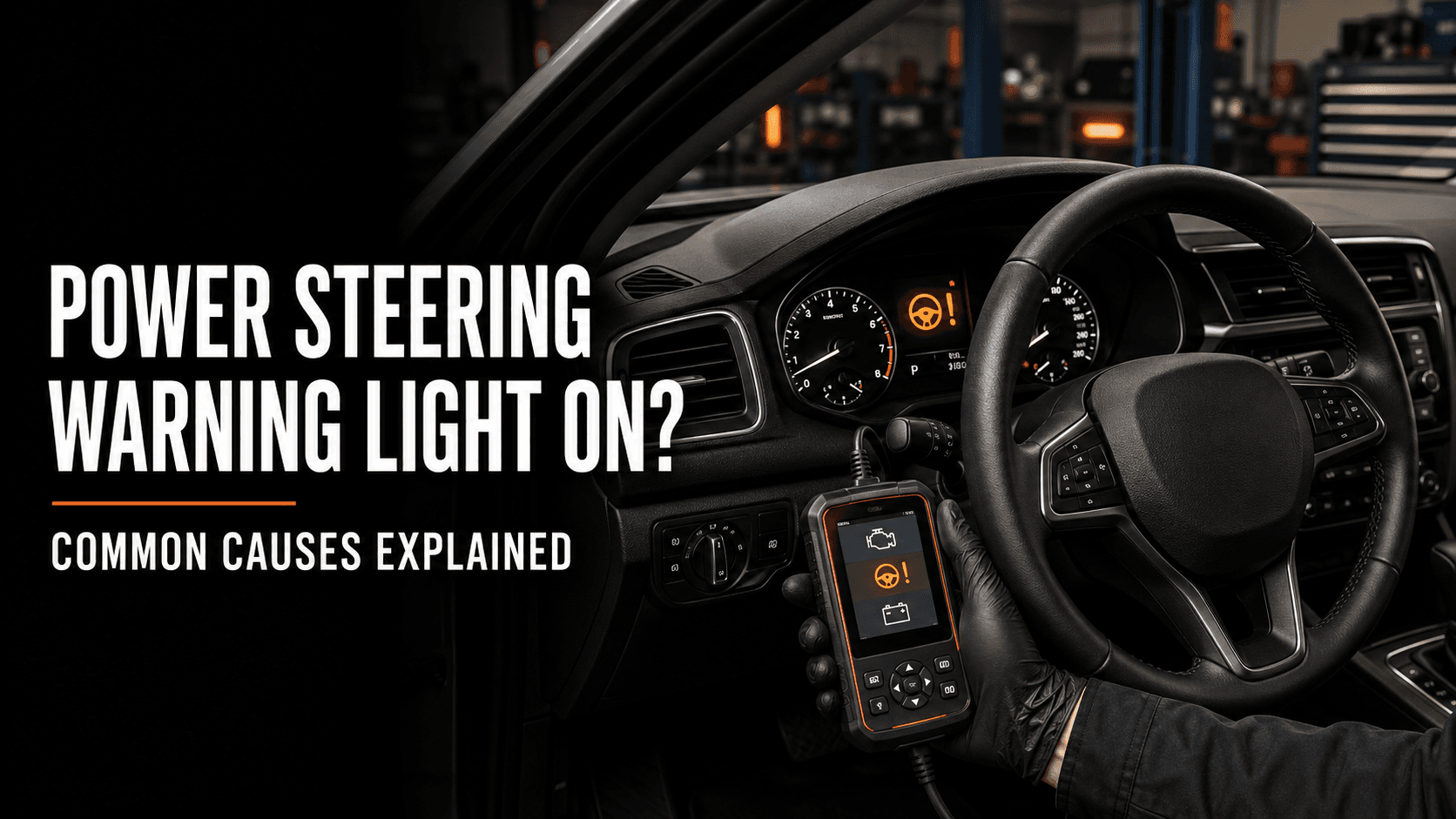
The warning commonly looks like a steering wheel, sometimes with an exclamation mark beside it. Depending on the vehicle, the dashboard may also display a message such as:
- Power steering fault
- Steering assist reduced
- Steering assist unavailable
- Service power steering
- Check power steering system
- Steering system malfunction
- Electric power steering fault
- Steering assist temporarily limited
- Power steering disabled
- Drive carefully
The warning does not identify the failed part by itself. It means the steering system found information, voltage or operating conditions outside its expected range.
Some vehicles continue providing normal assistance while the warning is on. Others reduce assistance or disable it completely, making the steering wheel noticeably harder to turn.
The cause may involve the steering system itself, but it can also come from low voltage, a charging problem, damaged wiring, lost module communication or a fault in another system that supplies information to electronic power steering.
Is the Power Steering Warning Light Serious?
It can be.
The seriousness depends on:
- Whether steering assistance has changed
- Whether the warning is red or yellow
- Whether other dashboard warnings are present
- Whether the vehicle is difficult to control
- Whether the warning remains on after restarting
- Whether the vehicle has electronic or hydraulic power steering
- Whether the problem occurs while driving or only during startup
A yellow steering warning may indicate reduced assistance or a stored fault. A red warning can indicate a more serious condition, although warning colors and meanings vary by manufacturer.
Stop driving as soon as it is safe when:
- The steering suddenly becomes very heavy
- Assistance changes while turning
- The steering wheel jerks or responds unpredictably
- A red steering warning remains illuminated
- The vehicle displays a stop-driving message
- The battery warning appears with the steering warning
- Several electronic systems begin shutting down
- There is smoke, overheating or an electrical burning smell
- The steering does not respond normally
The owner’s manual should explain the specific warning symbol and recommended action for the vehicle.
Electronic Power Steering Versus Hydraulic Power Steering
The possible causes depend partly on the type of power steering system installed in the vehicle.
Electronic Power Steering
Electronic power steering, often called EPS, uses an electric motor to provide steering assistance.
The system may include:
- Steering-assist motor
- Power steering control module
- Steering torque sensor
- Steering-angle sensor
- Wiring and connectors
- High-current fuses
- Battery and charging connections
- Communication-network wiring
- Steering-column or rack-mounted components
EPS does not rely on traditional power steering fluid. If an electronic system displays a steering warning, adding fluid will not correct the problem.
Hydraulic Power Steering
Traditional hydraulic power steering uses an engine-driven pump, fluid reservoir, hoses and hydraulic pressure.
Hydraulic steering problems may involve:
- Low power steering fluid
- Fluid leak
- Worn or broken drive belt
- Failed pump
- Restricted hose
- Air in the hydraulic system
- Mechanical steering-rack problem
Some hydraulic systems also contain electronic sensors or variable-assist controls, so a warning may still have an electrical component.
Electro-Hydraulic Power Steering
Some vehicles use an electrically powered hydraulic pump. These systems combine hydraulic components with an electric motor, high-current wiring and electronic controls.
A fault may therefore involve:
- Low fluid
- Hydraulic leak
- Electric pump failure
- Blown fuse
- Low battery voltage
- Damaged wiring
- Control-module problem
Identifying the type of system is an important first step before interpreting the warning.
Common Causes of a Power Steering Warning Light
Possible causes include:
- Weak battery
- Low system voltage during startup
- Charging-system problem
- Loose battery terminal
- Corroded ground connection
- Blown EPS fuse
- Damaged high-current wiring
- Loose steering-system connector
- Failed steering torque sensor
- Steering-angle sensor fault
- Electronic steering motor problem
- Power steering module communication fault
- Overheated steering motor
- Water or corrosion inside a connector
- Recent battery replacement
- Lost steering calibration
- ABS or stability-control fault
- Damaged communication-network wiring
- Collision or suspension damage
- Low hydraulic fluid on applicable vehicles
- Broken drive belt on applicable vehicles
- Mechanical steering-rack problem
The warning should be diagnosed using the vehicle’s symptoms and stored fault information rather than assuming the steering motor or module needs replacement.
Can a Weak Battery Cause a Power Steering Warning?
Yes. Low battery voltage is a common reason electronic power steering becomes temporarily unavailable.
EPS motors can require a significant amount of electrical current, especially during low-speed turns and parking maneuvers. If battery voltage drops too far, the steering module may reduce or disable assistance to protect the system.
Low-voltage symptoms may include:
- Steering warning during startup
- Heavy steering immediately after the engine starts
- Warning disappearing after a restart
- Slow engine cranking
- Headlights dimming
- Radio or dashboard restarting
- ABS or traction-control warning
- Multiple communication codes
- Clock or memory settings resetting
- Vehicle needing a jump-start
A battery can still start the engine while producing a voltage drop large enough to affect electronic modules.
The battery itself may be weak, but other possibilities include:
- Loose battery terminal
- Corroded cable
- Poor engine or body ground
- Damaged battery cable
- Parasitic electrical draw
- Charging-system problem
- High resistance in the steering power circuit
When a battery repeatedly becomes discharged, the guide explaining why a car battery keeps dying overnight covers lights, relays, accessories and modules that may remain active after shutdown.
Can an Alternator Problem Trigger the Steering Warning?
Yes. Once the engine is running, the charging system must maintain enough voltage for the steering motor and vehicle electronics.
If charging voltage becomes low, unstable or excessively high, the EPS system may disable assistance or store electrical faults.
Possible signs include:
- Battery warning light
- Steering warning while driving
- Headlights changing brightness
- Blower motor changing speed
- Dashboard display flickering
- Multiple warnings appearing together
- Electronics restarting
- Vehicle stalling
- Battery repeatedly losing charge
- Steering becoming heavier at low engine speed
The alternator is not the only possible cause. Charging-system performance may also be affected by:
- Battery cables
- Engine grounds
- Alternator wiring
- High-current fuse
- Loose connectors
- Belt condition
- Charging-control module
- Battery-monitoring sensor
Voltage should be evaluated while the system is operating under electrical load.
Power Steering Warning With Multiple Dashboard Lights
A steering warning that appears with ABS, traction-control, battery or check-engine lights may be part of a larger electrical or communication problem.
Electronic steering communicates with other vehicle systems. It may use information such as:
- Vehicle speed
- Steering angle
- Wheel-speed data
- Engine status
- Stability-control information
- Ignition status
- Battery voltage
- Driver-assistance data
When one required signal becomes unavailable, the EPS system may reduce or disable assistance even though the steering motor itself has not failed.
Common shared causes include:
- Low battery voltage
- Charging-system fault
- Weak ground
- Blown shared fuse
- ABS module problem
- Wheel-speed sensor fault
- Steering-angle sensor fault
- Communication-network problem
- One unavailable control module
The guide explaining why multiple dashboard warning lights appear together covers low voltage, shared sensors, grounding faults and lost module communication.
Power Steering Warning After Jump-Starting the Vehicle
A steering warning may appear after a jump-start because the vehicle recently experienced very low voltage.
Possible reasons include:
- Steering module recorded low-voltage faults
- Battery remains weak
- Charging system is not maintaining voltage
- Battery terminal is loose
- Ground connection has excessive resistance
- Steering calibration was lost
- A fuse failed during the electrical event
- Module communication was interrupted
- Original battery drain remains unresolved
The warning may disappear after restarting or driving, but that does not confirm that the electrical problem is gone.
A jump-start restores enough power to start the engine. It does not explain why the battery became discharged or whether the charging system is operating correctly.
Power Steering Warning After Battery Replacement
A warning may appear after the battery is replaced or disconnected.
Possible causes include:
- Loose battery connection
- Poorly secured ground cable
- Low-voltage codes stored before replacement
- Steering-angle information lost
- Required system initialization
- Communication interruption
- Wrong battery type or insufficient charge
- Battery-monitoring system not reset
- Fuse or connector disturbed during service
- Original electrical problem still present
Some vehicles relearn steering information automatically after the steering wheel is turned or the vehicle is driven. Others require a specific calibration or initialization procedure.
A warning that remains on should not be assumed to be a normal result of battery replacement.
Power Steering Warning After Wheel Alignment
A steering warning after an alignment may involve the steering-angle sensor or the relationship between the steering wheel and wheel position.
The steering-angle sensor helps the vehicle determine:
- Steering-wheel position
- Direction of turn
- Rate of steering movement
- Driver input
This information may be used by:
- Electronic power steering
- ABS
- Traction control
- Stability control
- Lane-keeping assistance
- Parking assistance
If the steering wheel is no longer centered or the sensor information does not match the vehicle’s movement, several warnings may appear.
Possible causes include:
- Steering wheel not centered
- Steering-angle sensor requires calibration
- Sensor connector disturbed
- Suspension component installed incorrectly
- Alignment outside specification
- Previous collision damage
- Incorrect steering-rack position
The required procedure varies by manufacturer.
Steering-Angle Sensor Problems
A faulty or incorrectly calibrated steering-angle sensor may cause:
- Power steering warning
- Traction-control warning
- Stability-control light
- Lane-assistance warning
- Steering assistance changing
- Steering wheel not returning normally
- Warning after alignment
- Warning after battery disconnection
- Incorrect steering-angle data
A fault code may identify an implausible signal, calibration problem or communication loss.
The sensor should not automatically be replaced. The diagnosis may also need to consider:
- Wheel alignment
- Steering-wheel position
- Wiring
- Connector condition
- Battery voltage
- Clock spring
- ABS module communication
- Calibration status
Steering Torque Sensor Faults
The torque sensor measures how much force the driver applies to the steering wheel and in which direction.
The EPS module uses this information to determine how much assistance the motor should provide.
A torque-sensor problem may cause:
- Steering assistance disappearing
- Assistance stronger in one direction
- Steering pulling or feeling uneven
- Steering warning light
- Intermittent heavy steering
- Steering wheel movement that feels unnatural
- Assistance returning after restart
- Torque-sensor fault codes
Depending on the vehicle, the torque sensor may be part of the steering column, motor assembly or steering rack.
Testing may include checking:
- Sensor signals
- Power and ground
- Wiring continuity
- Connector terminals
- Calibration
- Mechanical steering condition
Electronic Power Steering Motor Problems
The electric steering motor provides the physical assistance that reduces steering effort.
Motor-related faults may involve:
- Internal winding failure
- Overheating
- Excessive current draw
- Worn internal components
- Damaged motor wiring
- Poor high-current connection
- Mechanical binding
- Water intrusion
- Failed integrated electronics
A motor may fail completely or become intermittent.
Possible symptoms include:
- Steering assistance lost during parking
- Warning after repeated low-speed turns
- Steering returning after cooling
- Clicking or unusual noise
- Uneven assistance
- Hot electrical connection
- Blown EPS fuse
The motor should be evaluated together with the steering rack or column, power supply and mechanical steering condition.
Can Electronic Power Steering Overheat?
Yes. EPS systems can reduce assistance when the motor or control electronics become too hot.
This may happen during:
- Repeated parking maneuvers
- Holding the steering wheel against full lock
- Continuous low-speed turning
- Mechanical steering resistance
- Low voltage causing high current demand
- Motor deterioration
- Restricted movement in the steering system
The dashboard may display a temporary warning, and steering effort may increase until the system cools.
Repeated overheating during normal driving may indicate an underlying electrical or mechanical problem.
Avoid holding the steering wheel firmly against full lock for extended periods, as this can place unnecessary strain on the system.
Blown Power Steering Fuse
Electronic power steering may use a large fuse or fusible link because the motor can draw substantial current.
A blown steering fuse can disable assistance completely.
Possible causes include:
- Shorted motor
- Damaged high-current wiring
- Pinched harness
- Water inside a connector
- Loose terminal creating heat
- Internal module fault
- Incorrect jump-start procedure
- Collision damage
- Mechanical binding increasing motor load
Replacing the fuse may restore assistance temporarily. A fuse that fails again indicates a circuit problem that still needs diagnosis.
Never install a higher-amperage fuse. The guide explaining why a car fuse keeps blowing covers damaged wiring, short circuits, failed motors and moisture-related fuse faults.
Damaged Power Steering Wiring and Connectors
Electronic steering systems require reliable high-current power, ground, sensor and communication wiring.
Wiring may be affected by:
- Corrosion
- Road salt
- Moisture
- Heat
- Vibration
- Collision damage
- Rodent damage
- Previous repairs
- Harness rubbing against metal
- Loose terminals
- Damaged connector seals
- Engine or suspension work
A partially broken wire may work in some positions and fail when the harness moves.
Symptoms may appear:
- While turning
- After hitting a bump
- During rain
- After the vehicle warms up
- Only at startup
- During parking
- When another high-current accessory operates
Focused auto electrical diagnostics and repair may include power, ground, voltage-drop, connector and communication testing when steering assistance becomes intermittent.
Power Steering Warning After Rain or a Car Wash
Moisture may affect the EPS system if water reaches:
- Steering module connector
- Motor wiring
- Underhood fuse box
- Ground connection
- Communication wiring
- Steering-angle sensor connector
- Suspension-area harness
- Floor or dashboard wiring
Possible symptoms include:
- Steering warning after rain
- Assistance returning when the vehicle dries
- Several warning lights together
- Fuse failure
- Communication codes
- Steering becoming heavy intermittently
- Warning after driving through deep water
A problem that disappears after drying can still leave corrosion or terminal damage behind.
The guide to car electrical problems after rain explains how moisture affects connectors, wiring, fuse boxes and control modules.
Can a Bad Ground Cause a Power Steering Warning?
Yes. Electronic steering needs a strong ground connection to support the motor and control electronics.
A weak ground can produce:
- Reduced assistance
- Intermittent steering warning
- Voltage-related fault codes
- Hot ground cable
- Multiple dashboard warnings
- Steering problem when other accessories are used
- Communication faults
- Assistance returning when a cable is moved
A ground connection may appear secure while corrosion between the terminal and body creates resistance.
Voltage-drop testing under load can help reveal a ground problem that may not appear during a basic continuity test.
Power Steering Warning at Low Speed or While Parking
Electronic steering provides the most assistance at low speeds, where steering effort is naturally highest.
A warning that appears during parking may involve:
- Weak battery
- Charging voltage low at idle
- Steering motor overheating
- High-current connection problem
- Mechanical steering resistance
- Torque-sensor fault
- Steering motor deterioration
- Loose ground
- High-current fuse connection
The system may operate normally at highway speed because less steering assistance is needed.
A warning that appears repeatedly during ordinary parking maneuvers should be investigated even when assistance returns afterward.
Power Steering Warning at Highway Speed
Electronic steering generally reduces assistance at higher speeds to provide more stable steering feel.
A highway-speed warning may involve:
- Vehicle-speed information unavailable
- ABS or wheel-speed sensor fault
- Communication problem
- Steering-angle sensor issue
- Module overheating
- Charging-system instability
- Intermittent wiring fault
- Internal module problem
If steering behavior changes suddenly at highway speed, reduce speed carefully and move to a safe location.
Power Steering Warning When Turning
A warning that appears specifically during turns may provide an important clue.
Possible causes include:
- Harness moves during steering
- Torque sensor signal drops out
- Steering-angle sensor fault
- Clock spring or column wiring concern
- Motor load becomes excessive
- Mechanical steering binding
- Battery cable moves
- Power steering fluid shifts below the pickup on hydraulic systems
- Steering rack problem
Note whether the problem happens:
- Turning left
- Turning right
- Near full lock
- Only while moving
- Only while stopped
- After repeated turns
- At a specific steering-wheel position
This information can help focus the inspection.
Power Steering Warning With ABS and Traction-Control Lights
The steering, ABS and stability-control systems often share information.
An ABS or wheel-speed fault may affect steering assistance because the steering module no longer has reliable vehicle-speed information.
Possible causes include:
- Failed wheel-speed sensor
- Damaged sensor wiring
- ABS module communication fault
- Steering-angle sensor problem
- Low voltage
- Shared network fault
- Blown fuse
- Weak module ground
One sensor problem can therefore produce several warnings.
The steering system should not automatically be blamed simply because the steering warning is visible.
Power Steering Warning With the Battery Light
A steering warning and battery warning appearing together strongly suggest that system voltage should be evaluated.
As charging voltage drops, high-current systems may be disabled first. Electronic power steering can require more electrical power than many other accessories.
The vehicle may then develop:
- Heavy steering
- Dim headlights
- Dashboard warnings
- Radio resetting
- Blower motor slowing
- Transmission warning
- Engine stalling
If the battery warning remains on while driving, the vehicle may eventually lose electrical power and stop running.
Move to a safe location rather than continuing until the battery is completely discharged.
Power Steering Warning With a Check-Engine Light
A check-engine light and steering warning may share an electrical or communication cause, but they may also represent separate problems.
Possible shared causes include:
- Low voltage
- Engine module communication failure
- Vehicle-speed data unavailable
- Throttle or engine operating fault affecting steering strategy
- Shared network problem
- Weak ground
- Blown fuse
A full-system scan is more useful than reading engine codes alone because the steering module may store separate diagnostic information.
Can the ECU, ECM or BCM Cause a Steering Warning?
The steering system may exchange information with several vehicle computers.
ECU or ECM Communication
The engine computer may provide:
- Engine-running status
- Engine speed
- Vehicle operating information
- Charging-related commands
- Communication with the steering system
A missing engine-module signal can affect steering operation without proving that the ECU or ECM has failed.
Our guide to ECU vs. ECM vs. BCM explains the general differences between these vehicle computers.
Additional information is available on the ECU repair and ECM repair pages.
BCM and Body-System Communication
The body control module may participate in:
- Ignition status
- Warning messages
- Battery-management information
- Vehicle configuration
- Communication routing
- Security authorization
A BCM or gateway problem may interrupt information required by the steering module. However, damaged wiring, low voltage and lost power should be checked before determining that BCM repair is necessary.
Communication Codes and Lost Steering Module Communication
Vehicle modules communicate through a data network.
When the steering module stops responding, other computers may store lost-communication codes.
Possible causes include:
- Steering module missing power
- Failed ground
- Blown fuse
- Damaged CAN communication wiring
- Corroded connector
- Low battery voltage
- Water intrusion
- Internal module failure
- Another device interfering with the network
A communication code does not automatically prove the named module is defective.
The diagnosis should establish:
- Whether the steering module responds
- Whether it has correct power
- Whether its ground is reliable
- Whether communication wiring is intact
- Whether another module is affecting the network
- Whether the fault is current or historical
Hydraulic Power Steering Warning and Low Fluid
Vehicles with hydraulic power steering may illuminate a steering warning when fluid is low or hydraulic pressure is inadequate.
Possible signs include:
- Whining while turning
- Steering effort increasing
- Fluid below the minimum mark
- Visible fluid beneath the vehicle
- Foamy fluid
- Steering vibration
- Warning during sharp turns
- Pump noise
Low fluid usually means the system may have a leak.
Possible leak locations include:
- Pressure hose
- Return hose
- Steering rack
- Pump seal
- Reservoir
- Hose connection
Using the wrong fluid may damage the system. Refer to the owner’s manual or manufacturer information before adding fluid.
Electronic power steering systems generally do not have a fluid reservoir.
Broken Belt and Power Steering Warning
On hydraulic systems, the engine drive belt may power the steering pump.
A broken or slipping belt can cause:
- Sudden heavy steering
- Battery warning
- Engine-temperature warning
- Squealing noise
- Loss of charging
- Loss of coolant-pump operation on some vehicles
A belt failure can therefore create more than a steering problem.
Stop the vehicle safely if steering becomes heavy and the temperature or battery warning also appears.
Mechanical Steering Problems That Can Trigger EPS Faults
Not every EPS warning begins as an electrical failure.
Mechanical resistance can cause the steering motor to work harder and draw more current.
Possible mechanical causes include:
- Binding steering rack
- Damaged steering column
- Seized joint
- Suspension damage
- Incorrectly installed component
- Collision damage
- Wheel or tire interference
- Alignment problem
- Restricted movement after repair
The electrical and mechanical sides of the system may need to be evaluated together.
Replacing an electronic component will not correct mechanical binding.
Why the Steering Warning May Disappear After Restarting
Restarting the vehicle allows the steering module to reboot and perform another self-check.
The warning may disappear when:
- Voltage recovers
- Communication returns
- Motor cools
- Sensor signal returns
- Temporary fault is no longer active
- Module resets
The fault may remain stored even when the visible warning is gone.
Repeated temporary warnings should not be ignored because intermittent electrical problems can become permanent.
Record:
- When the warning appears
- Whether steering effort changes
- Which other warnings are present
- Weather conditions
- Whether the vehicle was just started
- Whether the battery was recently replaced
- Whether restarting restores assistance
How a Power Steering Warning Is Diagnosed
Proper diagnosis requires information from the steering system and the vehicle’s electrical network.
1. Confirming the Type of Steering System
The first step is determining whether the vehicle uses:
- Electronic power steering
- Hydraulic power steering
- Electro-hydraulic power steering
The diagnostic approach differs between these systems.
2. Reviewing the Symptoms
Important questions include:
- Is the steering heavier?
- Is assistance lost completely?
- Does the warning appear only during startup?
- Does turning direction matter?
- Does the problem occur while parking?
- Does rain or temperature affect it?
- Does restarting clear the warning?
- Was the battery recently replaced?
- Was the vehicle recently aligned or repaired?
- Are other warnings present?
3. Performing a Full-System Scan
Diagnostic equipment may be used to check:
- Power steering module codes
- ABS and stability-control faults
- Steering-angle data
- Torque-sensor information
- Communication codes
- Battery-voltage history
- Modules that do not respond
A basic engine-code reader may not access the power steering system.
4. Testing Battery and Charging Voltage
Testing may include:
- Battery condition
- Cranking voltage
- Charging voltage
- Voltage with accessories operating
- Battery-terminal condition
- Cable and ground inspection
Low system voltage should be addressed before condemning steering components.
5. Checking Fuses, Power and Grounds
The steering module and motor may use high-current circuits.
Testing may verify:
- Main EPS fuse
- Ignition fuse
- Module power supplies
- Motor power circuit
- Ground connections
- Voltage drop under steering load
- Fuse-box terminal condition
A loose high-current terminal can create heat and intermittent assistance.
6. Inspecting Wiring and Connectors
Wiring may be checked for:
- Corrosion
- Water
- Loose terminals
- Pinched harnesses
- Damaged insulation
- Collision damage
- Heat damage
- Previous repairs
- Rodent damage
- Harness movement
7. Evaluating Sensor Data
Steering-angle and torque-sensor information may be viewed while the steering wheel is moved.
The readings should change smoothly and match actual steering movement.
8. Checking Calibration
The system may require calibration after:
- Battery disconnection
- Alignment
- Steering-column work
- Rack replacement
- Sensor replacement
- Collision repair
9. Inspecting Mechanical Steering Condition
The steering rack, column, joints, suspension and related components should move without abnormal binding.
10. Confirming the Repair
After approved work or calibration is completed, the system should be checked under the conditions that originally caused the warning.
That may include:
- Repeated starts
- Low-speed turns
- Parking maneuvers
- Road testing
- Full-system rescan
- Verification that fault codes do not return
The power steering module repair page provides additional information about steering warnings, communication faults and electronic steering concerns.
Can You Reset a Power Steering Warning Light?
Some temporary warnings may clear after:
- Restarting the vehicle
- Restoring battery voltage
- Completing system initialization
- Driving after battery replacement
- Allowing an overheated motor to cool
A reset will not repair:
- Damaged wiring
- Failed sensor
- Weak ground
- Blown fuse
- Failing motor
- Internal module fault
- Mechanical steering problem
- Incorrect calibration
Disconnecting the battery may erase useful diagnostic information and create additional initialization requirements.
A warning that returns should be diagnosed instead of repeatedly reset.
Is It Safe to Drive With the Power Steering Light On?
Driving may be possible when the warning is yellow and steering still feels normal, but the system should be considered unreliable.
Do not continue driving when:
- Steering is suddenly heavy
- Assistance changes unpredictably
- The warning is red
- The vehicle says to stop
- Battery warning is also present
- Steering binds or jerks
- Several electrical systems shut down
- Smoke or overheating is present
- The vehicle was recently involved in a collision
- Essential control of the vehicle is affected
Without assistance, the steering wheel can require much more force, especially at low speed.
Even when the vehicle remains controllable, the warning means the system has detected a problem that should not be ignored.
Information to Record Before the Warning Disappears
When the fault is intermittent, record:
- Exact dashboard message
- Warning color
- Whether steering became heavier
- Whether assistance changed in one direction
- Vehicle speed
- Engine temperature
- Weather conditions
- Other warning lights
- Whether the vehicle was recently jump-started
- Whether the battery was replaced
- Whether the vehicle had alignment or suspension work
- Whether restarting cleared the warning
- Whether the fault occurred during parking
- Whether the steering motor or column made noise
Photos or videos can help document warnings that are no longer visible during inspection.
Frequently Asked Questions
Why is my power steering warning light on?
The system may have detected low voltage, damaged wiring, a failed sensor, blown fuse, steering motor problem, communication fault or mechanical steering concern.
Can a weak battery cause the power steering light?
Yes. Low voltage during startup can prevent the EPS module from operating or communicating correctly.
Why is my steering suddenly hard to turn?
Electronic steering assistance may have been reduced or disabled. Hydraulic systems may also lose assistance because of low fluid, a broken belt or pump failure.
Can an alternator problem cause heavy steering?
Yes. Electronic power steering may shut down when charging voltage becomes too low or unstable.
Why does the warning disappear after restarting?
Restarting allows the steering module to reboot. The fault may be intermittent, but stored codes can remain even when the visible warning clears.
Can I drive with the power steering warning light on?
Driving may be possible when steering remains normal, but the system can lose assistance. Stop safely when steering becomes heavy or unpredictable.
Does electronic power steering use fluid?
Usually not. EPS uses an electric motor. Hydraulic and electro-hydraulic systems may use fluid.
Why did the power steering light come on after replacing the battery?
The vehicle may have stored low-voltage faults, a loose battery connection, lost calibration or an initialization requirement.
Can a blown fuse disable electronic power steering?
Yes. EPS systems commonly use high-current fuses. A fuse that blows repeatedly indicates an unresolved electrical fault.
Can rain cause a power steering warning?
Yes. Moisture may affect wiring, connectors, grounds, fuse boxes or the steering module.
Why are the power steering, ABS and traction-control lights on together?
The systems may share wheel-speed, steering-angle or communication information. Low voltage can also affect all three.
Can a steering-angle sensor cause a power steering warning?
Yes. Missing or incorrect steering-angle information can affect EPS, ABS, stability control and driver-assistance systems.
Does a steering warning mean the rack needs replacement?
Not necessarily. The fault may involve voltage, wiring, a sensor, fuse, calibration or module communication.
Can the power steering module be repaired?
The available repair depends on the vehicle, module design and confirmed failure. Supporting wiring, power and grounds should be tested first.
Why does the warning appear only while parking?
The steering motor works hardest during low-speed turns. Weak voltage, overheating, excessive resistance or mechanical binding may become more noticeable while parking.
Can alignment cause a steering warning?
An incorrect steering-wheel position or steering-angle calibration problem may trigger steering, ABS or stability-control warnings after alignment work.