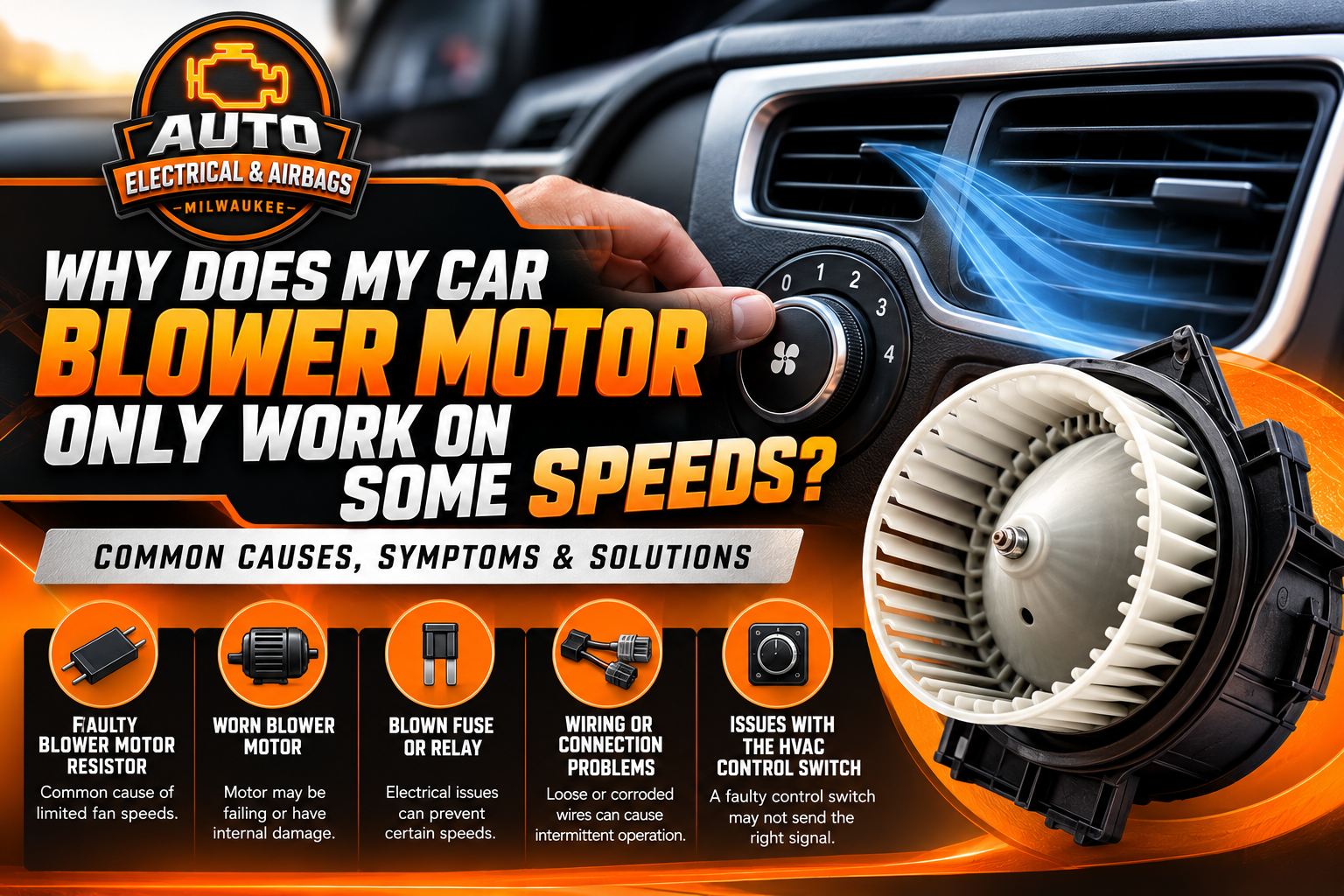
You turn on the heat or air conditioning and notice something strange.
The fan works on high, but not on low.
Maybe speeds 1 and 2 do nothing while speeds 3 and 4 still work. On another vehicle, the fan may only operate at full speed. Sometimes the blower works intermittently, changes speed on its own, or completely stops responding.
A common suspect is the blower motor resistor.
But the resistor is not always the problem.
Modern climate-control systems can use blower control modules, electronic climate panels, relays, wiring and control signals instead of a simple resistor pack.
A blower motor that draws too much current can even damage a replacement resistor or control module, causing the same problem to return.
This guide explains why a car blower motor may work only on certain speeds, how older and newer systems control fan speed, what symptoms point toward a resistor or control module, and why proper testing matters before replacing parts.
Quick Answer: Why Does My Car Fan Only Work on Certain Speeds?
A blower fan that only works on some settings may be caused by:
- Failed blower motor resistor
- Failed electronic blower control module
- Worn blower motor
- Blower motor drawing excessive current
- Damaged wiring
- Burned electrical connector
- Failed relay
- Faulty blower switch
- Climate-control panel problem
- Poor power or ground connection
- Blown fuse or circuit problem
On many older systems, losing several lower fan speeds while high speed still works is a classic symptom of a failed blower motor resistor.
But vehicle designs vary.
Testing should determine how the blower speed is controlled on the specific vehicle.
What Does the Blower Motor Do?
The blower motor is the electric fan responsible for moving air through the vehicle’s HVAC system.
HVAC stands for:
Heating, Ventilation and Air Conditioning.
The blower pushes air through the vents whether you are using:
- Air conditioning
- Heat
- Defrost
- Ventilation
The blower motor does not create cold or hot air itself.
Its job is to move air through the climate-control system and into the passenger compartment.
If the blower motor is not operating correctly, you may have working heat or AC inside the system but very little or no airflow from the vents.
How Does a Car Control Blower Fan Speed?
There are several different designs.
Older and simpler systems may use a blower motor resistor.
Newer vehicles may instead use an electronic blower motor control module, sometimes called a blower control unit, power transistor, final-stage unit or similar manufacturer-specific name.
Understanding which design your vehicle uses is important before parts are replaced.
What Is a Blower Motor Resistor?
A blower motor resistor helps reduce the electrical power supplied to the blower motor at lower fan settings.
In a simplified resistor-based system:
- Low speed uses more resistance
- Medium speeds use different resistance paths
- High speed may bypass much of the resistor circuit
That explains one of the classic symptoms of resistor failure:
The lower fan speeds stop working, but high speed still works.
Part of the resistor assembly may have failed while the high-speed circuit remains functional.
However, not every vehicle uses this exact design.
What Is a Blower Motor Control Module?
Many newer vehicles use electronic blower-speed control instead of fixed resistor steps.
An electronic control module can vary blower speed much more precisely.
This allows features such as:
- Many fan-speed levels
- Automatic climate control
- Gradual fan-speed adjustment
- Computer-controlled cabin temperature
When an electronic blower control module fails, symptoms can be different from an older resistor failure.
The fan may:
- Work only at full speed
- Work at random speeds
- Continue running after the vehicle is shut off
- Stop responding to the controls
- Operate intermittently
- Not work at all
That is why the term blower motor resistor does not accurately describe every modern system.
Why Does My Blower Motor Only Work on High?
This is one of the most common blower-speed complaints.
On a traditional resistor-controlled system, high speed may use a different electrical path than the lower speeds.
If the resistor fails, lower speeds may disappear while the high setting continues to provide power to the motor.
Possible causes include:
- Failed blower resistor
- Burned resistor connector
- Wiring problem
- Climate-control switch problem
But before replacing the resistor, it is important to consider why it failed.
A blower motor drawing excessive electrical current can overheat the resistor or connector.
Replacing only the resistor may result in another failure later.
Why Do Only Some Fan Speeds Work?
Partial fan-speed operation can be an important clue.
For example:
Speed 1: Does not work
Speed 2: Does not work
Speed 3: Works
Speed 4: Works
That pattern may point toward a resistor circuit or switch problem.
Another vehicle might show:
Low: Works
Medium: Works
High: Does not work
That could involve a different circuit, relay, switch or control problem.
The exact pattern matters because each fan setting may use different electrical paths depending on the vehicle.
Can a Bad Blower Motor Resistor Stop the Fan Completely?
It can on some systems.
However, a completely dead blower has several other possible causes.
These include:
- Failed blower motor
- Blown fuse
- Failed relay
- Missing power
- Poor ground
- Burned connector
- Climate-control panel problem
- Blower control module failure
A blower that does not work at any speed therefore requires a broader diagnosis than simply assuming the resistor failed.
What Are Common Blower Motor Resistor Symptoms?
Possible symptoms include:
- Fan works only on high speed
- Some fan speeds do not work
- Fan speed changes unpredictably
- Blower stops working intermittently
- Electrical connector near the resistor appears burned
- Replacement resistor fails repeatedly
A burning smell or melted electrical connector deserves particular attention because excessive resistance or current may be creating heat.
What Are Symptoms of a Bad Blower Motor Control Module?
Electronic blower-control module symptoms may include:
- Blower stuck at one speed
- Blower runs at maximum speed
- Fan ignores climate-control commands
- Fan operates intermittently
- Fan continues running after the vehicle is turned off
- Fan does not operate at all
However, a faulty control module is not the only possible cause.
The module needs correct:
- Power
- Ground
- Control signal
- Wiring connections
If one of those is missing, a working module can appear defective.
Can the Blower Motor Itself Cause Speed Problems?
Yes.
This is important because the blower motor is sometimes overlooked when a resistor or control module fails.
As an electric motor ages, it can develop problems involving:
- Bearings
- Brushes
- Internal windings
- Mechanical drag
A motor that has to work harder may draw more electrical current than normal.
That additional current creates heat.
The extra load can damage:
- Resistor
- Control module
- Connector
- Wiring
This is one reason a newly installed resistor may fail again if the underlying blower motor problem is not identified.
Why Does My New Blower Motor Resistor Keep Failing?
Repeated resistor failure is a clue that another problem may exist.
Possible causes include:
- Blower motor drawing excessive current
- Overheated connector
- Poor electrical connection
- Incorrect replacement part
- Wiring damage
- Moisture contamination
Simply replacing the resistor each time does not address the underlying cause.
The blower motor’s electrical load and surrounding circuit should be evaluated.
Can a Blower Motor Connector Melt?
Yes.
Electrical heat can develop when there is:
- High resistance
- Loose terminal
- Corrosion
- Excessive motor current
- Poor contact inside the connector
Signs can include:
- Brown or black discoloration
- Melted plastic
- Burned odor
- Distorted terminals
- Intermittent blower operation
Installing a new resistor or motor without repairing a damaged connector can allow the problem to continue.
Why Does My Blower Motor Work Sometimes?
Intermittent blower operation can come from several sources.
Possible causes include:
- Worn blower motor
- Loose connector
- Failing control module
- Damaged wiring
- Relay problem
- Climate-control panel fault
An aging blower motor may sometimes start again when:
- The vehicle hits a bump
- The dashboard is tapped
- Temperature changes
- The fan setting is changed
That behavior may suggest an internal motor or connection problem, but electrical testing is still needed.
Why Does Tapping the Blower Motor Make It Start?
This is a commonly reported symptom.
If tapping the blower housing makes the fan suddenly start, worn internal motor components may be involved.
The movement can temporarily allow electrical contact inside the motor.
This is a useful diagnostic clue, but it is not a proper repair.
If the motor has become unreliable, the circuit should be evaluated and the motor replaced if testing confirms the failure.
Can a Blower Motor Work but Still Be Bad?
Yes.
An electric motor does not have to be completely dead to be failing.
It may:
- Run slowly
- Draw too much current
- Stop intermittently
- Make noise
- Require tapping to start
- Overheat the circuit
This is why simply checking whether the motor spins is not always enough.
Why Does My Fan Speed Change by Itself?
A blower that changes speed without driver input can have several possible causes.
On automatic climate-control systems, some speed changes are normal.
The vehicle may automatically adjust airflow based on:
- Cabin temperature
- Desired temperature
- Sunlight sensor data
- Defrost demand
But unexpected or erratic changes may point toward:
- Blower control module
- Climate-control panel
- Wiring
- Communication problem
The first question is whether the speed change is commanded normally or happening because of a fault.
Why Does My Blower Keep Running After I Turn the Car Off?
A blower that continues operating after the vehicle is shut down may indicate an electrical control problem.
Possible causes include:
- Failed blower control module
- Relay stuck closed
- Wiring fault
- Control signal problem
Some vehicles may operate certain fans briefly under specific conditions, so vehicle-specific behavior matters.
But a cabin blower that runs continuously can eventually drain the battery.
Can a Blower Motor Problem Drain the Battery?
Potentially.
If the blower continues running after the vehicle should be shut down, it can draw substantial current.
A stuck relay, failed electronic control module or wiring problem may allow power to remain supplied.
If the battery began dying at the same time the blower developed unusual behavior, the two symptoms may be related.
Why Is There No Airflow Even Though the AC Compressor Is Working?
The refrigerant and airflow portions of the AC system are separate.
The AC compressor can function while the blower fan does not.
If there is no air coming through the vents, possible airflow-related causes include:
- Blower motor problem
- Blower resistor or control module
- Fuse
- Relay
- Climate-control electrical issue
- Wiring
- Airflow door problem
This distinction matters because an AC system can be producing cold air internally while the cabin fan fails to distribute it.
Why Is My Blower Motor Working but No Air Comes Out?
If you can hear the blower running but airflow is weak or absent, the problem may not be electrical.
Possible causes include:
- Clogged cabin air filter
- Blocked air intake
- HVAC door problem
- Duct problem
- Debris in the HVAC housing
The sound of the blower motor confirms that the motor is operating, but it does not confirm that air can move normally through the system.
Can a Blown Fuse Cause the Blower Motor to Stop Working?
Yes.
A blown fuse can interrupt electrical power to the blower circuit.
But the more important question is:
Why did the fuse blow?
Possible causes include:
- Short circuit
- Motor drawing excessive current
- Damaged wiring
- Failed electrical component
Repeatedly replacing the fuse without finding the cause can leave the actual problem unresolved.
Can a Bad Relay Cause the Blower Fan to Stop Working?
Yes, depending on the system design.
A relay may be used to switch electrical power to the blower circuit.
A failed relay can create:
- No blower operation
- Intermittent blower operation
But some newer systems use different electronic control arrangements.
The wiring diagram for the specific vehicle determines whether a relay is involved.
Can the Climate-Control Panel Cause Blower Problems?
Yes.
The climate-control panel is the driver’s interface with the HVAC system.
Depending on the vehicle, it may directly control circuits or send electronic commands to another module.
Possible symptoms of a control-panel problem include:
- Fan buttons do not respond
- Display goes blank
- Fan setting changes but blower does not react
- Temperature controls behave incorrectly
- Multiple HVAC functions fail together
Again, this does not automatically mean the panel itself has failed.
A missing power supply, ground or communication connection can make a functional control panel appear dead.
Can Low Battery Voltage Affect Climate Control?
Yes.
Modern climate-control systems contain electronic modules that require stable voltage.
Low battery voltage can contribute to:
- Module resets
- Fault codes
- Unresponsive electronic controls
- Communication problems
If multiple electronic systems begin behaving strangely at the same time, battery voltage and charging performance should be considered as part of the diagnosis.
Can Wiring Make a Good Blower Motor Look Bad?
Absolutely.
A blower motor requires enough voltage and a reliable ground while operating.
Damaged wiring can create:
- Voltage drop
- Intermittent operation
- Slow fan speed
- No operation
A motor can therefore test as functional when powered directly but fail in the vehicle because its wiring cannot deliver sufficient current.
For suspected wiring faults, our car wiring repair and electrical troubleshooting service focuses on damaged circuits, connectors and high-resistance electrical problems.
Blower Motor vs. Blower Resistor: How Can You Tell?
The symptoms can overlap.
| Symptom | Blower Motor Possible? | Resistor/Control Problem Possible? |
|---|---|---|
| Fan works only on high | Possible | Strong clue |
| Some speeds missing | Possible | Strong clue |
| Fan completely dead | Yes | Yes |
| Fan works after tapping motor | Strong clue | Less typical |
| Motor makes noise | Strong clue | Less typical |
| Resistor repeatedly fails | Motor may be causing overload | Yes |
| Connector overheated | Possible excessive motor draw | Yes |
| Fan stuck at full speed | Less typical | Strong electronic-control clue |
Testing helps separate the motor from the speed-control circuit.
How Is a Blower Motor Speed Problem Diagnosed?
The correct procedure depends on the vehicle design.
Confirm Which Fan Speeds Work
The pattern itself provides useful information.
A technician may record whether:
- Only high works
- Only low works
- Several specific speeds are missing
- Fan speed is completely uncontrollable
Scan the Climate-Control System
Some modern HVAC systems can store diagnostic trouble codes.
A scan may identify problems involving:
- Climate-control module
- Blower control
- Sensors
- Communication
Not every vehicle provides the same diagnostic capabilities.
Check Fuses and Relays
The blower circuit’s power supply should be verified.
If a fuse is blown, the circuit may need further testing to determine why.
Test Power and Ground at the Blower
If the blower does not operate, technicians can determine whether electrical power and ground are reaching it.
If proper power and ground are present but the motor does not operate, the motor becomes more suspicious.
If power is missing, the diagnostic path moves upstream through the circuit.
Inspect the Resistor or Control Module
The blower speed-control component can be checked for:
- Burned connector
- Heat damage
- Missing power
- Missing ground
- Control signal problems
Measure Blower Motor Current
If repeated speed-control component failures occur, blower motor current draw may need to be evaluated.
A motor drawing excessive current can overload other components in the circuit.
Check the Climate-Control Commands
On electronic systems, technicians may determine whether the climate-control panel is actually commanding the requested blower speed.
This helps distinguish between:
- A control-command problem
- A blower output problem
Why Parts Swapping Can Get Expensive
A fan that only works on high may make a resistor seem like the obvious answer.
Often, it is.
But imagine this sequence:
- Resistor fails.
- New resistor is installed.
- It works temporarily.
- Resistor fails again.
The underlying problem may be an aging blower motor drawing excessive current.
Now the customer has purchased the same part twice without correcting the cause.
Good electrical diagnosis asks:
Why did the component fail?
not only:
Which component stopped working?
Is This an AC Problem or an Electrical Problem?
It can be both.
The HVAC system includes refrigeration, heating, airflow and electronic controls.
For example:
AC blows warm air but fan works normally: Could involve refrigerant/compressor-related problems.
AC is cold but no air comes out: Could involve blower or airflow problems.
Fan works only on high: Stronger indication of an electrical blower-speed-control problem.
Climate panel is blank: Likely requires electrical diagnosis.
Understanding the symptom helps determine whether the problem belongs primarily to the refrigerant system or the electrical control side.
When Should You Have a Blower Motor Problem Diagnosed?
Consider professional electrical diagnosis when:
- Fan only works on high
- Several fan speeds are missing
- Blower works intermittently
- Fan stays on after the car is shut off
- Blower resistor keeps failing
- Electrical connector is melted
- Blower motor gets unusually hot
- Fan does not work at any speed
- Climate-control panel stops responding
- Battery begins dying after blower problems start
- Replacing a resistor did not fix the problem
The objective should be to identify whether the fault involves the motor, resistor/control module, wiring, connector, relay or climate-control electronics.
Car AC Electrical Diagnostics in Milwaukee
At Auto Electrical & Airbag Specialist in Milwaukee, we diagnose electrical problems affecting automotive AC and climate-control systems.
Our Car AC Electrical Diagnostics and Repair in Milwaukee service covers electrical faults involving blower motors, blower resistors and control modules, climate-control panels, sensors, fuses, relays, wiring and compressor-command circuits.
If testing identifies a damaged wire, connector or electrical circuit, our car wiring repair service can address the underlying wiring fault.
Auto Electrical & Airbag Specialist
2636 S 32nd St, Milwaukee, WI 53215
(414) 345-7568
Frequently Asked Questions About Blower Motor Speed Problems
Why does my car fan only work on high?
On resistor-controlled systems, lower fan speeds may stop working when the blower motor resistor fails. Wiring, switches and other controls can also cause similar symptoms.
Does a blower motor resistor control every fan speed?
On some traditional systems, the resistor controls lower speeds while high speed uses a different circuit. Newer vehicles may use an electronic blower control module instead.
Can a bad blower motor damage the resistor?
Yes. A motor drawing excessive current can create additional heat and potentially contribute to resistor, control module or connector failure.
Why did my new blower resistor fail again?
Repeated failure may indicate excessive blower motor current, a damaged connector, wiring problems or another underlying circuit issue.
Can a blower motor work intermittently?
Yes. Worn internal motor components, loose connections, wiring faults and control-module problems can all cause intermittent operation.
Why does tapping the blower motor make it work?
Movement may temporarily restore contact inside a worn electric motor. This can be a clue that the blower motor itself is failing.
Can a bad blower control module make the fan stay on?
Yes. Depending on system design, a failed electronic control module can sometimes leave the blower running or stuck at one speed.
Can a blower motor drain the car battery?
The motor itself generally should not operate with the vehicle shut down. If a control fault keeps it powered, however, it can discharge the battery.
Can a blown fuse stop the AC blower?
Yes. A blown fuse can remove power from the blower circuit, but the reason the fuse failed should also be diagnosed.
Why is my AC cold but there is no air coming through the vents?
If the refrigerant system is working but airflow is absent, the problem may involve the blower motor, speed-control circuit, electrical supply or an airflow restriction.
Is the blower motor resistor the same as the blower motor?
No. The blower motor physically spins the fan. A resistor or electronic control module regulates blower speed depending on the vehicle design.
How do technicians test a blower motor problem?
Testing can include checking fuses, power and ground, scanning the HVAC system, measuring blower current, inspecting wiring and evaluating the resistor or blower control module.
The Bottom Line
A blower fan that only works on certain speeds is often an electrical problem rather than a refrigerant problem.
Possible causes include:
- Blower motor resistor
- Electronic blower control module
- Worn blower motor
- Damaged connector
- Wiring problem
- Relay
- Climate-control panel
The symptom pattern provides an important clue, but it does not replace testing.
And when a resistor or control module repeatedly fails, it is especially important to ask:
“Why did this component fail?”
The actual cause may be farther downstream in the blower motor or electrical circuit.
Finding that cause first can prevent repeated part replacement and restore reliable heating, AC and defrost airflow.