The rear bumper was repaired or replaced.
The bodywork looks good.
Then the dashboard displays a message such as:
Blind Spot Monitoring Unavailable
Side Detection System Fault
Blind Spot Assist Inoperative
or
Check Blind Spot System
Sometimes the warning appears immediately after the repair. In other cases, the system seems to work at first and begins producing false alerts or intermittent warnings later.
That is possible because blind spot monitoring on many modern vehicles depends on radar sensors mounted behind or near the rear bumper.
Those sensors need more than electrical power.
They also depend on correct mounting position, unobstructed radar transmission, proper wiring, communication with other vehicle modules and, on many vehicles, calibration or initialization after certain repairs.
This guide explains why blind spot monitoring may stop working after bumper repair, how bumper shape and sensor position can affect radar performance, when calibration may be required and why replacing the sensor is not always the answer.
Quick Answer: Why Is Blind Spot Monitoring Not Working After Bumper Repair?
Possible causes include:
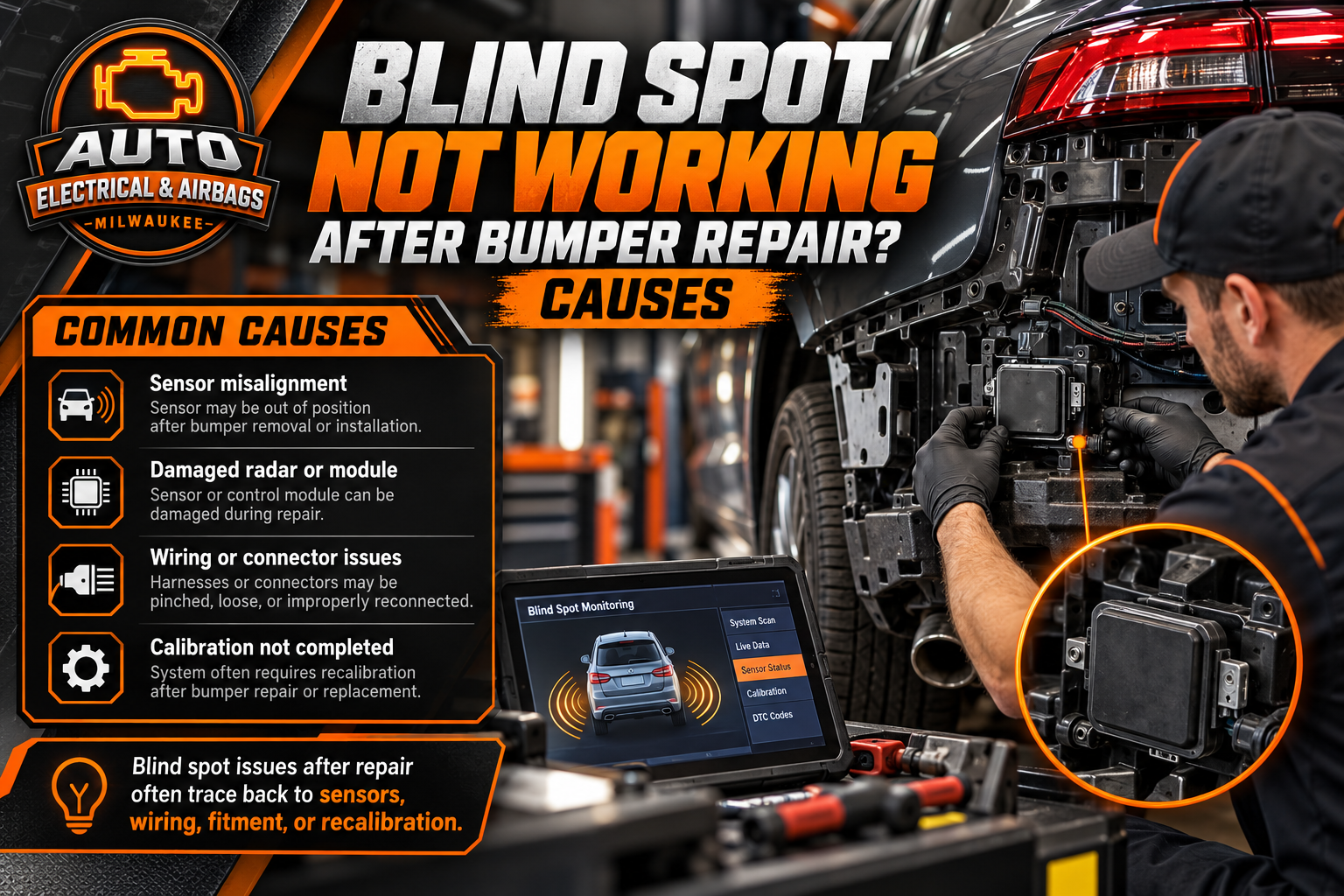
- Radar sensor moved out of position
- Sensor bracket bent or incorrectly installed
- Calibration or initialization not completed
- Sensor connector left loose
- Wiring damaged during repair
- Incorrect bumper cover
- Excessive paint or filler near radar area
- Sensor contaminated with paint or debris
- Radar sensor damaged in the original collision
- Module communication fault
- Incorrect replacement sensor
- Rear body structure still misaligned
The correct repair depends on the vehicle.
Manufacturer procedures should be checked because blind spot system requirements can vary significantly by year, make and model.
How Does Blind Spot Monitoring Work?
Most blind spot monitoring systems use radar sensors near the rear corners of the vehicle.
These sensors monitor areas beside and behind the vehicle while driving.
When another vehicle enters a monitored zone, the system may activate:
- Warning light in the side mirror
- Indicator near the mirror
- Audible warning
- Dashboard message
Some systems also interact with:
- Rear cross-traffic alert
- Lane-change assistance
- Parking systems
- Other driver-assistance features
The side mirror warning light is often only the output.
The actual sensing is commonly performed by radar units behind the rear bumper or quarter-panel area.
I-CAR notes that on many systems, the indicator in the mirror simply displays information received from rear radar sensors rather than containing the sensing hardware itself.
Where Are Blind Spot Radar Sensors Located?
Location varies by vehicle, but common locations include:
- Behind rear bumper cover
- Rear corners of vehicle
- Quarter panel behind bumper
- Mounted to bumper reinforcement or brackets
This is why rear-end collision damage and bumper repairs can directly affect the blind spot system.
A bumper may appear cosmetically correct while the radar sensor behind it is:
- Angled incorrectly
- Mounted too far inward or outward
- Attached to a bent bracket
- Positioned behind repaired material that affects radar transmission
Small differences can matter because the sensor is designed to monitor a specific area beside the vehicle.
Why Can Bumper Repair Affect Blind Spot Radar?
Radar signals need to pass through or around the bumper area in a predictable way.
A repair can potentially alter:
- Bumper thickness
- Shape
- Surface material
- Sensor angle
- Sensor distance from cover
- Mounting position
Recent FCA/Stellantis guidance specifically warns that repairs near blind spot sensors can cause false activation and requires applicable blind spot calibration or initialization procedures before returning the vehicle to service.
This is why some bumper repairs are more complicated than they appear.
Can Too Much Paint Affect a Blind Spot Sensor?
Potentially, yes.
The exact limitation depends on the manufacturer.
Radar sensors transmit through or behind bumper material.
Excessive layers of:
- Paint
- Primer
- Body filler
- Repair material
can affect radar performance on certain vehicles.
For example, FCA/Stellantis guidance places limits on repair material and coating thickness near blind spot radar areas.
Other manufacturers have their own requirements.
This does not mean ordinary bumper refinishing automatically causes a radar problem.
It means the repair method must match the vehicle manufacturer’s instructions.
Can Body Filler Affect Blind Spot Monitoring?
Yes, on some vehicles.
Body filler changes the thickness and composition of the material in front of the radar sensor.
Certain manufacturers restrict filler or plastic repair near radar sensing zones.
The problem may show up as:
- False blind spot warnings
- Missed vehicle detection
- Intermittent unavailable message
- Calibration failure
This is another reason radar-equipped bumper repair should follow OEM-specific guidance.
Can a Replacement Bumper Cause Blind Spot Problems?
It can if the replacement component differs from the original design or is installed incorrectly.
Possible issues include:
- Incorrect bumper cover
- Different material characteristics
- Wrong sensor bracket
- Misaligned mounting points
- Incorrect sensor position
The bumper may physically fit while still affecting the ADAS system.
That is why correct replacement parts and installation procedures matter.
What Happens If the Radar Sensor Is Slightly Misaligned?
A radar sensor does not simply detect everything around the vehicle.
It is aimed at a specific area.
If the mounting angle changes, the sensor may monitor the wrong area.
Possible symptoms include:
- False warnings
- Missed vehicles
- Warning activates too early
- Warning activates too late
- Blind spot system unavailable
- Calibration code stored
Even a sensor that still communicates electronically can perform incorrectly if its physical alignment is wrong.
Can a Bent Sensor Bracket Cause Blind Spot Problems?
Yes.
The radar sensor is often attached to a bracket that holds it at a specific position and angle.
A rear collision can bend the bracket without visibly damaging the sensor itself.
Installing the original radar sensor onto a distorted bracket can therefore leave the sensor aimed incorrectly.
Manufacturer procedures may require:
- Bracket inspection
- Measurement
- Replacement
- Sensor alignment
- Calibration
The sensor should not automatically be replaced simply because the system is not working.
The mounting structure matters too.
Does Blind Spot Monitoring Need Calibration After Bumper Repair?
Sometimes.
Calibration requirements vary by manufacturer and vehicle.
Calibration or initialization may be required after events such as:
- Radar sensor replacement
- Radar sensor removal and installation
- Rear structural repair
- Body repair near sensor mounting area
- Sensor bracket replacement
- Diagnostic trouble code indicating calibration loss
For example, I-CAR’s current 2024 Honda Accord data states that blind spot radar calibration or initialization is required after repairs near the sensor mounting location and after certain rear structural repairs.
Toyota guidance also lists sensor removal/reinstallation or replacement as calibration-triggering events on applicable blind spot systems.
The correct answer therefore comes from the repair information for the specific vehicle.
What Is Blind Spot Sensor Calibration?
Calibration teaches or verifies the sensor’s correct relationship to the vehicle.
Depending on the system, calibration may involve:
- Scan tool
- Calibration targets
- Measurement procedures
- Sensor angle adjustment
- Level floor
- Specific vehicle setup
- Road-driving procedure
Some systems use static calibration.
Others use dynamic calibration while the vehicle is driven.
Some require both setup and road verification.
There is no universal blind spot calibration procedure.
Can a Blind Spot Sensor Work Without Calibration?
Sometimes the system may appear to function even when calibration has not been completed.
That does not mean performance is correct.
A misaligned radar sensor may:
- Detect vehicles in the wrong location
- Produce false alerts
- Miss vehicles
- Store a calibration fault
This is why the absence of a warning light alone does not necessarily prove the sensor is correctly aligned.
Why Is the Blind Spot System Showing False Warnings After Repair?
False warnings can come from:
- Sensor misalignment
- Damaged mounting bracket
- Bumper repair material
- Incorrect calibration
- Sensor contamination
- Radar reflection from surrounding objects
Examples may include warnings when:
- No vehicle is beside you
- Passing guardrails
- Driving near barriers
- Turning
- Traveling on uneven roads
Some false detections can occur normally under specific road conditions, but repeated abnormal behavior after repair deserves investigation.
Why Does the System Say “Unavailable” After Bumper Repair?
An unavailable message may appear if the vehicle detects that the system cannot operate reliably.
Possible causes include:
- Sensor cannot communicate
- Calibration missing
- Sensor blocked
- Wiring fault
- Low voltage
- Module problem
- Radar alignment problem
The exact message and fault codes matter.
A full diagnostic scan can help distinguish between physical alignment and electrical failure.
Can a Loose Connector Cause Blind Spot Monitoring to Stop Working?
Yes.
Bumper removal often requires disconnecting electrical components.
If the radar sensor connector is:
- Not fully seated
- Damaged
- Corroded
- Has a bent terminal
the sensor may stop communicating.
This can produce a warning even when the radar unit itself is functional.
Can Wiring Be Damaged During Bumper Repair?
Yes.
Wiring near the rear bumper can be:
- Pinched
- Stretched
- Cut
- Routed incorrectly
- Left unsupported
A wire may also be damaged during the original collision and not become obvious until later.
This can cause:
- Intermittent warning
- Lost communication code
- Complete system failure
For damaged harness problems, our car wiring repair in Milwaukee focuses on electrical circuit, connector and wiring faults.
Can Collision Damage Affect Blind Spot Monitoring Even If the Sensor Looks Fine?
Absolutely.
The radar unit may look physically intact while the surrounding structure is not.
Possible hidden problems include:
- Bent bracket
- Distorted quarter panel
- Damaged mounting point
- Broken connector
- Internal sensor damage
- Wiring damage
The collision history is therefore an important part of diagnosis.
Can a Blind Spot Sensor Be Damaged Without Cracking?
Yes.
Electronic modules can be damaged internally by impact.
There may be no visible crack or broken housing.
However, the sensor should not be condemned solely because it was near the collision.
Testing should determine whether it:
- Communicates
- Stores internal faults
- Produces valid data
- Can be calibrated
Can Blind Spot Monitoring Fail After a Minor Bumper Impact?
Yes.
A relatively minor parking-lot impact can:
- Shift sensor mounting
- Damage bracket
- Deform bumper
- Disturb wiring
The visible bumper damage may look small while the radar alignment changes enough to affect operation.
Can a Blind Spot Sensor Cause Rear Cross-Traffic Alert to Stop Working?
Yes, on vehicles where both features use the same rear radar sensors.
A single radar problem may disable:
- Blind spot monitoring
- Rear cross-traffic alert
- Lane-change assistance
This is another reason multiple ADAS warnings can sometimes come from one underlying fault.
Can Blind Spot Monitoring Cause Other ADAS Warnings?
Potentially.
Modern safety systems communicate through vehicle networks.
A blind spot module problem may affect related driver-assistance functions depending on the vehicle.
Possible warnings can include:
- Lane change assist unavailable
- Rear cross traffic unavailable
- ADAS system fault
- Driver assistance limited
However, the exact relationship varies widely by manufacturer.
Can a CAN Bus Problem Affect Blind Spot Monitoring?
Yes.
Rear radar modules often communicate with other vehicle systems over electronic networks.
If the module loses:
- Power
- Ground
- Network communication
the blind spot system may become unavailable.
This can produce U-codes or lost-communication faults.
Our guide to CAN bus communication faults explains why a module that disappears from the network is not automatically a failed module.
Why Can Blind Spot Problems Be Intermittent?
Intermittent faults may be caused by:
- Loose connector
- Damaged wiring
- Moisture
- Vibration
- Sensor mounting movement
- Communication fault
The system may work normally for several trips and then become unavailable.
These patterns are useful diagnostic information.
Can Rain or Snow Affect Blind Spot Monitoring?
Yes.
Radar performance can be affected when the sensing area becomes blocked by:
- Snow
- Ice
- Heavy dirt
- Road grime
Manufacturer guidance has also noted that bumper contamination can interfere with radar operation.
A temporary warning that disappears after cleaning the bumper is different from a warning that began immediately after body repair and never goes away.
Can a Bumper Sticker Affect Blind Spot Radar?
Potentially, yes.
The exact effect depends on where it is placed and the vehicle design.
Stickers, metallic films or protective accessories near the radar zone can interfere with some systems.
This is why bumper modifications around ADAS sensor areas should be considered carefully.
Does Replacing the Side Mirror Fix Blind Spot Monitoring?
Usually not if the actual radar sensor is located in the rear bumper.
On many systems, the mirror contains only the warning indicator.
The sensor detecting traffic is mounted at the rear of the vehicle.
A broken mirror indicator can certainly create a display problem, but it is different from a radar detection problem.
Does a Blind Spot Code Mean the Radar Sensor Is Bad?
No.
The fault may involve:
- Calibration
- Wiring
- Connector
- Mounting
- Power
- Ground
- Communication
- Sensor itself
The code is the starting point for diagnosis.
Replacing a radar sensor before checking the surrounding system can become expensive.
How Is a Blind Spot Problem After Bumper Repair Diagnosed?
A logical diagnosis should consider both electrical and physical issues.
Review the Repair History
Important questions include:
- Was the rear bumper removed?
- Was the bumper repaired or replaced?
- Was the vehicle hit near the sensor?
- Was the radar sensor removed?
- Was a sensor bracket replaced?
- Was calibration performed?
Timing matters.
If the system worked before the repair and failed immediately afterward, that history should guide the inspection.
Perform a Full System Scan
A capable scan can identify:
- Sensor codes
- Calibration faults
- Communication codes
- Voltage faults
The pattern helps determine whether the issue is electronic, calibration-related or physical.
Inspect Sensor Mounting
The radar unit and bracket may need inspection for:
- Damage
- Correct angle
- Proper fasteners
- Correct mounting location
Inspect the Bumper Area
The area in front of the sensor may be checked for:
- Excessive repair material
- Paint buildup
- Incorrect part
- Deformation
- Accessories blocking radar
Check Wiring and Connectors
The electrical circuit should be checked for:
- Loose connectors
- Damaged terminals
- Broken wires
- Pinched harnesses
Verify Calibration Requirements
The manufacturer repair procedure should be checked for the exact vehicle.
If calibration is required, it should be performed according to that procedure.
Radar Sensor Problem vs. Calibration Problem
| Finding | Sensor Failure Possible? | Calibration/Mounting Problem Possible? |
|---|---|---|
| System unavailable after bumper repair | Yes | Strong clue |
| Calibration code stored | Possible | Strong clue |
| Sensor communicates normally | Less likely internal failure | Yes |
| False warnings | Possible | Yes |
| Bent bracket found | Less likely sensor itself | Strong clue |
| No communication with sensor | Yes | Wiring/power also possible |
| Warning began immediately after repair | Possible | Strong clue |
| Sensor cannot complete calibration | Possible | Yes |
The important point is that calibration failure does not automatically mean the radar sensor is defective.
Why Replacing the Radar Sensor First Can Be Expensive
Blind spot radar sensors can be expensive.
Imagine this sequence:
- Blind spot warning appears after bumper repair.
- Radar sensor is replaced.
- Warning remains.
- Sensor still will not calibrate.
The actual problem may have been:
- Bent bracket
- Incorrect bumper repair
- Wiring issue
- Misaligned body structure
Now an expensive sensor has been replaced unnecessarily.
A better sequence is:
Codes → wiring → mounting → bumper condition → calibration → sensor replacement if confirmed
Should You Return to the Body Shop?
If the blind spot problem began immediately after collision or bumper repair, contact the repair facility.
Provide details such as:
- Exact warning message
- Whether the warning is constant
- Whether false alerts occur
- Which area was repaired
The body shop may need to verify:
- Bumper repair
- Sensor bracket
- Calibration documentation
If the issue appears electrical or module-related, additional diagnostic testing may be appropriate.
When Should Blind Spot Monitoring Be Professionally Diagnosed?
Consider diagnosis when:
- System stopped working after bumper repair
- Blind spot warning remains on
- False warnings occur frequently
- Rear cross-traffic alert also stopped working
- Calibration will not complete
- Sensor communication codes are present
- One side works and the other does not
- Wiring or connector damage is suspected
- Radar sensor was replaced but warning remains
The objective is to determine whether the problem is coming from the radar itself, its mounting, calibration or the electrical system supporting it.
Blind Spot Monitoring Diagnostics in Milwaukee
At Auto Electrical & Airbag Specialist, we diagnose blind spot monitoring problems involving radar sensors, wiring, connectors, module communication and ADAS-related faults.
Our Blind Spot Monitoring Repair & Sensor Diagnostics in Milwaukee service is the natural next step when the system displays unavailable warnings, false alerts, communication faults or sensor-related codes.
For damaged wiring or connector issues, our car wiring repair service can help identify circuit faults.
Frequently Asked Questions About Blind Spot Monitoring After Bumper Repair
Why did my blind spot monitoring stop working after bumper repair?
The radar sensor may have been moved, misaligned, disconnected or left without required calibration. Bumper repair material and mounting changes can also affect radar performance on some vehicles.
Does blind spot monitoring need calibration after bumper replacement?
It depends on the vehicle. Some manufacturers require calibration after sensor removal, structural repair, mounting changes or other specific procedures.
Can too much paint affect a blind spot sensor?
Potentially, yes. Some manufacturers limit paint or repair material thickness in radar sensing areas.
Can body filler interfere with blind spot radar?
On some vehicles, yes. Manufacturer repair procedures may restrict filler or plastic repairs near the radar zone.
Can a bent sensor bracket cause false blind spot warnings?
Yes. The radar’s mounting angle is important, and a bent bracket can aim the sensor incorrectly.
Can the blind spot sensor be working but still need calibration?
Yes. A sensor may communicate normally while its physical alignment or learned position is incorrect.
Can a loose connector cause the blind spot system to be unavailable?
Yes. A loose or damaged radar connector can prevent communication with the sensor.
Does replacing the side mirror fix blind spot monitoring?
Usually not if the radar sensors are mounted behind the rear bumper. The mirror commonly contains the warning indicator, not the actual radar detector.
Can rain or snow temporarily disable blind spot monitoring?
Yes. Snow, ice or heavy contamination can block or interfere with some radar systems.
Can one radar sensor disable rear cross-traffic alert too?
Yes, when blind spot monitoring and rear cross-traffic alert share the same rear radar sensors.
Does a blind spot code mean the radar sensor needs replacement?
No. Wiring, mounting, calibration, power, ground and communication faults can create similar codes.
Why does the system give false warnings after body repair?
Sensor misalignment, altered bumper material, mounting changes or calibration problems may cause the sensor to monitor the wrong area.
The Bottom Line
Blind spot monitoring can stop working after bumper repair even when the bumper looks completely normal.
The system depends on more than the radar sensor itself.
It also depends on:
- Correct mounting
- Proper sensor angle
- Bumper condition
- Wiring
- Connectors
- Communication
- Vehicle-specific calibration
That means the best question is not:
“Do I need a new blind spot sensor?”
It is:
“Is the sensor correctly mounted, connected, calibrated and able to see through the repaired bumper area as the manufacturer intended?”
Answering that question first can prevent unnecessary radar replacement and help identify whether the real problem is electrical, structural or calibration-related.
Auto Electrical & Airbag Specialist
2636 S 32nd St, Milwaukee, WI 53215
(414) 345-7568