Written by: Auto Electrical & Airbag Specialist Editorial Team
Reviewed by: Auto Electrical & Airbag Specialist Technical Team
Updated: October 21, 2026
Reading time: 11 minutes
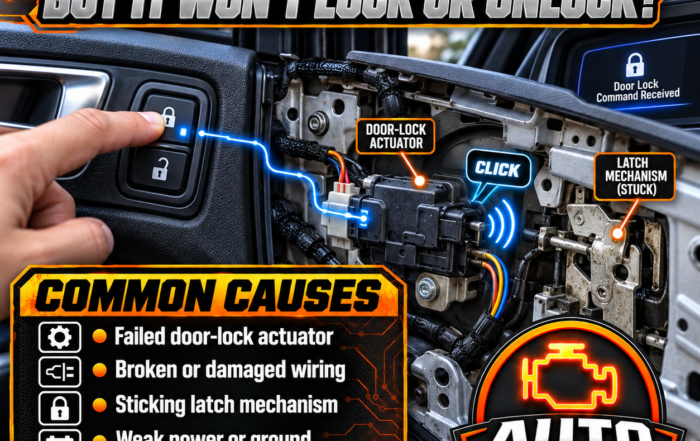
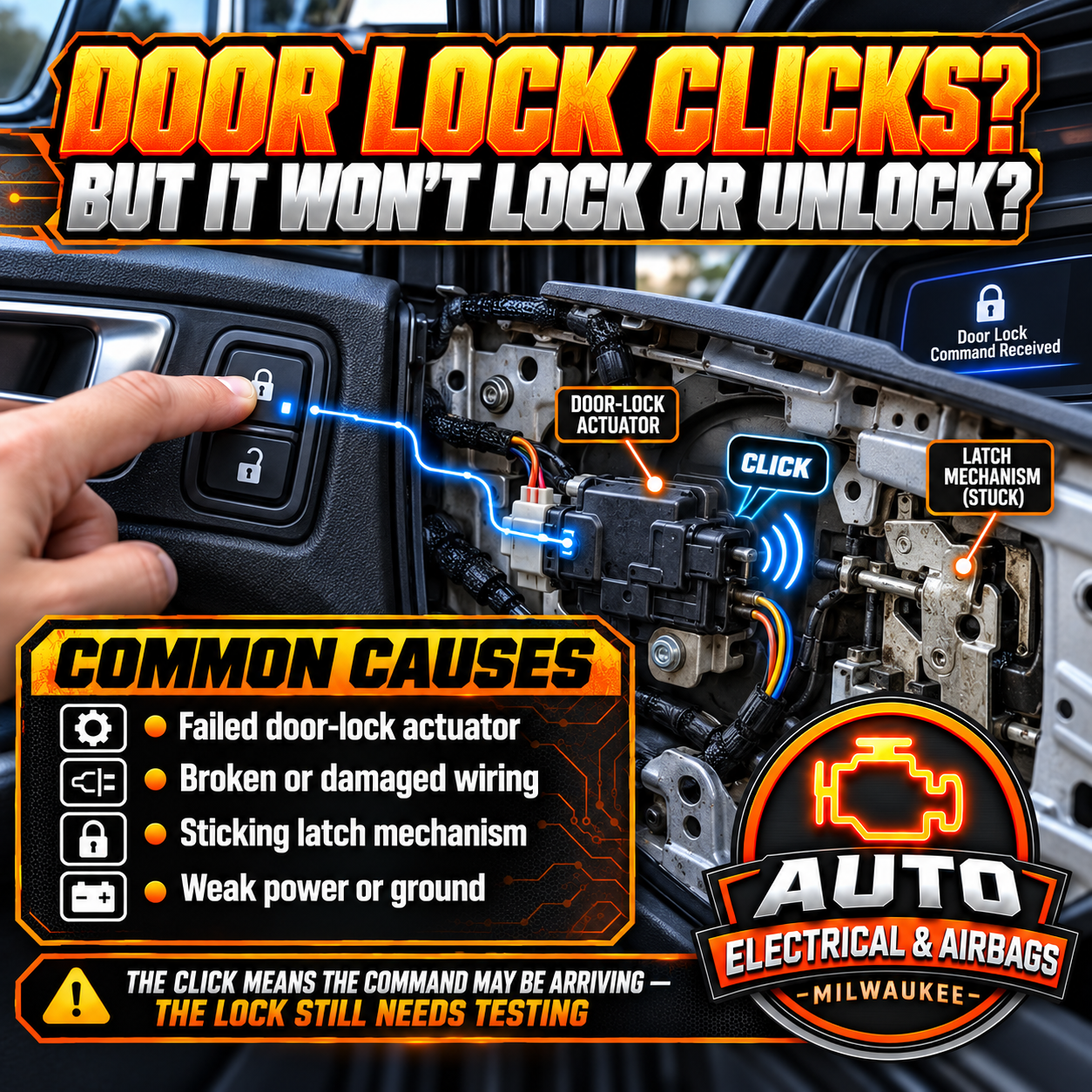
Quick answer: If your power door lock clicks but does not actually lock or unlock, the system is often receiving at least part of the electrical command. The problem may involve a weak door-lock actuator, a binding latch, damaged linkage, low voltage, a wiring fault, a loose connector, or a door-control problem. Hearing a click does not automatically mean the actuator is good—or that it is the failed part.
Key Takeaways
- A clicking sound means something in the lock circuit is responding, but it does not prove the latch is moving correctly.
- A weak door-lock actuator may make noise but no longer produce enough force to move the lock.
- A mechanical latch or linkage problem can imitate an electrical actuator failure.
- Door-jamb wiring can break internally because it flexes every time the door opens and closes.
- If several doors fail at once, a shared electrical issue, BCM, switch, or power supply becomes more important to investigate.
- If only one door fails, the local actuator, latch, wiring, or connector becomes more suspicious.
- Proper diagnosis should determine whether the problem is electrical, mechanical, or both before parts are replaced.
Why Does My Door Lock Click but Not Move?
The clicking sound is an important clue.
When you press:
- Door lock switch
- Key fob
- Passive-entry button
the vehicle sends a command to the lock system.
If you hear a click inside the door, some part of the system is responding.
That may be:
- Lock actuator
- Relay
- Latch assembly
- Door module
But sound alone does not tell us whether the mechanism can actually move.
A weak actuator can click without producing enough force.
A jammed latch can prevent a perfectly good actuator from moving the lock.
That is why the symptom should be broken into two questions:
Is the electrical command reaching the door?
and
Can the mechanical lock mechanism respond to that command?
What Is a Power Door Lock Actuator?
A door lock actuator is the electrical or electromechanical component that physically moves the door lock between locked and unlocked positions.
Depending on the vehicle, it may be:
- Separate electric actuator
- Integrated into the door latch
- Part of a larger electronic latch assembly
The actuator receives a command from the vehicle’s lock system and moves the latch or linkage.
On many newer vehicles, the actuator and latch are serviced together as one assembly.
What Are the Symptoms of a Bad Door Lock Actuator?
Possible symptoms include:
- Lock clicks but does not move
- Door locks only sometimes
- Door locks but will not unlock
- Door unlocks but will not lock
- Lock moves slowly
- Several button presses are needed
- One door does not respond with the others
- Buzzing or grinding inside the door
- Door lock works better when warm
- Manual lock still works
A weak actuator can fail gradually.
It does not always stop working completely in one moment.
Can a Door Lock Actuator Click but Still Be Bad?
Yes.
This is one of the most important points.
An electric actuator can still make noise while being too weak to move the latch.
Internal wear may allow the motor to spin or click without producing enough usable force.
Possible reasons include:
- Worn motor
- Damaged internal gears
- Weak mechanical drive
- High internal resistance
That means:
clicking does not equal working.
Why Does the Lock Work Sometimes?
Intermittent operation can point toward several possibilities:
- Weak actuator
- Loose connector
- Broken wiring
- Worn switch
- Door module issue
- Mechanical binding
Pay attention to patterns.
For example:
- Works when warm
- Fails when cold
- Works after slamming door
- Works only with door open
- Works after repeated button presses
Those patterns can help narrow the diagnosis.
Why Does Slamming the Door Make the Lock Work?
Door impact can temporarily move:
- Loose connector
- Broken wire
- Worn actuator
- Binding latch
If the lock suddenly works after the door is slammed, that usually indicates an intermittent problem.
It does not mean the door is fixed.
Repeatedly slamming the door can create additional damage.
Why Does the Door Lock Work Manually but Not Electrically?
If you can move the lock manually but the power function does not work, possible causes include:
- Failed actuator
- Missing actuator power
- Wiring fault
- Connector problem
- Switch issue
- Door module problem
The fact that the lock moves manually suggests the mechanism is not completely seized.
But electrical testing is still needed.
Why Does the Door Lock Click but Stay Locked?
If the actuator makes noise but the latch remains locked, possible causes include:
- Weak actuator
- Mechanical latch binding
- Damaged linkage
- Internal latch failure
- Low voltage at actuator
The actuator may be trying to move but cannot overcome the resistance.
Why Does the Door Unlock but Not Lock?
This is similar to a power window that works in only one direction.
Depending on the circuit, the system may reverse polarity or command the actuator differently for lock and unlock.
Possible causes include:
- Weak actuator
- Failed switch contact
- Wiring fault
- Control-module issue
- Mechanical binding
One-direction operation is useful diagnostic evidence.
It means at least part of the system is still functional.
Can a Bad Door Lock Switch Cause This?
Yes.
A switch can fail partially.
Possible symptoms include:
- Locks from key fob but not interior switch
- Works from passenger switch but not driver switch
- Lock command works but unlock does not
- Switch feels loose or inconsistent
Comparing different control methods helps isolate the problem.
If the Key Fob Works but the Door Switch Does Not, What Does That Mean?
If the locks work normally from the key fob but fail from one interior switch, the switch or its circuit becomes more suspicious.
The actuator clearly has the ability to operate.
That shifts attention toward:
- Door switch
- Switch wiring
- Door module input
This is why testing the same system from multiple controls can be very useful.
If the Interior Switch Works but the Key Fob Does Not, Is the Door Lock Bad?
Probably not.
If the lock operates normally from the interior switch, the actuator and mechanical latch are capable of working.
The issue may instead involve:
- Key fob battery
- Key fob
- Receiver
- BCM
- Programming
The lock actuator should not be replaced simply because remote locking fails.
Can Broken Door-Jamb Wiring Cause Lock Problems?
Yes.
Door wiring flexes every time the door opens and closes.
The harness typically runs through a rubber boot between the body and the door.
Over time, conductors can:
- Crack
- Break internally
- Stretch
- Lose connection
Possible symptoms include:
- Door lock works only with door open
- Power window also stops working
- Mirror stops working
- Speaker cuts out
- Lock becomes intermittent
Several electrical problems affecting the same door can be a strong clue that the door harness deserves inspection.
Why Does the Lock Work Only When the Door Is Open?
This can strongly suggest a wiring problem.
When the door opens, the harness bends one way.
When it closes, the harness bends another.
A partially broken wire may make contact in one position and separate in another.
For example:
Door open: conductor touches → lock works
Door closed: wire flexes → circuit opens
That is a classic intermittent electrical pattern.
Can a Poor Ground Cause a Weak Door Lock?
Yes.
Electric actuators need enough current to move the latch.
A high-resistance ground can reduce the usable voltage at the actuator.
Symptoms may include:
- Slow locking
- Weak actuator movement
- Intermittent lock function
- Lock clicks but does not move
A poor ground can make a good actuator look weak.
That is why voltage-drop testing can be valuable.
Can Low Battery Voltage Affect Door Locks?
Yes.
Power door locks depend on the vehicle’s electrical system.
A weak battery may cause:
- Slow actuator movement
- Reduced locking force
- Intermittent electronics
- Multiple body-electrical symptoms
If several doors suddenly become weak at the same time, system voltage becomes more relevant.
If only one door fails while the others work normally, the problem is more likely local to that door.
Can Cold Weather Make a Door Lock Actuator Fail?
Yes.
Cold temperatures can make an already weak actuator more noticeable.
Possible reasons include:
- Thickened lubricant
- Increased mechanical resistance
- Weak actuator motor
- Ice or moisture in latch area
A lock that works normally in warm weather but repeatedly fails in cold weather may have a marginal actuator or binding latch.
Can Water Inside the Door Cause Lock Problems?
Yes.
Doors are exposed to moisture.
Water can affect:
- Connectors
- Wiring
- Door modules
- Lock actuator
- Latch electronics
Possible symptoms include:
- Lock fails after rain
- Lock becomes intermittent
- Corrosion in connector
- Several door functions malfunction
Our guide to car electrical problems after rain explains how moisture can create intermittent body-electrical faults.
Can a Door Lock Actuator Drain the Battery?
Potentially.
If an actuator, latch, or door-control module remains active when it should sleep, it can contribute to parasitic battery drain.
This is less common than a simple actuator failure, but it is possible.
Clues may include:
- Clicking after vehicle is shut off
- Repeated lock cycling
- Door module staying awake
- Battery dying overnight
A parasitic-draw test can determine whether the circuit is consuming current after the vehicle should be asleep.
Can the BCM Cause Power Door Lock Problems?
Yes.
The Body Control Module commonly participates in body-electrical functions such as:
- Door locks
- Keyless entry
- Interior lights
- Security
- Windows
- Other convenience systems
But a single failed door lock does not automatically mean the BCM is bad.
If only one door fails, local components are usually more important to investigate first.
If several body systems fail together, the BCM or its supporting power, ground, or communication circuits become more relevant.
Our guide to bad BCM symptoms explains why body-control problems should be tested rather than assumed.
Can a BCM Be Bad if Only One Door Does Not Lock?
It is possible, but it is generally not the first thing to suspect.
A single-door failure more strongly points toward:
- Actuator
- Latch
- Local wiring
- Connector
- Door module
The complete system design matters.
Some vehicles use individual door modules, which means a localized electronic problem can affect only one door.
What Is a Door Control Module?
Many modern vehicles use electronic modules inside individual doors.
A door module may manage:
- Power windows
- Door locks
- Mirrors
- Memory functions
- Lighting
- Communication
If several functions fail on the same door, the door module or its power/ground supply becomes more relevant.
For example:
- Window dead
- Lock dead
- Mirror dead
That pattern suggests something broader than one failed actuator.
Can a CAN Bus Problem Affect Door Locks?
Yes, on electronically networked vehicles.
Door modules may communicate with the BCM over a vehicle network.
A communication failure can cause:
- Door lock not responding
- Window not responding
- Mirror controls failing
- Communication codes
But an isolated weak actuator that still clicks is more likely to be a local mechanical or electrical problem than a full CAN bus failure.
Can a Broken Latch Look Like a Bad Actuator?
Yes.
The lock actuator may work correctly but be unable to move a damaged or binding latch.
Possible latch symptoms include:
- Actuator clicks
- Manual lock feels stiff
- Door difficult to open
- Door does not fully latch
- Lock works only intermittently
The mechanical condition should be inspected before the electrical actuator is condemned.
Can Lubrication Fix a Power Door Lock?
Sometimes mechanical binding can improve with proper latch service, but lubricant is not a universal repair.
It will not fix:
- Burned actuator motor
- Broken gear
- Damaged wiring
- Failed switch
- BCM problem
The first step is determining whether the resistance is actually mechanical.
Why Does My Lock Buzz or Grind?
Buzzing or grinding can indicate internal actuator or latch damage.
Possible causes include:
- Worn gear
- Stripped gear teeth
- Weak motor
- Jammed latch
A noisy actuator that does not complete the locking movement is often more suspicious than one that operates quietly and normally.
Can a Door Lock Actuator Fail Slowly?
Yes.
Gradual failure is common.
The progression may look like:
- Lock becomes slightly slower.
- Requires repeated button presses.
- Works only sometimes.
- Clicks but barely moves.
- Stops moving completely.
That gradual change can be useful in distinguishing an actuator problem from a sudden wiring disconnect.
Can a Fuse Cause Only One Door Lock to Fail?
Usually, a shared fuse affects more than one lock or control circuit.
If every other door works normally and one door does not, a single common fuse becomes less likely.
However, circuit design varies.
The wiring diagram for the exact vehicle determines which components share protection.
Can a Relay Cause a Door Lock Problem?
Some vehicles use relays in the lock system.
Others control the locks electronically through a BCM or door module.
A relay should not be replaced solely because the lock clicks or fails.
The actual circuit design should be checked first.
How Is a Power Door Lock Problem Diagnosed?
A logical diagnosis starts by separating:
electrical command
from
mechanical movement.
Test Every Control Method
Technicians may test:
- Key fob
- Driver switch
- Passenger switch
- Passive-entry button
This helps determine whether the problem is limited to one input or affects the entire door.
Compare Other Doors
If three doors work and one fails, the problem is likely local.
If every door fails, a shared electrical issue becomes more important.
Listen to the Actuator
A click, buzz, or grinding sound provides useful information.
Test Voltage at the Actuator
The actuator should receive the correct electrical command when lock and unlock are requested.
If proper voltage reaches the actuator but it cannot move the latch, the actuator or mechanical assembly becomes more suspicious.
Inspect the Latch and Linkage
The mechanism should be checked for binding or damage.
Inspect Door-Jamb Wiring
This is especially important if operation changes with door position.
Scan the BCM or Door Module
On modern vehicles, scan data may show:
- Lock command
- Door status
- Module communication
- Stored faults
This can help determine whether the command is being received and processed.
Actuator Problem vs. Wiring Problem
| Symptom | Actuator Possible? | Wiring Possible? |
|---|---|---|
| Lock clicks but does not move | Strong clue | Possible |
| Works only with door open | Possible | Strong clue |
| Other door electronics also fail | Possible | Strong clue |
| Correct voltage reaches actuator | Strong clue | Less likely |
| No voltage at actuator | Less likely | Strong clue |
| Grinding inside latch | Strong clue | Less likely |
| Works after slamming door | Yes | Yes |
Testing determines which side is actually failing.
Actuator Problem vs. BCM Problem
A single-door problem more commonly points toward:
- Local actuator
- Latch
- Wiring
- Connector
- Door module
A broader BCM-related issue may produce:
- Several doors not locking
- Keyless entry problems
- Interior-light problems
- Security-system faults
- Window issues
- Other body-electrical symptoms
That broader pattern matters.
Why Replacing the Actuator First Can Waste Money
Consider this sequence:
- Door lock clicks but does not move.
- Actuator is replaced.
- Lock still fails.
- Broken door-jamb wiring is finally discovered.
The actuator was never the actual fault.
A better diagnostic sequence is:
Control input → voltage at actuator → wiring → mechanical latch → actuator replacement if confirmed
That reduces unnecessary parts replacement.
When Should Power Door Locks Be Professionally Diagnosed?
Consider electrical diagnosis when:
- Lock clicks but does not move
- Lock works only sometimes
- One door behaves differently from the others
- Lock works only with door in certain position
- Window and lock fail together
- Lock works from one switch but not another
- Several doors stop responding
- BCM or door-module codes are present
- New actuator did not solve the problem
- Problem began after door repair or collision work
The more intermittent or multi-system the problem becomes, the more useful proper electrical testing is.
Power Door Lock Electrical Diagnostics in Milwaukee
At Auto Electrical & Airbag Specialist, we diagnose power door lock problems involving actuators, latches, switches, wiring, connectors, door modules, BCM circuits, and related electrical faults.
Our Power Window & Door Lock Electrical Repair in Milwaukee service is the main service page this article supports. It is designed for doors that click but do not move, locks that work intermittently, and door-electrical problems involving wiring or control modules.
If diagnosis points toward a broken conductor in the door harness, our Car Wiring Repair in Milwaukee service focuses on wiring, connectors, grounds, and intermittent electrical faults.
For wider body-electrical problems involving multiple doors or systems, our BCM Repair & Body Control Module Diagnostics service may also be relevant.
Auto Electrical & Airbag Specialist
2636 S 32nd St, Milwaukee, WI 53215
(414) 345-7568
Frequently Asked Questions About Power Door Locks
Why does my door lock click but not lock?
The actuator may be weak, the latch may be binding, or the system may have a voltage, wiring, or connector problem.
Can a door lock actuator make noise and still be bad?
Yes. The motor can make a clicking or buzzing sound without producing enough force to move the latch.
Why does the door lock work manually but not electrically?
The mechanical latch may still be functional while the actuator, wiring, switch, connector, or door-control system has failed.
Why does my lock work only when the door is open?
A partially broken wire in the door-jamb harness can make contact in one door position and lose connection in another.
Can a BCM cause only one door lock to stop working?
It is possible, but a single-door failure more commonly points toward the local actuator, latch, wiring, connector, or door module.
Why does slamming the door make the lock work?
Impact may temporarily restore connection in a broken wire, loose connector, worn actuator, or binding latch.
Can a bad actuator drain the battery?
Potentially, especially if the actuator or door module remains active or repeatedly cycles when the vehicle should be asleep.
Why does the key fob lock the door but the switch does not?
The actuator is capable of operating, so the interior switch or its control circuit becomes more suspicious.
Why does the interior switch work but the key fob does not?
The lock actuator may be fine. The problem may involve the key fob, receiver, BCM, or programming.
Can cold weather make a door lock actuator stop working?
Yes. Cold temperatures can increase mechanical resistance and expose a weak actuator.
How do technicians test a door lock actuator?
They may test voltage and ground at the actuator while commanding lock and unlock, inspect the latch, compare other doors, inspect wiring, and scan the BCM or door module.
Should I replace the actuator first if it clicks?
Not automatically. A clicking lock can also be caused by a binding latch, weak voltage, wiring damage, or a connector problem.
The Bottom Line
A power door lock that clicks but will not lock or unlock tells us something important:
The system is responding—but the lock is not completing the movement.
The actual cause may be:
- Weak actuator
- Damaged latch
- Wiring
- Connector
- Door-jamb harness
- Switch
- Door module
- BCM-related control issue
- Low voltage
The best diagnostic question is:
“Is the actuator receiving the correct electrical command, and can the latch physically respond to it?”
Answering both parts separates an electrical problem from a mechanical one and helps prevent unnecessary actuator or module replacement.