Written by: Auto Electrical & Airbag Specialist Editorial Team
Reviewed by: Auto Electrical & Airbag Specialist Technical Team
Updated: October 20, 2026
Reading time: 11 minutes
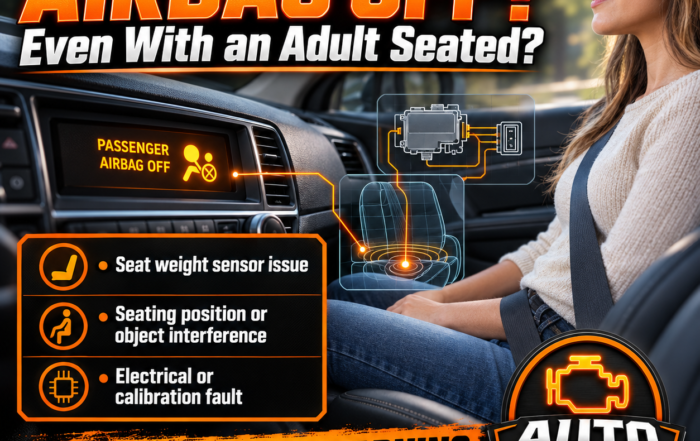
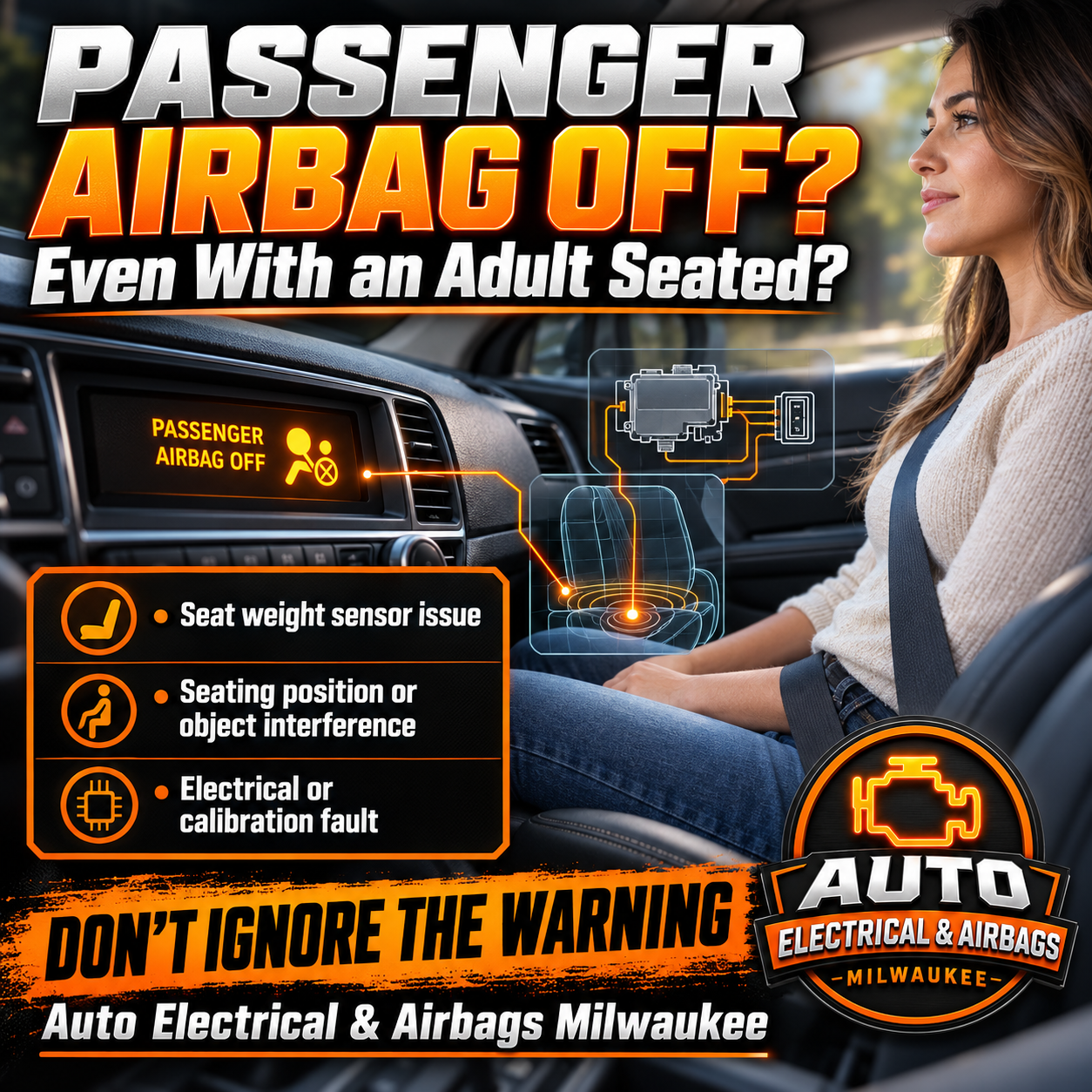
Quick answer: If the passenger airbag says OFF while a properly seated adult is in the front passenger seat, the vehicle may be misreading the occupant because of seating position, weight distribution, an occupant classification sensor problem, under-seat wiring, a loose connector, lost calibration, or another SRS fault. The airbag itself is not automatically the failed component.
Key Takeaways
- Modern vehicles may use an Occupant Classification System (OCS) to determine whether the passenger frontal airbag should be active.
- The system can consider seat loading, occupant position, sensor data, and other inputs.
- A properly seated adult should not simply ignore an unexpected Passenger Airbag OFF indication.
- Moving the seat, replacing the seat, upholstery work, water intrusion, wiring damage, or loss of calibration can affect the system.
- An occupancy-sensor fault code does not automatically mean the sensor needs replacement.
- Diagnosis should include the complete SRS system, wiring, connectors, sensor data, and vehicle-specific calibration requirements.
What Does “Passenger Airbag OFF” Actually Mean?
The Passenger Airbag OFF indicator is part of the vehicle’s Supplemental Restraint System, or SRS.
Its purpose is to tell the occupants when the front passenger airbag has been suppressed under the conditions detected by the vehicle.
Modern passenger airbag systems are more sophisticated than simply asking:
“Is someone sitting in the seat?”
Many vehicles use an occupant classification or detection system that attempts to distinguish between conditions such as:
- Empty passenger seat
- Small occupant
- Child restraint
- Properly seated adult
The exact logic varies by manufacturer and model.
According to NHTSA, advanced frontal airbag systems can depend heavily on the loading or pressure placed on the passenger-seat cushion. Changes in how weight is distributed can affect how the system classifies the occupant.
That is why an unexpected Passenger Airbag OFF light can sometimes be caused by seating position — but it can also indicate a system fault that requires diagnosis.
What Is an Occupant Classification System?
An Occupant Classification System, commonly abbreviated OCS, is a system used to determine how the front passenger seat is occupied.
Depending on the vehicle, it may use information from:
- Seat weight sensors
- Pressure sensors
- Seat position sensors
- Seat belt buckle status
- Passenger-seat control modules
- Other restraint-system inputs
The system sends that information to the restraint control system.
The vehicle then determines whether the passenger frontal airbag should be active or suppressed according to its programmed strategy.
This is why the passenger seat can contain far more electronics than many drivers realize.
Why Does the Vehicle Need to Classify the Passenger?
Airbags deploy extremely quickly and with significant force.
The restraint system is designed to balance occupant protection with the need to suppress the passenger frontal airbag under certain conditions.
For example, the system may need to differentiate between:
- An empty seat
- A small occupant
- A child restraint
- A properly seated adult
Federal airbag requirements allow advanced systems to automatically suppress the passenger airbag when specific occupant conditions are detected.
The important point is that the system makes this decision from sensor data, not from what the driver can visually see.
A person may clearly appear to be an adult while the vehicle is receiving sensor information that does not match the expected adult classification.
Why Can an Adult Passenger Be Classified Incorrectly?
There are several possible reasons.
The problem may involve normal seating position, incorrect sensor data, damaged wiring, calibration, or another SRS fault.
Seating Position
The amount and distribution of weight on the seat cushion matters on many systems.
An adult passenger who is:
- Leaning heavily toward the door
- Sitting partially off the cushion
- Sitting far forward
- Supporting some body weight elsewhere
- Sitting in an unusual posture
may affect how the system reads the seat.
NHTSA specifically notes that changes in the pressure placed on the seat bottom can affect occupant classification.
Seat Loading
Objects placed on or around the passenger seat can also alter the readings.
Examples include:
- Heavy bag
- Toolbox
- Groceries
- Laptop bag
- Package
These objects do not necessarily “break” the airbag system, but they can change the conditions the system senses.
Sensor or Electrical Fault
If a properly seated adult is consistently classified incorrectly, the issue may involve:
- Occupancy sensor
- Seat wiring
- Connector
- Seat module
- Calibration
- SRS communication
That is when diagnosis becomes important.
What Should You Do First if the Passenger Airbag Says OFF?
If the indicator appears unexpected, begin with the simple things before assuming a part has failed.
Have the passenger:
- Sit upright.
- Sit centered in the seat.
- Keep their back against the seatback.
- Keep their weight naturally on the seat cushion.
- Remove heavy bags or objects from the seat.
- Follow the passenger-airbag instructions in the vehicle owner’s manual.
Then observe the indicator according to the vehicle’s documented startup procedure.
If the light still does not behave as expected with a properly seated adult, the system should be diagnosed.
NHTSA specifically advises checking the owner’s manual when the passenger-airbag indicator does not provide the expected result.
Can Moving the Passenger Seat Cause the Airbag Light to Change?
Yes.
This is an important diagnostic clue.
The passenger seat may contain wiring for:
- Occupant classification
- Seat belt buckle sensor
- Side airbag
- Seat position sensor
- Power seat
- Heated seat
- Ventilated seat
- Seat module
That wiring moves every time the seat moves.
If a wire or connector is damaged, the connection can change depending on seat position.
You may notice:
- Passenger airbag status changes after moving the seat
- SRS warning appears when the seat is moved backward
- Warning disappears when seat is moved forward
- Power seat and airbag issues happen together
That pattern makes under-seat wiring especially important to inspect.
Can a Loose Connector Under the Seat Cause Passenger Airbag Problems?
Yes.
A loose or damaged connector can interrupt communication between the passenger seat components and the SRS system.
Possible connector problems include:
- Loose terminal
- Bent pin
- Broken connector lock
- Corrosion
- Wire pulled partly out of connector
- Liquid contamination
The sensor itself can be completely functional while its electrical connection is faulty.
That is why the presence of an occupancy-sensor code should not immediately lead to sensor replacement.
Can a Broken Wire Make the Occupancy Sensor Look Bad?
Absolutely.
A sensor depends on its supporting electrical circuit.
That circuit may include:
- Power
- Ground
- Signal
- Communication wiring
If one conductor is damaged, the SRS module may receive an implausible reading or lose the sensor entirely.
A scan tool may then display a code that appears to identify the occupancy sensor.
But the actual fault could be:
- Open wire
- Short circuit
- High resistance
- Connector problem
The code identifies where the system detected a problem.
It does not automatically identify the failed component.
Can Seat Replacement Cause Passenger Airbag Problems?
Yes.
The passenger seat may contain components that are part of the occupant classification system.
A replacement seat may differ in:
- Sensor type
- Module
- Wiring
- Cushion design
- Occupant classification hardware
A used seat that physically fits the vehicle may not automatically be electronically compatible.
Depending on the vehicle, seat replacement may require:
- Correct part verification
- Sensor setup
- Zero-point calibration
- Occupant classification initialization
This is especially important after salvage-seat replacement or interior repairs.
Can Upholstery Work Affect the Occupancy Sensor?
Potentially.
Some occupant classification systems depend on components located within or beneath the seat cushion.
Work involving:
- Seat foam
- Seat upholstery
- Seat cover
- Cushion replacement
can affect how force is transferred to the sensing system.
Manufacturer-specific service information should be followed whenever repairs involve the passenger-seat cushion or occupant classification components.
Can Water or a Spilled Drink Cause Passenger Airbag Problems?
Yes.
Liquid can reach electrical components underneath the passenger seat.
Possible affected areas include:
- Wiring
- Connectors
- Seat module
- Occupancy sensor circuitry
The result may be:
- Corrosion
- Short circuit
- High resistance
- Intermittent sensor reading
- SRS warning
The problem may not appear immediately.
Corrosion can develop gradually after the original spill or water intrusion.
Why Does the Passenger Airbag Indicator Change When Someone Shifts Position?
Occupant classification systems may respond to how weight is distributed on the seat.
If the passenger changes position significantly, sensor readings may change.
That does not automatically indicate a fault.
However, the indicator should behave according to the vehicle manufacturer’s documented operation.
If it repeatedly changes while a properly seated adult remains in a normal position, that deserves further investigation.
Can Low Battery Voltage Cause an SRS or Passenger Airbag Fault?
It can contribute.
The SRS system contains electronic modules that require stable voltage.
Low system voltage can cause:
- Fault codes
- Module resets
- Communication faults
This may happen after:
- Dead battery
- Jump start
- Battery replacement
- Charging-system problem
However, low voltage should not become a catch-all explanation.
If the passenger-airbag indicator remains incorrect, the fault should still be diagnosed.
Can a Power Seat Problem and Passenger Airbag Problem Be Related?
Yes, because both systems can share the same physical area.
For example:
- Power seat stops intermittently
- SRS warning appears
- Passenger-airbag status becomes incorrect
That combination can point toward wiring underneath the seat.
Our guide to power seat electrical problems explains how repeated seat movement can stress wiring and connectors.
Does a Passenger Airbag Sensor Need Calibration?
Sometimes.
Depending on the vehicle, the occupant classification system may require:
- Zero-point calibration
- Initialization
- Relearn procedure
- Scan-tool setup
This may be required after certain repairs involving:
- Passenger seat removal
- Occupant classification sensor
- Seat cushion
- Seat module
- Replacement seat
Vehicle-specific procedures matter.
There is no single universal passenger-seat calibration process.
Can You Calibrate a Bad Occupancy Sensor?
No.
Calibration cannot repair:
- Broken sensor
- Damaged wiring
- Corroded connector
- Internal electronic failure
If calibration repeatedly fails, technicians need to determine why.
Possible causes include:
- Sensor fault
- Wiring fault
- Incorrect seat component
- Incorrect vehicle setup
- Module issue
Calibration should be performed when appropriate — not used as a substitute for diagnosis.
Does a Passenger Airbag Code Mean the Seat Sensor Is Bad?
No.
A code related to occupant classification may be caused by:
- Occupancy sensor
- Under-seat wiring
- Connector
- Seat module
- Calibration
- Power supply
- Communication fault
The trouble code provides direction.
It does not automatically tell you which component to replace.
Can the Passenger Airbag Say OFF Without the Main SRS Light Being On?
Yes, depending on the vehicle and conditions.
The passenger-airbag status indicator and the general SRS warning light have different purposes.
The passenger status indicator tells you whether the passenger frontal airbag is currently being suppressed.
The SRS warning light generally indicates that the restraint system has detected a fault.
Because vehicle logic varies, the owner’s manual should be used to interpret the exact indicator behavior.
Does Passenger Airbag OFF Mean the Passenger Airbag Is Disabled?
If the vehicle indicates Passenger Airbag OFF, the system is reporting that the passenger frontal airbag is being suppressed under the conditions it currently detects.
That is why an unexpected OFF indication with a properly seated adult should not simply be dismissed.
The vehicle manufacturer’s instructions should be used to confirm whether the indicator behavior is normal.
Is It Safe for an Adult to Ride There if the Passenger Airbag Says OFF?
If a properly seated adult is present and the indicator does not match the operation described in the owner’s manual, the condition should be diagnosed.
Do not assume that passenger frontal airbag operation is normal when the vehicle is specifically indicating that it is off.
NHTSA advises owners to consult the owner’s manual when the passenger-airbag indicator does not provide the expected result.
Can an Occupancy Sensor Problem Affect Airbag Deployment?
Potentially.
The entire purpose of the occupant classification system is to influence how the vehicle manages the passenger frontal airbag.
If the system incorrectly classifies a passenger, it may not make the intended restraint decision.
That is why an unexpected passenger-airbag status deserves more attention than an ordinary convenience-system warning.
How Is a Passenger Occupancy Sensor Problem Diagnosed?
A good diagnosis should evaluate the whole system rather than immediately replacing the passenger-seat sensor.
Verify the Condition
The first step is determining exactly what is happening.
Questions include:
- Is a properly seated adult present?
- Does the light change when seat position changes?
- Is the main SRS warning light also on?
- Did the problem start after seat work?
Perform a Complete SRS Scan
A capable scan tool may identify faults involving:
- Occupant classification
- Seat position
- Seat belt circuits
- SRS control module
- Communication
The complete fault-code pattern matters.
Inspect Under-Seat Wiring and Connectors
Technicians may look for:
- Loose connector
- Damaged terminal
- Broken wire
- Corrosion
- Water contamination
- Wiring stretched by seat movement
Review Live Sensor Data
Where supported, scan data may show occupant classification information or sensor status.
This helps determine whether the vehicle is receiving plausible seat information.
Verify Calibration or Initialization
If the seat or occupancy components were removed or replaced, the correct calibration status should be confirmed.
Follow the Manufacturer Procedure
Because the SRS is a safety system, diagnosis and repair should follow the procedure for the exact vehicle.
Occupancy Sensor Problem vs. Wiring Problem
| Finding | Occupancy Sensor Possible? | Wiring/Connector Possible? |
|---|---|---|
| Passenger airbag status incorrect | Yes | Yes |
| Warning changes when seat moves | Possible | Strong clue |
| Connector visibly damaged | Less likely | Strong clue |
| Sensor data remains incorrect with circuit verified | Strong clue | Less likely |
| Problem began after seat removal | Possible | Strong clue |
| Calibration fails repeatedly | Yes | Possible |
| Water found under seat | Possible | Strong clue |
Symptoms provide direction.
Circuit testing provides the answer.
Occupancy Sensor Problem vs. SRS Module Problem
A passenger-specific fault does not automatically point to the main SRS module.
A broader restraint control module problem may produce several unrelated SRS faults.
A problem limited to passenger classification may more strongly suggest:
- Passenger-seat sensor
- Wiring
- Connector
- Seat module
- Calibration
The scan results help separate a seat-specific fault from a larger restraint-system problem.
Why Replacing the Seat Sensor First Can Waste Money
Imagine this repair sequence:
- Passenger airbag remains OFF with an adult seated.
- Occupancy sensor is replaced.
- Warning remains.
- A damaged connector under the seat is finally discovered.
The sensor was not the cause.
A better diagnostic process is:
Fault codes → wiring and connectors → live sensor data → calibration status → component replacement if confirmed
This is the same approach we use throughout modern electrical diagnosis:
test the circuit before replacing the expensive part.
When Should the Passenger Airbag System Be Professionally Diagnosed?
Consider SRS diagnosis when:
- Passenger airbag remains OFF with a properly seated adult
- Status indicator changes unpredictably
- SRS warning light is also illuminated
- Problem started after passenger-seat removal
- Problem began after upholstery work
- Warning changes when seat is moved
- Liquid was spilled around the passenger seat
- Occupancy-related codes are stored
- Calibration will not complete
- Seat components were replaced
- Previous parts replacement did not solve the problem
Because this system affects occupant protection, clearing the warning without identifying the cause is not an appropriate repair.
Passenger Airbag and SRS Diagnostics in Milwaukee
At Auto Electrical & Airbag Specialist, we diagnose passenger airbag and SRS faults involving occupancy sensors, seat wiring, connectors, restraint modules, stored fault codes, and related electrical problems.
Our SRS Repair & Airbag Light Diagnostics in Milwaukee service is the primary service page for problems involving passenger classification, SRS wiring, connectors, warning lights, and restraint-system faults.
For broader restraint-system concerns, you can also review our Airbag Repair & SRS Light Diagnostics in Milwaukee.
Auto Electrical & Airbag Specialist
2636 S 32nd St, Milwaukee, WI 53215
(414) 345-7568
Frequently Asked Questions About Passenger Airbag OFF Warnings
Why does the passenger airbag say OFF when an adult is sitting there?
Possible causes include seating position, unusual weight distribution, an occupancy sensor fault, under-seat wiring, a connector problem, lost calibration, or another SRS issue.
Can sitting incorrectly turn the passenger airbag off?
It can affect classification on some systems because the sensors may depend on how weight is distributed across the seat.
Can a bag on the passenger seat affect the airbag sensor?
Yes. Additional weight on the passenger seat can affect how the vehicle interprets seat occupancy.
Can moving the passenger seat cause an airbag fault?
Yes. Wiring and connectors beneath the seat can be stressed or moved as the seat changes position.
Does an occupant classification code mean the sensor is bad?
No. Wiring, connectors, calibration, seat modules, and communication problems can produce similar codes.
Can a passenger seat need recalibration?
Yes. Some vehicles require initialization or calibration after certain seat or occupant-classification repairs.
Can replacing the passenger seat cause an SRS problem?
Yes. Sensor type, module configuration, wiring, and calibration can differ between seats.
Can water under the passenger seat cause airbag problems?
Yes. Moisture can damage or corrode seat wiring, connectors, modules, and sensor circuits.
Does Passenger Airbag OFF mean the frontal airbag is suppressed?
Yes. The vehicle is indicating that the passenger frontal airbag is being suppressed under the conditions it currently detects.
Can low battery voltage cause SRS faults?
Yes. Low voltage can contribute to module resets, stored faults, and communication errors.
Should I just clear the passenger-airbag code?
No. A safety-system fault should be diagnosed to determine why the code or warning appeared.
How do technicians diagnose passenger occupancy problems?
Diagnosis may include SRS scanning, inspection of under-seat wiring, live data review, calibration verification, and vehicle-specific electrical testing.
The Bottom Line
A Passenger Airbag OFF light with a properly seated adult is not something to solve by guessing at parts.
The actual cause may involve:
- Seating position
- Occupant classification sensor
- Under-seat wiring
- Connector
- Seat module
- Calibration
- SRS communication
The most useful diagnostic question is:
“Why is the vehicle classifying this passenger differently than expected?”
Answering that question through proper SRS diagnosis can separate normal occupant-detection behavior from a real sensor, wiring, calibration, or restraint-system fault.