What Does a Flashing Check Engine Light Mean?
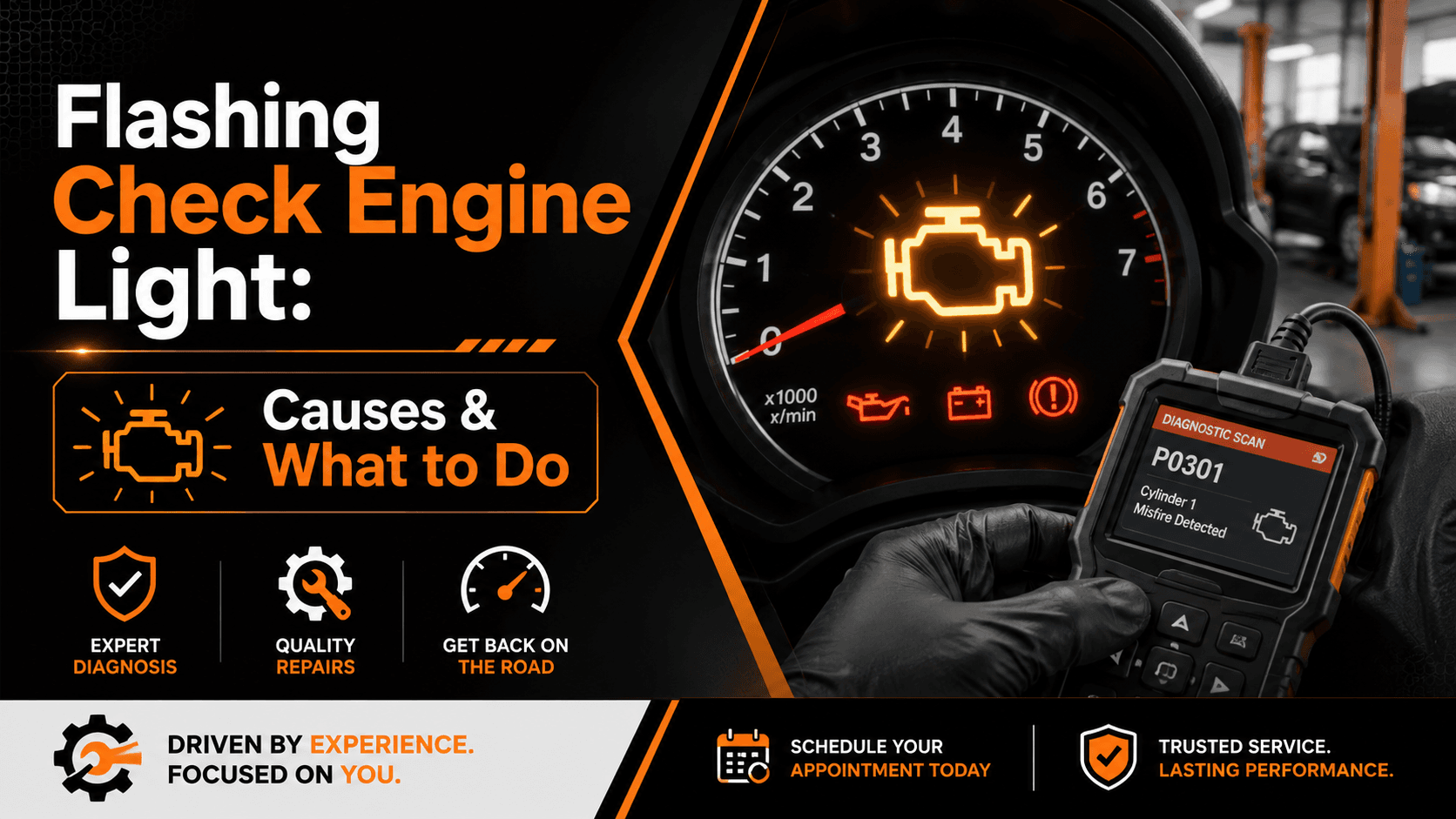
A flashing or blinking check engine light generally deserves more immediate attention than a check engine light that stays solid.
The check engine light turns on when the vehicle’s engine-control system detects a problem and stores a diagnostic trouble code. When the light begins flashing, the vehicle may be detecting a more serious or active fault that could lead to additional damage if driving continues.
One common reason for a flashing check engine light is a severe engine misfire, but the warning can also involve electrical circuits, ignition components, sensors, wiring, voltage problems, fuel delivery, or the vehicle’s engine-control system.
The important point is this:
A flashing check engine light tells you there is a serious active problem. It does not tell you exactly which part has failed.
If the engine is shaking, losing power, running extremely rough, making unusual noises, overheating, or producing other severe symptoms, continuing to drive may not be safe or appropriate.
Flashing Check Engine Light vs. Solid Check Engine Light
The difference between a solid and flashing check engine light can help indicate how urgently the problem should be investigated.
Solid Check Engine Light
A solid check engine light means the vehicle has detected a fault and stored a trouble code.
The vehicle may still seem to drive normally.
Possible causes range from relatively minor faults to problems involving sensors, wiring, ignition, emissions equipment, voltage, engine controls, or other systems.
A solid light should still be diagnosed, particularly if it remains on or keeps returning.
Flashing Check Engine Light
A flashing check engine light usually indicates a more urgent active fault.
You may notice:
- Engine shaking
- Rough idle
- Reduced power
- Hesitation
- Poor acceleration
- Engine stumbling
- Unusual exhaust smell
- Vehicle struggling to stay running
- Other dashboard warning lights
If these symptoms occur with a flashing light, avoid unnecessary driving and have the problem evaluated as soon as possible.
Why Is My Check Engine Light Blinking?
There is no single cause of a blinking check engine light.
The warning may be triggered when the engine computer detects an abnormal condition serious enough to require immediate attention.
Possible causes include:
- Severe engine misfire
- Ignition coil problems
- Spark plug or ignition faults
- Fuel delivery problems
- Injector problems
- Sensor or sensor-circuit faults
- Damaged electrical wiring
- Loose or corroded connectors
- Poor electrical grounds
- Low or unstable system voltage
- Engine-control module communication problems
- Other engine-management faults
This is why guessing based only on the warning light can quickly become expensive.
The correct repair depends on what caused the vehicle to generate the trouble code in the first place.
Can a Misfire Cause the Check Engine Light to Flash?
Yes. An active engine misfire is one of the most common situations associated with a flashing check engine light.
A misfire occurs when one or more cylinders do not produce combustion correctly.
You may feel:
- Shaking at idle
- Jerking while accelerating
- Loss of power
- Uneven engine operation
- Hesitation
- Rough running
Possible causes of a misfire can include ignition, fuel, mechanical, sensor, wiring, or engine-control problems.
That is important because seeing a misfire code does not automatically mean you should immediately replace a particular ignition component.
The circuit and system still need to be evaluated.
Why Is a Flashing Check Engine Light Serious?
A severe misfire can allow unburned fuel to enter the exhaust system.
That can create excessive heat and potentially damage expensive emissions components such as the catalytic converter.
The underlying problem may also affect drivability and engine performance.
This is why a flashing check engine light should not be treated the same way as a warning that has been solid for several weeks while the vehicle otherwise runs normally.
The vehicle is actively telling you that something significant is happening.
Can I Drive With a Flashing Check Engine Light?
It is generally best to avoid continuing to drive unnecessarily with a flashing check engine light, particularly when the vehicle is also running poorly.
Safely stop driving if you notice symptoms such as:
- Severe engine shaking
- Significant loss of power
- Vehicle struggling to accelerate
- Strong fuel smell
- Engine repeatedly stalling
- Overheating
- Unusual mechanical noises
- Smoke
- Other serious warning lights
If the light flashes only briefly and then stops, that still deserves attention. The vehicle may have stored information about the event that can help diagnose what happened.
Do not assume the problem disappeared simply because the warning stopped flashing.
What If the Check Engine Light Flashes and Then Stops?
A check engine light that flashes for a short period and then becomes solid—or turns off completely—can indicate that the severe condition was intermittent.
For example, the problem may occur:
- During hard acceleration
- At highway speeds
- When the engine is cold
- After the engine warms up
- During wet weather
- Under heavy engine load
- Only at idle
- Occasionally with no predictable pattern
Intermittent problems can be more difficult to diagnose because the vehicle may operate normally by the time it reaches the repair shop.
Stored trouble codes, freeze-frame information, live data, and the conditions under which the warning occurred can all provide useful diagnostic clues.
Why Does My Check Engine Light Flash When I Accelerate?
A check engine light that begins flashing primarily during acceleration may indicate that the fault becomes more severe when the engine is under load.
Possible causes can involve:
- Ignition problems
- Weak ignition coils
- Spark-related faults
- Fuel delivery
- Injector problems
- Sensor readings
- Wiring faults
- Engine-control issues
The fact that the problem happens under acceleration is useful diagnostic information.
When scheduling testing, tell the shop exactly when the warning occurs rather than simply saying that the check engine light is on.
Details such as “it only flashes while accelerating uphill” can be much more useful than they may seem.
Why Does My Check Engine Light Flash at Idle?
A flashing light at idle may occur when the engine computer detects an active fault while the vehicle is sitting still.
You might notice that the engine:
- Shakes
- Runs unevenly
- Sounds different
- Almost stalls
- Has an unstable idle speed
Again, a misfire may be involved, but proper diagnostics are needed to determine why the misfire or other fault is occurring.
Can an Electrical Problem Cause a Check Engine Light?
Yes.
The engine-control system relies heavily on electrical circuits.
Sensors need proper power, grounds, wiring, connectors, and signal circuits to communicate accurate information to the vehicle computer.
Electrical causes of a check engine light may include:
- Broken sensor wiring
- Short circuits
- Open circuits
- Poor grounds
- Damaged connectors
- Corroded terminals
- Unstable voltage
- Missing sensor reference voltage
- Module power-supply faults
- Communication-network problems
If the warning is flashing, keeps returning, or appears with electrical symptoms, our check engine light diagnostics in Milwaukee can help identify whether the problem involves a sensor, wiring, voltage, ignition, or engine-control system.
Can a Weak Battery Cause a Check Engine Light?
Low or unstable vehicle voltage can sometimes contribute to electronic faults and stored trouble codes.
Modern vehicles contain numerous sensors and control modules that depend on stable electrical power.
Voltage problems can potentially contribute to:
- Communication codes
- Sensor-related codes
- Module faults
- Multiple dashboard warnings
- Starting problems
- Electronic systems behaving unpredictably
However, you should not assume a check engine light is caused by the battery simply because the battery is old.
Battery and charging voltage can be tested as part of the diagnostic process when the symptoms suggest an electrical issue.
Why Did My Check Engine Light Come On After a Jump Start?
A check engine light can sometimes appear after a dead battery or jump start.
Possible reasons include:
- Low-voltage fault codes were stored
- Voltage dropped while attempting to start
- A connection is loose
- Battery voltage remains unstable
- A preexisting fault became noticeable
- Electronic modules temporarily lost communication
- The vehicle has another unrelated problem
If the warning clears and does not return, the event may have been related to the low-voltage condition.
If the light stays on, begins flashing, or returns repeatedly, the stored codes should be checked rather than repeatedly clearing them.
Why Did My Check Engine Light Come On After Replacing the Battery?
Battery replacement does not automatically cause a check engine problem, but disconnecting power or operating with a failing battery beforehand can sometimes leave stored faults.
After battery replacement, check:
- Battery terminals are tight
- Connections are clean
- Grounds are secure
- Charging voltage is appropriate
- No wiring was disturbed
If numerous dashboard warnings appear at the same time after replacement, voltage and connection problems are worth investigating before assuming several unrelated systems failed simultaneously.
Can Bad Wiring Cause a Misfire Code?
Yes, depending on the circuit involved.
Ignition coils, fuel injectors, sensors, and engine-control components all rely on electrical wiring.
A damaged wire or connector can potentially interrupt:
- Power
- Ground
- Control signals
- Sensor information
- Communication
This is why replacing a coil, injector, sensor, or other component based only on a trouble code may not solve the problem if the actual fault is in the circuit connected to it.
Does a Trouble Code Tell You Which Part Is Bad?
Not necessarily.
This is one of the most important things to understand about modern vehicle diagnostics.
A diagnostic trouble code identifies a condition the vehicle computer detected.
It may tell you:
- Which circuit reported the fault
- Which sensor reading was abnormal
- Which cylinder misfired
- Which module lost communication
- Whether voltage was outside an expected range
But it does not always tell you why that condition occurred.
For example, a sensor-related code could be caused by:
- The sensor itself
- Damaged wiring
- A poor connector
- Missing power
- A bad ground
- Another system affecting the sensor reading
- A control-module problem
A code scan provides direction. Diagnosis determines the cause.
Why Does My Check Engine Light Keep Coming Back After a Repair?
If the light returns after a component has already been replaced, several possibilities exist.
The replacement part may not have addressed the underlying cause, or another fault may exist in the same system.
Common reasons include:
- Damaged wiring was not repaired
- Connector problem remains
- Ground connection is poor
- Voltage is unstable
- Another component is affecting the circuit
- Incorrect diagnosis
- Multiple faults are present
- Electronic module communication issue
- Original trouble code was interpreted too narrowly
Replacing another part without additional testing can repeat the same cycle.
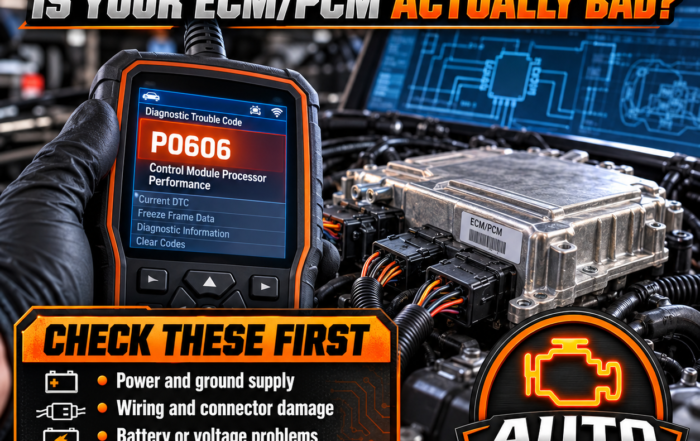
When an engine-control problem may involve the vehicle computer itself, ECU diagnostics and repair can help determine whether the ECU is actually at fault or whether the problem lies in the circuits connected to it.
Can the ECM Cause a Check Engine Light?
Yes. The engine control module monitors and manages many engine-related systems, so ECM-related faults can trigger warning lights and trouble codes.
However, actual ECM failure should not be assumed simply because a code mentions the module.
Before determining that an ECM is faulty, testing may need to confirm:
- Proper module power
- Proper grounds
- Wiring integrity
- Connector condition
- Communication with other modules
- Related sensor circuits
If diagnostic results point toward the engine computer, further ECM repair and diagnostics may be appropriate.
Should I Clear a Flashing Check Engine Light?
Clearing the code does not repair the problem.
It only removes diagnostic information and may temporarily turn off the warning.
If the vehicle detects the fault again, the light will return.
Clearing codes before diagnostics can also remove information that may help determine when and why the fault occurred.
If the light is flashing, the priority should be identifying the cause—not making the dashboard light disappear.
What Happens During Check Engine Light Diagnostics?
The exact process depends on the vehicle and trouble codes, but diagnostics may include:
- Reading stored, pending, and history trouble codes.
- Reviewing freeze-frame data from when the fault occurred.
- Checking live sensor information.
- Confirming the reported symptoms.
- Testing battery and charging voltage when relevant.
- Inspecting wiring and connectors.
- Testing power and ground circuits.
- Checking sensors or actuators related to the code.
- Evaluating communication between electronic modules.
- Performing additional mechanical testing when the fault is not electrical.
The goal is to determine what caused the code—not simply replace the first component associated with it.
How Much Does Check Engine Light Diagnostic Testing Cost?
Diagnostic cost depends on how difficult the fault is to reproduce and how much testing is required.
A straightforward problem may take less time than an intermittent wiring fault that only appears occasionally.
At our Milwaukee facility, electrical diagnostics start at $135.
For a more detailed explanation of diagnostic pricing and why some electrical problems take longer to trace, read our guide to auto electrical diagnostic costs in Milwaukee.
What Should I Do When My Check Engine Light Starts Flashing?
If your check engine light begins flashing:
- Pay attention to how the vehicle is running. Shaking, severe loss of power, unusual noises, overheating, or other major symptoms make the situation more urgent.
- Reduce unnecessary driving. A flashing warning can indicate an active fault that may cause additional damage.
- Do not simply clear the code. Diagnostic information may help identify what happened.
- Write down when the problem occurs. Note whether it happens at idle, during acceleration, on the highway, when cold, after rain, or under another specific condition.
- Have the codes and affected system properly diagnosed.
A flashing check engine light should not be ignored just because the vehicle can still move.
The warning is telling you that the engine-control system is detecting an active problem. Finding the actual cause—whether mechanical, ignition-related, sensor-related, wiring-related, voltage-related, or electronic—is the best way to avoid unnecessary parts replacement and potentially more expensive damage later.