Auto electrical diagnostics at our Milwaukee shop start from $135. This is the starting diagnostic rate, not the final repair price. The total cost depends on the vehicle, symptoms, circuit accessibility and the amount of testing required to identify the fault.
A straightforward issue involving a fuse, relay or visible damaged connector may require less testing than an intermittent battery drain, hidden wiring fault or vehicle module that stops communicating only under certain conditions. Modern vehicles contain interconnected sensors, computers and communication circuits, so the visible symptom may appear far from the actual cause.
Our auto electrical diagnostics and repair in Milwaukee service focuses on testing the affected system before parts are replaced. The goal is to determine whether the problem comes from the component itself or from its wiring, power supply, ground connection or communication circuit.
What Is an Automotive Electrical Diagnostic?
An automotive electrical diagnostic is a structured testing process used to identify the cause of a vehicle’s electrical or electronic malfunction. It involves more than connecting a scanner and reading a fault code.
A diagnostic trouble code identifies the system where a problem was detected, but it does not always identify the failed part. For example, a communication code involving the body control module does not automatically mean the BCM needs replacement. The module could be missing power, have a poor ground, be connected through damaged wiring or be unable to communicate because another component is affecting the vehicle network.
Depending on the symptoms, electrical diagnostics may include:
- Confirming the customer’s reported problem
- Checking the battery and system voltage
- Scanning connected vehicle modules
- Reviewing stored, pending and historical fault codes
- Checking related fuses and relays
- Testing component power and ground
- Inspecting wiring and electrical connectors
- Performing voltage-drop tests
- Checking sensor and switch signals
- Testing vehicle communication circuits
- Isolating circuits to locate abnormal electrical draws
- Retesting the affected system after repairs
The exact process varies by vehicle. A no-start condition requires a different diagnostic path than an airbag warning light, failed power window or module communication error.
Why Do Auto Electrical Diagnostic Costs Vary?
The cost of diagnosing a car electrical problem depends primarily on the time and testing needed to isolate the fault. Two vehicles with similar symptoms may have entirely different underlying problems.
The Problem May Be Constant or Intermittent
A constant failure is often easier to test because the technician can observe the problem during the appointment. An intermittent electrical problem may disappear when the vehicle arrives at the shop.
Loose terminals, internal wire damage, moisture, corrosion, temperature changes and vibration can cause an electrical feature to work sometimes and fail at other times. The technician may need to review fault history, reproduce the conditions or inspect several possible failure points.
Wiring May Be Difficult to Access
Automotive wiring runs through the dashboard, doors, seats, engine compartment, trunk and other enclosed areas. Accessing the affected connector or section of the wiring harness may require more time than testing an exposed fuse or relay.
The diagnostic process should narrow the problem to the correct circuit before interior panels or vehicle components are removed.
Several Systems May Be Connected
Modern vehicle computers exchange information over communication networks. A power or ground failure affecting one module can create warning lights or fault codes in several other systems.
A driver may see an airbag light, ABS light, power steering warning and failed interior features at the same time. That does not necessarily mean four separate components failed. The systems may share a power supply, ground point or communication circuit.
Previous Repairs Can Affect Diagnosis
Aftermarket remote starters, alarms, audio systems, collision repairs and previous wiring work can change the electrical system. Spliced wires, incorrect connectors or added accessories may introduce faults that do not follow the vehicle’s original wiring layout.
Let the shop know about recent repairs, battery replacement, jump-starting, water exposure, collision damage or aftermarket accessories when scheduling the appointment.
Vehicle Design and Technology Differ
Electrical systems vary between manufacturers, models and production years. Some vehicles use a traditional fuse and relay arrangement, while others control the same feature through an electronic module.
Our Milwaukee shop primarily services American and Japanese vehicles. Provide the year, make and model before the appointment so the shop can confirm that it services the vehicle and affected system.
What Does the $135 Starting Diagnostic Rate Cover?
The $135 starting rate begins the process of evaluating the reported electrical problem. The initial testing depends on the symptoms and affected system.
It may involve:
- Confirming the electrical malfunction
- Performing an initial vehicle scan
- Reviewing relevant fault codes
- Checking related fuses and relays
- Verifying basic power and ground
- Inspecting accessible connectors or wiring
- Determining whether additional testing is necessary
The starting diagnostic rate is not a promise that every electrical fault can be identified or repaired for $135. Some problems require extended circuit testing, component access, wiring-harness inspection or diagnosis across multiple vehicle modules.
After testing, the shop can explain what was found, whether additional diagnosis is required and which repair is appropriate.
Common Electrical Problems That May Require Diagnostics
Electrical diagnostics may be appropriate when a vehicle experiences one or more of the following symptoms:
- The engine does not crank or start
- The battery repeatedly loses power
- Several dashboard warning lights appear together
- A fuse continues to blow after replacement
- Lights flicker, remain on or stop working
- Power windows, locks or mirrors fail
- A power seat moves slowly or stops responding
- The airbag or SRS warning light remains illuminated
- The ABS light appears
- Electronic power steering becomes unavailable
- The climate-control panel or blower stops working
- Blind-spot monitoring becomes unavailable
- A scanner cannot communicate with one or more modules
- Electrical features work intermittently
- The vehicle behaves differently after rain or water exposure
These symptoms can have multiple possible causes. Replacing the most obvious component without testing may not resolve the problem.
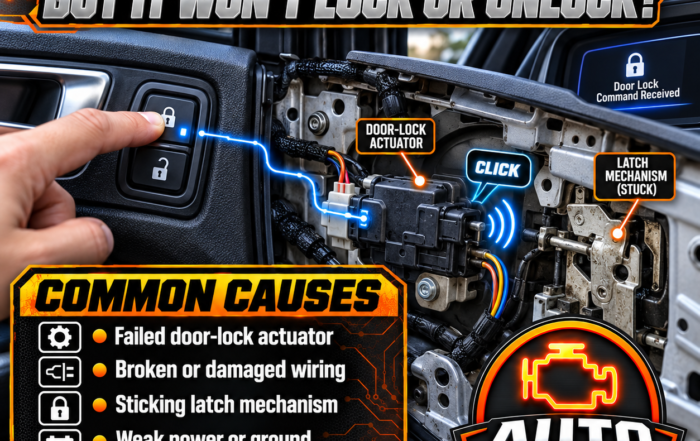
For example, failed windows or locks may involve switches, motors, actuators, door modules or damaged wiring between the door and vehicle body. Our car door electrical repair service evaluates the electrical parts and circuits responsible for those features.
Lighting failures may also involve more than a bulb. Our vehicle lighting electrical repair service diagnoses problems involving switches, fuses, relays, connectors, grounds, wiring and electronic lighting controls.
Why Reading a Fault Code Is Not a Complete Diagnosis
A scan tool is valuable because it can communicate with vehicle computers and retrieve diagnostic trouble codes. However, a code is evidence—not a final conclusion.
A code may indicate:
- A sensor signal is outside the expected range
- A circuit is open or shorted
- A module has lost communication
- Voltage is too high or too low
- A component is not responding as commanded
- A system detected an implausible reading
- A fault occurred previously but is not currently active
Additional testing is needed to determine why the code appeared.
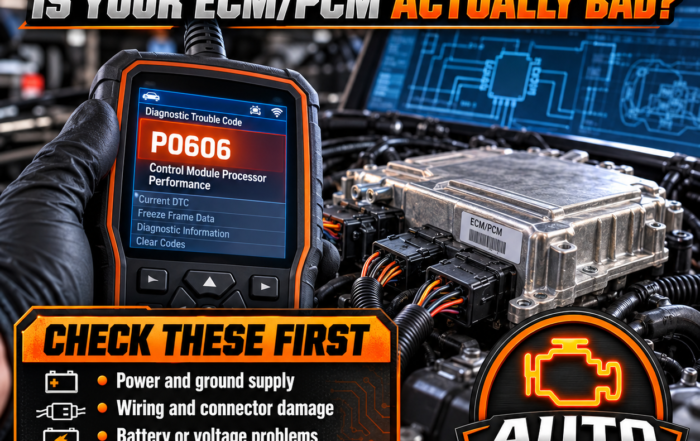
For example, an ECU-related code does not automatically prove the engine computer has failed. The ECU may be affected by low voltage, a poor ground, damaged wiring, a shorted sensor or an interruption in module communication. Our ECU and car computer diagnostics evaluate the computer together with its surrounding electrical system.
The same principle applies to ECM diagnostics and BCM diagnostics. Testing power, grounds, connectors and communication wiring can help prevent unnecessary vehicle-computer replacement.
How Parasitic Battery-Drain Testing Works
A parasitic battery drain occurs when an electrical component or circuit continues using excessive power after the vehicle has been turned off.
Some electrical activity after shutdown is normal. Modules may remain active briefly before entering sleep mode. The problem occurs when a light, switch, relay, accessory or computer remains active long enough to discharge the battery.
Battery-drain diagnostics may include:
- Testing the battery’s condition and state of charge.
- Confirming that the charging system operates correctly.
- Allowing the vehicle’s modules to complete their shutdown cycle.
- Measuring electrical current while the vehicle is parked.
- Isolating circuits to locate the source of the draw.
- Testing the components connected to the affected circuit.
A battery that repeatedly dies does not always need another replacement. If another circuit is draining it while the vehicle is parked, a new battery may eventually experience the same problem.
Diagnosing No-Start Electrical Problems
“No-start” can describe several different situations:
- Nothing happens when the key is turned
- The starter clicks once
- Rapid clicking occurs
- The dashboard turns on, but the engine does not crank
- The engine cranks but does not start
- The problem happens only sometimes
Possible electrical causes include:
- Weak battery voltage
- Damaged battery cables
- Poor engine or body grounds
- Blown fuses
- Failed relays
- Starter-control circuit problems
- Ignition switch faults
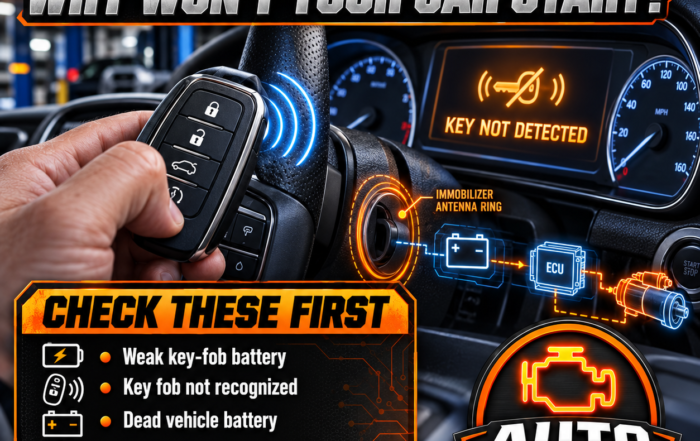
- Security authorization problems
- Damaged wiring
- ECU or ECM communication failures
- A sensor preventing proper starting operation
The exact symptom matters. Tell the shop whether the engine cranks, which lights appear, whether a clicking sound occurs and whether the problem began after a battery replacement, jump-start, collision or recent repair.
Airbag, SRS and Safety-System Diagnostics
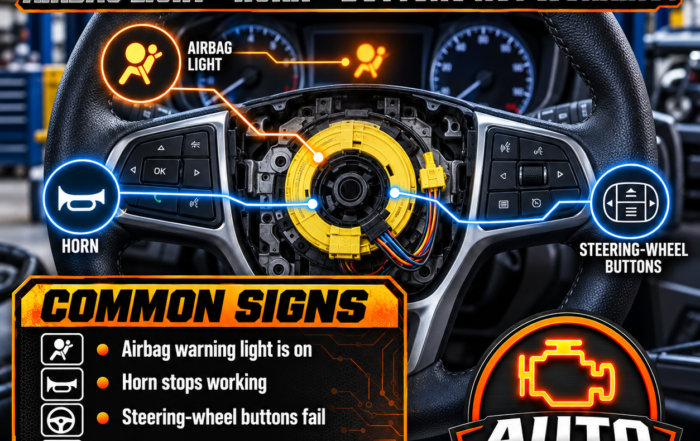
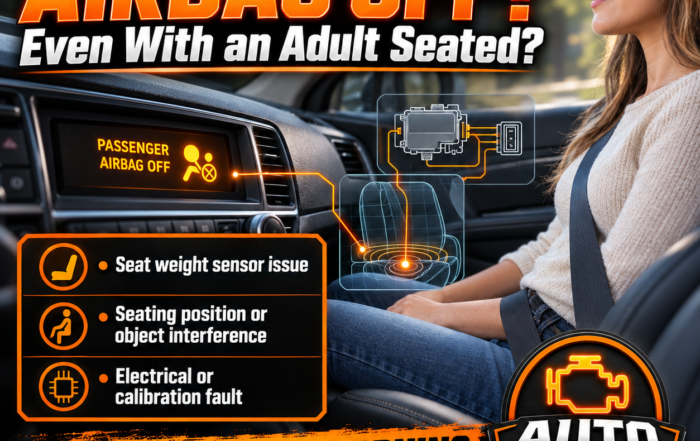
An illuminated airbag or SRS warning light indicates that the restraint system has detected a fault. The affected system may involve crash sensors, seat belt pretensioners, occupant-detection components, clock springs, connectors, wiring or the airbag control module.
Because the SRS is a safety system, the cause should be properly diagnosed instead of having the warning light cleared without repair. Our airbag repair and SRS light diagnostics focus on identifying the stored fault and evaluating the related components.
Additional information about restraint-system faults is available on our SRS repair and airbag light diagnostics page.
AC and Climate-Control Electrical Diagnostics
A vehicle that is not blowing cold air may have a refrigerant, mechanical or electrical problem. Electrical AC faults can affect the blower motor, fan-speed control, climate-control panel, sensors, switches, wiring and compressor-command circuits.
Possible electrical symptoms include:
- Blower motor does not operate
- Fan works only at certain speeds
- Climate-control display is blank
- AC works intermittently
- Compressor does not receive an engagement command
- Fuse repeatedly blows
- Airflow direction does not respond to controls
Our car AC electrical diagnostics and repair service focuses on the wiring, circuits and electronic controls affecting climate-control operation.
Can an Electrical Diagnostic Save Money?
Proper diagnostics can reduce unnecessary spending by identifying the cause before expensive parts are replaced. It does not guarantee that the final repair will be inexpensive, but it provides a more informed path forward.
Without testing, a vehicle owner may replace:
- The battery
- Starter
- Alternator
- Sensor
- Blower motor
- Window motor
- ECU
- ECM
- BCM
- Airbag module
If the actual problem is a corroded ground, damaged wire, failed relay or loose connector, replacing the main component may not resolve the symptom.
Diagnostic testing is especially important when a module or other expensive electronic component is suspected. The surrounding circuit should be evaluated before the component is condemned.
What Information Should You Provide Before Your Appointment?
Before scheduling automotive electrical diagnostics, write down:
- Vehicle year, make and model
- Main symptom
- When the problem began
- Whether the issue is constant or intermittent
- Warning lights or dashboard messages
- Whether the engine cranks or starts
- Which electronic features are affected
- Recent battery replacement or jump-start
- Recent collision or water exposure
- Previous electrical or wiring work
- Aftermarket alarms, remote starters or audio equipment
- Repairs or parts already attempted
Photos or videos of intermittent warning messages can also be helpful when the symptom is not always present.
Where Can I Get Auto Electrical Diagnostics in Milwaukee?
Auto Airbag & Electrical Specialist provides automotive electrical diagnostics at:
2636 S 32nd St
Milwaukee, WI 53215
Electrical diagnostics start from $135. Call (414) 345-7568 before visiting and provide the vehicle’s year, make, model and symptoms.
Our Milwaukee facility serves drivers from communities throughout the area. Visit our auto electrical repair service areas to find information for West Allis, Greenfield, Wauwatosa, New Berlin, Franklin, Oak Creek, Cudahy and South Milwaukee.
Auto Electrical Diagnostic Cost FAQs
Is a code scan the same as an electrical diagnostic?
No. A code scan retrieves information stored by vehicle modules, while an electrical diagnostic tests the circuits and components connected to the affected system. A code is a starting point and does not always prove which part failed.
How much do auto electrical diagnostics start from in Milwaukee?
Electrical diagnostics at our Milwaukee shop start from $135. The final amount depends on the vehicle, symptoms, accessibility and complexity of the fault.
Why might additional diagnostic time be necessary?
Additional time may be required for intermittent faults, hidden wiring damage, battery drains, inaccessible connectors or communication problems involving several vehicle modules.
Can electrical diagnostics identify why my battery keeps dying?
Yes, when the battery discharge is caused by an abnormal electrical draw. Testing may be used to isolate the circuit and determine which light, relay, switch, accessory or module remains active.
Does a module communication code mean the module is bad?
Not necessarily. The module may be missing power or ground, have a damaged connector or be connected through faulty communication wiring. The surrounding circuit should be tested before module replacement.
Can several warning lights come from one electrical problem?
Yes. Multiple systems may share voltage, grounds or communication circuits. One electrical failure can sometimes cause warning lights or faults in several connected modules.
Do you service every vehicle make?
Our shop primarily services American and Japanese vehicles. Call with the vehicle’s year, make and model to confirm service availability.
How do I schedule an electrical diagnostic?
Call (414) 345-7568 or use our contact page to provide your vehicle information and describe the problem. All appointments and repairs are completed at our Milwaukee facility.