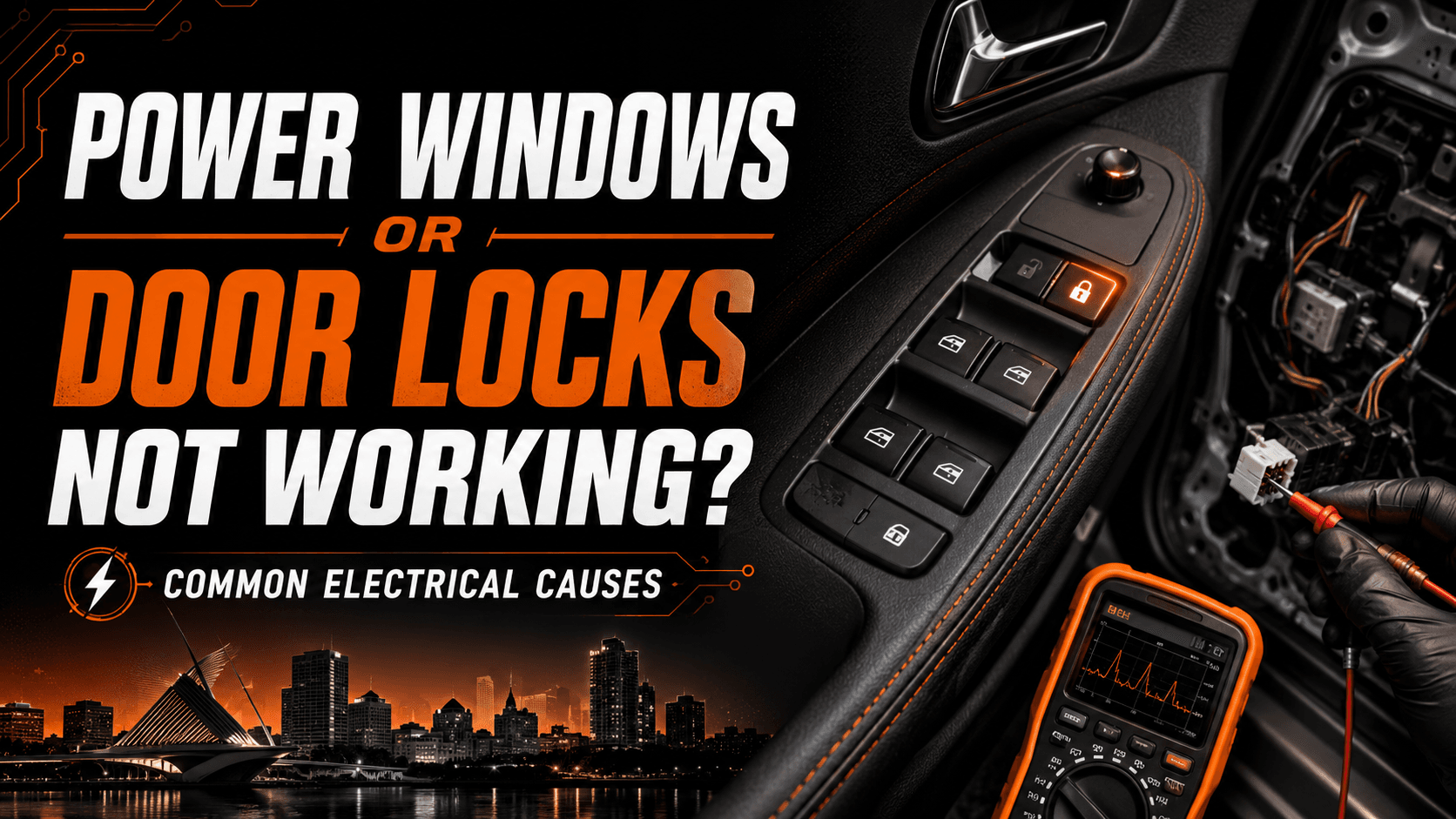
Why Your Power Windows or Door Locks Stopped Working
When power windows or door locks stop working, it can feel like a small inconvenience at first. But door electrical problems can quickly become frustrating, especially when a window gets stuck open, a door will not lock, the key fob stops working, or interior lights stay on and drain the battery.
Modern vehicle doors are not simple mechanical parts anymore. They often include wiring, switches, motors, lock actuators, door modules, sensors, mirrors, speakers, lighting, keyless entry components, and communication with the body control module.
That means a power window or door lock problem is not always caused by the part you see. The issue may be inside the door, in the wiring harness, at a connector, inside a switch, or related to the BCM.
This guide explains common electrical causes of power window and door lock problems, what symptoms to watch for, and why proper diagnostics matter before replacing parts.
Common Door Electrical Problems Drivers Notice
Door electrical issues can show up in several different ways. Some problems affect only one door, while others affect multiple doors or the whole vehicle.
Common symptoms include:
- Power window will not move
- Window moves slowly
- Window works sometimes but not always
- Window goes down but not up
- Door lock does not respond
- Door locks cycle randomly
- Key fob does not lock or unlock the vehicle
- Driver master switch does not control other windows
- Passenger window works from one switch but not another
- Side mirror adjustment does not work
- Heated mirror does not work
- Interior light stays on
- Door ajar warning stays on
- Alarm goes off randomly
- Battery keeps dying overnight
- Door speaker cuts in and out
- Multiple door functions fail at once
These symptoms can help narrow down whether the issue may be a switch, motor, actuator, wiring fault, fuse, relay, door module, or BCM-related problem.
For door-specific testing, visit our door electrical diagnostics in Milwaukee page.
Why Door Electrical Problems Can Be Hard to Diagnose
A vehicle door opens, closes, moves, shakes, and gets exposed to temperature changes, moisture, and daily use. Over time, wiring and connectors can wear out.
Door electrical problems can be tricky because the issue may be:
- Inside the door panel
- In the rubber wiring boot between the door and body
- At the master switch
- At the window motor
- At the lock actuator
- At a door module
- At a fuse or relay
- At the BCM
- In a ground connection
- In a connector with corrosion or loose pins
A window motor may be blamed when the real issue is a broken wire. A lock actuator may be replaced when the problem is the switch or BCM command. That is why testing is important.
1. Bad Window Switch
The window switch is one of the first parts people suspect when a power window stops working. In some cases, the switch is the problem.
A window switch may fail because of:
- Wear from repeated use
- Spilled drinks
- Dirt or debris
- Internal contact failure
- Moisture
- Broken switch housing
- Electrical short
Signs of a possible switch problem include:
- Window works from one switch but not another
- Driver master switch does not control a passenger window
- Switch feels loose or stuck
- Window responds only when pressing hard
- Window works intermittently
- Multiple windows fail from the master switch
However, a bad switch is not the only possible cause. The circuit still needs power, ground, wiring, and a working motor.
2. Window Motor Failure
The window motor is what physically moves the glass up and down. If the motor fails, the window may stop moving.
Signs of a possible window motor issue include:
- Window does not move at all
- Window moves very slowly
- You hear a clicking sound in the door
- Window works after tapping the door panel
- Window stops in the middle of travel
- Window works sometimes, then fails again
But before replacing the motor, the circuit should be tested. A motor cannot work if it is not receiving proper power and ground.
A window motor problem can sometimes be confused with:
- Bad switch
- Broken wire
- Blown fuse
- Faulty relay
- Door module issue
- Bad ground
- Window regulator problem
3. Window Regulator Problems
The window regulator is the mechanical part that moves the glass. While it is not always an electrical part, it can affect how the window behaves.
A regulator issue may cause:
- Window falls into the door
- Window moves crooked
- Grinding noise
- Window gets stuck halfway
- Motor runs but glass does not move
- Window moves unevenly
- Cable or track failure
If the motor runs but the glass does not move properly, the issue may be more mechanical than electrical. But if the motor does not receive power, the problem may still be electrical.
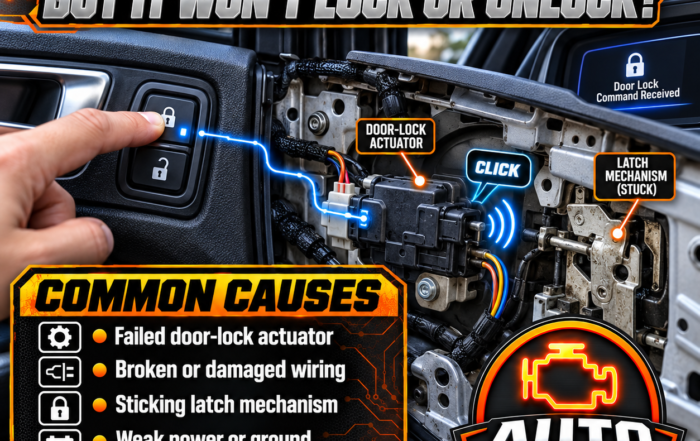
4. Door Lock Actuator Failure
The door lock actuator is the part that physically locks and unlocks the door when you press the switch or key fob.
A failing lock actuator may cause:
- One door does not lock
- One door does not unlock
- Lock makes noise but does not move
- Lock moves weakly
- Door lock works sometimes
- Key fob works on some doors but not others
- Manual lock works but power lock does not
If only one door has a lock problem, the actuator may be involved. But wiring, connectors, switches, and BCM commands should still be checked.
5. Blown Fuse or Faulty Relay
Some door electrical circuits use fuses or relays. If a fuse blows or a relay fails, one or more functions may stop working.
A fuse or relay issue may affect:
- Power windows
- Door locks
- Mirrors
- Interior lights
- Accessory power
- Door modules
- Keyless entry functions
Possible signs include:
- Multiple windows stop working
- All door locks stop working
- No response from switch
- Same fuse blows repeatedly
- Door functions work after relay replacement
- Electrical problem returns after fuse replacement
A blown fuse should not be ignored. If it blows again, there may be a short, wiring fault, overloaded circuit, or failing component.
For larger electrical testing, our auto electrical diagnostics in Milwaukee page explains how wiring and circuit problems are traced.
6. Broken Wiring in the Door Harness
One of the most common causes of door electrical problems is damaged wiring in the door harness.
The wiring between the vehicle body and the door bends every time the door opens and closes. Over time, wires can break, crack, stretch, or lose connection.
Broken door wiring may cause:
- Window works only when the door is in a certain position
- Door locks work intermittently
- Speaker cuts in and out
- Mirror controls stop working
- Door ajar warning appears randomly
- Interior lights stay on
- Keyless entry acts strangely
- Multiple functions fail in the same door
This type of problem may be hidden inside the rubber boot between the door and the body. It may not be visible unless the wiring is inspected closely.
7. Loose or Corroded Connectors
Connectors allow different electrical parts to communicate and receive power. If a connector becomes loose, corroded, wet, or damaged, door electrical functions may fail.
Connector problems may happen because of:
- Moisture intrusion
- Age
- Door repairs
- Prior accident damage
- Poor previous repair work
- Spilled liquid
- Corrosion
- Loose pins
- Broken clips
Signs of connector issues include:
- Intermittent window operation
- Door lock works sometimes
- Multiple functions fail together
- Problem changes when door moves
- Warning light comes and goes
- Electrical issue returns after repair
A connector problem can make a good switch, motor, actuator, or module look bad.
8. Door Module Problems
Some vehicles use door modules that control functions inside the door. These modules may communicate with the BCM and other systems.
A door module may control:
- Power windows
- Door locks
- Mirrors
- Memory mirror settings
- Heated mirrors
- Courtesy lights
- Door ajar signals
- Keyless entry communication
- Seat memory communication in some vehicles
A door module issue may cause:
- Several functions in one door stop working
- Master switch does not communicate
- Mirror and window fail together
- Door lock and window fail together
- Scan tool communication codes
- Intermittent door electronics
- No response from one door
Door module problems should be diagnosed carefully because wiring and connector issues can cause similar symptoms.
9. BCM Issues
The BCM, or body control module, controls many body-related electrical systems. Door locks, windows, interior lighting, keyless entry, security functions, and door signals may all involve the BCM depending on the vehicle.
A BCM-related issue may cause:
- Door locks acting randomly
- Key fob not working correctly
- Interior lights staying on
- Door ajar warning staying on
- Multiple door functions failing
- Battery drain
- Security light problems
- Windows or locks not responding
- Exterior or interior lighting problems
- Communication fault codes
BCM issues can overlap with door electrical problems because the BCM may receive door signals and send commands to locks, lights, security systems, and modules.
For more information, visit our BCM repair in Milwaukee page.
10. Door Ajar Warning Stays On
A door ajar warning may seem minor, but it can create bigger problems if the vehicle thinks a door is open when it is actually closed.
A false door ajar signal may cause:
- Interior lights staying on
- Battery drain
- Alarm problems
- Locks not working correctly
- Keyless entry issues
- Warning chimes
- Dashboard warning message
- BCM staying awake
Possible causes include:
- Bad door latch
- Faulty door switch
- Wiring fault
- Connector issue
- BCM input problem
- Corrosion
- Door alignment problem
If the interior lights stay on and the battery keeps dying, the door ajar signal should be checked.
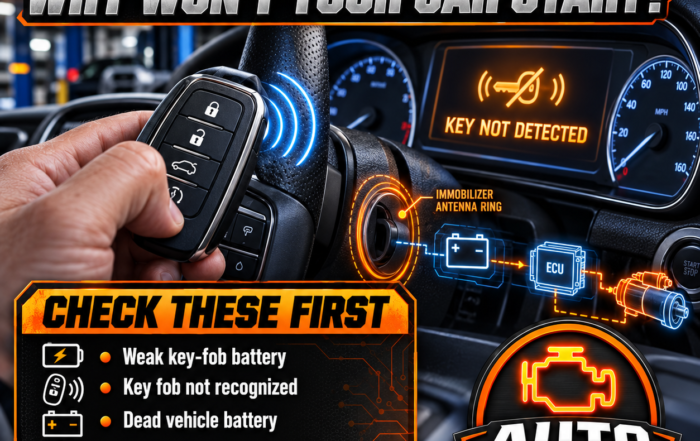
11. Key Fob or Keyless Entry Problems
Sometimes a door lock issue appears to be caused by the key fob, but the actual problem may be elsewhere.
Keyless entry problems may involve:
- Weak key fob battery
- Bad key fob
- Receiver issue
- BCM problem
- Door lock actuator issue
- Wiring fault
- Antenna issue
- Security system concern
- Programming issue
Signs include:
- Key fob works only sometimes
- Locks work from switch but not remote
- Remote works close to vehicle only
- One door does not respond
- All doors fail to respond
- Alarm behaves strangely
If the lock switch works but the fob does not, the issue may be remote or receiver-related. If neither works, the problem may be actuator, wiring, fuse, BCM, or module-related.
12. Mirror Electrical Problems
Side mirrors may include several electrical features, depending on the vehicle.
Mirror-related electrical problems may affect:
- Mirror adjustment
- Heated mirror
- Power folding mirror
- Turn signal mirror light
- Blind spot indicator
- Memory mirror position
- Mirror puddle light
A mirror issue may be related to:
- Mirror switch
- Door wiring
- Door module
- BCM communication
- Fuse or relay
- Connector damage
- Mirror motor
- Blind spot monitoring circuit
If the mirror has a blind spot warning indicator, a mirror or door wiring issue may overlap with blind spot monitoring repair.
13. Lighting Issues Connected to Door Electrical Problems
Door electrical problems can sometimes affect lighting. Interior lights, puddle lights, mirror lights, and door courtesy lights may all depend on door switches, wiring, or BCM signals.
Lighting symptoms may include:
- Interior lights stay on
- Interior lights do not turn on
- Door courtesy lights fail
- Mirror lights do not work
- Puddle lights stay on
- Door-open lighting acts randomly
- Exterior lights behave strangely with locks
If the problem involves vehicle lighting beyond the doors, our vehicle lighting electrical repair in Milwaukee page may also be useful.
14. Battery Drain From Door Electrical Issues
Door electrical problems can drain the battery if a circuit stays awake after the vehicle is parked.
Battery drain may happen if:
- Interior lights stay on
- Door ajar signal stays active
- BCM does not go to sleep
- Door module stays awake
- Lock circuit keeps cycling
- Aftermarket alarm wiring interferes
- Keyless entry system stays active
- Wiring short keeps a circuit powered
Signs of battery drain include:
- Vehicle is dead in the morning
- Battery dies after sitting a few days
- Interior lights stay on
- Battery was replaced but still dies
- Door warning stays on
- Locks or alarm act strangely
This is why a door issue should not always be treated as a simple convenience problem. It can become a larger electrical issue.
15. Aftermarket Alarm, Remote Start, or Stereo Wiring
Aftermarket electrical work can sometimes create door lock, window, alarm, or battery drain problems.
This may include:
- Alarm systems
- Remote start systems
- Aftermarket radios
- Amplifiers
- LED lighting
- Dash cameras
- GPS trackers
- Door speaker wiring
- Keyless entry add-ons
Possible signs include:
- Problem started after installation
- Door locks act randomly
- Alarm goes off unexpectedly
- Battery drains overnight
- Interior lights behave strangely
- Wiring was spliced near the dash or doors
- Remote start affects locks or security
Aftermarket wiring should be inspected if the timing matches the start of the issue.
When One Door Fails vs All Doors Fail
This is an important clue.
If only one door has a problem, possible causes include:
- Window motor
- Lock actuator
- Door switch
- Door wiring
- Door module
- Connector issue
- Local ground issue
If all doors have a problem, possible causes include:
- Fuse
- Relay
- Master switch
- BCM
- Main power supply
- Ground issue
- Communication fault
- Keyless entry or security system issue
If the issue affects one part only, the problem may be local. If many systems fail together, the issue may be central, module-related, or power-related.
Questions to Ask Before Replacing Parts
Before replacing switches, motors, actuators, or modules, ask:
- Is the problem in one door or all doors?
- Does the window work from one switch but not another?
- Do locks work manually but not electrically?
- Does the key fob work?
- Do interior lights stay on?
- Does the door ajar warning stay on?
- Does the issue change when the door is moved?
- Did the problem start after repair work?
- Was there water damage?
- Was aftermarket wiring installed?
- Are there other electrical issues?
- Is the battery draining?
These answers help narrow down the diagnostic path.
Why Diagnostics Matter Before Replacing Door Parts
Door electrical problems often get misdiagnosed because many parts can cause similar symptoms.
For example:
- A bad wire can look like a bad motor.
- A bad switch can look like a bad regulator.
- A BCM issue can look like a lock actuator problem.
- A door latch signal can cause battery drain.
- A loose connector can cause intermittent failures.
- A blown fuse may point to a short circuit, not just a bad fuse.
Proper diagnostics may include:
- Checking fuses and relays
- Testing power and ground
- Testing switch operation
- Testing window motor command
- Testing lock actuator command
- Inspecting door wiring harness
- Checking connectors
- Scanning for BCM or door module codes
- Testing door ajar signals
- Checking battery draw if needed
- Inspecting aftermarket wiring
The goal is to find the actual failure before replacing parts.
When Milwaukee Drivers Should Schedule Door Electrical Diagnostics
You should consider diagnostics if:
- A power window is stuck
- Door locks do not work
- Key fob does not lock or unlock properly
- Interior lights stay on
- Door ajar warning stays on
- A window works only sometimes
- Multiple door functions fail together
- Battery keeps dying
- Door locks cycle randomly
- Mirror controls stop working
- The problem changes when the door moves
- A fuse keeps blowing
- A BCM or door module code appears
Door electrical issues are easier to solve when the symptoms are documented clearly. Try to note which door is affected, what works, what does not, and whether the issue happens all the time or only sometimes.
Final Thoughts
Power windows and door locks may seem simple, but the electrical systems behind them can be more complex than they look. A window or lock problem may involve the switch, motor, actuator, fuse, relay, wiring, connector, door module, BCM, or even a battery drain issue.
Common causes include:
- Bad window switch
- Window motor failure
- Lock actuator fault
- Broken door wiring
- Loose or corroded connector
- Blown fuse
- Faulty relay
- Door module problem
- BCM issue
- Door ajar signal fault
- Keyless entry issue
- Aftermarket wiring problem
- Lighting or interior electrical issue
For Milwaukee drivers, the best first step is to identify whether the issue is isolated to one door or connected to a larger electrical problem.
Helpful related pages:
- Door Electrical Diagnostics in Milwaukee
- BCM Repair in Milwaukee
- Auto Electrical Diagnostics in Milwaukee
- Vehicle Lighting Electrical Repair in Milwaukee
- Power Seat Electrical Repair in Milwaukee
For questions about power windows, door locks, interior lights, wiring, BCM issues, or other electrical concerns, contact Auto Electrical & Airbags at (414) 345-7568.