Check Engine Lights and Electrical Warning Problems
A check engine light does not automatically mean the vehicle has a major mechanical failure. In some cases, the warning can be triggered by a sensor circuit, damaged wiring, unstable voltage, a poor ground, connector problems, or communication between electronic control modules.
For Muskego drivers who bring their vehicle to our Milwaukee shop, we look beyond the warning light itself to determine what caused the system to report the fault.
Problems That May Require Further Electrical Testing
- Check engine light stays on or keeps returning
- Check engine light appears along with other dashboard warnings
- Warning light comes on after a battery or starting problem
- Vehicle runs normally but a warning light remains on
- Fault code returns after a sensor or component was replaced
- Several modules report communication errors
- Warning lights appear intermittently
- Vehicle has electrical symptoms along with the check engine light
- Scanner reports low-voltage or circuit-related faults
- Wiring or connector damage is suspected
A diagnostic trouble code gives us a starting point, but it does not always prove which part has failed. Depending on the code and symptoms, further testing may involve the related wiring, sensor circuit, power supply, grounds, connectors, or control modules.
This helps avoid replacing a sensor or electronic component when the actual problem is somewhere else in the circuit.
What We Check After a Warning Light Appears
A warning light tells us which system noticed a problem, but the next step is figuring out why the fault occurred. Depending on the symptoms and stored codes, testing may involve several parts of the electrical system before the actual cause is clear.
Fault Codes and Live Sensor Data
We review stored trouble codes, live sensor information, and communication errors to see what the vehicle was detecting when the warning appeared.
Power and Ground Testing
Low voltage, poor grounds, loose connections, and voltage drops can trigger fault codes or make sensors and electronic modules behave incorrectly.
Wiring and Connector Inspection
Damaged wiring, corrosion, loose terminals, moisture, or previous repairs can interrupt a sensor signal or prevent a module from communicating properly.
Sensor Circuit Testing
A sensor-related code does not always mean the sensor itself has failed. The wiring, reference voltage, ground, connector, and signal circuit may also need to be checked.
Module Communication Checks
When several systems report faults at the same time, testing can determine whether vehicle computers are communicating correctly and receiving the power and ground they need.
For a broader overview of the testing available at our Milwaukee facility, see our auto electrical diagnostics and repair service.
Battery Drain and No-Start Electrical Problems
A check engine light is not the only sign of an electrical fault. Battery drain, intermittent starting problems, or a vehicle that has power but will not crank can also point to wiring, voltage, relay, sensor, or module issues.
For Muskego drivers bringing their vehicle to our Milwaukee shop, we may investigate problems such as:
- Battery dies overnight or after sitting
- New battery keeps losing power
- Vehicle has lights and power but will not crank
- Vehicle starts only sometimes
- Clicking occurs when trying to start
- Battery or charging warning appears
- Vehicle needs repeated jump starts
- Electrical power drops unexpectedly
- No-start problem returns after a battery replacement
- Starting problem happens only under certain conditions
A repeated dead battery may be caused by a parasitic electrical draw, charging issue, damaged wiring, poor connection, or electronic module that remains active after the vehicle is shut off.
Likewise, a no-start condition does not automatically mean the battery or starter has failed. Testing the related circuits helps determine whether the problem involves power, grounds, wiring, relays, sensors, or another electronic system.
Why a Check Engine Code May Point to an Electrical Problem
A diagnostic trouble code is generated when the vehicle detects a reading or condition outside its expected range. The code can help narrow down which system needs attention, but it does not necessarily prove that the component named in the code has failed.
For example, an engine-related code may be influenced by:
- Damaged or broken sensor wiring
- Loose or corroded electrical connectors
- Missing reference voltage to a sensor
- Poor ground connections
- Low or unstable system voltage
- Short circuits or open circuits
- Communication problems between vehicle computers
- Power-supply problems affecting the engine-control system
- Previous wiring or electrical repairs
This matters when a sensor or component has already been replaced but the check engine light comes back. In that situation, testing the electrical circuit behind the code may reveal a wiring, voltage, connector, or communication problem that replacing another component would not solve.
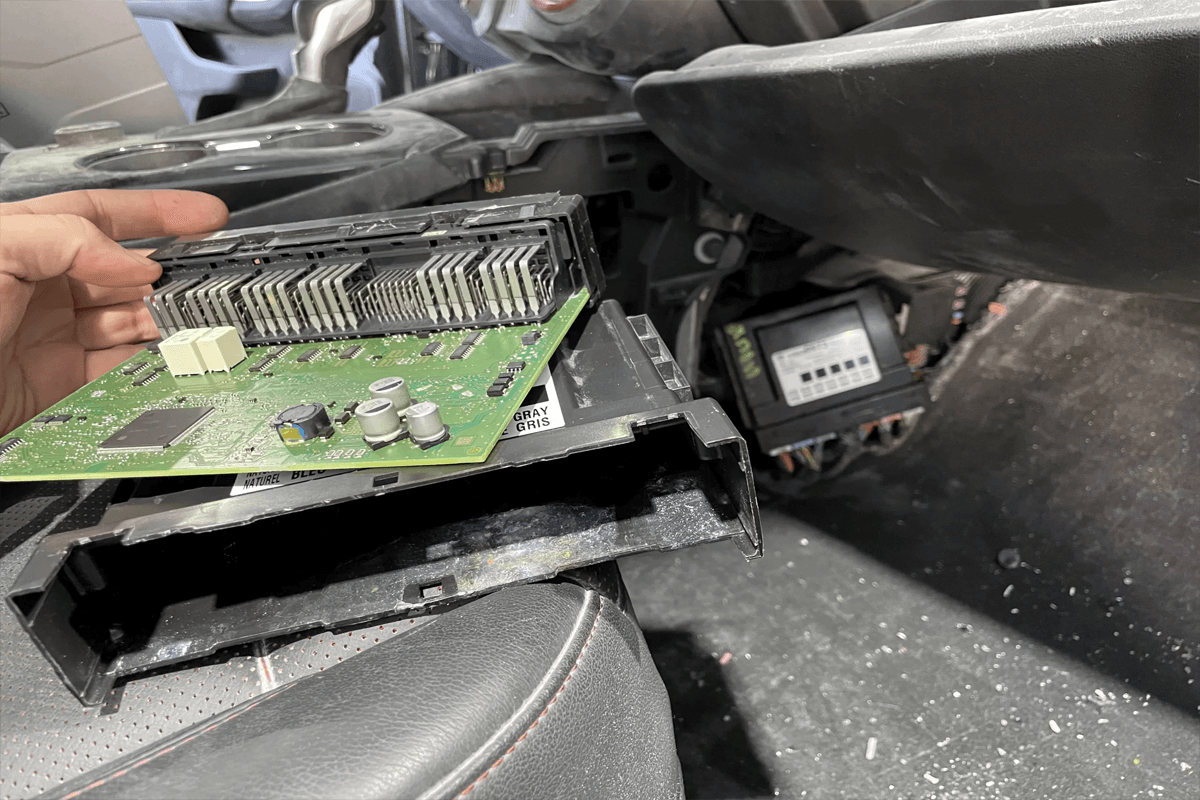
When testing indicates that the engine-control computer itself may be involved, further ECU diagnostics and repair can determine whether the fault is actually within the module or somewhere in the circuits connected to it.
Check Engine Light Before an Emissions Test
If the check engine light is on before an emissions test, clearing the light without fixing the underlying problem may not solve anything. The warning can return when the vehicle detects the fault again, and electrical issues involving sensors, wiring, voltage, connectors, or engine-control circuits may be part of the reason the light is on.
For Muskego drivers, our Milwaukee shop can diagnose electrical and electronic problems connected to a check engine warning, including:
- Sensor circuit faults
- Damaged or corroded wiring
- Loose electrical connectors
- Low or unstable voltage
- Ground problems
- Engine-control communication faults
- Warning lights that return after being cleared
- Trouble codes that return after a component was replaced
We do not need to present ourselves as an emissions-testing location. The purpose of our service is to identify electrical or electronic faults that may be causing the warning light before the vehicle is taken for testing.
If the check engine light keeps returning, electrical diagnostics can help determine whether the problem is the component named in the code or something elsewhere in the circuit.
Bringing Your Vehicle From Muskego to Our Milwaukee Shop
Our repair facility is located in Milwaukee. We serve Muskego drivers who bring their vehicles to our shop when a check engine light, recurring warning, no-start condition, or other electrical problem requires more detailed diagnostic testing.
This can be especially helpful when a trouble code keeps returning after being cleared or when a sensor or component has already been replaced without solving the original problem. Testing the wiring, voltage, grounds, connectors, sensor circuits, and vehicle computers can help identify what is actually causing the fault.
- Check engine lights that keep returning
- Multiple dashboard warning lights
- Battery drain or repeated dead batteries
- Intermittent no-start problems
- Sensor and circuit-related fault codes
- Wiring and connector problems
- Vehicle-module communication faults
- Problems previous repairs did not resolve
Auto electrical diagnostics at our Milwaukee facility start at $135. The amount of testing required depends on the vehicle, symptoms, stored fault codes, and complexity of the electrical problem.
2636 S 32nd St
Milwaukee, WI 53215
Auto Electrical Repair FAQs for Muskego Drivers
Is your repair shop located in Muskego?
No. Our repair facility is located in Milwaukee. We serve Muskego drivers who bring their vehicles to our shop for electrical diagnostics, warning-light problems, and other difficult electrical repairs.
Can a check engine light be caused by an electrical problem?
Yes. Some check engine light faults can involve sensor wiring, damaged connectors, poor grounds, low or unstable voltage, circuit problems, or communication between vehicle computers.
Why does my check engine light keep coming back after being cleared?
Clearing a trouble code does not repair the fault that caused it. If the vehicle detects the same problem again, the warning light can return. Further testing may be needed to check the related sensor circuit, wiring, connectors, voltage, grounds, or control module.
What if I already replaced the part listed by the trouble code?
A trouble code does not always prove that the named component is bad. If the code returns after a part was replaced, the surrounding wiring, connector, power supply, ground, sensor circuit, or module communication may need to be tested.
Can you diagnose a no-start problem if the lights still work?
Yes. A vehicle can still have interior or dashboard power while a starting circuit has a problem. Possible causes can include wiring, relays, grounds, sensors, voltage problems, or electronic control systems.
How much does auto electrical diagnostic testing start at?
Auto electrical diagnostics at our Milwaukee facility start at $135. The amount of testing needed depends on the vehicle, symptoms, stored fault codes, and complexity of the electrical problem.

